The Italian Express
Recipes, Stories, and Sunday Sauce from Mariuch’s Kitchen
Wolf Publishing
The Italian Express
THE
ITALIAN EXPRESS
Recipes, Stories, and Sunday Sauce
from Mariuch’s Kitchen
One family. No measuring unless absolutely necessary.
RICK NOVAK
Reek-ee the Menace
Copyright © 2026 Rick Novak
All rights reserved.
Published by:

WOLF PUBLISHING
New Canaan, Connecticut
THE ITALIAN EXPRESS
Recipes, Stories, and Sunday Sauce from Mariuch’s Kitchen
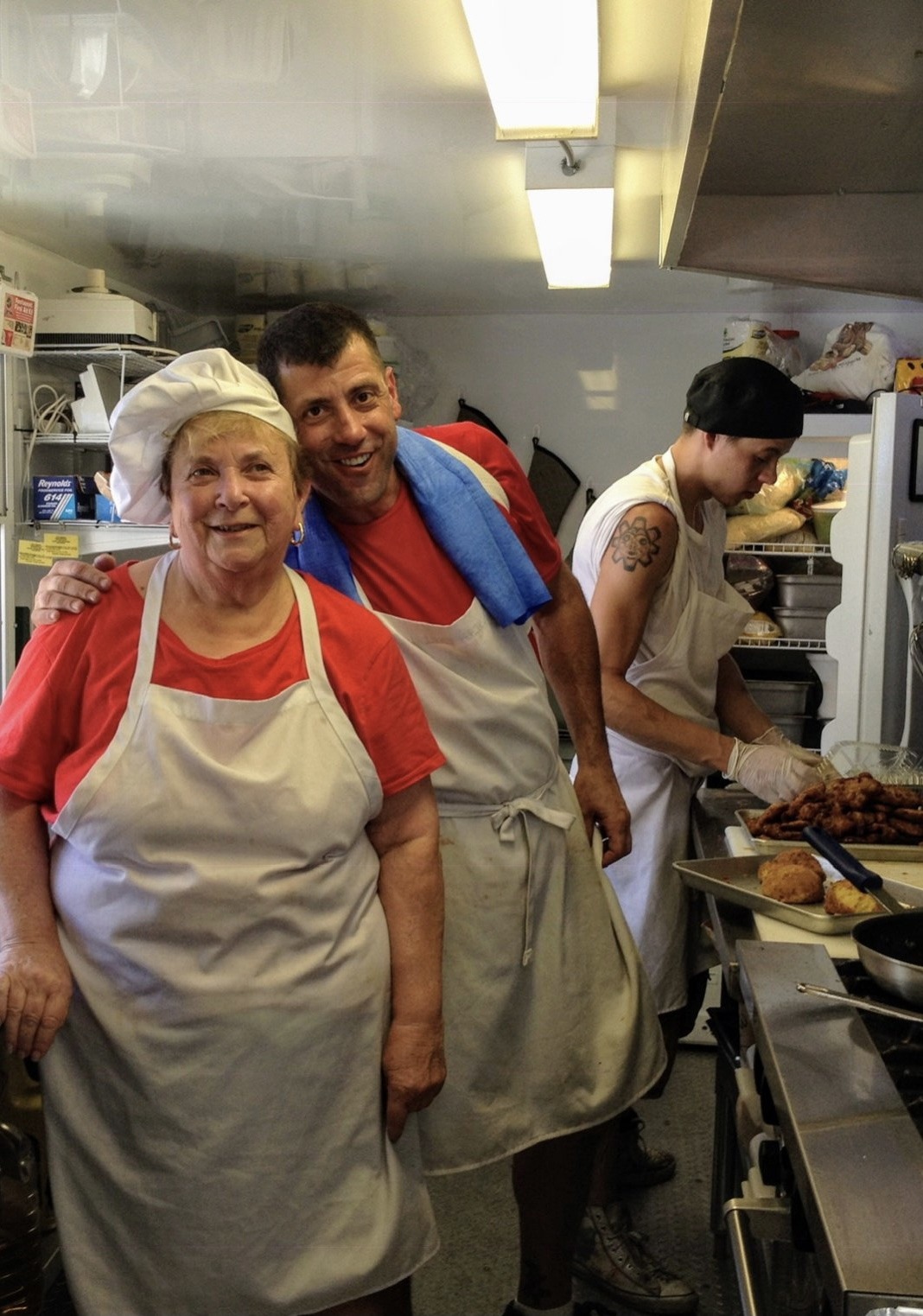
Mariuch and Reek-ee • The Italian Express Food Truck • Norwich, Connecticut • circa 2010 |
|---|
Mariuch,
I wrote this book because I could not bear the thought of losing what you placed in my hands.
The past may be but a memory, but the sauce, the recipes, and your love remain.
This book is yours, Mom.
I love you with my whole heart.
A Christmas Note for Mariuch
Mom,
The best part of making this book has been having another reason to talk cooking with you. To ask how you do something, hear what I got wrong, and discover that a measurement I thought was settled is apparently still open for discussion.
I love that we can still argue about a recipe.
I love that you can taste something and know what it needs.
And I love that, after all these years, cooking beside you still teaches me something.
This Christmas, I wanted to give you your kitchen on paper: the food, the stories, the opinions, and the laughter.
Thank you for letting me stand beside you.
Merry Christmas, Mom.
Love, Reek-ee
Keep Cooking with Mariuch
The recipes in this book also live in The Italian Express Kitchen, a free companion app. Open it on your phone or tablet to find recipes, photographs, feast plans, and cooking tips while you cook.
https://italian-express-app.vercel.app
The book preserves the stories. The app helps you bring the food to the table.
I Am Not Losing the Sauce
My humor is the invitation. The inheritance is the reason this book exists.
I already lost the accordion.
I already lost the basement.
I am not losing the sauce too.
This book began with that decision. Not with a business plan, a publishing schedule, or the belief that the world was waiting for another Italian cookbook. It began with the knowledge that families lose things. A room disappears. A voice goes quiet. A recipe that everybody knows by heart is suddenly remembered differently by everybody who remains.
Food is never merely food in our family. It is memory made visible. It is inheritance you can smell from the hallway. It is the language people use when they love one another fiercely but do not always know how to say it plainly. A pot on the stove means there is room for you. A second helping means you are not leaving yet. A container pressed into your hands means somebody will still be taking care of you tomorrow.
Before Italian Express fed New London, and after it closed, these recipes fed us. Mumma placed them in Mariuch’s hands. Mariuch placed them in mine. None of that happened with measuring spoons lined up neatly on a counter. It happened by standing beside somebody, watching her hands, listening to the sound of the pan, and learning what “enough” looked like before anyone thought to write it down.
That kind of knowledge is powerful, but it is fragile. If nobody stops to preserve it, it can vanish while everybody is still certain they will remember.
What We Carry Forward
Tradition survives because somebody loves it enough to keep cooking.
So this book writes it down: the recipes, certainly, but also the instincts beneath them. Use excellent olive oil. Crush the tomatoes with your hands. Garlic should be golden, never brown. Make the pot larger than necessary because somebody is always about to show up hungry. And if Mariuch tells you to get out of her sauce, understand that nobody ever really did.
The book is funny because our kitchen was funny. Reek-ee the Menace was never going to produce a solemn culinary archive, and Mariuch would not have tolerated one. There will be opinions. There will be rules delivered as verdicts. There will be measurements subject to appetite and adult supervision conspicuously absent. But the jokes are not the point. They are the sound of the people behind the food.
Tradition is not preserved by embalming it. Mariuch could look at vodka in the gravy and say, “Madonna,” then taste it, bend the rule, and make it her own. That is how inheritance stays alive. We honor what came before, trust what was placed in our hands, and carry it forward without pretending that time has stopped.
These recipes belong to Italian Express, but more deeply they belong to a family. They hold Sunday sauce, crowded tables, the restaurant, the food truck, the old kitchen, and the certainty that nobody should leave hungry. They are the evidence of love after the people who first expressed it have stepped away from the stove.
The past may be but a memory. The sauce, the recipes, and the love remain.
Mangia.
FROM MARIUCH’S KITCHEN TO
ITALIAN EXPRESS
There are families that inherit money, and there are families that inherit houses. We inherited sauce, sausage, meatballs, pasta, and the absolute certainty that if somebody left your house hungry, something had gone terribly wrong.
The Pascale family came to America from southern Italy carrying the things immigrants could carry and protecting the things that mattered most. Somewhere along the way, recipes crossed the ocean too. They were not written on glossy cards, and nobody measured everything into neat little bowls. They lived in hands, in memory, in smell, and in the sound something made when it hit hot olive oil. One generation showed the next, and that generation showed the next.
That was how Mariuch learned.
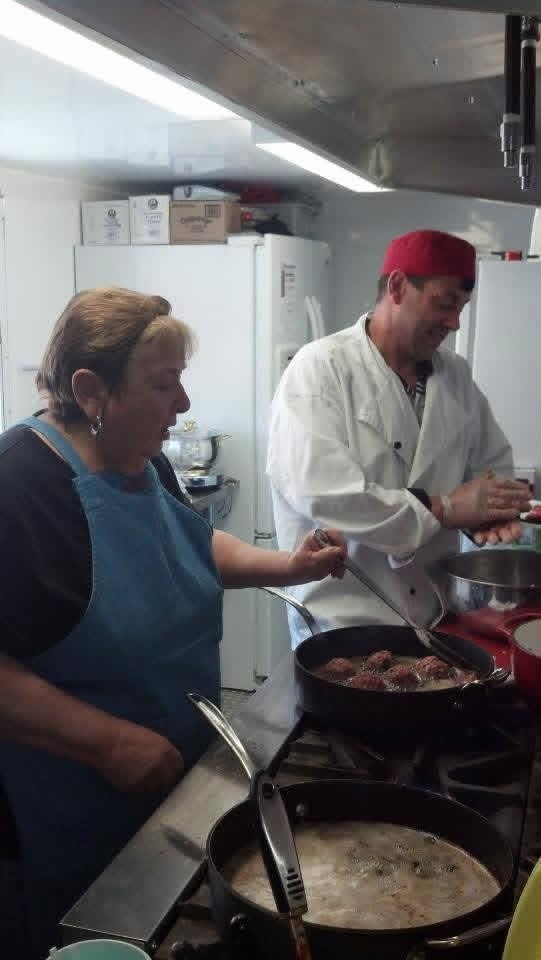
She stood close enough to watch. She learned when the garlic was golden without needing a timer, how much Pecorino belonged in something by looking at it, how dough felt when it was ready, and how sauce told you what it needed. A recipe was not finished because the measurements said it was finished. It was finished when it tasted right.
Eventually, I stood beside her and learned the same way.
Years later, I was watching The Great Food Truck War and had one of those thoughts that probably should have been examined a little more carefully before acting on it:
Hey. I can do that.
I got a food truck.
And somehow, in the middle of that decision, Mariuch and Reek-ee ended up cooking side by side again.
That was the beginning of Italian Express.
THE FOOD TRUCK YEARS
The truck gave us a place to take everything we knew out into the world.
We cooked the way we had always cooked. Fresh ingredients. Real olive oil. Garlic. Pecorino. Sauce made from scratch. Sausage. Meatballs. Pasta. The real stuff.


Italian Express eventually became part of the Yantic Mobile Food Park, surrounded by other trucks doing their own thing. One of them sold brick-oven pizza.
Naturally, I tried it.
And naturally, I had an opinion.
I remember thinking
Hmm. I can make this a lot better.
This was probably not the beginning of peaceful relations among local food trucks.
So I went back to Mariuch.
We started experimenting.
Dough, water, yeast, fermentation, sauce, cheese, heat. What could go into a brick oven raw and what absolutely could not. How wet was too wet. How much cheese was enough, which was always a difficult question in our family.
We kept working until the pizza tasted the way we wanted it to taste.
Then the food truck became something bigger.
HAMILTON STREET

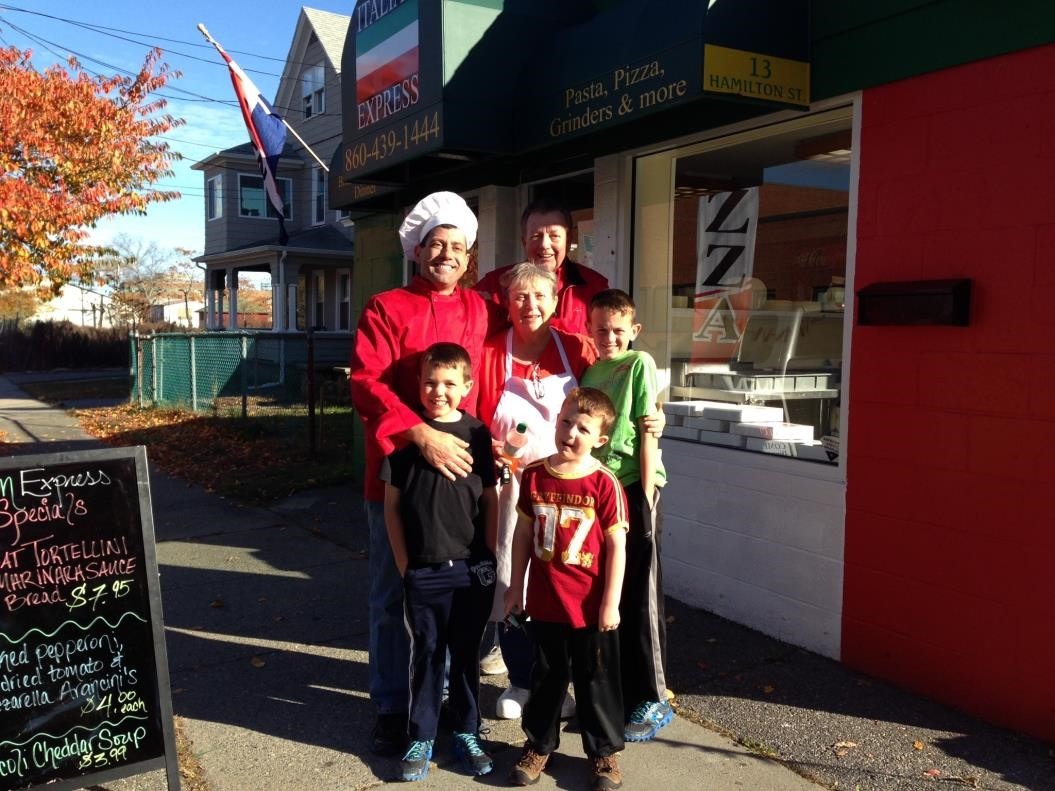
Italian Express eventually became a little restaurant at 13 Hamilton Street in New London.
It was not enormous, and that was part of its charm. There was a green awning. The building was painted in the colors of Italy. Pizza boxes sat near the window. Specials were written where people could see them. A real brick oven burned inside.
And there was Mariuch.
And there was Reek-ee, me. Ricky.
Side by side again.
Only now people were paying us to do what we had been doing all along.
The old Italian Express description called what we served Italian comfort food — the kind your mom would have made if she were Italian.
That was funny because, in my case, my mom actually was Italian.
And she was standing right there.
Italian Express made the food we actually knew. There were fresh pastas and filled pastas, ravioli, tortellini, lasagna, manicotti, stuffed shells, baked ziti, gnocchi, sauces, soups, meatballs, braciole, sausage, chicken dishes, eggplant dishes, arancini, salads, grinders, pizza, and desserts. Some things came directly from Mariuch and the generations before her. Some grew out of the restaurant. Some came from Reek-ee standing over a skillet and deciding that whatever was in front of him could probably be made better.
We made real food. Fresh food. Food that required somebody to actually cook.
And whatever we made, the idea stayed the same: make it fresh, make it right, do not get clever just to be clever, and do not send somebody away hungry.
Especially that last one.
Portion control was never one of our strongest institutional values.
Italian Express sold pizza by the slice.
Except apparently one “slice” was two pieces.
We were either generous people or terrible at fractions.
Nobody complained.
THE BRICK OVEN
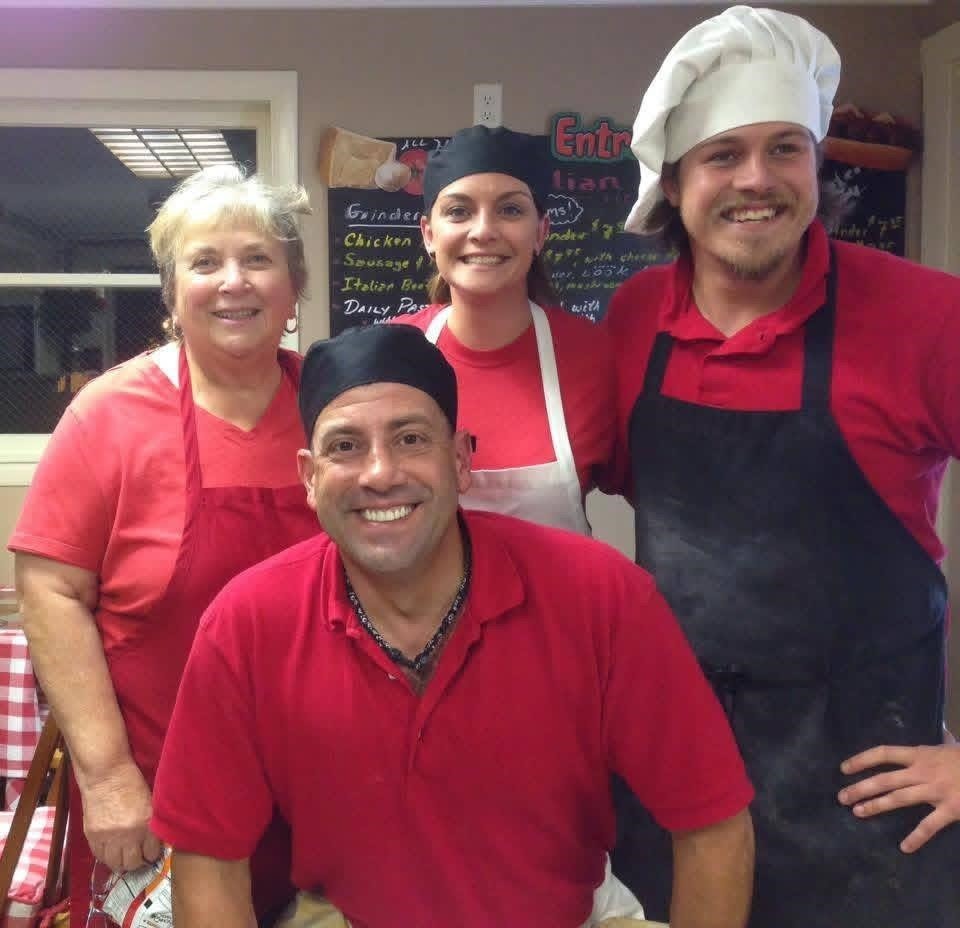
When the restaurant opened, we did exactly what we had threatened to do during the food-truck years.
We bought a brick oven.
A real one.
Fire. Brick. Heat.
No conveyor belt. No pretending.
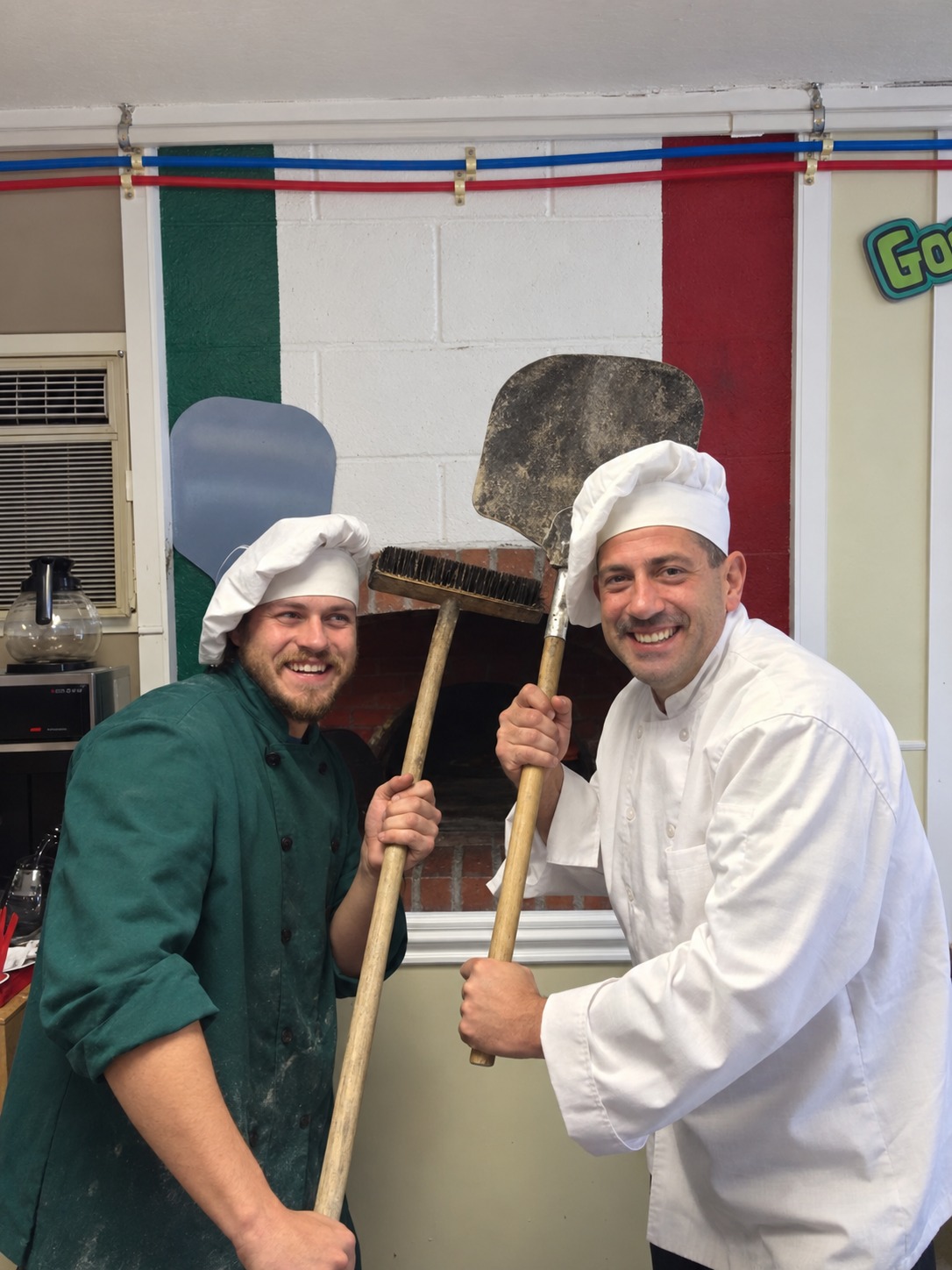

And suddenly all those experiments with Mariuch had somewhere to go.
There was the Classico Italia. The Bianco. The Agita. Then came the meat pies, vegetable pies, artichokes, eggplant, sausage, ricotta, buffalo chicken, bacon, and combinations that probably would have caused serious concern in Naples.
Nobody in New London seemed particularly troubled.
The oven was hot, people were hungry, and we kept making pizza.
At some point we reached the only reasonable conclusion:
We had become the pizza gods of New London.
Not officially. There was no ceremony. But we had a brick oven, fourteen pizzas, and absolutely no intention of asking permission.
AND THEN THERE WERE THE GRINDERS
New London takes grinders seriously.
Very seriously.
You do not casually announce that you have a good grinder in a city that considers the grinder part of its identity. New London claims to be be the birthplace of the grinder itself. Go figure.
So, you had better bring it.
And we did.
There was the Classic Italian grinder. There was the Italian Steak Grinder, Reek-ee, and don’t even ask how I got that name from Ricky, invented because apparently shaved steak, red peppers, onions, mushrooms, pepperoncini, hot cherry peppers, sweet red cherry peppers, garlic, basil, mozzarella, Pecorino, and olive oil still needed to be put into one sandwich before I could leave well enough alone.
And then there was Mariuch’s Sausage and Pepper Grinder.
That one developed its own reputation.
The sausage was homemade. The peppers and onions cooked into that glossy, dripping mixture. The roll had to be toasted because otherwise the whole glorious thing would collapse in your hands. Then came mozzarella.
A lot of mozzarella.
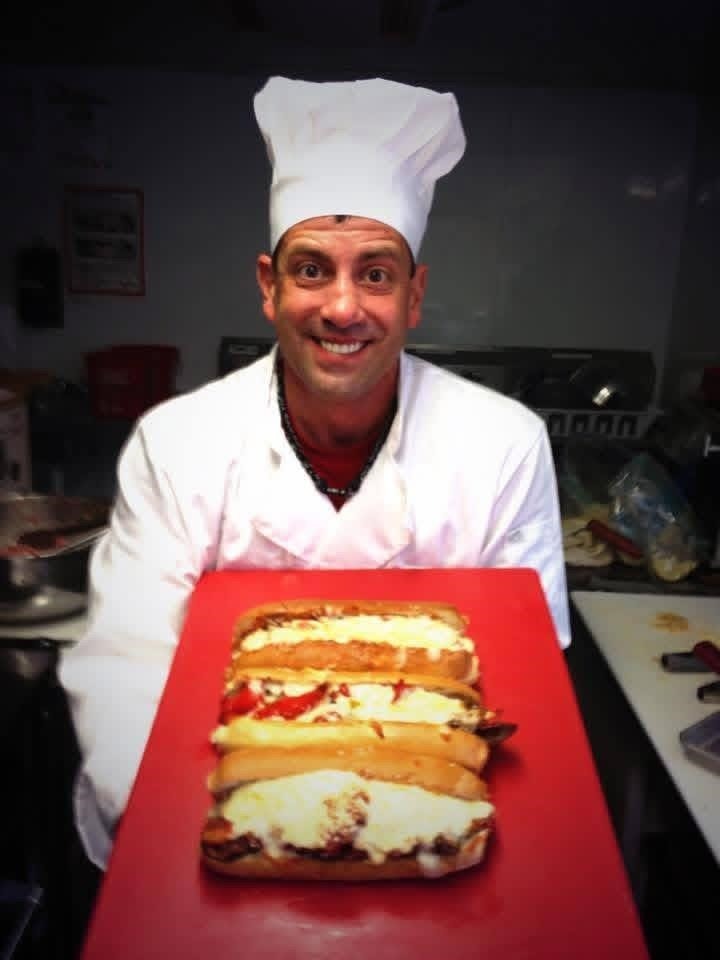
The local press noticed.
Marisa Nadolny wrote that the house-made sausage and peppers had “knocked my socks off” and that she had made it her mission to recommend them to as many people as possible.
Covert Cuisine went even further, calling it what “might be the greatest sausage and peppers grinder of all time.”
We saw no compelling reason to argue.
At New London Sailfest one weekend, we served about 1,000 grinders in three hours.
That sentence still sounds insane.
It was insane.
There were grinders everywhere. Bread, sausage, peppers, cheese, people, and then more people. Somewhere in the middle of all of it was Reek-ee in a chef’s hat trying to look as though this was completely normal.
It was not normal.
It was wonderful.
THE FOOD WAS ONLY PART OF IT
Looking back, the photographs tell the part of the story that menus cannot.
There is Mariuch behind the counter. There are children wearing ridiculous smiles and chef hats. There is family standing outside the restaurant. There is the storefront in the sunshine. There is the food park. There are handwritten specials, flags, pizza boxes, awnings, and all the ordinary little things that once seemed completely unremarkable because we saw them every day.
They do not seem ordinary anymore.
That is what happens to a life.
You rarely know which Tuesday afternoon will someday become history. You rarely know that the photograph somebody takes while everyone is standing around the restaurant will later become proof that this strange, exhausting, funny little chapter actually happened.
And the thing I understand now is that Italian Express was never only about owning a restaurant.
It was about getting to stand beside Mariuch again.
The food truck did that first.
Then the restaurant gave us a bigger kitchen.
We cooked together. We argued. We tasted things. We changed things. We made things the way the family had always made them and invented new things because apparently leaving well enough alone was never going to be one of my gifts.
That is what I remember most.
Not the receipts.
Not the equipment.
Not the hours.
Her.
Standing there.
Cooking. With Mariuch, my mom.
Reek-ee and Mariuch. Need I say more?
WHAT LASTED
Italian Express eventually closed. Restaurants do. Food trucks disappear, signs come down, brick ovens go cold, buildings become something else, and people move on.
But that is not the same thing as losing it.
The food kept going. The recipes kept going. Mariuch kept cooking, and I kept cooking. The Sunday Sauce still smells like Sunday Sauce. The meatballs are still fried before they ever see the sauce. The sausage still wants fennel. The garlic still better be golden and never brown. The Pecorino is still Locatelli, and somebody is still going to tell you that you need more olive oil.
The fresh pasta still gets made. Ravioli still gets filled. Lasagna still gets layered. Sauce still gets tasted before anybody declares it finished. The kitchen may be different, but the rules are not.
That is why this book exists.
It is not an attempt to recreate a restaurant.
It is something more important than that.
It is an attempt to keep the hands moving.
Mariuch learned by watching the people who came before her. I learned by standing beside Mariuch. Now these recipes are being written down so somebody else will not have to guess what we meant.
They will still have to taste. They will still have to adjust. They will still have to understand that Italian cooking is not baking and that sometimes the answer really is another handful of Pecorino.
But the road will still be here.
Italian Express was one chapter.
Mariuch’s kitchen was there before it.
And the food lasted longer than both.
The inheritance was never the building, the truck, the sign, or even the brick oven. The inheritance is knowing what to do when the garlic hits the oil, knowing when the sauce tastes right, knowing that the grinder roll needs to be toasted before you put something dripping and magnificent inside it, knowing that if there is enough food for eight you can probably feed twelve, and knowing that when everybody finally sits down, somebody will still ask whether there is more Pecorino.
There is.
Of course there is.
The real inheritance was always cooking by Mariuch’s side.
Stata zeet. Mangia.
Shut up and eat.
Mariuch's Sunday Sauce
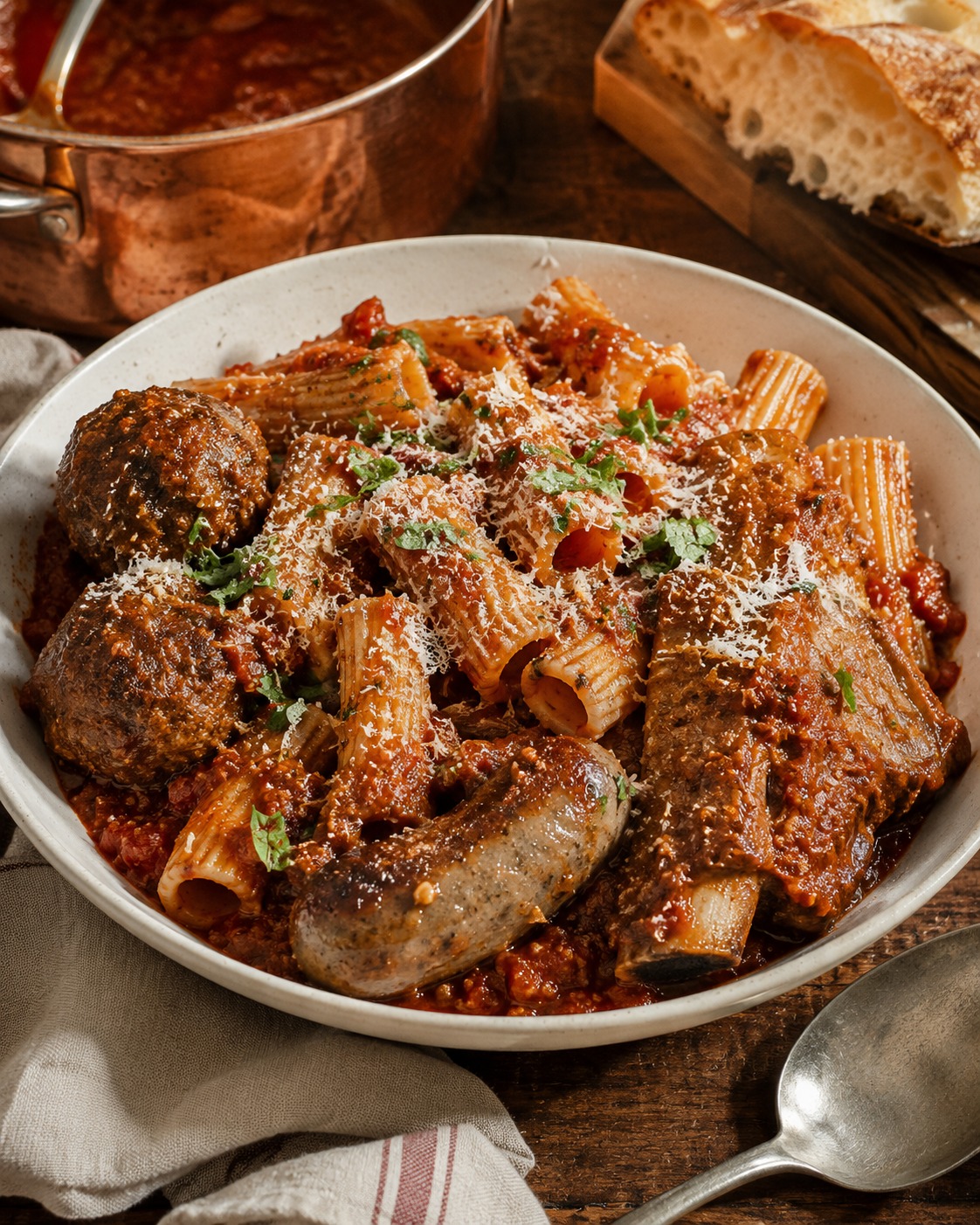
THE SAUCE THAT STARTED EVERYTHING
MARYANNE “MARIUCH” PASCALE
Southern Italian family sauce • 12 cups • 2–3 hours
The sauce came before the restaurant
Before Italian Express fed New London, and long after it closed, this sauce fed a family. Mariuch made it by hand and eye: garlic cooked until golden, whole San Marzano tomatoes crushed between her fingers, pork slowly giving the pot its depth, and enough Pecorino at the end to make the sauce unmistakably hers. Reek-ee carried it into the food truck and restaurant. This version carries it forward.
| MAKES About 12 cups |
SIMMER 2–3 hours |
HEAT Gentle and slow |
|---|
Ingredients
| • ⅓ cup excellent extra-virgin olive oil | • 2 pounds pork ribs or pork chops | ||
|---|---|---|---|
| • ½ head garlic (5–7 large cloves), minced | • 2 pounds hot Italian sausage | ||
| • 1 teaspoon red-pepper flakes, or to taste | • Pan-fried meatballs, prepared separately | ||
| • 3 tablespoons tomato paste | • Braciole, for a full Sunday version | ||
| • 1 cup dry red wine, optional | • ½ cup chopped fresh parsley, divided | ||
| • Three 28-ounce cans whole San Marzano tomatoes | • ½ cup torn fresh basil, divided | ||
| • One 28-ounce can crushed tomatoes | • Kosher salt and freshly ground black pepper | ||
| • One 15-ounce can tomato purée | • Locatelli Pecorino Romano: a modest handful during cooking, then one generous handful (¾–1 cup) at the end | ||
| • 1 emptied tomato can of water, plus more as needed | • Sugar only if the tomatoes genuinely need it | ||
 |
“Mom is the best chef I know.” Maryanne “Mariuch” Pascale cooked beside Reek-ee at Italian Express while in her seventies. Her recipes are the heart of this book. |
||
THE METHOD / PART ONE
Build the flavor
1. Brown the meat. Brown the pork in olive oil and set it aside. Pan-fry the hot sausage until deeply browned. Prepare and pan-fry the meatballs separately; they enter the sauce only near the end.
2. Start the garlic. Coat the bottom of a large, heavy saucepot generously with excellent olive oil. Add the minced garlic and red-pepper flakes.
3. Release the flavor. Sauté over medium heat until the garlic becomes golden. Never let it turn dark brown. Cooking the pepper flakes in the oil releases their heat throughout the sauce.
4. Add the tomato paste. Stir in the tomato paste and cook briefly until it darkens slightly. When using red wine, add it now and let it reduce for a minute or two.
5. Stop the garlic from burning. Immediately add the three cans of whole San Marzano tomatoes. The tomatoes drop the temperature before the garlic can cross from golden to bitter.
6. Crush by hand. Break apart every whole tomato with your hands, retaining some natural texture. Do not blend the life out of them.
7. Build the sauce. Add the crushed tomatoes, tomato purée and one tomato can of water. Add the browned pork, half the parsley, half the basil, salt, black pepper and a modest amount of Pecorino.
8. Bring it to a boil. Let the sauce reach a real boil while stirring so nothing catches on the bottom. Then immediately lower the heat.
REEK-EE SAYS: Golden garlic is flavor. Brown garlic is bitterness. Have the tomatoes open and ready before you begin. |
|---|
THE METHOD / PART TWO
Let time do the work
9. Simmer slowly. Simmer for two to three hours, stirring regularly. Add water as needed. The sauce should remain thick and substantial—never paste and never soup.
10. Handle the pork. After about two hours, remove the pork and let it cool. Pull the meat from the bones, break it into pieces and discard the bones and excess fat.
11. Add the sausage. Add the browned hot sausage around the two-hour mark and let it finish cooking in the sauce.
12. Return everything at the end. About 30 minutes before serving, return the cleaned pork and add the separately pan-fried meatballs. Add braciole when making the full Sunday version.
13. Finish with Pecorino. Add the remaining parsley and basil. Stir in one generous handful—approximately ¾ to 1 cup—of Locatelli Pecorino Romano. Taste before adding more salt.
14. Judge the tomatoes. Add sugar only when the tomatoes are unusually acidic. Good San Marzano tomatoes ordinarily need none.
Mariuch's rules
Half a head of garlic means we are not messing around. Bada bing, bada boom.
Hot sausage—never sweet. No onion, oregano, bay leaves or cheese rind.
Fry the sausage and meatballs separately. Crush the tomatoes by hand.
Add water gradually. Thick sauce is the goal; watery sauce is a failure.
Pecorino goes in during cooking, but the generous handful comes at the end.
It is sauce or gravy. Both are correct. The family argument is optional.
One-trip shopping list
| □ Produce: garlic, parsley, basil | □ Pantry: tomato paste, red-pepper flakes, salt, black pepper | |
|---|---|---|
| □ Meat: pork ribs or chops, hot Italian sausage | □ Dairy: Locatelli Pecorino Romano | |
| □ Prepared: pan-fried meatballs; optional braciole | □ Oil and wine: excellent olive oil; optional dry red wine | |
| □ Tomatoes: 3 whole San Marzano, 1 crushed, 1 small purée | □ For serving: rigatoni or your preferred pasta, crusty bread | |
| REEK-EE APPROVED RECIPE • GARLIC COUNT VERIFIED. ADULT SUPERVISION STILL ABSENT. | ||
Mariuch & Reek-ee’s Bolognese
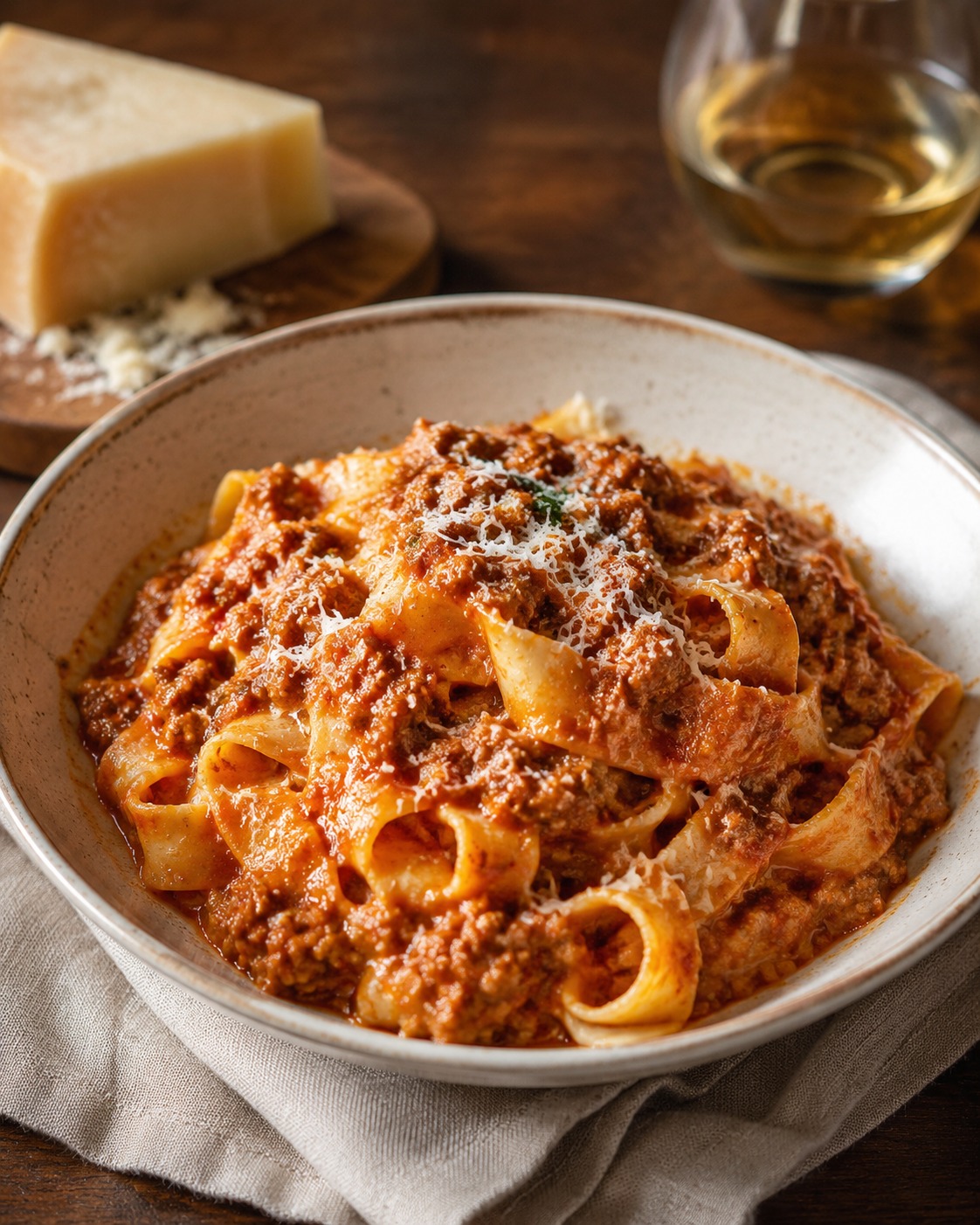
MEAT, CREAM, WINE AND RESTRAINT
MARYANNE “MARIUCH” PASCALE
Italian Express Bolognese • Serves 12–16 • At least 3 hours
Northern tradition, Italian Express appetite
The old Bolognese lesson is restraint: meat first, then cream, white wine and only enough tomato to bind it all together. Mariuch and Reek-ee kept that architecture and made it worthy of Italian Express—equal beef and pork, equal onion, carrot and celery, heavy cream instead of milk, and a pot large enough to feed actual people. It is thick, deeply meaty and brick-red, not ordinary tomato sauce with hamburger thrown into it.
| SERVES 8 people |
SIMMER 3–4 hours |
TEXTURE Thick and meaty |
|---|
Ingredients
| • 2 tablespoons excellent extra-virgin olive oil | • Freshly grated nutmeg | ||
|---|---|---|---|
| • 6 tablespoons unsalted butter | • 2 cups dry white wine | ||
| • 1 cup onion, very finely minced | • Two 28-ounce cans whole San Marzano tomatoes, crushed by hand | ||
| • 1 cup carrot, very finely minced | • Water as needed during the long simmer | ||
| • 1 cup celery, very finely minced | • Locatelli Pecorino Romano, for finishing | ||
| • 1 pound ground beef, preferably chuck | • 2 pounds tagliatelle, pappardelle or another substantial pasta | ||
| • 1 pound ground pork | • Reserved pasta water, as needed | ||
| • Kosher salt and freshly ground black pepper | • More Pecorino for the table | ||
| • 2 cups heavy cream | • Crusty Italian bread, for serving | ||
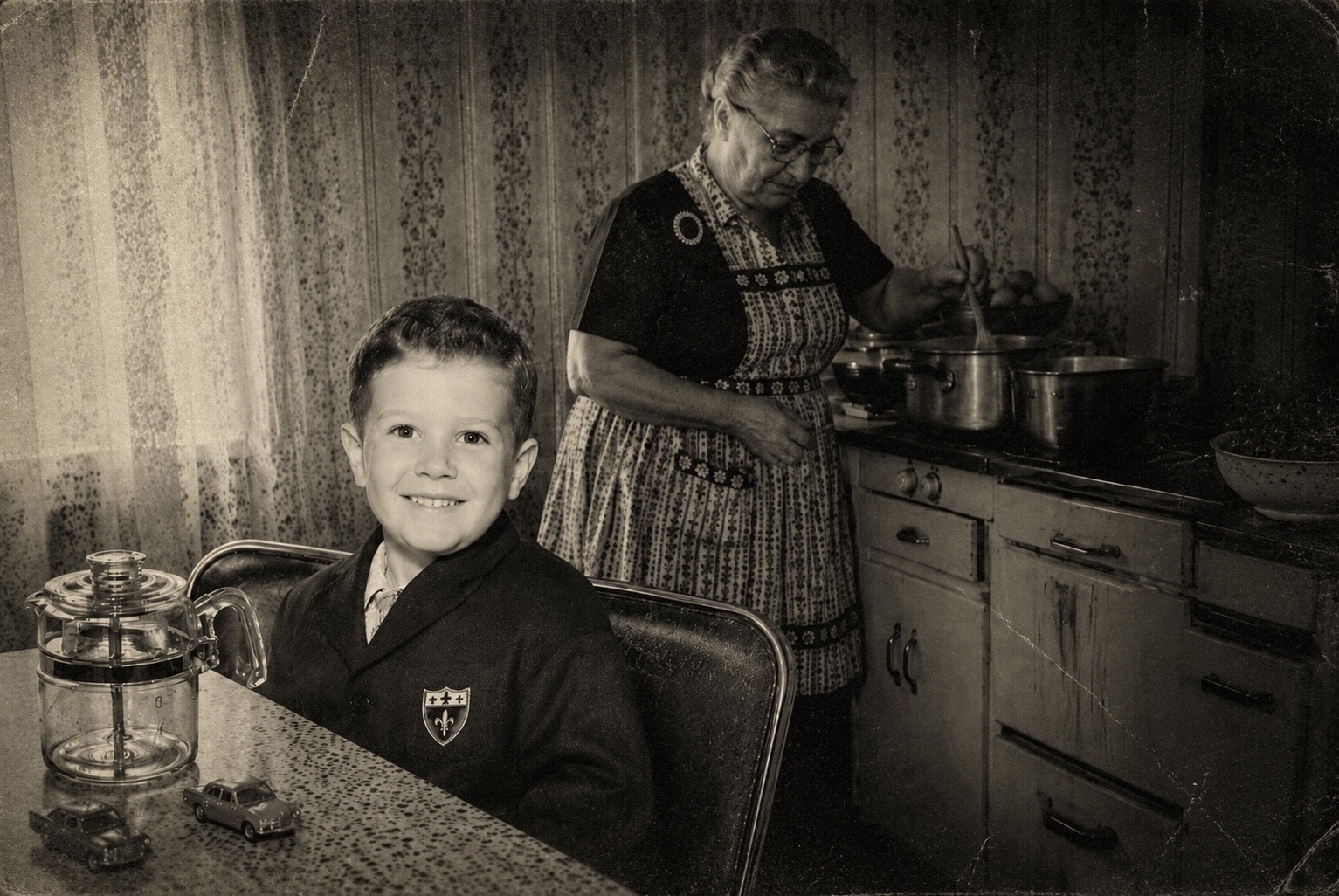 |
FROM HER NONNA'S KITCHEN Mariuch learned to cook from her nonna - my bisnonna. She learned by standing beside her, watching her hands and trusting her eye. That knowledge passed from one kitchen to the next, and eventually into Italian Express. |
||
Reek-ee and Mumma circa 1967
THE METHOD / PART ONE
Build the sauce in the right order
1. Make the battuto. Mince the onion, carrot and celery very finely and in exactly equal amounts. The pieces should disappear into the finished sauce rather than announce themselves.
2. Begin with butter and oil. Melt the butter with the excellent olive oil in a large, heavy pot over medium heat. Do not let the butter brown.
3. Soften the vegetables. Add the onion first and cook until translucent. Add the carrot and celery and cook slowly until completely soft and fragrant, about 10 minutes. Do not brown them.
4. Add both meats. Add the beef and pork. Season generously with salt and black pepper. Break the meat apart with a wooden spoon and cook until it loses its raw color.
5. Keep the meat tender. Cook gently. The goal is small, tender pieces that become part of the sauce—not hard, dry pebbles fried into submission.
6. Add the cream. Pour in the heavy cream and bring it to a gentle simmer. Continue cooking until the cream has been absorbed by the meat and almost entirely evaporated.
7. Add the nutmeg. Grate in a restrained amount of fresh nutmeg. It should warm the cream and meat without making the sauce taste like dessert.
8. Add the white wine. Pour in the dry white wine only after the cream has cooked away. Simmer until the wine has evaporated and the smell of raw alcohol is completely gone.
REEK-EE SAYS: Milk is for cereal. We use cream. |
|---|
THE METHOD / PART TWO
Let the meat become the sauce
9. Add the tomatoes. Add both cans of whole San Marzano tomatoes, crushing every tomato by hand as it enters the pot. Stir thoroughly so the meat, vegetables and tomatoes become one sauce.
10. Bring it to the gentlest simmer. Let the sauce just begin to bubble, then immediately reduce the heat. Bolognese cooks by patience, not violence.
11. Cook for at least three hours. Simmer uncovered for three to four hours, stirring from the bottom occasionally so nothing sticks or scorches.
12. Use water when needed. Add a few tablespoons of water whenever the sauce becomes too dry before the fat naturally separates. Add only enough to sustain the long simmer.
13. Judge the finished texture. The sauce should be thick, creamy and dominated by tender meat. It should be brick-red, not bright red; rich, not watery; sauce, not soup.
14. Dress the pasta. Boil the pasta until al dente. Toss it with the Bolognese and enough reserved pasta water to make the sauce cling to every strand or ridge.
15. Finish properly. Add a generous shower of Locatelli Pecorino Romano and serve immediately, with more Pecorino at the table.
Mariuch & Reek-ee’s rules
Beef and pork, one pound each. Neither one gets to own the pot.
Onion, carrot and celery are equal—one cup of each, minced fine.
Heavy cream. Never milk. Who cooks with milk? Yuck.
Cream cooks away before the white wine enters. The order matters.
No garlic, oregano, basil or red-pepper flakes.
The finished sauce is meat-forward and thick—not red sauce with hamburger.
One-trip shopping list
| □ Produce: onion, carrots, celery | □ Pantry: salt, black pepper, whole nutmeg | |
|---|---|---|
| □ Meat: 1 lb ground beef, 1 lb ground pork | □ Oil and wine: excellent olive oil, dry white wine | |
| □ Dairy: butter, heavy cream, Locatelli Pecorino Romano | □ Pasta: tagliatelle, pappardelle or rigatoni | |
| □ Tomatoes: two 28-oz cans whole San Marzano | □ For serving: extra Pecorino and crusty Italian bread | |
| REEK-EE APPROVED RECIPE • MEASUREMENTS SUBJECT TO APPETITE | ||
Mariuch’s Marinara
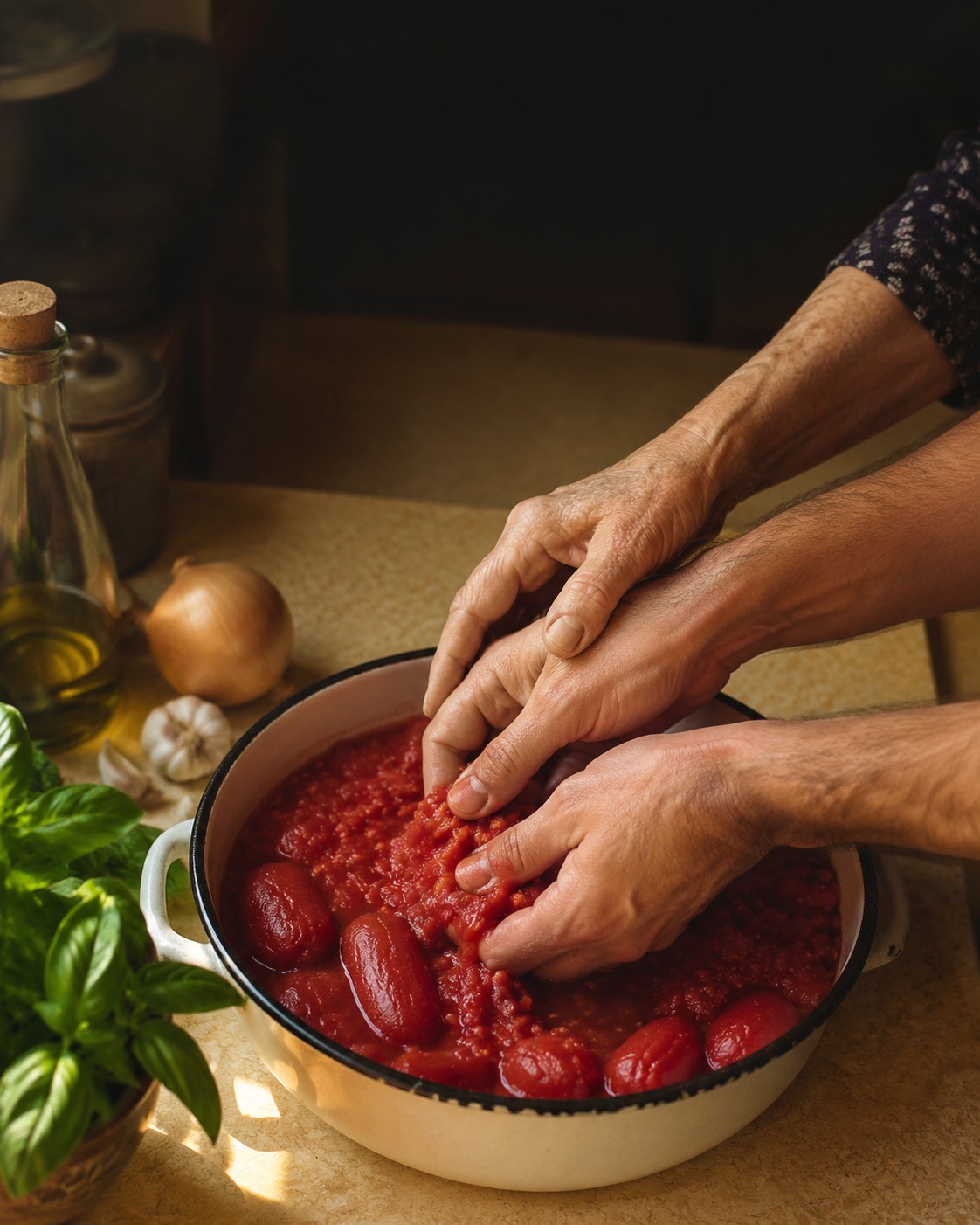
TWO HANDS, ONE LESSON
FROM MUMMA’S HANDS TO MARIUCH’S—AND THEN TO MINE
Quick weeknight sauce • About 3 cups • 25 minutes
The sauce that taught me everything
This was the first sauce Mumma ever taught Mariuch to make. A weeknight sauce, not the Sunday gravy, small enough to make while everyone was still hungry and waiting. She stood on a chair to reach the counter. Sixty years later, she stood me at that same counter and taught it to me the same way it was taught to her, hand over hand, nothing measured that didn’t need to be.
| YIELD About 3 cups |
TIME 25 minutes |
METHOD Hand-crushed |
|---|
Ingredients
| • 2 tablespoons extra-virgin olive oil | • ½ teaspoon red-pepper flakes |
|---|---|
| • ½ medium yellow onion, chopped (about ½ cup) | • 1 teaspoon sea salt or kosher salt |
| • 4 to 6 garlic cloves, finely minced | • ¼ teaspoon freshly ground black pepper |
| • One 28-ounce can San Marzano whole tomatoes | • 2 tablespoons fresh basil leaves, torn by hand, plus more to garnish |
TWO HANDS, ONE LESSON Mumma taught Mariuch. Mariuch taught me. The recipe survives because one set of hands remembers what another set of hands was shown. |
|---|
THE LESSON / PART ONE
In her words
1. Put the pan on the heat first. Medium, not high. You are not in a hurry, and if you are, put the pan down and come back when you’re not.
2. Watch the oil. The oil goes in, and you wait. You’ll know it’s ready. It moves different when it’s hot; it gets thin and it shines.
3. Give the onion its time. Sprinkle it in—don’t dump it—and don’t touch it right away. Let it sit a second before you stir. Five minutes, maybe less. You want it soft and gold, not brown. Brown means you weren’t paying attention.
4. Now the garlic. In it goes with the pepper flakes, and this part goes fast: one minute, maybe less. You’ll smell it change. That smell is the whole reason we’re standing here.
5. Move when the smell changes. The second you smell it, move, because garlic doesn’t forgive you for waiting.
6. Here. Put your hand in. She’d hold the can out to me the way Mumma held it out to her.
7. Crush them yourself. Not a spoon first, not a blender ever—your hand. It goes in with the juice, all of it, and you squeeze until there’s nothing whole left.
8. Let the sauce know. That’s how the sauce knows it was made by somebody who cared about it.
| REEK-EE SAYS : A blender is fast. A hand remembers. |
|---|
THE LESSON / PART TWO
The sauce will tell you
9. Season it. Add the salt and pepper. Stir everything together and bring it up to a light boil, then bring it right back down.
10. Cover it halfway. Not all the way. Let it sit there for 15 minutes. You’ll hear it before you need to look at it.
11. The basil comes last. Always last. Tear it—don’t cut it—and stir it in right at the end, off the heat if you can manage it. A knife bruises it. Your fingers don’t.
12. Taste it first. Taste it before anybody else does. If it needs you, it will tell you.
13. Send it out loved. Put more torn basil on top, because it should look like somebody loved it before it left the pot.
14. Mangia. That is the whole lesson. Serve it while it is hot.
Mariuch’s rules
Crush the tomatoes with your hand. That is not optional.
Garlic goes fast. If you can smell it, you are already late.
The basil comes last and it gets torn, never cut.
Taste before you serve. The sauce will tell you what it needs.
Don’t rush the onion. Gold, not brown.
One-trip shopping list
| □ Produce: yellow onion, garlic, fresh basil | □ Oil: extra-virgin olive oil |
|---|---|
| □ Pantry: sea salt or kosher salt, black pepper, red-pepper flakes | □ Tomatoes: one 28-ounce can San Marzano whole tomatoes |
| TWO HANDS, ONE LESSON • MANGIA! |
Mariuch’s Alfredo, Her Way
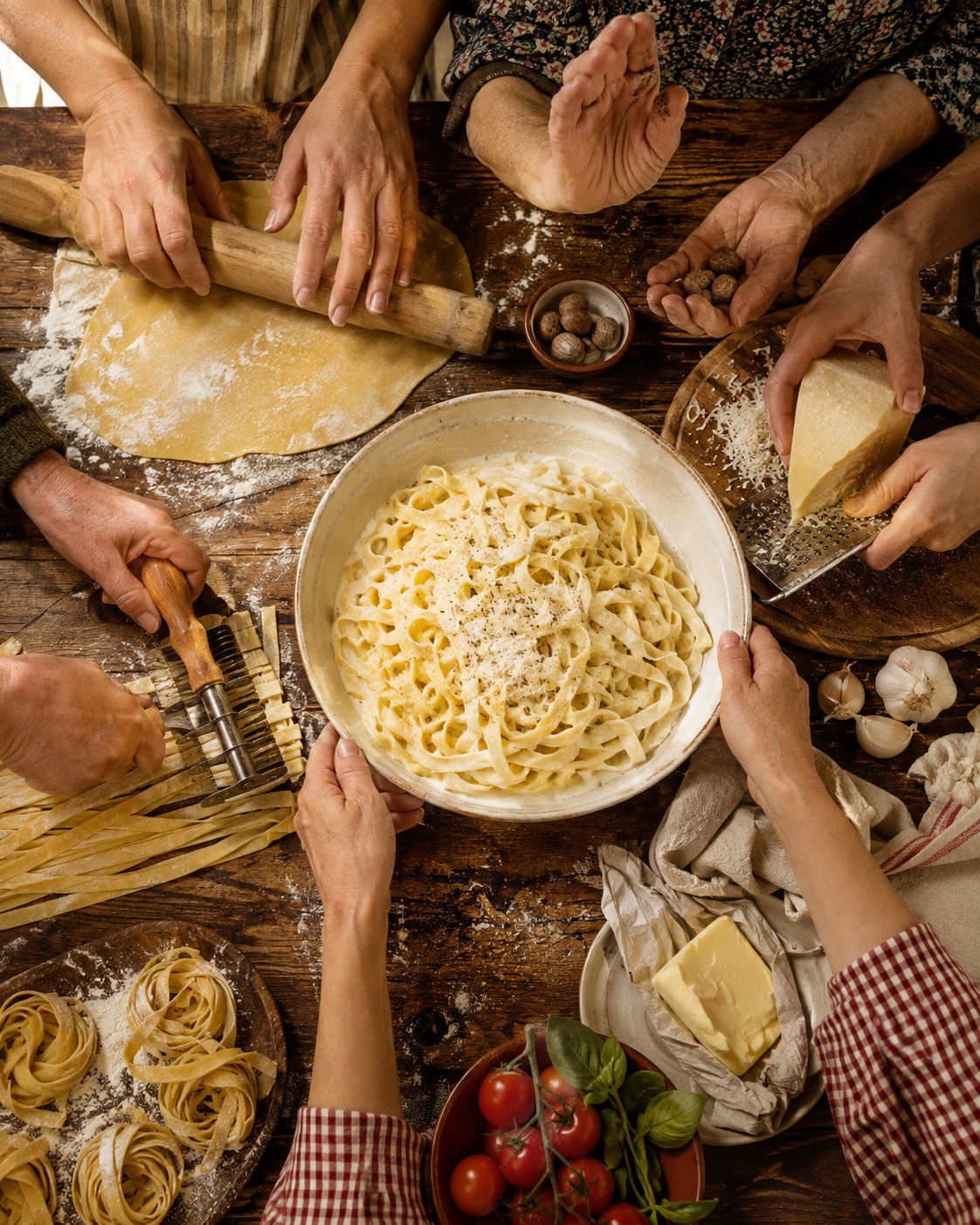
EIGHT HANDS AND A GRANDMOTHER’S PINCH
MARIUCH AND THREE GRANDSONS / EIGHT HANDS
Rich fettuccine Alfredo, Italian Express style • Serves 8 • About 30 minutes
Her way—not Rome’s
Alfredo started in Rome as butter, cheese, and pasta water, nothing more. Ours never stayed that simple, because nothing in Mariuch’s kitchen ever did. A full stick of butter, real cream, five cloves of garlic, and a fistful of Pecorino turned it into something else entirely—richer, bolder, unmistakably hers. She taught it to her three grandsons, boys who thought they already knew, the same way she taught everything: hands first, questions answered with a look instead of an explanation, and a pinch of nutmeg measured against your own cheek.
| SERVES 8 |
TIME About 30 minutes |
STYLE Italian Express |
|---|
Ingredients
| • 1 stick (8 tablespoons) unsalted butter | • 2 pounds fresh fettuccine, cut from thin pasta sheets (store-bought is fine) |
|---|---|
| • 5 garlic cloves, minced | • A big pinch of freshly grated nutmeg—a grandmother-sized pinch, not a shy one |
| • 2 cups heavy cream | • Kosher salt |
| • 3 cups grated Locatelli Pecorino Romano, plus more for serving | • Reserved pasta water, as needed |
“THIS IS NOT A SUGGESTION AMOUNT. THIS IS THE AMOUNT.” — Maryanne “Mariuch” Pascale, on the butter, every single time |
|---|
BUILD THE SAUCE
Butter first. Questions later.
1. Get the pan right. Use a pan big enough to hold all the pasta later. You are not making this for a mouse.
2. Melt the butter. Melt the full stick over medium heat in that same pan. Let it go fully liquid before you move on.
3. Add the garlic. Stir in the minced garlic and cook just until the kitchen smells like something worth stopping for, about one minute. Do not let it brown.
4. Pour in the cream. Add the two cups of cream and bring it to a gentle simmer, stirring so it doesn’t catch on the bottom.
5. Add the nutmeg. One big pinch, grated fresh if you can. Not a little. A grandmother amount.
6. Season lightly. A pinch of kosher salt, no more yet. The cheese still has to have its say.
REEK-EE SAYS Locatelli Pecorino Romano. Anything else is for people who did not have a grandmother. |
|---|
BRING IT HOME
The cheese still has to have its say
7. Cook the fettuccine. Boil the pasta in generously salted water until just shy of al dente, whether it’s fresh-cut or store-bought.
8. Move the pasta into the sauce. Transfer it directly into the pan along with a splash of pasta water.
9. Add the cheese gradually. Stir in the Pecorino a handful at a time, tossing constantly, until it melts into a smooth sauce that clings to every strand.
10. Loosen as needed. Add more pasta water in small splashes if the sauce gets too thick before the pasta is fully coated.
11. Taste before anyone else does. Adjust the salt only now, not before.
12. Serve it right away. Warmed plates, more Pecorino on top, and don’t wait for the table to be perfectly set.
Mariuch’s rules
The butter is not negotiable. A full stick, every time.
Garlic goes in just long enough to smell it. That smell is the whole recipe.
Locatelli Pecorino Romano. Say it with your whole chest.
Nutmeg gets measured the same way it’s always been measured. Generously.
Taste it yourself before it goes to the table. The sauce will tell you if it’s ready.
One-trip shopping list
| □ Dairy: unsalted butter, heavy cream, Locatelli Pecorino Romano | □ Pasta: 2 lb fresh fettuccine (or store-bought) |
|---|---|
| □ Produce: garlic | □ Pantry: whole nutmeg, kosher salt |
Mariuch’s Vodka Sauce
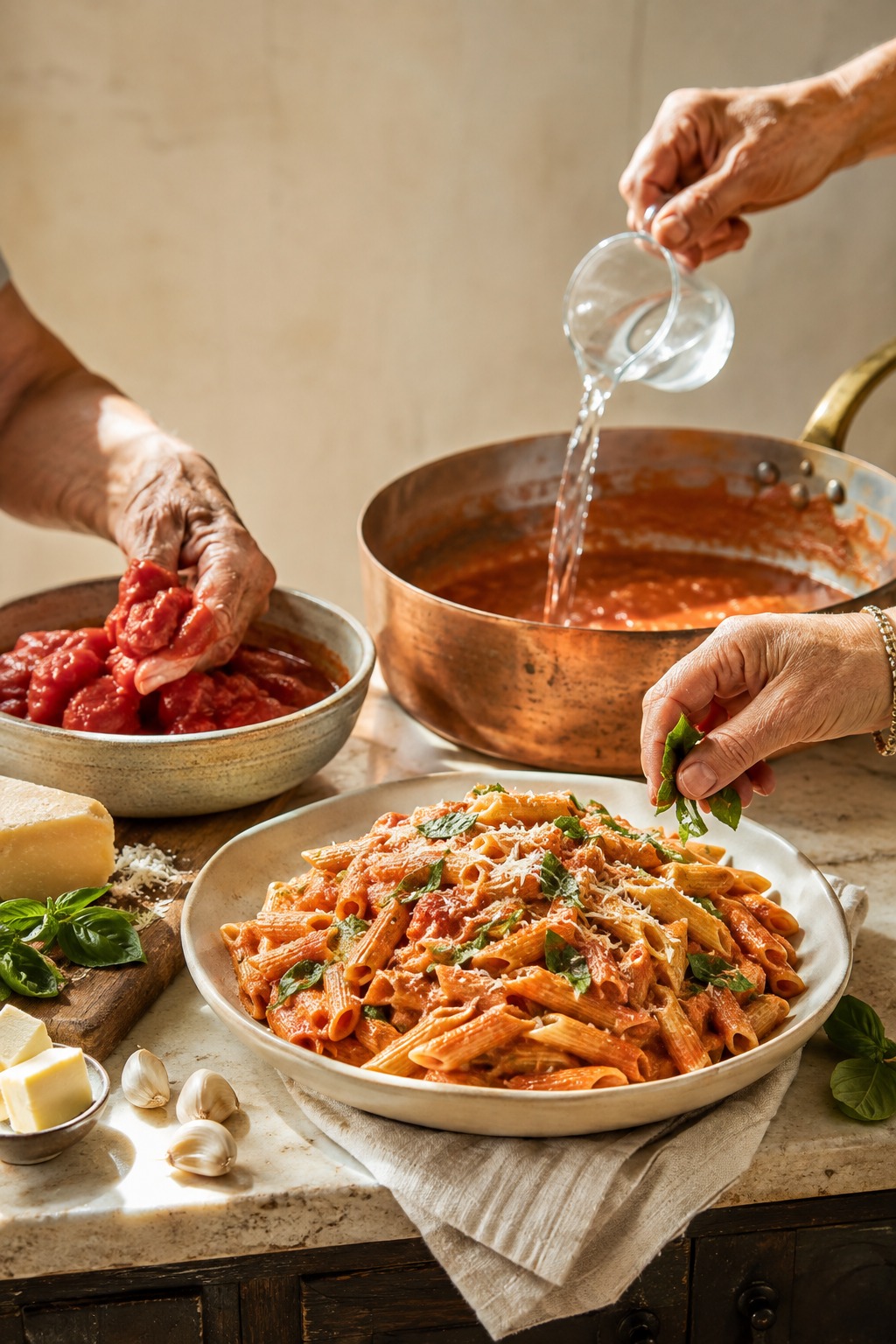
WE CAME. WE SAW. WE MADE IT BETTER.
NOT FROM ITALY, BUT OURS NOW
Hand-crushed tomato vodka sauce, our way • Serves 8 • About 45 minutes
An idea isn’t a conquest.
Sometime in the 1970s, somewhere between Italy and New York, somebody put vodka in tomato sauce and everybody lost their minds about it. Nobody agrees on exactly who did it first. Credit wherever it’s due—somebody had an idea. But an idea isn’t a conquest, and Mariuch has never once mistaken the two. Out came whole San Marzanos crushed by her own hand, real garlic instead of one lonely clove, Locatelli Pecorino Romano, and a heavier pour of vodka than anybody in New York had the nerve to use. She tasted it, nodded once, and delivered the verdict. Now that’s Italian.
Siamo venuti. Abbiamo visto. Abbiamo conquistato. L’abbiamo reso migliore. We came. We saw. We conquered. We made it better.
| SERVES 8 people |
TIME About 45 minutes |
STYLE Italian Express |
|---|
Ingredients
| • 1 pound penne | • One 28-ounce can whole San Marzano tomatoes, crushed by hand into meaty, medium chunks—not too big, not too small | |
|---|---|---|
| • 2 tablespoons olive oil | • 2 cups heavy cream | |
| • 4 tablespoons butter | • 1½ cups grated Locatelli Pecorino Romano, plus more to top | |
| • 1 small onion, chopped finely | • Salt and pepper to taste | |
| • 4 cloves garlic, minced | • Fresh basil, torn, plus more to top | |
| • 2 pinches red-pepper flakes | • Reserved pasta water, as needed | |
| • ¾ cup vodka | ||
We came. We saw. We conquered. We made it better. The recipe may not have begun in Mariuch’s kitchen. It became ours the moment she put her hands into it. |
||
THE METHOD / PART ONE
Build the sauce
1. Get the water going. Boil a generously salted pot of water for the penne and cook it al dente according to package directions.
2. Start the base. Add the oil and butter to a large skillet over medium heat. Sauté the onion about 5 minutes, until softened. A little browning is fine.
3. Add the garlic and heat. Stir in the garlic and red-pepper flakes and cook about 30 seconds, until fragrant.
4. Add the vodka. Pour it in and let it bubble for about 30 seconds.
5. Crush and add the tomatoes. Stir in the hand-crushed San Marzanos, chunks and all, until well combined with the base.
6. Add the cream. Stir it in and reduce the heat to medium-low. Let the sauce warm through and thicken, a couple of minutes, longer if you want it thicker still.
7. Season. Salt and pepper to taste.
8. Add the cheese. Stir in the Pecorino until melted through.
| REEK-EE SAYS Locatelli Pecorino Romano. We didn’t conquer this sauce just to hand the cheese decision over to New York too. |
|---|
THE METHOD / PART TWO
Bring it home
9. Fold in the pasta. Add the drained penne to the sauce along with a splash of pasta water, and fold it together until every piece is coated.
10. Finish and serve. Top with torn fresh basil and more Pecorino. Serve right away.
Mariuch’s rules
Whole tomatoes, crushed by hand. A tube of paste is not a substitute for actual tomatoes.
Four cloves of garlic, not one. We are not shy people.
Locatelli Pecorino Romano, always.
The vodka goes in—generously. If you can’t tell it’s there, you weren’t paying attention.
It doesn’t have to be from Italy to be Italian. It has to be made right.
One-trip shopping list
| □ Produce: onion, garlic, fresh basil | □ Dairy: butter, heavy cream, Locatelli Pecorino Romano | |
|---|---|---|
| □ Pantry: red-pepper flakes, salt, pepper | □ Tomatoes: one 28-ounce can whole San Marzano | |
| □ Oil and spirits: olive oil, vodka | □ Pasta: 1 lb penne | |
| BADA BING, BADA BOOM • MADE IT BETTER | ||
Mariuch’s Pasta e Fagioli
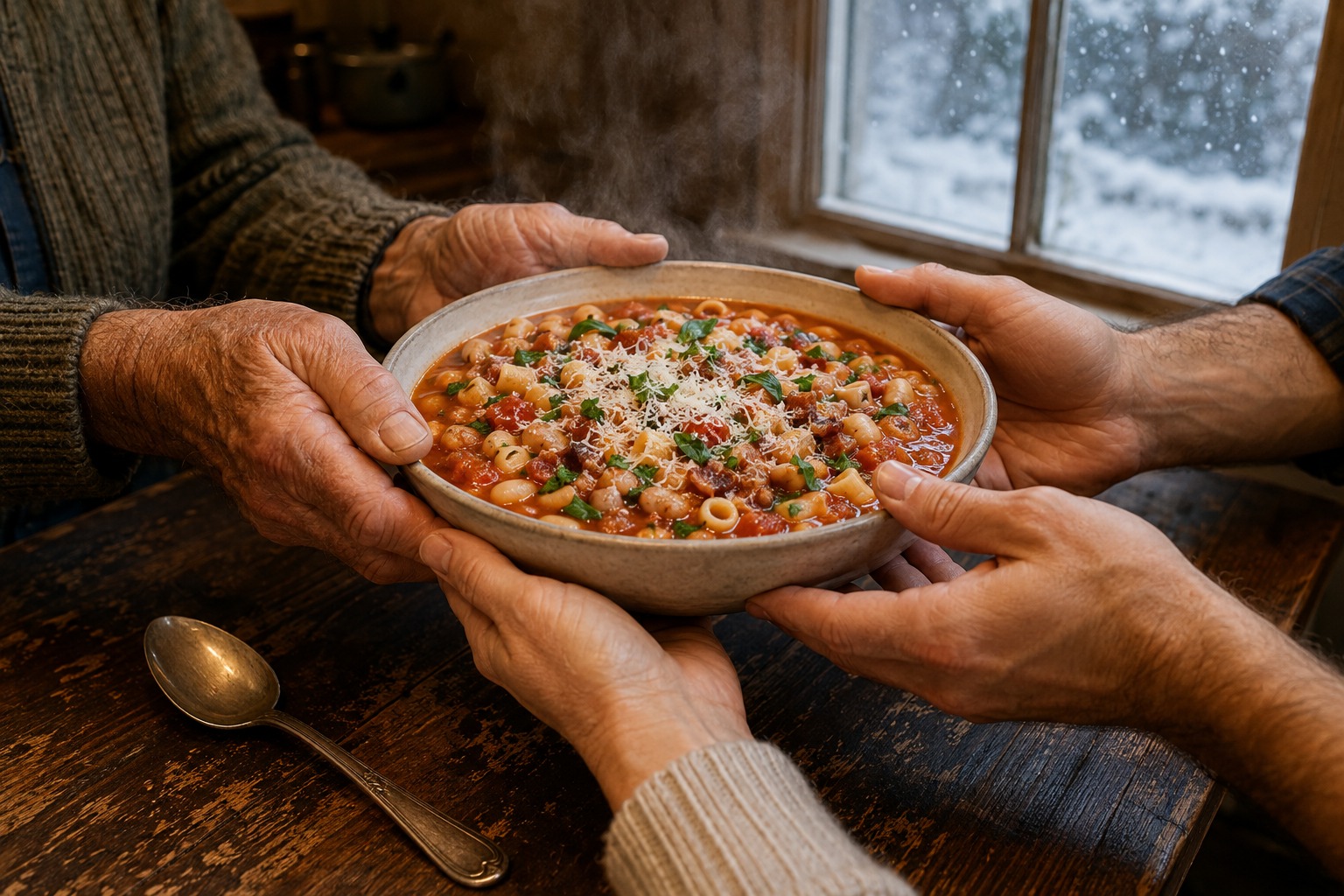
THE ANSWER TO EVERY COLD DAY
NOBODY IN THAT FAMILY WAS EVER COLD FOR LONG
Hearty pasta and bean soup • Serves 8 • About 45 minutes
From Mulberry Street to Mariuch’s table.
Mariuch learned this soup from her father, who was born on Mulberry Street in New York City’s Little Italy. His parents were born there too, and his grandmother had a pushcart. This was not a recipe that crossed the ocean written on a card. It grew up on those streets and passed through the family the old-fashioned way: one person beside another, watching the pot, following somebody’s hands, and learning what ‘enough’ looked like without anybody measuring it.
Her father taught Mariuch. Mariuch taught her children and grandchildren. And through every generation, the answer to somebody complaining about being cold remained the same. It was not a blanket. It was a pot.
Whoever walked into Mariuch’s kitchen shivering got the same treatment: sit down, stop talking, the soup’s almost ready. She never once turned up the heat in a room when she could turn it up in a bowl instead.
| SERVES 8 people |
TIME About 45 minutes |
ROOTS Mulberry Street |
|---|
Ingredients
| • 4 slices bacon, chopped | • ¼ cup fresh basil, torn, divided |
|---|---|
| • 4 ounces pancetta, diced | • Salt and black pepper |
| • 8 garlic cloves, chopped | • Four 15-ounce cans cannellini beans, drained and rinsed |
| • 8 cups chicken broth | • 2 teaspoons quality red wine vinegar |
| • Two 28-ounce cans whole San Marzano peeled tomatoes | • Locatelli Pecorino Romano, grated generously, for serving |
| • 1 pound ditalini | • Extra chopped parsley, for serving |
| • ¼ cup fresh parsley, chopped, divided |
THE METHOD / BUILD THE BASE
Build the base
1. Render the bacon and pancetta. In a large Dutch oven or pot, cook the bacon and pancetta over medium-high heat, stirring occasionally, until golden and crisp, 3 to 4 minutes.
2. Add the garlic. Stir it in and cook until golden. Lower the heat if the bottom of the pot starts getting too dark.
3. Build the pot. Add the broth and the San Marzano tomatoes, crushing each tomato by hand over the pot as it goes in. Add the ditalini, half the torn basil, and half the chopped parsley. Save the remaining herbs for serving. Add a pinch each of salt and pepper, then bring to a boil over high heat.
| REEK-EE SAYS We don’t make our own broth. Life’s too short and the soup’s too good to spend that kind of time proving a point. |
|---|
THE POT KNOWS WHAT TO DO
Bacon and pancetta build the base. Hand-crushed tomatoes give it body. Ditalini and cannellini make it a meal. The herbs do two jobs: half warm through the pot, half wake up the bowl.
THE METHOD / FINISH IT
Finish it
4. Add the beans. Stir in the drained, rinsed cannellini beans.
5. Simmer until the pasta is done. Reduce to a lively simmer over medium-high heat and cook until the ditalini is al dente, 7 to 9 minutes, stirring often and scraping the bottom so nothing sticks. Mash some of the tomatoes and beans against the side of the pot as you go.
6. Finish off the heat. Stir in the vinegar. Season to taste with salt and pepper.
7. Serve. Garnish generously with grated Locatelli Pecorino Romano and the reserved fresh herbs.
Mariuch’s rules
Cold is not a reason to sit still. Cold is a reason to eat.
Don’t be shy with the Locatelli Pecorino Romano. Nobody’s ever complained about too much on this soup.
Mash some of the beans and tomatoes as it cooks. It thickens the whole pot without anyone having to work for it.
Save half the herbs for the top. What goes in the pot and what goes on the bowl are two different jobs.
One-trip shopping list
| □ Meat: bacon, pancetta | □ Beans: four 15-ounce cans cannellini |
|---|---|
| □ Produce: garlic, fresh parsley, fresh basil | □ Pasta: 1 lb ditalini |
| □ Pantry: chicken broth, red wine vinegar, salt, black pepper | □ Dairy: Locatelli Pecorino Romano |
| □ Tomatoes: two 28-ounce cans whole San Marzano |
| FROM MULBERRY STREET • STILL WARM |
|---|
Mariuch’s Zuppa di Lenticchie all’Italiana
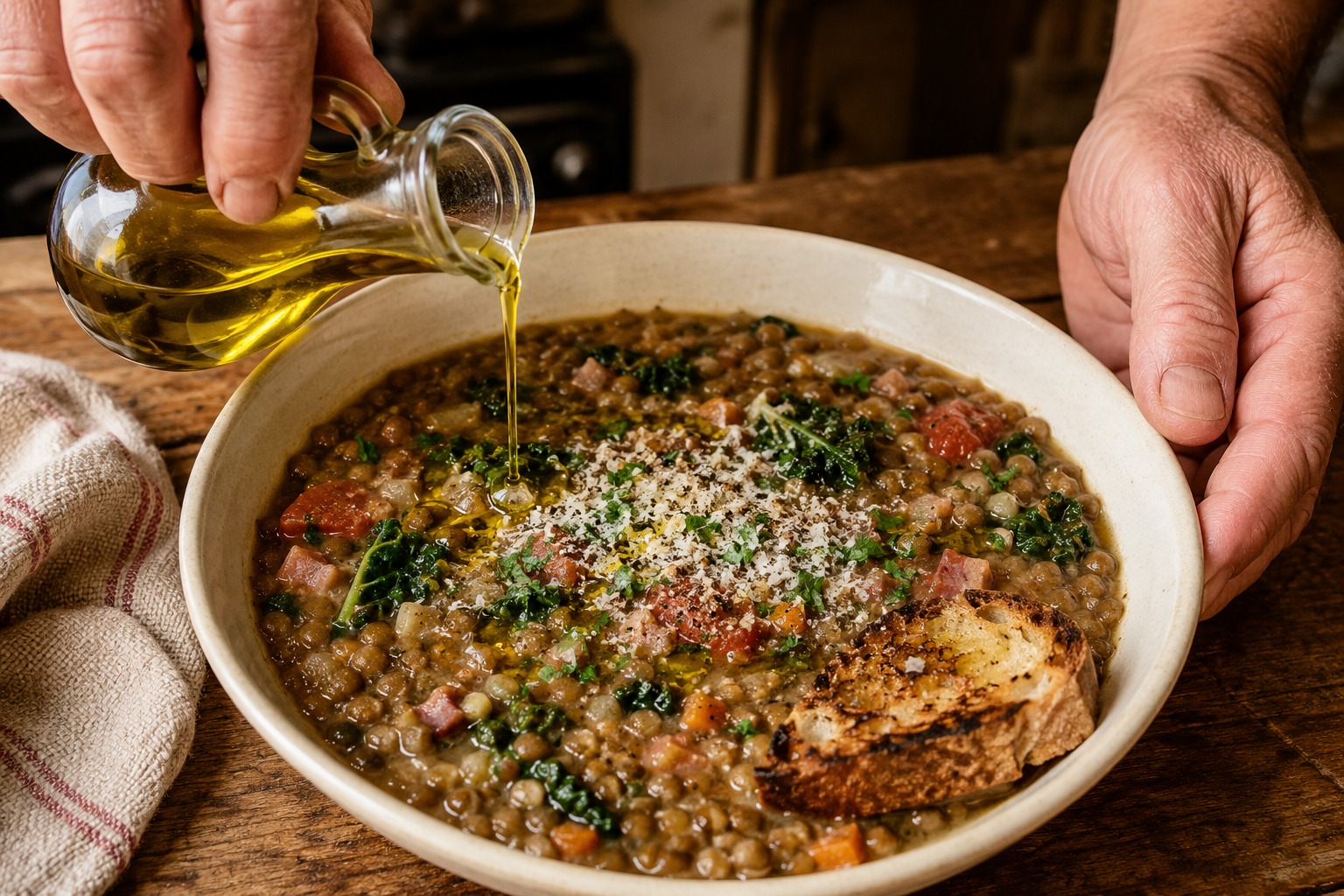
NO ONE REMEMBERS WHERE THIS ONE CAME FROM
NOBODY COULD TELL YOU WHERE THIS ONE CAME FROM
Deep, rustic Italian lentil soup • Serves 8 • About 1 hour 30 minutes
Some recipes just accumulate.
Every other recipe in this book has a person attached to it. A Mumma, a father from Mulberry Street, a name and a kitchen and a story you could trace backward if you wanted to. Ask Mariuch where the lentil soup came from and you get a shrug, and then a look like the question itself was a little beside the point.
It didn’t come from anywhere in particular. It came from decades of standing at a stove long enough to know things without being able to say where the knowing started. It came from tasting a soffritto a thousand times until you knew exactly how patient it needed you to be. It came from good tomatoes and a Locatelli Pecorino Romano rind saved instead of thrown away, because somewhere along the way she learned that a rind still has work left in it. Mostly, it came from the same place everything else in this book came from, whether there’s a name attached or not.
Love. Experience. Just knowing. Some recipes get handed down. This one just accumulated.
| SERVES 8 people |
TIME About 1½ hours |
ORIGIN Just knowing |
|---|
Ingredients
| • 3 tbsp extra-virgin olive oil, plus more for finishing | • 2 bay leaves |
|---|---|
| • 5 oz pancetta, finely diced | • 2 sprigs fresh rosemary |
| • 1 large yellow onion, finely diced | • 4 sprigs fresh thyme |
| • 2 medium carrots, finely diced | • ½ tsp crushed red-pepper flakes |
| • 2 celery ribs, finely diced | • 1 tsp freshly ground black pepper |
| • 6 garlic cloves, minced | • Kosher salt, as needed |
| • 2 tbsp tomato paste | • 1 small bunch Tuscan kale, stems removed and leaves sliced |
| • 1 cup dry white wine | • 1 tbsp red wine vinegar |
| • One 28-oz can whole San Marzano tomatoes, crushed by hand | • ½ cup freshly grated Locatelli Pecorino Romano |
| • 2 cups Italian brown or green lentils, rinsed and picked over | • Italian parsley, chopped |
| • 8 cups good chicken stock | • For the table: crusty Italian bread, more Locatelli Pecorino Romano, excellent olive oil, black pepper |
| • 1 Locatelli Pecorino Romano rind |
THE METHOD / BUILD THE SOFFRITTO
Build the soffritto
1. Render the pancetta. Cook the pancetta with the olive oil in a heavy Dutch oven over medium-low heat until the fat has rendered and it begins to turn golden, 6 to 8 minutes. Don’t rush it.
2. Build the soffritto. Add the onion, carrots, and celery. Lower the heat and cook 12 to 15 minutes, stirring occasionally, until everything is very soft, sweet, and beginning to caramelize. This is where the soup starts becoming extraordinary.
3. Add garlic and heat. Stir in the garlic and red-pepper flakes and cook about 1 minute.
4. Add the tomato paste. Cook it 2 to 3 minutes, stirring against the bottom of the pot, until it turns dark brick red.
5. Deglaze with the wine. Pour in the wine and scrape up every browned bit from the bottom. Let it reduce by roughly half.
| REEK-EE SAYS Don’t rush the soffritto. Everything that makes this soup worth making happens in those first twenty minutes. |
|---|
Let it become soup
6. Build the pot. Add the crushed tomatoes, lentils, chicken stock, Locatelli Pecorino Romano rind, bay leaves, rosemary, thyme, and black pepper. Bring just to a boil, then immediately reduce to a gentle simmer.
7. Simmer. Partially cover and simmer 35 to 45 minutes, stirring occasionally, until the lentils are tender but haven’t completely fallen apart.
8. Make the move that changes the soup. Remove the herb stems, bay leaves, and rind. Mash about 2 cups of soup thoroughly, then stir it back into the pot. The broth turns thick and velvety while most lentils stay intact.
THE METHOD / THE BOWL THAT MAKES PEOPLE SHUT UP
Finish it
9. Add the kale. Stir in the cavolo nero and simmer another 8 to 10 minutes.
10. Finish off the heat. Turn off the heat and stir in the red wine vinegar and grated Locatelli Pecorino Romano. Taste and adjust the salt, remembering the pancetta, stock, and cheese rind have already contributed plenty.
11. Rest it. Let it sit 10 minutes before serving.
12. Build the bowl. Put a thick slice of grilled or toasted country bread in the bottom of a wide soup bowl. Ladle the soup over it. Finish with grated Locatelli Pecorino Romano, chopped parsley, black pepper, and a generous ribbon of excellent extra-virgin olive oil. That last raw olive oil isn’t decoration. It is part of the flavor.
Mariuch’s rules
Don’t rush the soffritto. Twenty patient minutes now saves the whole pot later.
Save the Locatelli Pecorino Romano rind. It still has work left in it.
Mash some of the lentils at the end. That’s how the broth goes creamy without a drop of cream.
The raw olive oil on top isn’t a garnish. It’s the last ingredient, not a decoration.
One-trip shopping list
| □ Meat: pancetta | □ Stock: 8 cups chicken stock |
|---|---|
| □ Produce: onion, carrots, celery, garlic, rosemary, thyme, cavolo nero, parsley | □ Dairy: Locatelli Pecorino Romano rind and grated Locatelli Pecorino Romano |
| □ Pantry: tomato paste, lentils, bay leaves, red-pepper flakes, black pepper, kosher salt, red wine vinegar | □ Wine and oil: dry white wine, excellent extra-virgin olive oil |
| □ Tomatoes: one 28-oz can whole San Marzano | □ For serving: crusty Italian bread |
| LOVE • EXPERIENCE • JUST KNOWING |
|---|
Mariuch’s Italian Wedding Soup
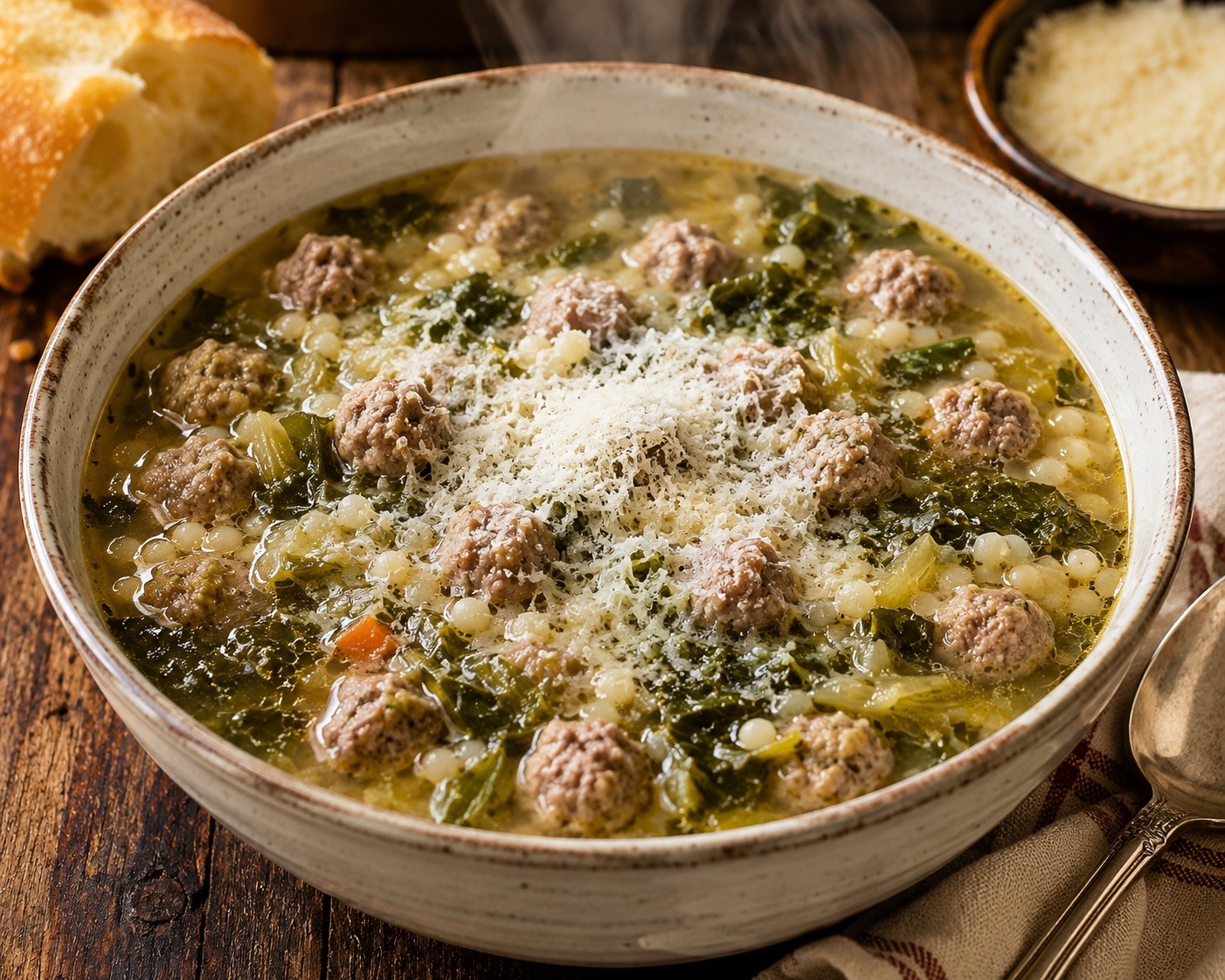
Mariuch never saw the point in making life harder than it had to be. Start with a great broth, drop the little meatballs right into it, pile in the escarole, and let the pot do its job. If the broth needs help, give it some. If it tastes right, leave it alone. That’s cooking.
Italian-American wedding soup with tiny meatballs, escarole & acini di pepe • Serves 8–10
SERVES 8–10 |
METHOD Tiny meatballs in broth |
GREENS Escarole |
|---|
Ingredients
| For the tiny meatballs | For the soup |
|---|---|
| • 1 pound ground beef | • 3 tablespoons excellent extra-virgin olive oil |
| • 1 pound ground pork | • 1 large yellow onion, finely chopped |
| • 2 large eggs | • 3 carrots, diced |
| • 1 cup fresh breadcrumbs | • 3 celery stalks, diced |
| • 1 cup freshly grated Locatelli Pecorino Romano | • 4 cloves garlic, minced |
| • 4 cloves garlic, minced | • 12 cups excellent-quality chicken broth or stock |
| • ¼ cup fresh flat-leaf parsley, finely chopped | • High-quality chicken base or bouillon, only as needed |
| • 1 teaspoon kosher salt | • 2 large heads escarole, thoroughly washed and chopped |
| • ½ teaspoon freshly ground black pepper | • 1½ cups acini di pepe |
| • Kosher salt, as needed | |
| • Freshly ground black pepper | |
| • ½ cup freshly grated Locatelli Pecorino Romano, stirred into the soup near the end | |
| For serving | |
| • 1 cup freshly grated Locatelli Pecorino Romano, for everybody to pile on their own bowl |
THE METHOD / PART ONE
Make the soup.
1. Make the meatballs.
Put the beef, pork, eggs, breadcrumbs, Locatelli Pecorino Romano, garlic, parsley, salt, and black pepper into a large bowl.
Mix gently with your hands until everything is evenly combined.
Roll the mixture into very small meatballs, about ½ to ¾ inch across.
Keep them small. This is wedding soup, not Sunday dinner.
2. Start the soup.
Heat the olive oil in a large soup pot over medium heat.
Add the onion, carrots, and celery.
Cook until they begin to soften but still have some structure.
Add the garlic and cook just until fragrant.
Golden garlic is flavor. Brown garlic is bitterness.
3. Build the broth.
Pour in the chicken broth or stock and bring it to a gentle simmer.
Taste it.
If the broth already tastes rich and delicious, leave it alone.
If it needs something, add a little high-quality chicken base or bouillon.
Taste again.
Add more only if it needs it.
The broth will tell you how much.
There is no prize for spending half the day making stock when you already have an excellent one sitting in front of you.
4. Cook the meatballs in the broth.
Bring the broth to a steady gentle simmer.
Drop the raw little meatballs directly into the soup.
Do not brown them first.
Let them cook gently in the broth until cooked through.
That flavor belongs in the soup.
THE METHOD / PART TWO
Finish it.
5. Add the escarole.
Add the chopped escarole.
It will look like far too much when it first goes into the pot.
It isn’t.
Stir it down into the broth and let it cook until tender.
6. Add the pasta.
Stir in the acini di pepe.
Cook until the pasta is tender.
Keep an eye on the soup as it cooks because the pasta will absorb broth.
If it becomes thicker than you want, add a little more chicken broth.
7. Add the Pecorino.
When the soup is almost finished, stir in ½ cup freshly grated Locatelli Pecorino Romano.
Let it melt into the broth.
Taste everything again.
Adjust the kosher salt, black pepper, broth, or chicken base as needed.
When the broth tastes right, stop.
8. Serve it.
Ladle the soup into large bowls, making sure everybody gets plenty of meatballs, escarole, pasta, and broth.
Put the remaining 1 cup Locatelli Pecorino Romano on the table.
Let everybody add as much as they want.
Around here, that usually means more than you think.
Mariuch’s Rules:
• Start with a really good broth.
• If it tastes right, leave it alone.
• If it needs help, add a little chicken base until tasty.
• Be careful with adding too much salt
• Pecorino is salty
Mariuch’s Meatballs
THE TIES THAT BIND
FROM HER FATHER’S HANDS TO MARIUCH’S — AND THEN TO MINE
Fried family meatballs • Serves 8 • About 1½ hours
The ties that bind
MARIUCH’S MEATBALLS
THE TIES THAT BIND
Nobody knows exactly where the first one was fried. Mariuch learned to make meatballs from her father. Her father learned from his father. And his father, according to family lore, learned from his father sometime around the 1840s.
Maybe. Who actually knows? Nobody thought to document the genealogy of a meatball. They were too busy eating them.
What we do know is that somewhere along the way, the recipe became part of the family. It traveled through generations without a recipe card, without exact measurements, and apparently without anybody thinking that someday Reek-ee would be sitting here trying to explain how much of a loaf of bread goes into a bowl of meat.
Because that’s the problem. The meatball is the point.
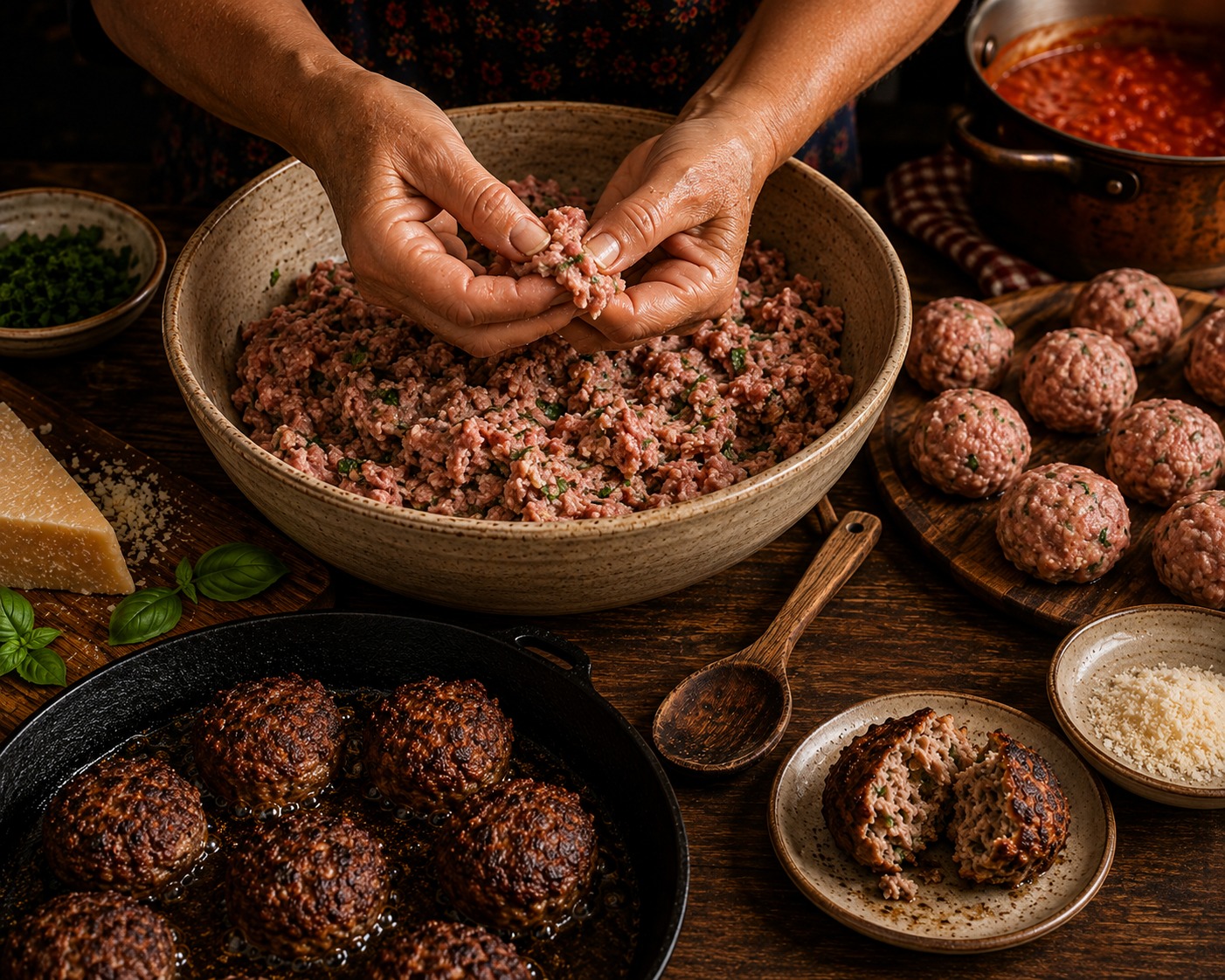
Mariuch’s father didn’t teach her by saying, “Use exactly 11.3 ounces of bread.” He taught her how the mixture should feel. She learned the same way he had learned: hands in the bowl. And that’s how she taught Reek-ee.
Good Italian bread gets soaked in milk and squeezed out. Then it gets massaged through the meat—not too much, not too little. Two eggs to start. Maybe three. Garlic enough to matter. Pecorino, but remember it’s salty. Parsley. Basil torn by hand.
Then you stop. You make one meatball. You fry it in olive oil until it has a serious crust. And you eat it.
Too hard? More soaked bread. Too dry? Maybe the third egg. Too wet? More Pecorino. Needs something? Add it. Then make another one. There is no shame whatsoever in requiring a second test meatball.
For nearly two centuries—or so the story goes—somebody in this family has apparently been standing over a frying pan doing essentially the same thing.
A father taught his son. That son taught his son. A father taught his daughter, Mariuch. And Mariuch taught Reek-ee.
The names changed. The kitchens changed. The hands changed. The meatball kept going.
| SERVES 8 people |
TIME About 1½ hours |
FINISH 30 min in sauce |
|---|
Ingredients
| • 1½ pounds ground beef, preferably 80/20 chuck | • ½ cup finely chopped fresh Italian parsley | |
|---|---|---|
| • 1 pound ground pork — or use another pound of ground chuck | • ½ cup fresh basil, torn by hand | |
| • ½ to 1 loaf good Italian bread | • 2 teaspoons kosher salt | |
| • Water or milk, enough to thoroughly soak the bread | • 1 teaspoon freshly ground black pepper | |
| • 2–3 large eggs | • Excellent olive oil, generously, for frying | |
| • 1½ to 2 cups freshly grated Locatelli Pecorino Romano | • Mariuch’s Sunday Sauce, for finishing | |
| • 8 garlic cloves, chopped — not too fine, not too big | • No oregano. | |
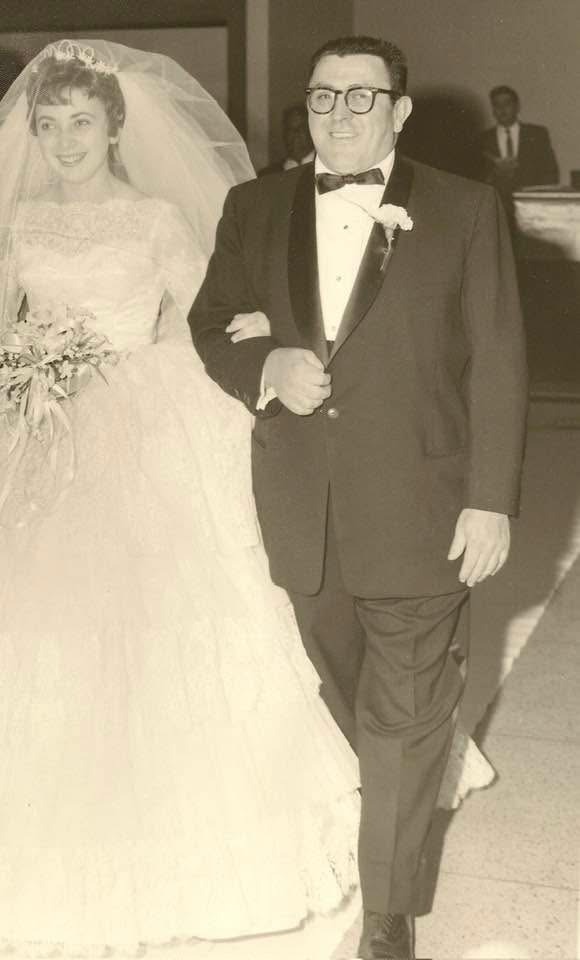 |
FROM HER FATHER’S HANDS The man beside Mariuch on her wedding day is her father—the man who taught her the family meatball. He learned it from the hands before his. She carried it forward. Then she taught Reek-ee. No recipe card. Just hands teaching hands. |
|
THE METHOD / PART ONE
The touch comes first
1. Get the bread right. Soak the torn Italian bread completely in water or milk until thoroughly soft. Transfer it to a fine-mesh strainer and shake the strainer firmly back and forth. As the excess liquid drains away, the bread begins gathering into one large mass. Keep shaking until it resembles a large mound of very wet pizza dough—still soft, moist, and a little gloopy, but with definite form. That’s when it’s ready. Don’t squeeze it dry. The shaking removes the excess liquid while leaving the bread properly moist for the meatballs.
| REEK-EE SAYS Too wet? More Pecorino. Finally, a cooking problem with an excellent solution. |
|---|
2. Start with two eggs. Put the beef and pork—or all chuck—into a very large bowl. Add the prepared bread, 2 eggs, Locatelli Pecorino Romano, chopped garlic, parsley, torn basil, salt, and black pepper.
3. Get your hands in there. Massage everything together gently with your hands, working the softened bread completely through the meat. Use the thumb against the index and middle fingers, rubbing in a small circular motion to massage the mixture together. You aren’t simply stirring ingredients. You are working the bread into the meat until they become one mixture. But don’t overdo it. Not too much. Not too little. Over-massage the meat and you’ll make a hard meatball. And Mariuch has the wooden spoon after all.
4. Feel it. The mixture should be soft and moist, but not mushy. Shape a little lightly in your palm. If it feels too dry, add the third egg. If it feels too firm or hard, prepare more soaked bread and work it gently into the mixture. If it feels too wet, add a little more Locatelli Pecorino Romano. That’s why the ingredient list says half a loaf to a loaf and two to three eggs. The bowl decides.
The test meatball gets the final vote
5. Fry one first. Pour a generous layer of olive oil into a heavy frying pan and heat it over medium to medium-high heat. Form one small test meatball and put it into the oil. Leave it alone. Let the bottom develop a real, dark brown crust before turning it. Continue frying until it is deeply browned all around and cooked through. Then eat it. This is quality control, not snacking. Well. It is also snacking.
6. Judge the meatball. Don’t just decide whether it tastes good. Pay attention to the inside. Mariuch’s meatball should be soft and tender, never hard and never a breadball. Too hard? More soaked bread. Too dry? Maybe the third egg. Too wet? More Pecorino. Not enough garlic, herbs, salt, pepper, or cheese? Fix it now. Then make another test meatball if you need to. Nobody has ever suffered from this procedure.
THE METHOD / PART TWO
Fry them. Then let the sauce have them.
7. Shape them gently. Once the test meatball is right, form the mixture into meatballs approximately the size of a large golf ball. Don’t squeeze them into submission. Bring each one together gently and stop. They don’t have to be perfectly round. They’re meatballs, not ball bearings.
8. Fry in olive oil. Add the meatballs to the hot olive oil in batches. Do not crowd the frying pan. Once they’re down, don’t mess with them. Let each side sit against the pan until it develops the deep brown crust you saw on the test meatball. Turn them only when the crust has formed and the meatball releases willingly. Continue until deeply browned all around.
9. Eat a couple. Transfer the fried meatballs to a tray to drain. Then eat one. Maybe two. Hot. Fried. No sauce. Yummy. But control yourself. People are expecting dinner.
10. Into the Sunday Sauce. Gently lower the remaining fried meatballs into Mariuch’s simmering Sunday Sauce. Let them simmer in the sauce for at least 30 minutes before serving. Don’t stir them aggressively. They’re deliberately tender.
11. Let the magic happen. That hard fried crust now does something completely different. It softens. It absorbs the Sunday Sauce. At the same time, the meatballs give their browned meat, garlic, Pecorino, herbs, and olive-oil flavor back to the pot. The meatball changes the sauce. The sauce changes the meatball. Bada bing. Bada boom.
Mariuch’s rules
| • Ground pork is optional. The proper massage of the bread is not. | • Basil is torn by hand. Locatelli Pecorino Romano only. No oregano. |
|---|---|
| • Start with two eggs. The third goes in only if the mixture tells you it needs it. | • Fry in olive oil. Always make a test meatball. Don’t overwork the mixture. |
| • Half a loaf of Italian bread is a starting point. You may head toward the whole loaf. | • Large golf-ball size. Leave them alone long enough to build the crust. |
| • More bread makes a hard meatball softer. It should never turn the meatball into a breadball. | • Eat a couple before the sauce. Tradition or quality control—whichever explanation is required. |
| • Eight cloves of garlic. Big flavor. | • Finish in Sunday Sauce for at least 30 minutes. Soft inside. Never hard. Never a breadball. |
One-trip shopping list
| □ Meat: 1½ lb 80/20 ground chuck, 1 lb ground pork—or all chuck | □ Bakery: 1 loaf good Italian bread |
|---|---|
| □ Dairy: water or milk, 2–3 eggs, Locatelli Pecorino Romano | □ Produce: garlic, Italian parsley, fresh basil |
| □ Pantry: kosher salt, black pepper | □ Frying: excellent olive oil |
| □ Finishing: Mariuch’s Sunday Sauce |
| MARIUCH’S RULE The recipe isn’t finished when the ingredients are measured. It’s finished when it tastes right. |
|---|
| REEK-EE APPROVED RECIPE • THE FAMILY HISTORY GETS FUZZY. THE MEATBALL DOES NOT. |
Mariuch’s Braciole
ALL GOOD THINGS TAKE TIME
FROM STATEN ISLAND, WITH LOVE
Southern Italian stuffed beef rolls • Serves 6 • Up to 2½ hours in Sunday Sauce
MARIUCH’S BRACIOLE
BRAH-ZHOLE
All good things take time.
Mariuch learned to make braciole by watching Aunt Eli make it on Staten Island.
Or, more accurately, she learned to make brah-ZHOLE.
Nobody in that kitchen was saying bra-CHO-leh. That would have sounded almost suspiciously proper. In the Italian-American neighborhoods around New York, the old southern Italian pronunciations had crossed the Atlantic right along with the people. Final vowels disappeared. Consonants softened. Braciole became braciol—brah-ZHOLE, or brazhul.
The same kitchens gave us gabagool, manigot, mozzarell and prosciutt.
It wasn't laziness.
It was inheritance with an accent.
Those sounds survived because the people did.
Our family came from southern Italy, including Avellino. Domenico Pascale made the crossing from Italy to New York in the immigrant generation, arriving in a city where Italian families built new lives block by block. Whatever changed after they arrived—and almost everything did—the food and language of home had a remarkable way of hanging on.
That is how a recipe can travel farther than the person who first cooked it.
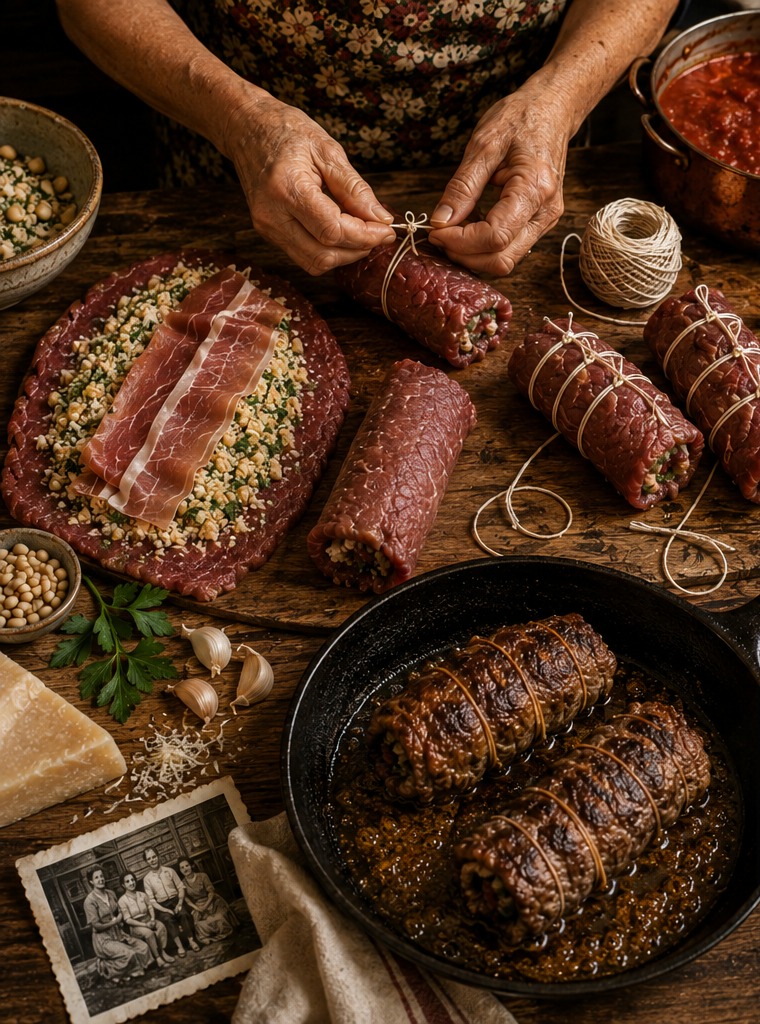
Years later, on Staten Island, Mariuch stood watching Aunt Eli make braciole: pounding the beef thin, making the filling, laying down the prosciutto, rolling each piece, tying every little bundle, browning them one by one, and finally lowering them into the Sunday Sauce.
Reek-ee remembers looking at the whole production and reaching the obvious conclusion:
This is an awful lot of work for a piece of meat.
Then he ate one.
Never mind.
Some foods are fast because they should be. Braciole isn't one of them. You pound. You fill. You roll. You tie. You brown. Then you put the whole thing into the sauce and wait for what feels like forever.
And somewhere during all that waiting, six ordinary pieces of beef become something people remember decades later.
Maybe that's why this recipe belongs so naturally to the family that carried it.
Domenico's generation crossed an ocean and built something that couldn't be built quickly. Aunt Eli stood at a counter on Staten Island and kept making food the long way. Mariuch watched her hands. Eventually Reek-ee watched Mariuch's.
Nobody involved seems to have been particularly interested in shortcuts.
Thank God.
Because after all the pounding, filling, rolling, tying, browning and simmering, you cut the string, put the braciole on a plate, cover it with Sunday Sauce, and take the first bite.
Then you understand.
All good things take time.
| REEK-EE SAYS: I thought braciole was entirely too much work. Then I ate it. I would like to formally withdraw my objection. So long as there are no raisins in it. |
|---|
| SERVES 6 people |
TIME Up to 2½ hours |
FINISH Sunday Sauce |
|---|
Ingredients
| • ½ cup panko breadcrumbs | • ¼ teaspoon red-pepper flakes |
|---|---|
| • ½ cup freshly grated Locatelli Pecorino Romano | • 1½ pounds top round beef roast |
| • 1 loosely packed cup flat-leaf Italian parsley leaves and tender stems, finely chopped | • 1 teaspoon kosher salt |
| • ¼ cup pine nuts, lightly toasted and roughly chopped | • 6 large, thin slices prosciutto, about 4 ounces |
| • 2–3 tablespoons excellent extra-virgin olive oil | • Excellent olive oil, generously, for browning |
| • 6 medium garlic cloves, minced | • Mariuch's Sunday Sauce, for braising and serving |
• ½ teaspoon freshly ground black pepper, divided • ⅓ cup raisins or currants, optional; see the filling note |
THE METHOD / PART ONE
Pound it. Fill it. Roll it. Tie it.
1. Make the filling. Put the panko, Pecorino, parsley, toasted pine nuts, all six cloves of garlic, ¼ teaspoon black pepper and red-pepper flakes into a bowl. Drizzle in 2 tablespoons of the olive oil and mix it with your hands. If the breadcrumbs still seem dry, add the third tablespoon. You want a filling that is moist and loose enough to spread—not wet and certainly not cement. Six cloves of garlic may look like a lot. It isn't. For an optional traditional variation, add ⅓ cup raisins or currants, soaked in warm water for 8 to 10 minutes and drained. Neither Mariuch nor Reek-ee likes them; we leave them out.
2. Cut the beef. Cut the top round into six approximately ½-inch slices. Try to cut them evenly because you're about to pound them anyway, and there is no reason to create additional work for yourself. Mariuch would already like to know why this is taking so long.
3. Pound them. Arrange the beef several inches apart on a cutting board and cover it with plastic wrap. Now pound. Use the flat side of a meat pounder and work each slice into a rough rectangle no more than ¼ inch thick. Don't annihilate it. We're making braciole, not settling a score. You need the beef thin enough to roll easily and substantial enough to survive two hours in Sunday Sauce.
4. Season it. Season both sides of the beef with the kosher salt and remaining ¼ teaspoon black pepper. Easy with the salt. Pecorino and prosciutto are coming. They have opinions.
5. Spread the filling. Divide the breadcrumb mixture among the six pieces of beef and spread it evenly over each one. Take it almost to the edges, but leave yourself enough room to roll without half the filling landing on the cutting board. And yes, some will land on the cutting board. Put it back. Nobody saw anything.
6. Prosciutto goes next. Lay one thin slice of prosciutto over the filling on each piece of beef, folding it where necessary so it fits. Press it down gently. This is one of those moments when the ingredients begin looking considerably more promising than they did five minutes ago.
THE METHOD / PART TWO
Now make six little packages.
7. Roll them. Starting at a short end, roll each piece of beef into a compact bundle. Keep the filling tucked inside as you go. Not so loose that everything falls out. Not so tight that you squeeze everything out. Apparently braciole, like most things involving Mariuch, requires judgment.
8. Tie them. Secure each bundle with two pieces of kitchen twine. Snug. Not strangled. If you have somehow constructed something resembling a Christmas ham, you've become overly enthusiastic.
| REEK-EE SAYS: Six pieces of meat. Twelve pieces of string. At this point I was still unconvinced dinner was worth the administrative burden. |
|---|
THE METHOD / PART TWO
Now make six little packages.
9. Get the olive oil hot. Coat a large sauté pan generously with excellent olive oil and heat it over medium-high heat until shimmering. Not smoking. We're browning the braciole, not calling the fire department.
10. Brown them properly. Put the bundles into the pan without crowding them. Then leave them alone. Let the first side build a serious brown crust before you start rolling them around. Continue turning until every side is beautifully browned, 6–8 minutes total. This is not the place for pale meat. That crust is flavor, and all of it is going into the Sunday Sauce.
11. Into the sauce. Transfer the browned braciole directly into a pot of gently simmering Mariuch's Sunday Sauce. Nestle them down into the sauce. Now the hard part: Leave them there.
THE METHOD / PART THREE
Sunday Sauce takes over.
12. Give them time. Let the braciole simmer gently in the Sunday Sauce for 2 to 2½ hours. Not a rolling boil. A slow simmer. Turn them occasionally and make sure they're surrounded by sauce. Then stop bothering them. You already pounded, filled, rolled, tied and browned them. You've contributed enough.
13. Know when they're done. The beef should be deeply tender. The filling should have melded into the meat, and the braciole should have given some of its beef, garlic, Pecorino, prosciutto and browned flavor back to the sauce. This is why we waited.
14. Take them out carefully. Lift the braciole from the sauce and put them onto a platter. They're tender now. Treat them accordingly. Let them rest for a few minutes so you can handle them.
15. Remove the evidence. Use kitchen scissors to cut off every piece of twine. Count if necessary. You put twelve pieces on. Twelve pieces come off. Serving somebody six feet of cotton string would undermine the previous three hours of work.
16. Bring them to the table. Serve the braciole whole or slice them into thick rounds so everybody can see the spiral of beef, prosciutto and filling. Spoon plenty of Mariuch's Sunday Sauce over everything. Put Locatelli Pecorino Romano on the table. Then eat. And suddenly all that pounding, spreading, rolling, tying and waiting seems completely reasonable. Reek-ee formally withdraws his objection.
Mariuch's rules
| • Six cloves of garlic. Two cloves would merely annoy the other four. | • Brown them properly in olive oil before they ever see the sauce. |
|---|---|
| • Locatelli Pecorino Romano only. | • Don't rush the braise. Two to 2½ hours. |
| • Panko gives the filling structure without making it heavy. | • Gentle simmer. Braciole does not improve through violence. |
| • Toast the pine nuts. That little step matters. | • Remove every piece of string before serving. |
| • Pound the beef thin, but don't destroy it. | • Spoon Sunday Sauce over the top. |
| • Filling first. Prosciutto over the filling. | • All good things take time. |
| • Two pieces of twine per braciole. Keep the packages together. |
One-trip shopping list
| □ Meat: 1½ lb top round beef roast, 4 oz thinly sliced prosciutto | □ Bakery: panko breadcrumbs |
|---|---|
| □ Produce: flat-leaf Italian parsley, 6 garlic cloves | □ Dairy: Locatelli Pecorino Romano |
| □ Pantry: pine nuts, kosher salt, black pepper, red-pepper flakes, kitchen twine | □ Oil: excellent extra-virgin olive oil |
| □ For braising: Mariuch's Sunday Sauce |
| MARIUCH'S RULE If you're going to take the time to make braciole, take the time to make it right. |
|---|
| REEK-EE APPROVED RECIPE • ALL GOOD THINGS TAKE TIME. |
Mariuch’s Hot Italian Sausage
FOUR MEALS, ONE BATCH
Homemade family sausage • About 5 pounds • Roughly 18–22 six-inch links
The recipe came from Mariuch’s great-great-grandmother.
We do not know her name.
I wish we did.
Somewhere along the line, she taught the family how to make hot Italian sausage. The recipe survived. Her name did not.
We should have carried both forward.
I cannot put her name on this page, but I can acknowledge what she gave us. Every time we make this sausage, we are still using something she taught the family.
This was never food made for display. It was food made to work.
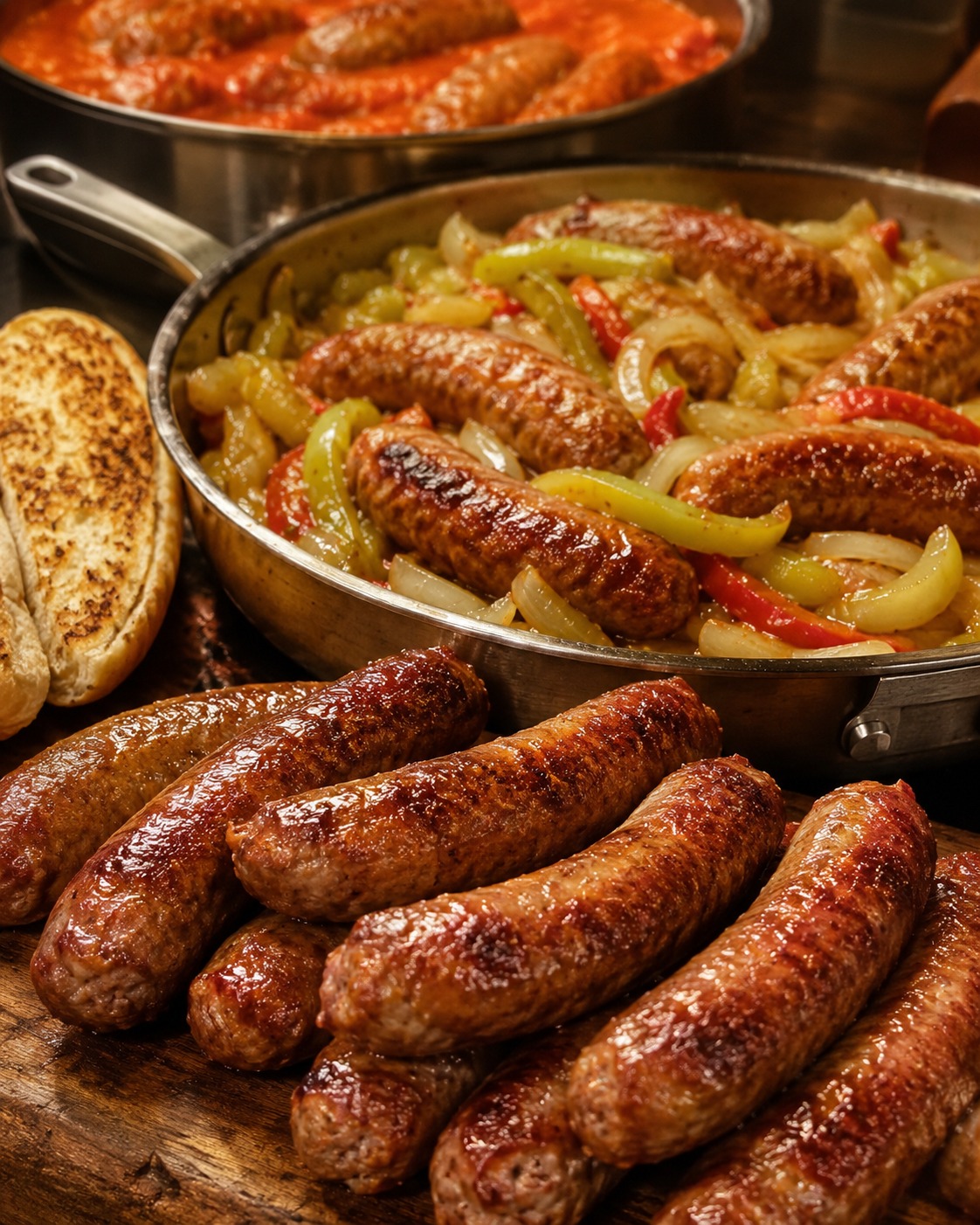
You made the sausage. You fried it in olive oil until the outside was crisp and deeply browned. You added a little water, covered the pan, and cooked it through.
And then that batch could go almost anywhere.
Some links went into Sunday Sauce about thirty minutes before dinner.
Some got eaten exactly as they were, six inches of hot sausage on a plate, because apparently self-control is not one of the ingredients.
Some were saved for Mariuch’s sausage and peppers, which could become the grinder everybody talked about.
And if there was somehow any sausage left the next morning, it got sliced into an Italian omelet.
That was not some grand lesson about thrift.
That was simply how we cooked.
Nothing got treated like a single-use ingredient. One good batch became dinner, another dinner, maybe breakfast, maybe lunch, maybe somebody standing at the refrigerator eating a cold piece before anybody else noticed.
The food moved with the family.
So did the recipe.
From a great-great-grandmother whose name we lost, to Mariuch, to Reek-ee, to a frying pan, to Sunday Sauce, to peppers and onions, to a grinder, to breakfast the next morning.
I am grateful the sausage kept going.
I wish we could thank her by name.
YIELD About 5 pounds |
LINKS Roughly 15–18 |
STYLE Hot Italian |
|---|
Ingredients
| • 5 pounds well-marbled pork shoulder or pork butt, cut into 1-inch cubes and very cold | • 10 large garlic cloves, finely chopped or grated |
|---|---|
| • 1.6 ounces kosher salt | • 2 tablespoons finely chopped fresh Italian parsley |
| • 4 tablespoons whole fennel seeds, lightly toasted and coarsely crushed | • 1 tablespoon finely chopped fresh basil |
| • 2 tablespoons ground fennel seed | • 2 teaspoons dried marjoram |
| • 2 tablespoons freshly ground black pepper | • ½ teaspoon freshly grated nutmeg |
| • 2 tablespoons crushed hot red-pepper flakes | • ¾ cup ice-cold dry red wine |
| • 1 tablespoon hot Calabrian chile flakes, or additional crushed red-pepper flakes | • ¼ cup ice water |
| • 2 tablespoons real Hungarian sweet paprika | • 2 tablespoons excellent extra-virgin olive oil |
| • 2 tablespoons real Hungarian hot paprika | • Natural hog casings, soaked and thoroughly rinsed |
No coriander. Mariuch never used it.
THE METHOD / MAKE THE SAUSAGE
1. Get everything cold.
Put the cubed pork into the freezer for about 20–30 minutes. It should be very cold and firm around the edges but not frozen solid.
Chill the grinder parts too.
Cold meat grinds cleanly. Warm meat smears.
2. Season the pork.
Combine the kosher salt, whole and ground fennel, black pepper, red-pepper flakes, Calabrian chile, both Hungarian paprikas, garlic, parsley, basil, marjoram, and nutmeg.
Scatter the seasoning over the cold pork and mix thoroughly with your hands.
3. Grind it.
Grind the pork through a ¼-inch plate.
For a slightly more rustic sausage, grind most of it through the medium plate and a smaller portion through a larger plate.
4. Add the wine.
Mix the cold red wine, ice water, and olive oil.
Pour it over the ground meat.
Mix firmly with your hands for 1–2 minutes until the meat becomes sticky and tacky and begins holding together.
That is what you want.
5. Fry one first.
Before stuffing anything, fry a small test patty in olive oil.
Eat it.
Taste for salt, fennel, garlic, paprika, pepper, and heat.
If it needs something, fix it now.
More fennel? Add it.
More garlic? Add it.
More heat? Add it.
There is no prize for discovering the sausage needed more seasoning after you have already stuffed twenty links.
6. Let it rest.
Cover and refrigerate the sausage mixture for at least 4 hours, preferably overnight.
7. Stuff the sausage.
Stuff the mixture into the prepared natural hog casings.
Do not pack them so tightly that the casings burst.
Twist into links about 6 inches long.
Prick only obvious air pockets.
8. Let the links settle.
Arrange the sausage on a rack and refrigerate uncovered for several hours or overnight.
OR BE LAZY
You do not have to make the sausage.
Go to a real Italian market and buy good hot Italian sausage.
That is not cheating.
That is being lazy.
Lazy Mary, get up out of bed!
Then proceed exactly the same way.
COOK THE SAUSAGE FIRST
Coat a large skillet generously with excellent olive oil.
Add the sausage and fry over medium heat until the casings develop a deep, crisp brown exterior.
Do not settle for pale sausage.
Once the links are beautifully browned, add about 1 cup water to the pan.
Cover and cook until the sausage is completely cooked through.
Remove the sausage.
Do not clean the pan.
Everything left behind belongs to whatever comes next.
NOW YOU HAVE OPTIONS
This is the whole point.
One batch of sausage does not have to become one meal.
OPTION ONE / INTO THE SUNDAY SAUCE
Take as many cooked sausage links as you want and add them to Mariuch’s Sunday Sauce about 30 minutes before serving.
Let them finish there gently.
The sauce gets the browned pork, fennel, garlic, chile, and paprika.
The sausage gets the sauce.
Everybody wins.
OPTION TWO / EAT THE SAUSAGE
Put a six-inch link on a plate.
Eat it.
There is no requirement that everything become another recipe.
Sometimes sausage is dinner.
THE MAIN EVENT
Peperoni Ripieni (Stuffed Peppers)
Bell peppers stuffed with beef, rice, and cheese • Serves 8 • About 1½ hours
At Italian Express, customers would point to a stuffed pepper and ask whether it came with anything else. Then they saw the size of it. Big bell peppers packed with seasoned beef, rice, and Locatelli, then baked in Sunday sauce until soft and sweet. It is a whole dinner in one pepper, and it was always one of the first things to sell out.
Ingredients
| • 8 large bell peppers, any color | • 1½ pounds ground beef |
|---|---|
| • 1 cup cooked white rice | • 1 small onion, finely chopped |
| • 3 garlic cloves, minced | • 2 eggs |
| • ¾ cup grated Locatelli Pecorino Romano | • ½ cup Italian breadcrumbs |
| • ¼ cup chopped fresh parsley | • 1 teaspoon kosher salt |
| • ½ teaspoon black pepper | • 4 cups Mariuch’s Sunday Sauce or Marinara |
| • 1 cup shredded mozzarella | • 2 tablespoons olive oil |
THE METHOD
1. Get the oven ready.
Heat the oven to 375°F. Spread 2 cups of sauce in the bottom of a 9 × 13-inch baking dish.
2. Prep the peppers.
Cut the tops off the peppers and scoop out the seeds and ribs. Stand them up in the dish. Trim a sliver off the bottom if one wants to tip over.
3. Make the filling.
Mix the beef, rice, onion, garlic, eggs, Locatelli, breadcrumbs, parsley, salt, and pepper with your hands until just combined.
4. Stuff them.
Pack the filling into the peppers, mounding it a little on top. Spoon the rest of the sauce over and around them, and drizzle with olive oil.
5. Bake covered, then uncovered.
Cover with foil and bake 50 minutes. Uncover, top each pepper with mozzarella, and bake 15 to 20 minutes more, until the cheese is bubbling and the filling reaches 160°F.
6. Let them rest.
Give them 10 minutes before serving, with plenty of sauce spooned over each one.
MARIUCH SAYS
A pepper is just a bowl you can eat. Fill it like you mean it.
REEK-EE SAYS: Cook the rice the day before. Cold rice holds the filling. Warm rice holds a grudge. |
|---|
THE MAIN EVENT
Melanzane Ripiene (Stuffed Eggplant)
Eggplant boats filled with their own insides, cheese, and sauce • Serves 8 • About 1¼ hours
I reached for the garbage bowl with the scooped-out eggplant in my hand. Mariuch slid the frying pan toward me instead. Eggplant halves scooped out, filled with the chopped eggplant cooked with garlic, breadcrumbs, and Locatelli, then baked in sauce. It is the Southern Italian way of using every bit of the vegetable and making it taste like a feast.
Ingredients
| • 4 medium eggplants | • ⅓ cup olive oil, plus more for brushing |
|---|---|
| • 1 small onion, finely chopped | • 4 garlic cloves, minced |
| • 1 cup Italian breadcrumbs | • 1 cup grated Locatelli Pecorino Romano |
| • 2 eggs, beaten | • ¼ cup chopped fresh basil |
| • ¼ cup chopped fresh parsley | • 1 teaspoon kosher salt |
| • ½ teaspoon black pepper | • 3 cups Mariuch’s Marinara |
| • 1½ cups shredded mozzarella |
THE METHOD
1. Hollow the boats.
Heat the oven to 400°F. Halve the eggplants lengthwise. Scoop out the flesh, leaving a ½-inch wall. Chop the flesh into small pieces.
2. Soften the shells.
Brush the shells with oil, sprinkle with salt, and roast cut side up on a sheet pan for 15 minutes.
3. Cook the filling.
Warm the oil in a large skillet. Cook the onion 5 minutes, add the garlic and chopped eggplant, and cook 10 minutes, until soft. Let it cool a few minutes.
4. Finish the filling.
Stir in the breadcrumbs, Locatelli, eggs, basil, parsley, salt, and pepper.
5. Fill and bake.
Spread 2 cups of sauce in a baking dish. Set the shells in it, pack in the filling, and spoon the rest of the sauce on top. Lower the oven to 375°F and bake 25 minutes.
6. Top and finish.
Add the mozzarella and bake 10 minutes more, until bubbling. Rest 10 minutes before serving.
MARIUCH SAYS
You don’t throw away the inside of the eggplant. You don’t throw away anything. I lived through things.
REEK-EE SAYS: Pick the eggplant that feels heavy and shiny, with a green stem. If it's soft and dull, put it back. It's had a longer week than you have. |
|---|
Osso Buco
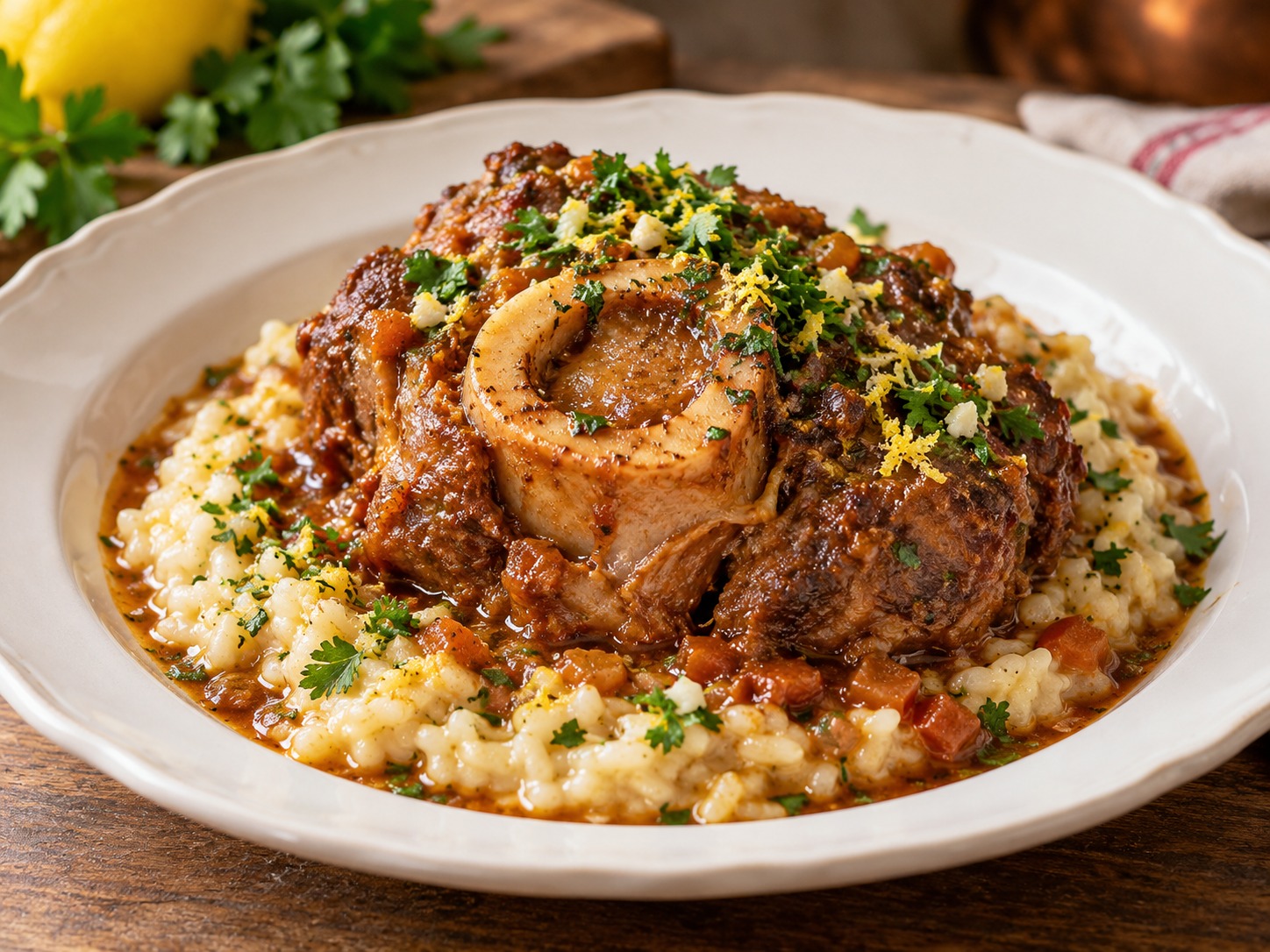
THE MAIN EVENT
Braised veal shanks with gremolata • Serves 6 • About 3 hours
The first time I served osso buco, I forgot the little spoons. Mariuch sent me back to the kitchen before she touched her plate. Thick veal shanks braised slowly in wine, tomato, and vegetables until the meat falls off the bone, then finished with a bright sprinkle of lemon, garlic, and parsley. The marrow in the center of the bone is the prize, and somebody always fights for it.
Ingredients
| • 6 veal shanks, about 1½ inches thick | • Kosher salt and black pepper |
|---|---|
| • ½ cup all-purpose flour | • ¼ cup olive oil |
| • 2 tablespoons butter | • 1 onion, chopped |
| • 2 carrots, chopped | • 2 celery ribs, chopped |
| • 4 garlic cloves, minced | • 2 tablespoons tomato paste |
| • 1 cup dry white wine | • 1 can (14 ounces) San Marzano tomatoes, crushed by hand |
| • 2 cups chicken broth | • 2 bay leaves |
| • Gremolata: zest of 1 lemon, 1 garlic clove, minced, and ¼ cup chopped parsley |
THE METHOD
1. Tie and season.
Tie kitchen string around the middle of each shank so it holds its shape. Season with salt and pepper and dust with flour.
2. Brown the shanks.
Heat the oil and butter in a large Dutch oven. Brown the shanks well on both sides, in batches, about 5 minutes per side. Set aside.
3. Build the base.
Cook the onion, carrots, and celery 8 minutes, until soft. Add the garlic and tomato paste and stir 1 minute. Pour in the wine and scrape up every brown bit.
4. Braise low and slow.
Add the tomatoes, broth, and bay leaves. Return the shanks in one layer. Cover and braise in a 325°F oven for 2 to 2½ hours, until the meat is falling off the bone.
5. Make the gremolata.
Mix the lemon zest, garlic, and parsley.
6. Serve it.
Snip off the strings. Serve each shank with plenty of sauce and a sprinkle of gremolata, over polenta or risotto.
MARIUCH SAYS
Give everybody a little spoon for the marrow. And if they don’t want it, give it to me.
REEK-EE SAYS: The string is not decoration. It is the only thing standing between you and osso buco hash. |
|---|
Branzino all’Acqua Pazza (Branzino in Crazy Water)
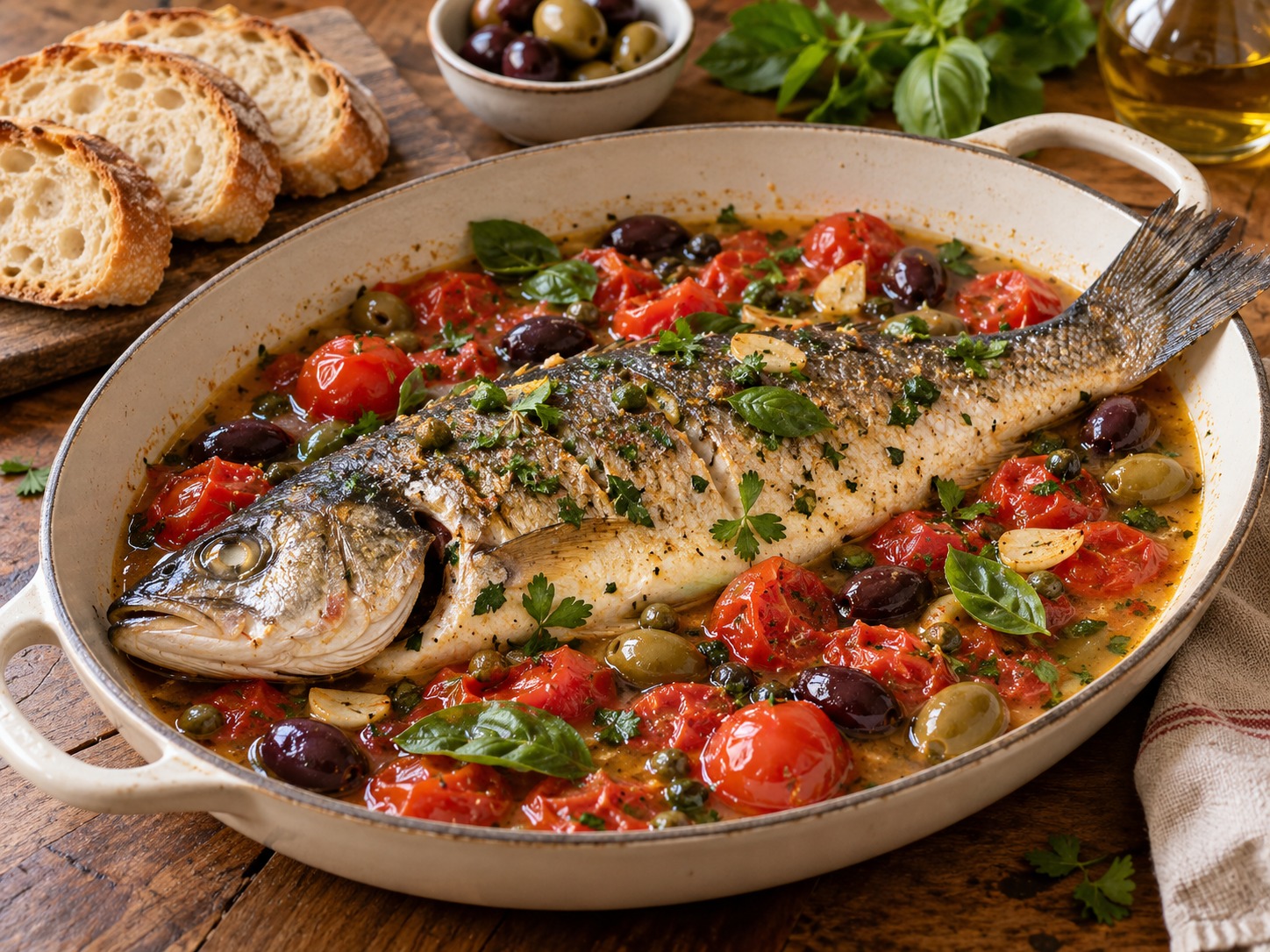
THE MAIN EVENT
Whole fish poached in tomatoes, garlic, and white wine • Serves 4 • About 40 minutes
I brought the branzino to the table expecting questions about the bones. What everybody wanted was another piece of bread for the broth. Acqua pazza means crazy water, the old fishermen’s broth of tomatoes, garlic, wine, and herbs. A whole branzino poaches right in it, and the broth becomes the best sauce you ever dipped bread into. It looks like a restaurant dish and takes forty minutes.
Ingredients
| • 2 whole branzino, about 1½ pounds each, cleaned and scaled | • Kosher salt and black pepper |
|---|---|
| • 4 sprigs fresh parsley | • 1 lemon, thinly sliced |
| • ¼ cup olive oil | • 4 garlic cloves, sliced |
| • Pinch of red-pepper flakes | • 1 pint cherry tomatoes, halved |
| • ½ cup dry white wine | • 1 cup water |
| • 2 tablespoons capers, rinsed | • ¼ cup black olives, pitted |
| • Fresh basil and parsley, torn | • Crusty bread for serving |
THE METHOD
1. Prep the fish.
Pat the fish dry inside and out. Season the cavities with salt and pepper and stuff each with parsley sprigs and lemon slices.
2. Start the crazy water.
In a pan wide enough for both fish, warm the oil with the garlic and pepper flakes until the garlic is pale gold.
3. Add the tomatoes.
Add the tomatoes and cook 3 minutes, until they start to burst. Add the wine, water, capers, and olives and bring to a simmer.
4. Poach the fish.
Lay the fish in the pan. Cover and simmer gently 10 minutes. Carefully turn them, cover, and cook 8 to 10 minutes more, until the flesh flakes easily at the thickest part.
5. Serve it in the pan.
Scatter fresh basil and parsley on top and bring the whole pan to the table with plenty of bread.
MARIUCH SAYS
A fish should look at you from the plate. That’s how you know it was honest.
REEK-EE SAYS: Let the fish market clean and scale it. They have the knives, the sink, and the patience. You have a nice shirt on. Ask them to show you how to lift the fillets off the bones, too. |
|---|
Costoletta di Vitello alla Milanese (Bone-In Veal Chop Milanese)
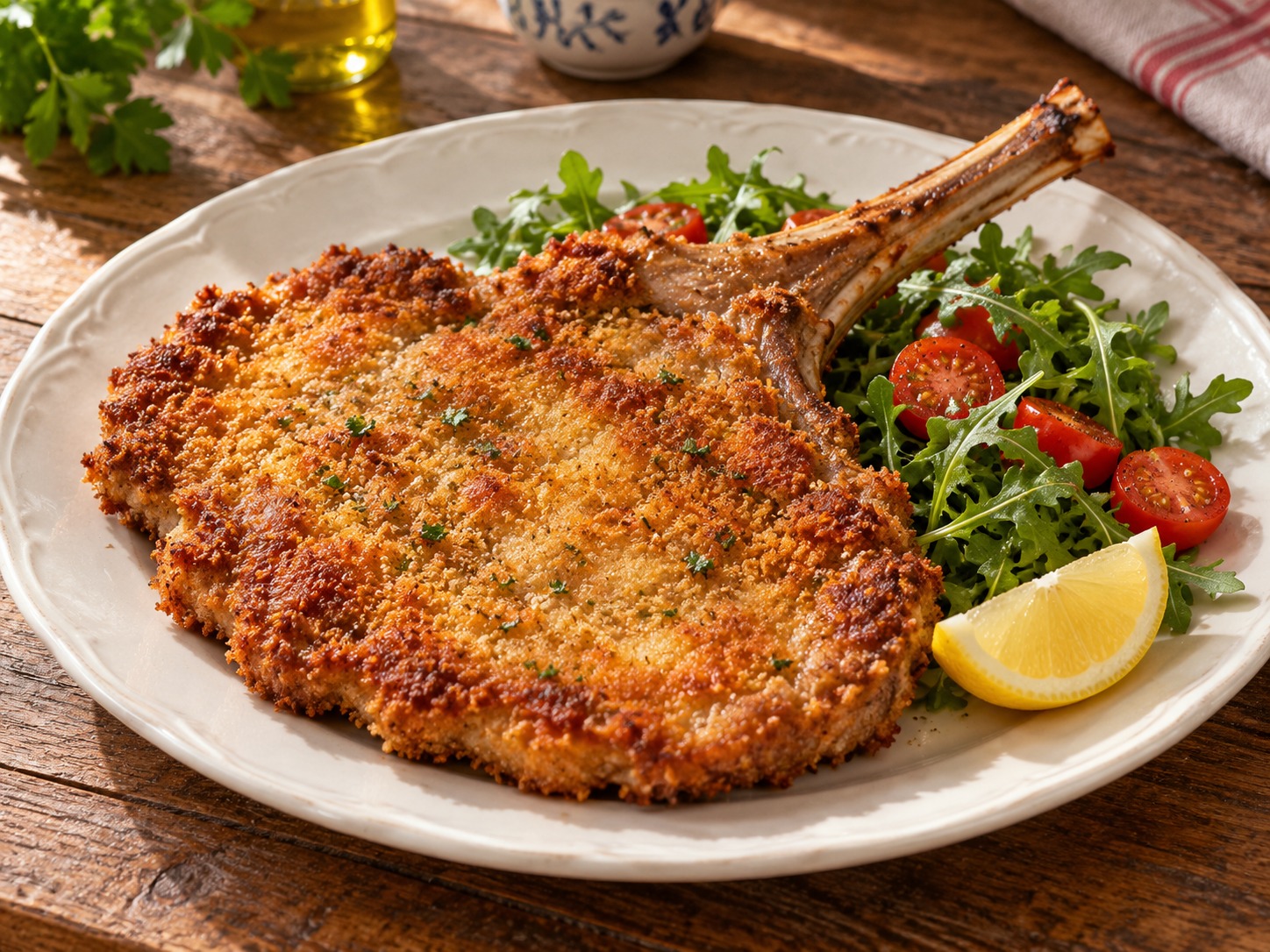
THE MAIN EVENT
Pounded veal chop, breaded and fried golden • Serves 4 • About 45 minutes
Every time I carried this chop through the dining room, somebody at another table stopped me to ask what it was. A thick bone-in veal chop, pounded thin around the bone, breaded, and fried in butter until it is golden and as big as the plate. It is topped with a pile of arugula, tomatoes, and lemon. When this came out of the kitchen, the whole room turned around to look.
Ingredients
| • 4 bone-in veal rib chops, about 1 inch thick | • Kosher salt and black pepper |
|---|---|
| • 1 cup all-purpose flour | • 3 eggs |
| • 2 cups plain breadcrumbs | • ½ cup grated Locatelli Pecorino Romano |
| • ½ cup olive oil | • 6 tablespoons butter |
| • 4 cups baby arugula | • 1 cup cherry tomatoes, halved |
| • 2 lemons, cut in wedges | • Extra olive oil for dressing |
THE METHOD
1. Pound the chops.
Lay each chop between two sheets of plastic wrap. Pound the meat, not the bone, until it is about ¼ inch thick and spreads out like a fan.
2. Set up three plates.
Flour in the first. Eggs beaten with a pinch of salt in the second. Breadcrumbs mixed with the Locatelli in the third.
3. Bread them.
Season the chops, then coat each one in flour, then egg, then breadcrumbs, pressing so the crumbs stick.
4. Fry them golden.
Heat 2 tablespoons oil and 1½ tablespoons butter in a large skillet over medium heat. Fry one chop at a time, 3 to 4 minutes per side, until deep golden and cooked through to 145°F. Drain on a rack and keep warm in a 200°F oven. Add fresh oil and butter for each chop.
5. Top and serve.
Toss the arugula and tomatoes with a little oil, lemon juice, and salt. Pile it on top of each chop and serve with lemon wedges.
MARIUCH SAYS
Pound it thin so it covers the plate. Then they think they got more.
REEK-EE SAYS: Fresh butter for every chop. Reusing the butter is how you save a dime and ruin the most expensive thing in the pan. |
|---|
THE MAIN EVENT
Cotolette di Pollo (Chicken Cutlets)
Crisp skillet-fried chicken tenderloins • Serves 6 • About 45 minutes
When Mariuch fried cutlets, I found reasons to stay in the kitchen. Setting the table could wait until I had claimed one of the small pieces. These are the cutlets before they become chicken Parmigiana: thin chicken, a seasoned breadcrumb crust, and a skillet of hot oil. Serve them with lemon, a salad, and good bread. They do not need sauce to earn their place at dinner.
Ingredients
| • 2 pounds chicken tenderloins | • 2 tablespoons finely chopped flat-leaf parsley |
|---|---|
| • 1 cup all-purpose flour | • ½ teaspoon garlic powder |
| • 3 large eggs | • ½ teaspoon kosher salt, plus more to taste |
| • 2 tablespoons water | • ½ teaspoon freshly ground black pepper |
| • 2 cups Italian-style panko | • About 1 cup olive oil suitable for frying, adding more as needed |
| • ½ cup freshly grated Locatelli Pecorino Romano | • 2 lemons, cut into wedges |
THE METHOD
1. Prepare the tenderloins.
Trim any tough tendons, pat the chicken dry, and gently flatten thicker pieces for even cooking. Season lightly with salt and pepper.
2. Set up the breading.
Put the flour in one shallow dish. Beat the eggs with the water in a second. In a third, combine the Italian-style panko, Locatelli, parsley, garlic powder, ½ teaspoon salt, and ½ teaspoon pepper.
3. Bread the chicken.
Coat each tenderloin lightly with flour and shake off the excess. Dip it in the egg, letting the extra drip back into the dish, then press it into the panko mixture on both sides. Set the breaded tenderloins on a tray and let them stand for about 10 minutes while you prepare the skillet.
4. Heat the oil.
Pour enough oil into a large, heavy skillet to reach about ¼ inch up the sides. Heat over medium heat to about 350°F. Set a wire rack over a sheet pan beside the stove.
5. Fry in batches.
Lay a few tenderloins in the skillet, leaving space between them. Fry until golden on both sides, turning once and checking the thickest part with a thermometer. Remove when it reaches 160°F.
Between batches, remove loose crumbs with a slotted spoon. Add oil as needed and let it return to temperature before adding more chicken. Replace the oil if it becomes dark or smells burnt.
6. Rest and serve.
Rest the chicken on the wire rack. Check that it reaches 165°F before serving; if it does not, return it to the skillet to finish cooking. Serve with lemon wedges. If you need to hold the first batch briefly, put the rack and sheet pan in a 200°F oven while you finish frying. Keep the chicken uncovered.
MARIUCH SAYS
Pound them evenly. The skinny end should not be finished while the fat end is still thinking about it.
REEK-EE SAYS Cook in batches. Six cutlets in one skillet is a traffic jam with breadcrumbs. |
|---|
Mariuch’s rules
• Pound to an even thickness so the chicken cooks evenly.
• Press the crumbs onto the chicken, then give the coating a few minutes to settle.
• Keep the oil hot enough to fry, but never let it smoke.
• Check that the chicken reaches 165°F before serving. Crust color does not tell you what is happening inside.
• Drain on a rack and serve uncovered to preserve the crisp crust.
One-trip shopping list
| □ Meat: 2 pounds chicken tenderloins | □ Pantry: all-purpose flour, Italian-style panko, garlic powder, kosher salt, black pepper |
|---|---|
| □ Produce: flat-leaf parsley, 2 lemons | □ Oil: olive oil suitable for frying |
| □ Dairy and eggs: Locatelli Pecorino Romano, 3 eggs |
MARIUCH’S RULE
Have the table ready before the last cutlet leaves the skillet.
| REEK-EE APPROVED RECIPE • SAVE A SMALL ONE FOR THE COOK. |
|---|
THE MAIN EVENT
Pollo Marsala (Chicken Marsala)
Thin chicken cutlets in a mushroom and Marsala wine sauce • Serves 6 • About 40 minutes
On busy nights, the smell of Marsala reached the counter before the plate did. By then, somebody waiting for a grinder usually wanted to know what was cooking. Tender chicken cutlets in a glossy sauce of mushrooms, butter, and dry Marsala wine. It was one of the most ordered dinners at Italian Express, and it is quicker than most people think.
Ingredients
| • 2 pounds boneless chicken breasts | • Kosher salt and black pepper |
|---|---|
| • ½ cup all-purpose flour | • 3 tablespoons olive oil |
| • 4 tablespoons butter, divided | • 1 pound cremini mushrooms, sliced |
| • 2 garlic cloves, minced | • 1 cup dry Marsala wine |
| • ¾ cup chicken broth | • ¼ cup heavy cream (optional) |
| • 2 tablespoons chopped parsley |
THE METHOD
1. Make cutlets.
Slice each breast in half the long way, then pound to an even ¼ inch thick. Season with salt and pepper and dredge in flour.
2. Brown the chicken.
Heat the oil and 1 tablespoon butter in a large skillet. Brown the cutlets 2 to 3 minutes per side, until golden and cooked through to 165°F. Set aside.
3. Cook the mushrooms.
Add 1 tablespoon butter and the mushrooms. Cook without stirring for 3 minutes, then stir and cook until browned. Add the garlic for 1 minute.
4. Make the sauce.
Pour in the Marsala and scrape up the brown bits. Let it bubble 2 minutes. Add the broth and simmer until reduced by about half. Stir in the cream if using.
5. Finish.
Swirl in the last 2 tablespoons of butter. Return the chicken and spoon the sauce over until glossy. Top with parsley.
MARIUCH SAYS
Buy the Marsala you would drink. If you wouldn’t drink it, don’t feed it to the chicken.
REEK-EE SAYS: Leave the mushrooms alone for three minutes. Don't stir. Don't poke. Don't check on them. For an Italian, this is the hardest step in the book. |
|---|
THE MAIN EVENT
Pollo Piccata (Chicken Piccata)
Chicken cutlets in a lemon, butter, and caper sauce • Serves 6 • About 30 minutes
Piccata was one of the dinners I could make while still unwinding from work, with my sleeves rolled up and the lemon already cut beside the stove. Thin, golden chicken cutlets in a bright sauce of lemon, butter, white wine, and capers. It is sharp, light, and fast, the dinner you make when you want something good in half an hour.
Ingredients
| • 2 pounds boneless chicken breasts | • Kosher salt and black pepper |
|---|---|
| • ½ cup all-purpose flour | • 3 tablespoons olive oil |
| • 5 tablespoons butter, divided | • 2 garlic cloves, minced |
| • ½ cup dry white wine | • ¾ cup chicken broth |
| • ⅓ cup fresh lemon juice | • 3 tablespoons capers, rinsed |
| • 2 tablespoons chopped parsley | • 1 lemon, thinly sliced |
THE METHOD
1. Make cutlets.
Slice each breast in half the long way and pound to ¼ inch thick. Season and dredge in flour.
2. Brown the chicken.
Heat the oil and 1 tablespoon butter. Brown the cutlets 2 to 3 minutes per side, cooked through to 165°F. Set aside.
3. Start the sauce.
Add the garlic for 30 seconds. Pour in the wine and scrape the pan. Add the broth, lemon juice, and capers, and simmer 4 to 5 minutes, until reduced by about a third.
4. Make it silky.
Off the heat, swirl in the remaining 4 tablespoons of butter until the sauce turns glossy.
5. Finish.
Return the chicken, spoon the sauce over, and top with lemon slices and parsley.
MARIUCH SAYS
Squeeze real lemons. That little plastic lemon in the refrigerator is not a lemon. It is a liar.
REEK-EE SAYS: The butter goes in off the heat. A boiling pan breaks the sauce, and a broken piccata sauce is just lemony grease with ambitions. |
|---|
Mariuch’s Linguine alle Vongole
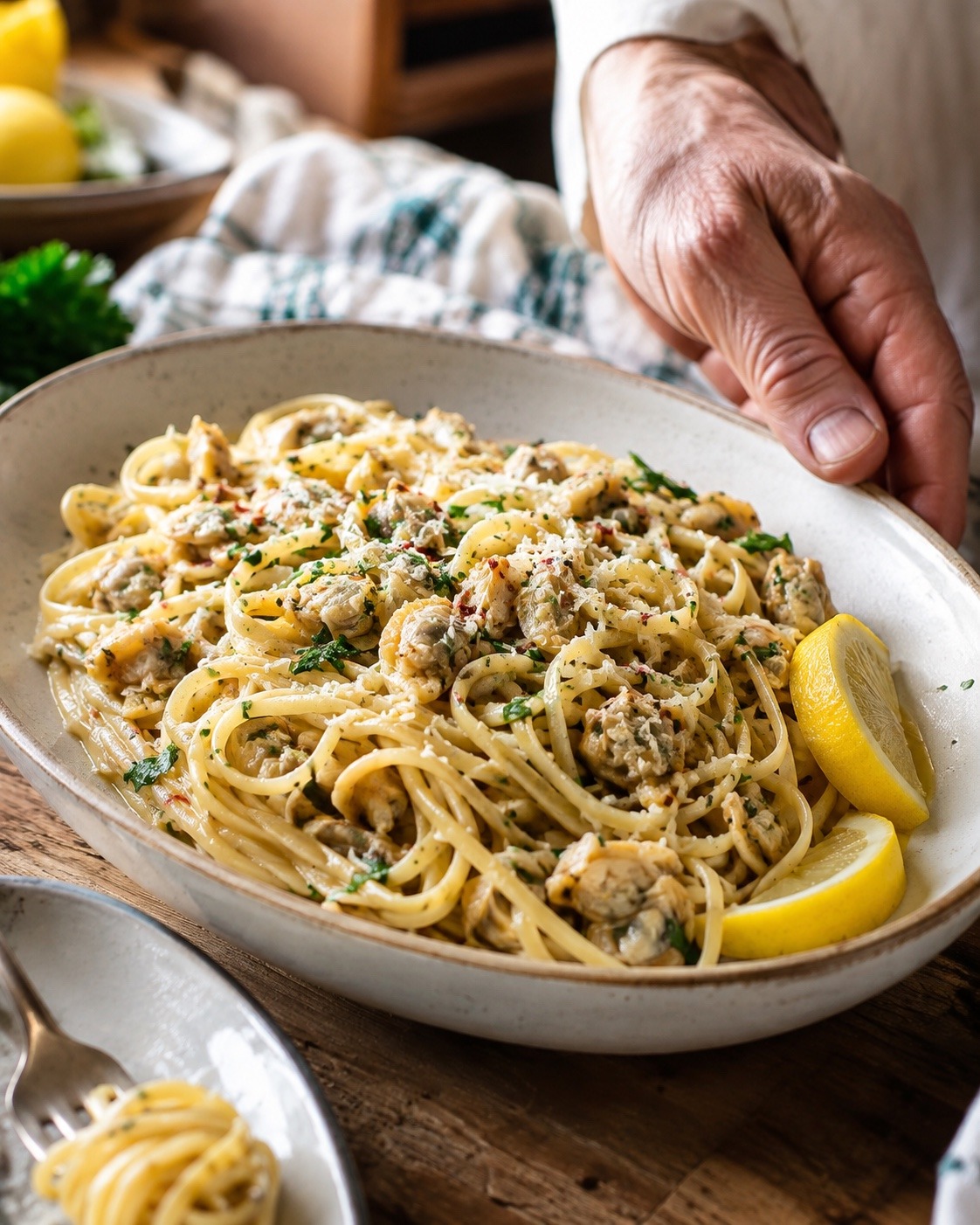
Linguine with Fresh Clams • Serves 6–8
Mariuch’s linguine with clams is one of those recipes that never comes out exactly the same twice, and that is part of what makes it right. Fresh clams get steamed, chopped, and folded into a sauce of olive oil, garlic, white wine, clam juice, butter, a little lemon, red pepper flakes, parsley, and Locatelli Pecorino Romano, then everything gets tossed with linguine until the pasta is glossy and coated. Some days it wants more heat, some days more lemon, maybe another splash of clam juice or another handful of Locatelli Pecorino Romano. You taste it, you adjust it, and when the skillet tells you it’s right, you stop.
| SERVES 6–8 people |
STYLE Fresh clams • skillet-finished |
|---|
Ingredients
| • 2 pounds linguine | • 2 tablespoons butter |
|---|---|
| • 4 dozen littleneck clams, scrubbed very well | • ½ cup chopped fresh flat-leaf parsley, plus more for garnish |
| • ½ cup excellent extra-virgin olive oil | • Kosher salt, as needed |
| • 8–10 garlic cloves, thinly sliced or roughly chopped | • Freshly ground black pepper |
| • ½ teaspoon crushed red pepper flakes, or more to taste | • Reserved pasta water |
| • 1 cup dry white wine | • Fresh lemon wedges, for serving |
| • 1 cup clam juice | • Freshly grated Locatelli Pecorino Romano, for finishing |
THE METHOD
Let the skillet tell you when it’s right.
1. Steam the clams.
Place the cleaned clams in a large covered pot with enough water to create steam. Cook just until the shells open.
Remove the clams from their shells and chop the clam meat into small pieces. Set aside.
Discard any clams that do not open.
2. Cook the linguine.
Bring a large pot of well-salted water to a boil. Cook the linguine until just shy of al dente.
Before draining, reserve about 2 cups of pasta water.
3. Build the garlic base.
Heat the olive oil in a large skillet or wide pot over medium-low heat.
Add the garlic and crushed red pepper flakes.
Cook gently until the garlic is fragrant and golden.
Never brown the garlic.
4. Add the wine and clam juice.
Pour in the white wine and bring it to a simmer.
Add the clam juice and allow the mixture to reduce slightly so the flavors concentrate.
5. Finish the sauce.
Add the butter and swirl it into the clam broth until the sauce becomes glossy.
Add the chopped clams and warm them gently. Do not cook them aggressively or they will become tough.
6. Finish the linguine in the sauce.
Add the linguine directly to the pan.
Toss everything together over medium heat, adding reserved pasta water as needed until the sauce coats the pasta beautifully.
Add the chopped parsley and freshly ground black pepper.
Taste and adjust the salt only if necessary—the clams and clam juice already bring plenty.
7. Serve it Mariuch’s way.
Pile the linguine into a large serving bowl.
Garnish generously with fresh parsley.
Finish with freshly grated Locatelli Pecorino Romano.
Serve with fresh lemon wedges alongside so everybody can squeeze lemon over their own plate.
Mariuch’s Rules
• Fresh clams first. Steam them, shell them, and chop them small.
• Use the clam juice.
• Use the white wine.
• Use the butter.
• The lemon is not optional.
• And finish it with parsley and Locatelli Pecorino Romano.
MARIUCH’S RULE This is the way we make it. But we make it a little different every time. Taste it. Adjust it. Some days it wants more garlic, more lemon, more heat, more butter, or another splash of clam juice. The skillet will tell you when it’s right. |
|---|
PASTA
Ravioli di Carne o Formaggio (Meat or Cheese Ravioli)
Fresh egg pasta pillows, two fillings • Makes about 48 ravioli, serves 8 • About 2 hours
You could tell which ravioli were mine without asking. Mariuch’s were lined up neatly; mine looked as though they had been through something. Homemade ravioli, filled either with seasoned beef and pork or with creamy ricotta and Locatelli. The dough is the same either way. Make a double batch, freeze half, and you have a Sunday dinner waiting for you on a Tuesday.
Ingredients
| • Pasta dough: 4 cups all-purpose flour (or “00” flour) | • 6 large eggs |
|---|---|
| • 1 tablespoon olive oil | • Pinch of salt |
| • Cheese filling: 2 pounds whole-milk ricotta, drained overnight | • 1 cup grated Locatelli Pecorino Romano |
| • 1 egg | • ¼ cup chopped parsley |
| • Pinch of nutmeg, salt, and pepper | • Meat filling: 1 pound ground beef and pork mix |
| • 1 small onion, minced, and 2 garlic cloves, minced | • ½ cup grated Locatelli Pecorino Romano |
| • 1 egg | • ¼ cup Italian breadcrumbs |
| • Mariuch’s Sunday Sauce or Marinara for serving |
THE METHOD
1. Make the dough.
Mound the flour on the counter and make a well. Add the eggs, oil, and salt. Beat with a fork, pulling in flour, then knead 8 to 10 minutes until smooth. Wrap and rest 30 minutes.
2. Make a filling.
Cheese: mix everything for the cheese filling. Meat: brown the beef and pork with the onion and garlic, cooked through, then cool and mix with the cheese, egg, and breadcrumbs.
3. Roll the sheets.
Divide the dough in four. Roll each piece through a pasta machine to the second-thinnest setting, or by hand until you can almost see your hand through it.
4. Fill and seal.
Drop teaspoons of filling 1½ inches apart on one sheet. Brush around them with water, lay a second sheet on top, and press out the air around each mound. Cut into squares and press the edges with a fork.
5. Cook.
Boil in salted water 3 to 4 minutes, until they float and the edges are tender. Lift out with a slotted spoon, never a colander.
6. Serve.
Spoon sauce over the top and finish with more Locatelli.
MARIUCH SAYS
Press out the air. Air in the ravioli is how it explodes in the pot, and then you’re eating soup.
REEK-EE SAYS: Freeze the extras flat on a floured sheet pan, then bag them. Cook them straight from frozen, allowing about an extra minute. Now you have a homemade dinner on a Tuesday, and you didn't do anything on Tuesday. |
|---|
Ravioli all’Aragosta (Lobster Ravioli)
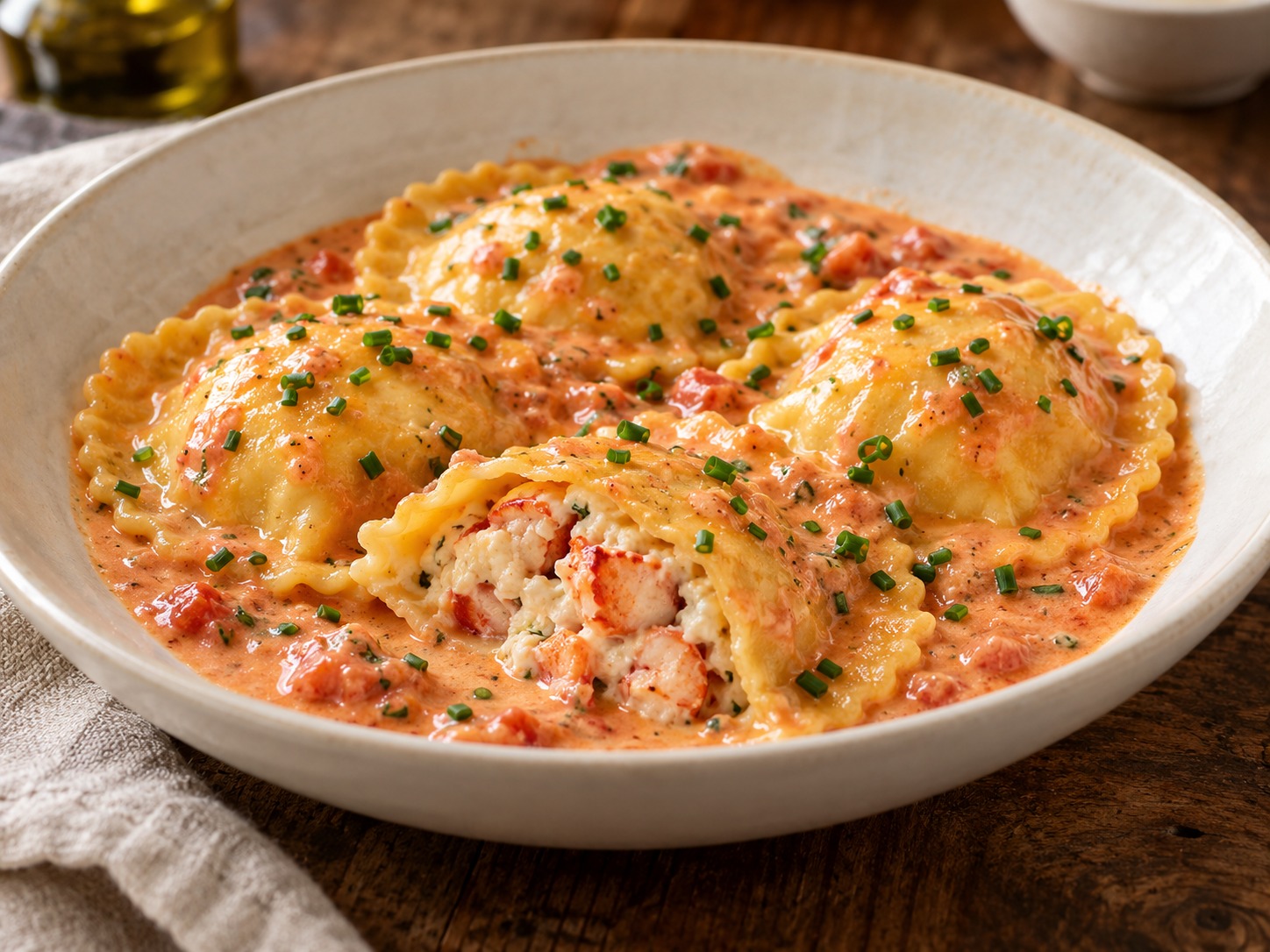
PASTA
Lobster and ricotta ravioli in a pink tomato cream sauce • Serves 6 • About 2 hours
Making lobster ravioli for company taught me to count before I started filling, rather than discover at the table that I had been too generous. Sweet lobster meat folded into ricotta and lemon, sealed in fresh pasta, and served in a light, rosy tomato cream sauce. This is the ravioli for an anniversary, a birthday, or any night that deserves it.
Ingredients
| • 1 batch pasta dough from the Meat or Cheese Ravioli | • 1 pound cooked lobster meat, chopped |
|---|---|
| • 1 cup whole-milk ricotta, drained | • ¼ cup mascarpone |
| • Zest of 1 lemon | • 2 tablespoons chopped chives |
| • Salt and white pepper | • Sauce: 3 tablespoons butter |
| • 1 shallot, minced | • 2 garlic cloves, minced |
| • ¼ cup brandy or dry white wine | • 1 can (14 ounces) San Marzano tomatoes, crushed by hand |
| • ¾ cup heavy cream | • Fresh basil |
THE METHOD
1. Make the dough.
Make and rest the pasta dough as for the meat or cheese ravioli.
2. Make the filling.
Mix the lobster, ricotta, mascarpone, lemon zest, chives, and a pinch of salt and pepper. Chill until ready.
3. Fill and seal.
Roll the sheets thin, add teaspoons of filling, seal, cut, and press the edges just like the other ravioli.
4. Make the sauce.
Melt the butter and cook the shallot and garlic 2 minutes. Add the brandy and let it bubble away. Add the tomatoes and simmer 10 minutes, then stir in the cream and simmer 3 minutes more.
5. Cook and serve.
Boil the ravioli 3 to 4 minutes. Lift them into the sauce, toss gently, and finish with torn basil.
MARIUCH SAYS
No cheese on top. The lobster already paid for itself. Don’t insult it.
REEK-EE SAYS: Buy the lobster meat already cooked. I have nothing against lobsters. I just don't want to look one in the eye on a Wednesday. |
|---|
PASTA
Gemelli con Salsiccia, Broccoli Rabe e Aglio (Gemelli with Sausage, Broccoli Rabe, and Garlic)
Twisted pasta with sausage, bitter greens, and garlic • Serves 8 • About 40 minutes
A customer who always asked us to hold the broccoli rabe tasted it from his wife’s plate one night. The next time, he ordered the dish as we made it. Hot sausage, bitter broccoli rabe, and plenty of garlic tossed with twisted gemelli and Locatelli. Bitter, spicy, and rich all in one forkful. This is the pasta for people who say they don’t like broccoli rabe, right up until they try it.
Ingredients
| • 1½ pounds gemelli pasta | • 2 bunches broccoli rabe, tough ends trimmed |
|---|---|
| • 1½ pounds hot Italian sausage, casings removed (see Mariuch’s Hot Italian Sausage) | • ½ cup olive oil |
| • 6 garlic cloves, sliced | • ½ teaspoon red-pepper flakes |
| • 1 cup chicken broth | • 1 cup grated Locatelli Pecorino Romano |
| • Kosher salt |
THE METHOD
1. Blanch the rabe.
Boil the broccoli rabe in salted water 2 minutes. Lift it out, cool, and chop. Keep the water boiling for the pasta.
2. Brown the sausage.
Warm 2 tablespoons oil in a large skillet. Cook the sausage, breaking it into pieces, until browned and cooked through to 160°F.
3. Garlic and greens.
Add the rest of the oil, the garlic, and the pepper flakes. Cook until the garlic is pale gold, then add the rabe and broth and simmer 5 minutes.
4. Cook the pasta.
Cook the gemelli 1 minute short of the package time. Save 1 cup of pasta water.
5. Toss it all.
Add the pasta to the skillet with half the Locatelli and a splash of pasta water. Toss 2 minutes until glossy. Serve with the rest of the cheese.
MARIUCH SAYS
Bitter is good for you. That’s why the greens are bitter and the sausage is happy.
REEK-EE SAYS: Blanch the broccoli rabe first. Mariuch says bitter is good for you. Blanching is how you get the rest of the table to agree with her. |
|---|
Spaghetti e Polpette (Spaghetti and Meatballs)
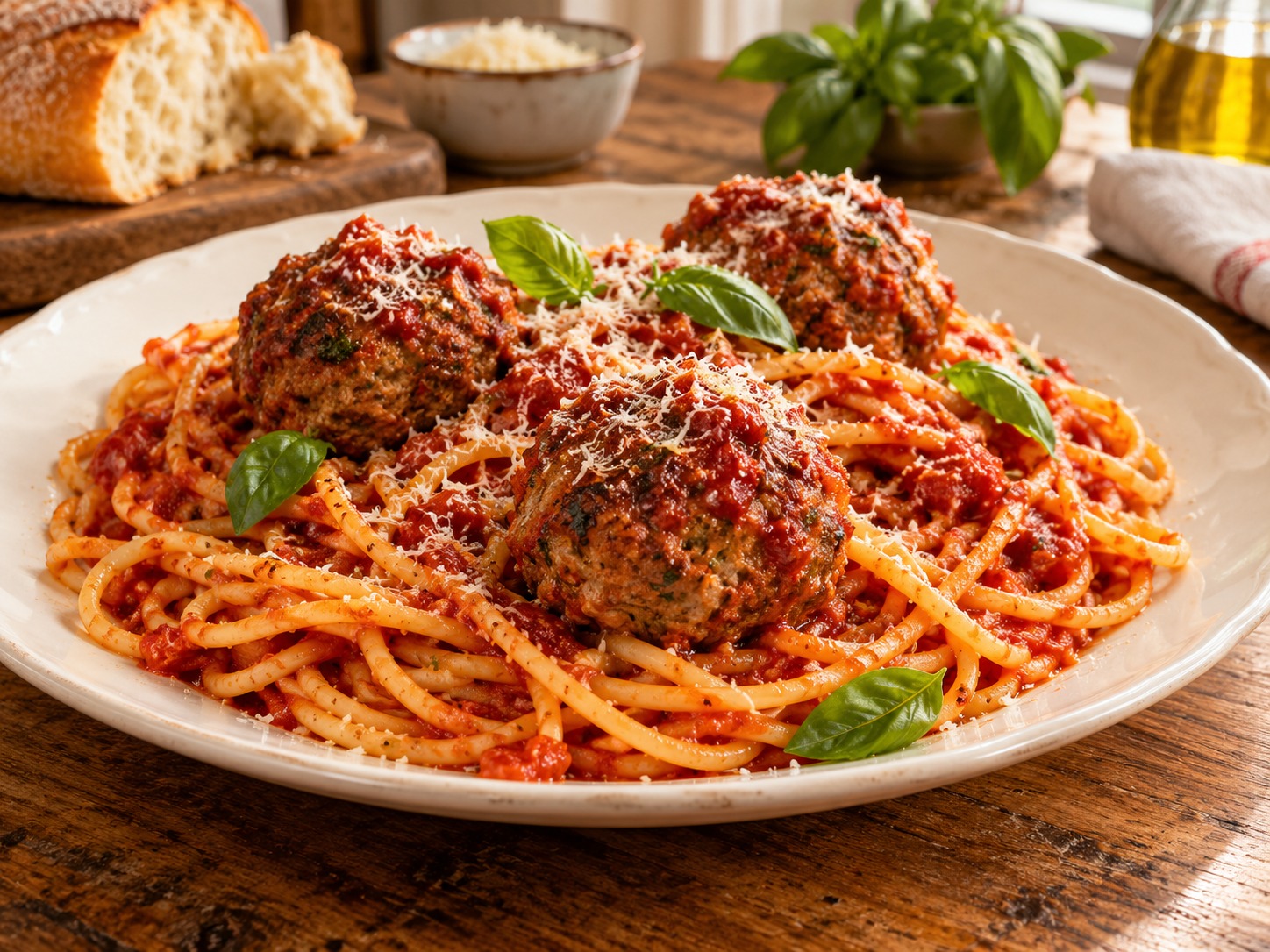
PASTA
Mariuch’s meatballs and Sunday sauce over spaghetti • Serves 8 • About 30 minutes (with sauce and meatballs made)
Sunday dinner had its own soundtrack: forks against the platter, everybody talking at once, and Mariuch asking who had taken the last meatball. This is the dish everybody pictures when they think of an Italian kitchen. It is really two recipes already in this book, Mariuch’s Sunday Sauce and Mariuch’s Meatballs, brought together over a big platter of spaghetti. Make the sauce and meatballs ahead, and dinner is thirty minutes away.
Ingredients
| • 2 pounds spaghetti | • 1 full batch Mariuch’s Meatballs |
|---|---|
| • 8 cups Mariuch’s Sunday Sauce | • Kosher salt for the pasta water |
| • 1½ cups grated Locatelli Pecorino Romano | • Fresh basil |
THE METHOD
1. Warm the meatballs in the sauce.
Bring the Sunday sauce to a gentle simmer. Add the meatballs and let them simmer at least 30 minutes, until heated through to 165°F.
2. Cook the spaghetti.
Boil the spaghetti in well-salted water until 1 minute short of al dente. Save a cup of pasta water.
3. Marry the pasta and sauce.
Drain the spaghetti and toss it in a big pan with 3 or 4 ladles of sauce over the heat for 1 minute, adding pasta water if it looks tight.
4. Build the platter.
Pile the spaghetti on a platter, top with the meatballs and more sauce, and finish with Locatelli and torn basil.
MARIUCH SAYS
The meatballs go in the sauce, not on top of the pasta like a hat. They need time to get to know each other.
REEK-EE SAYS: Toss the pasta with the sauce before it goes on the platter. A ladle of sauce on top of naked spaghetti is a cafeteria move. We toss. |
|---|
PASTA
Pasta al Ragù Veloce (Quick Pasta with Meat Sauce)
A weeknight meat sauce in under an hour • Serves 8 • About 50 minutes
Some nights I came home hungry enough to start the sauce before I opened the mail. The mail could wait; the garlic was already in the pan. Not every night is Sunday. This is the meat sauce for a Wednesday: beef and sausage simmered with tomatoes, garlic, and a splash of red wine, ready in less than an hour and tossed with rigatoni.
Ingredients
| • 2 pounds rigatoni or penne | • 2 tablespoons olive oil |
|---|---|
| • 1 pound ground beef | • ½ pound sweet Italian sausage, casings removed |
| • 1 onion, finely chopped | • 4 garlic cloves, minced |
| • 2 tablespoons tomato paste | • ½ cup dry red wine |
| • 2 cans (28 ounces each) San Marzano tomatoes, crushed by hand | • 1 teaspoon dried oregano |
| • Fresh basil | • Kosher salt and black pepper |
| • 1 cup grated Locatelli Pecorino Romano |
THE METHOD
1. Brown the meat.
Heat the oil in a large pot. Brown the beef and sausage, breaking them up, until cooked through. Spoon off extra fat.
2. Build the base.
Add the onion and cook 5 minutes. Add the garlic and tomato paste and stir 1 minute. Pour in the wine and let it bubble away.
3. Simmer.
Add the tomatoes, oregano, and a pinch of salt. Simmer 30 minutes, stirring now and then. Tear in basil at the end.
4. Cook and toss.
Cook the pasta 1 minute short. Toss it in the sauce with a splash of pasta water and half the Locatelli. Serve with the rest.
MARIUCH SAYS
Quick doesn’t mean careless. It means you started on time.
REEK-EE SAYS: Give the tomato paste one full minute in the pan before the wine. It's the cheapest minute in cooking. It buys you about two and a half hours. |
|---|
PASTA
Pollo e Salsiccia Scarpariello (Chicken and Sausage Scarpariello)
Chicken, sausage, and vinegar peppers in a garlic pan sauce • Serves 6 • About 1 hour
Whenever I put scarpariello on the table, the bread basket emptied before the pasta bowl had made it around. Scarpariello means shoemaker’s style, a dish from people who cooked with whatever was on hand. Chicken and sausage are browned hard, then tossed with garlic, rosemary, and tangy vinegar peppers in a pan sauce you will want to drink. It is served over pasta or with plenty of bread.
Ingredients
| • 2½ pounds bone-in chicken thighs and drumsticks | • 1 pound sweet or hot Italian sausage, cut into 2-inch pieces |
|---|---|
| • Kosher salt and black pepper | • 3 tablespoons olive oil |
| • 1 onion, sliced | • 6 garlic cloves, sliced |
| • 2 sprigs fresh rosemary | • 1 cup sliced hot or sweet vinegar cherry peppers, plus ¼ cup of their liquid |
| • ½ cup dry white wine | • 1 cup chicken broth |
| • 2 tablespoons butter | • ¼ cup chopped parsley |
| • 1 pound penne or crusty bread for serving |
THE METHOD
1. Brown the chicken.
Heat the oven to 425°F. Season the chicken. Brown it skin side down in the oil in a large ovenproof skillet, about 8 minutes, until deep golden. Turn and brown 3 minutes. Set aside.
2. Brown the sausage.
Brown the sausage pieces on all sides in the same pan. Set aside with the chicken.
3. Make the sauce.
Cook the onion 5 minutes. Add the garlic, rosemary, and peppers for 1 minute. Add the wine, pepper liquid, and broth, and scrape up the brown bits.
4. Finish in the oven.
Return the chicken skin side up and the sausage. Roast 20 to 25 minutes, until the chicken reaches 175°F.
5. Finish the sauce.
Swirl the butter into the pan juices, scatter the parsley, and serve over pasta or with bread.
MARIUCH SAYS
This is how the shoemaker ate. He didn’t have much, so he made it taste like a lot.
REEK-EE SAYS: Brown the chicken deep golden. Golden is good. Deep golden is scarpariello. Burnt is a phone call for pizza. |
|---|
PASTA
Gnocchi al Pesto con Pollo (Chicken Pesto Gnocchi)
Potato gnocchi with fresh basil pesto and grilled chicken • Serves 6 • About 40 minutes
I used to bring the basil into the kitchen by the handful, setting it beside the cutting board with the stems still damp. Soft potato gnocchi tossed in bright homemade basil pesto with slices of golden chicken and sweet cherry tomatoes. It is a summer favorite that is good any time of year, and the pesto takes five minutes in a blender.
Ingredients
| • 2 pounds potato gnocchi, fresh or store-bought | • 1½ pounds boneless chicken breasts |
|---|---|
| • 2 tablespoons olive oil | • Kosher salt and black pepper |
| • 1 pint cherry tomatoes, halved | • Pesto: 3 cups packed fresh basil leaves |
| • ⅓ cup pine nuts, toasted | • 2 garlic cloves |
| • ½ cup grated Locatelli Pecorino Romano | • ½ cup extra-virgin olive oil |
| • Squeeze of lemon |
THE METHOD
1. Make the pesto.
Blend the basil, pine nuts, garlic, and Locatelli. With the blender running, pour in the oil until smooth. Add a squeeze of lemon and a pinch of salt.
2. Cook the chicken.
Pound the chicken to an even thickness. Season and sear in the oil 5 to 6 minutes per side, cooked through to 165°F. Rest 5 minutes and slice.
3. Cook the gnocchi.
Boil the gnocchi in salted water just until they float, 2 to 3 minutes. Save ½ cup of the water.
4. Toss.
Toss the gnocchi with the pesto, tomatoes, and a splash of the cooking water until creamy. Top with the sliced chicken and more Locatelli.
MARIUCH SAYS
Pesto never touches the stove. You cook it, it turns brown and sad.
REEK-EE SAYS: Toss the pesto in a bowl, not the hot pan. Pasta water makes it creamy. The burner makes it brown, and you do not want to defend brown pesto to Mariuch. |
|---|
Pollo alla Parmigiana con Pasta (Chicken Parmigiana with Pasta)
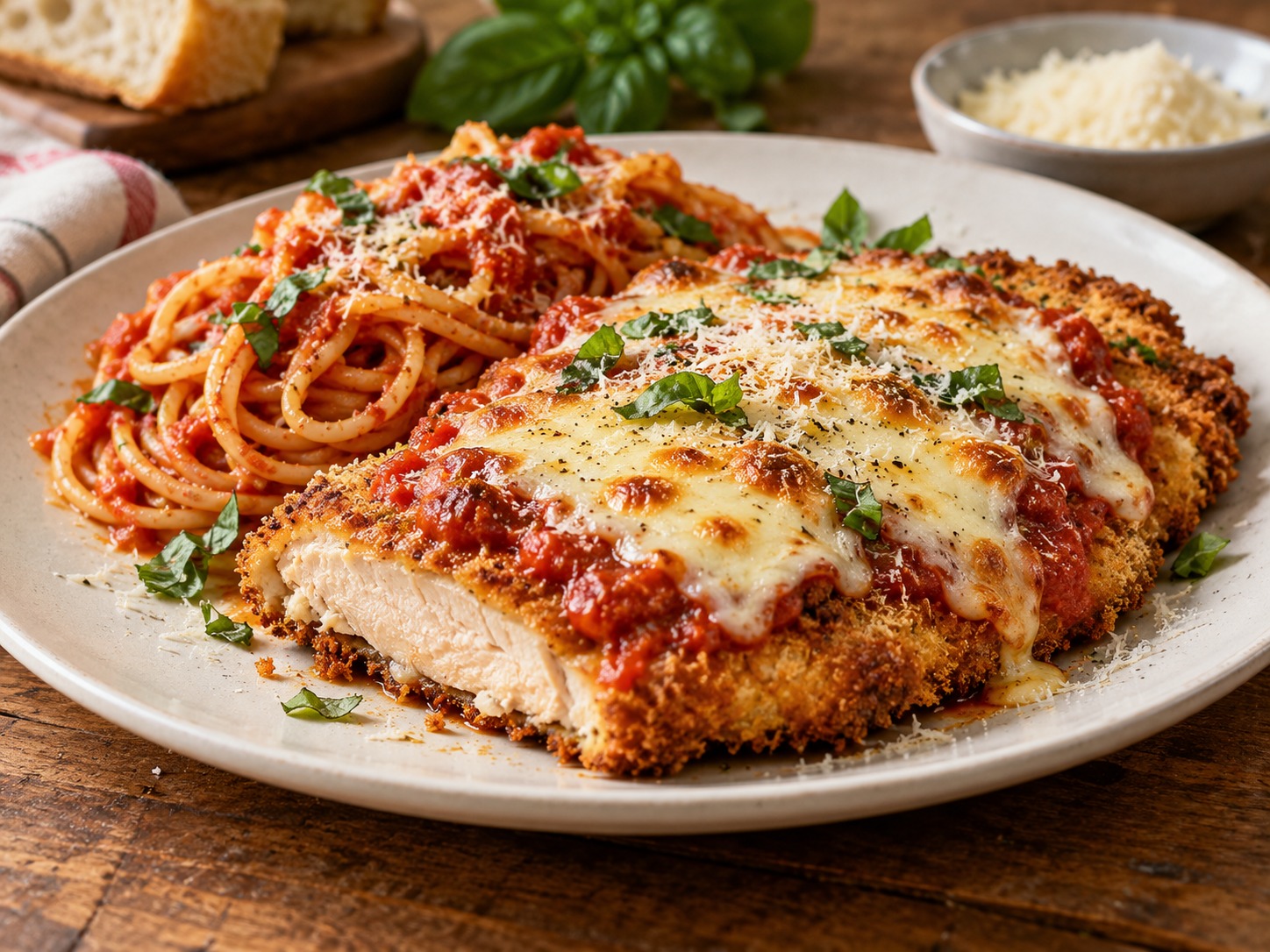
PASTA
Skillet-fried chicken tenderloins baked with sauce and mozzarella • Serves 6 • About 1 hour
During a dinner rush at Italian Express, the next chicken Parm order was often waiting before I had put mozzarella on the one in front of me. Crispy breaded chicken cutlets layered with Sunday sauce, melted mozzarella, and Locatelli, baked until bubbling and served beside a pile of spaghetti. This was one of the biggest sellers Italian Express ever had, and it never once came back to the kitchen.
Ingredients
| • 2 pounds chicken tenderloins | • Kosher salt and black pepper |
|---|---|
| • 1 cup all-purpose flour | • 3 eggs |
| • 2 cups Italian-style panko | • ½ cup grated Locatelli Pecorino Romano, plus more for topping |
| • Vegetable or olive oil for frying | • 4 cups Mariuch’s Sunday Sauce or Marinara |
| • 1 pound fresh mozzarella, sliced | • Fresh basil |
| • 1½ pounds spaghetti |
THE METHOD
1. Make cutlets.
Trim any tough tendons, pat the tenderloins dry, and gently flatten thicker pieces for even cooking. Season with salt and pepper.
2. Bread them.
Dredge each tenderloin in flour, then beaten eggs, then Italian-style panko mixed with Locatelli. Press so the crumbs stick.
3. Fry them.
Heat ¼ inch of oil in a large skillet. Fry the tenderloins in batches until golden on both sides, turning once. Drain on a rack; they finish cooking in the oven.
4. Bake.
Heat the oven to 400°F. Spread sauce in a baking dish, lay in the cutlets, spoon a little sauce on each, and cover with mozzarella and Locatelli. Bake 15 to 20 minutes, until bubbling and the chicken reaches 165°F.
5. Serve.
Toss the cooked spaghetti with sauce. Serve each cutlet with pasta and a basil leaf on top.
MARIUCH SAYS
Sauce on the bottom, sauce on top, never drown the middle. You fried it crispy for a reason.
REEK-EE SAYS: Drain the cutlets on a rack, not paper towels. You just spent twenty minutes making them crispy. Don't let a paper towel undo it in thirty seconds. |
|---|
PASTA
Melanzane alla Parmigiana con Pasta (Eggplant Parmigiana with Pasta)
Layers of fried eggplant, sauce, and cheese • Serves 8 • About 1½ hours
I always hoped there would be a square of eggplant Parm left for the next day, when I could eat it without first making everybody else’s dinner. Slices of eggplant, breaded and fried, then layered with Sunday sauce, mozzarella, and Locatelli and baked until it holds together like a lasagna. It is served in thick squares next to a plate of spaghetti, and it is even better the next day.
Ingredients
| • 3 medium eggplants, sliced into ⅓-inch rounds | • Kosher salt |
|---|---|
| • 1 cup all-purpose flour | • 4 eggs |
| • 3 cups Italian breadcrumbs | • 1 cup grated Locatelli Pecorino Romano, divided |
| • Vegetable or olive oil for frying | • 6 cups Mariuch’s Sunday Sauce or Marinara |
| • 1½ pounds fresh mozzarella, sliced | • Fresh basil |
| • 1½ pounds spaghetti |
THE METHOD
1. Salt the eggplant.
Lay the slices on towels, salt both sides, and let them sit 30 minutes to draw out the water. Pat dry.
2. Bread and fry.
Dredge in flour, then eggs, then breadcrumbs mixed with half the Locatelli. Fry in ¼ inch of oil, 2 to 3 minutes per side, until golden. Drain on a rack.
3. Layer.
Heat the oven to 375°F. In a 9 × 13-inch dish, layer sauce, eggplant, mozzarella, Locatelli, and basil. Repeat three times, ending with sauce and cheese.
4. Bake and rest.
Bake 40 minutes, until bubbling and browned. Rest 20 minutes before cutting.
5. Serve.
Cut into squares and serve beside spaghetti tossed with sauce.
MARIUCH SAYS
Salt the eggplant and let it cry first. Then it doesn’t make you cry later.
REEK-EE SAYS: Let it rest a full twenty minutes. I know. Everybody's hungry and it smells incredible. Cut it now and it slides around the plate like it's trying to leave. |
|---|
PASTA
Involtini di Melanzane (Eggplant Rollatini)
Fried eggplant rolled around ricotta and cheese • Makes about 12 rolls • Serves 6 • About 1½ hours
I used to put too much filling into the first few rolls, then try to stretch what remained across the rest of the eggplant. Mariuch watched me do it once and handed me a measuring spoon. Long slices of tender fried eggplant wrap around ricotta, mozzarella, and Locatelli, then bake in marinara until the filling is hot and the cheese on top has melted. Two rolls make a generous serving, with bread nearby for the sauce.
For the eggplant
| • 2 large, firm eggplants, about 2½ to 3 pounds total | • ¾ cup all-purpose flour, for a light coating |
|---|---|
| • 1 teaspoon kosher salt, for drawing out moisture | • About 1 cup olive oil suitable for frying, adding more as needed |
For the filling
| • 1 pound whole-milk ricotta, about 2 cups, well drained | • ½ cup freshly grated Locatelli Pecorino Romano |
|---|---|
| • 1 large egg | • 2 tablespoons finely chopped flat-leaf parsley |
| • ½ cup shredded whole-milk mozzarella | • ¼ teaspoon freshly ground black pepper |
For assembly
| • 3 cups Mariuch’s Marinara | • ¼ cup freshly grated Locatelli Pecorino Romano |
|---|---|
| • 1 cup shredded whole-milk mozzarella | • A few fresh basil leaves, torn, for serving |
THE METHOD
1. Slice and salt the eggplant.
Trim off the stems. Cut the eggplants lengthwise into slices about ¼ inch thick, aiming for 12 broad slices suitable for rolling. Keep the narrow end pieces for another use.
Lay the slices on a rack over a sheet pan and sprinkle both sides with the teaspoon of salt. Let stand for 30 minutes. Blot away the moisture and pat the slices thoroughly dry.
2. Fry the slices.
Put the flour in a shallow dish. Coat each eggplant slice lightly and shake off the excess.
Heat about ¼ inch of oil in a large skillet over medium heat to approximately 350°F. Fry a few slices at a time, about 2 to 3 minutes per side, until lightly golden and flexible enough to roll. Adjust the heat as needed and add more oil between batches, allowing it to return to temperature.
Transfer the slices to a wire rack over a sheet pan. Let them cool enough to handle.
3. Mix the filling.
Combine the drained ricotta, egg, ½ cup mozzarella, ½ cup Locatelli, parsley, and pepper. Stir until evenly mixed. The cheeses bring salt, so there is no need to add more here.
4. Prepare the baking dish.
Heat the oven to 375°F. Spread 1 cup of marinara across the bottom of a 9 × 13-inch baking dish.
5. Fill and roll.
Divide the filling evenly among the eggplant slices, using about ¼ cup per slice. Place it near the wide end and roll the eggplant around it without squeezing.
Arrange the rolls seam side down in the dish. If a slice tears, overlap the torn section and place that part underneath.
6. Add sauce and cheese.
Spoon the remaining 2 cups of marinara over and between the rolls. Scatter the remaining mozzarella and the ¼ cup Locatelli over the top.
7. Bake.
Cover loosely with foil and bake for 20 minutes. Uncover and bake another 10 to 15 minutes, until the sauce bubbles, the cheese melts, and the center of the filling reaches 160°F.
8. Rest and serve.
Let the rollatini stand for 10 minutes before serving. Finish with torn basil and spoon some sauce from the dish over each portion.
MARIUCH SAYS
Drain the ricotta. You are filling the eggplant, not giving it a drink.
REEK-EE SAYS Put the seam underneath. Nobody came to dinner to watch your work unravel. |
|---|
Mariuch’s rules
• Choose firm eggplants with enough width to make useful slices.
• Cut evenly. Thick slices resist rolling; very thin ones tear.
• Dry the salted eggplant thoroughly before it goes near hot oil.
• Fry until tender and flexible, rather than crisp.
• Divide the filling before you start rolling so the last slice gets its share.
• Keep the seams underneath and give the finished dish time to rest.
One-trip shopping list
| □ Produce: 2 large eggplants, flat-leaf parsley, fresh basil | □ Oil: olive oil suitable for frying |
|---|---|
| □ Dairy and eggs: 1 pound whole-milk ricotta, 1½ cups shredded whole-milk mozzarella, ¾ cup grated Locatelli Pecorino Romano, 1 egg | □ Sauce: 3 cups Mariuch’s Marinara, or the ingredients to make it |
| □ Pantry: all-purpose flour, kosher salt, black pepper |
MARIUCH’S RULE
The eggplant should be tender enough to cut with the side of your fork.
| REEK-EE APPROVED RECIPE • TWELVE ROLLS. COUNT THEM BEFORE THE FAMILY DOES. |
|---|
Torrette di Melanzane (Eggplant Stacks)
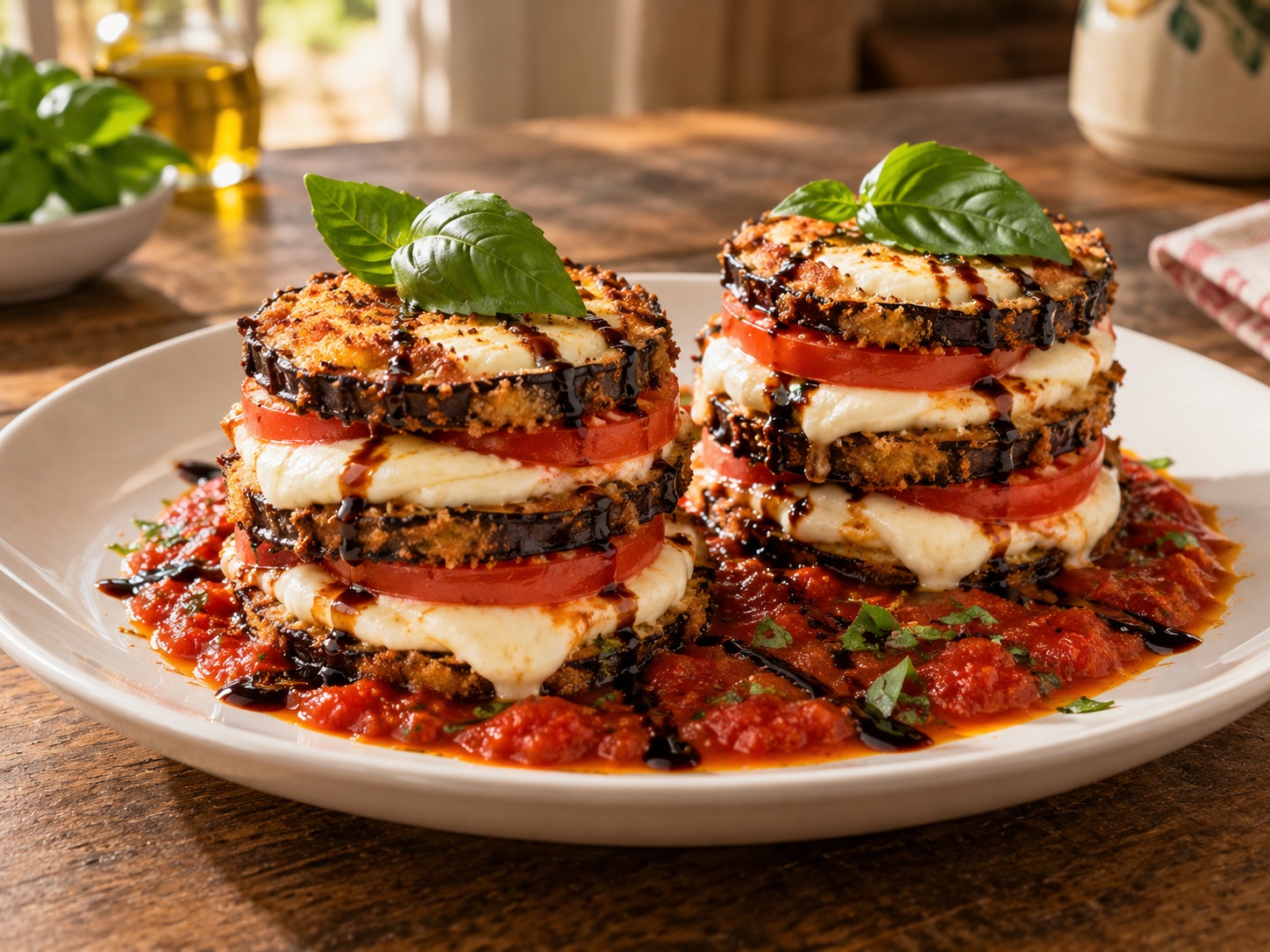
PASTA
Towers of fried eggplant, tomato, and fresh mozzarella • Serves 6 • About 1 hour
My first eggplant stacks stood perfectly on the counter. Carrying them to the table revealed a few weaknesses in the construction. Thick rounds of fried eggplant stacked high with fresh mozzarella, ripe tomato, and basil, baked just until the cheese melts and served on a pool of sauce. They look like something from a fancy restaurant, and they are nothing more than good ingredients built carefully.
Ingredients
| • 2 large eggplants, cut into ½-inch rounds (18 slices) | • Kosher salt |
|---|---|
| • 1 cup all-purpose flour | • 3 eggs |
| • 2 cups Italian breadcrumbs | • ½ cup grated Locatelli Pecorino Romano |
| • Vegetable or olive oil for frying | • 1 pound fresh mozzarella, sliced into 12 rounds |
| • 2 large ripe tomatoes, sliced into 12 rounds | • Fresh basil leaves |
| • 2 cups Mariuch’s Marinara, warmed | • Balsamic glaze (optional) |
| • 1 pound spaghetti or linguine (optional) |
THE METHOD
1. Salt and fry the eggplant.
Salt the slices 30 minutes and pat dry. Bread in flour, eggs, and breadcrumbs mixed with Locatelli. Fry until golden and drain on a rack.
2. Build the towers.
Heat the oven to 375°F. On a lined sheet pan, start each tower with an eggplant round. Add mozzarella, tomato, and a basil leaf. Repeat once, then top with a third eggplant round.
3. Bake.
Bake 10 to 12 minutes, until the cheese is melting and the towers are hot through.
4. Plate them.
Spoon warm marinara on each plate, set a tower in the center, and finish with a basil leaf, a little Locatelli, and a drizzle of balsamic glaze if you like. Serve with pasta on the side.
MARIUCH SAYS
Build it straight. If it leans, it looks like it had wine before dinner.
REEK-EE SAYS: Move each tower with a wide spatula, in one piece. Use tongs and you stop being a cook and start being a contractor. |
|---|
PASTA
Tortellini di Carne o Formaggio (Meat or Cheese Tortellini)
Hand-folded little rings, in broth or with sauce • Makes about 100, serves 8 • About 2½ hours
At the kitchen table, we folded tortellini while the conversation wandered through everybody’s business. By the time the tray was full, we had heard quite a lot. Tortellini are small, folded rings of fresh pasta filled with meat or cheese. They take patience and a few extra hands at the table. Serve them the old way in hot chicken broth, or tossed with Alfredo or Sunday sauce.
Ingredients
| • 1 batch pasta dough from the Meat or Cheese Ravioli | • Cheese filling: 1 pound whole-milk ricotta, drained |
|---|---|
| • ½ cup grated Locatelli Pecorino Romano | • 1 egg yolk |
| • Pinch of nutmeg and salt | • Meat filling: ½ pound ground pork |
| • ¼ pound prosciutto, minced | • ¼ pound mortadella, minced |
| • ½ cup grated Locatelli Pecorino Romano | • 1 egg |
| • Pinch of nutmeg | • For serving: 3 quarts chicken broth, or Mariuch’s Alfredo or Sunday Sauce |
THE METHOD
1. Make the filling.
Cheese: mix all the cheese filling ingredients. Meat: cook the pork until done, cool, then mix with the prosciutto, mortadella, Locatelli, egg, and nutmeg until it forms a paste.
2. Roll and cut.
Roll the dough very thin and cut into 2-inch squares. Keep the dough you aren’t using covered so it doesn’t dry out.
3. Fill and fold.
Put ½ teaspoon of filling in the center of each square. Fold it into a triangle and press the edges. Wrap the two bottom corners around your fingertip and pinch them together into a ring.
4. Cook.
Simmer in broth or salted water 3 to 4 minutes, until tender.
5. Serve.
Ladle into bowls with the hot broth, or toss with sauce and Locatelli.
MARIUCH SAYS
Tortellini is how you get the grandchildren to sit still. Give them a job and a little square of dough.
REEK-EE SAYS: Make them on a rainy Sunday with the whole family at the table. A hundred tortellini with four people takes under an hour. A hundred tortellini alone takes the rest of your life. |
|---|
Lasagna al Ragù (Mariuch’s Meat Lasagna)
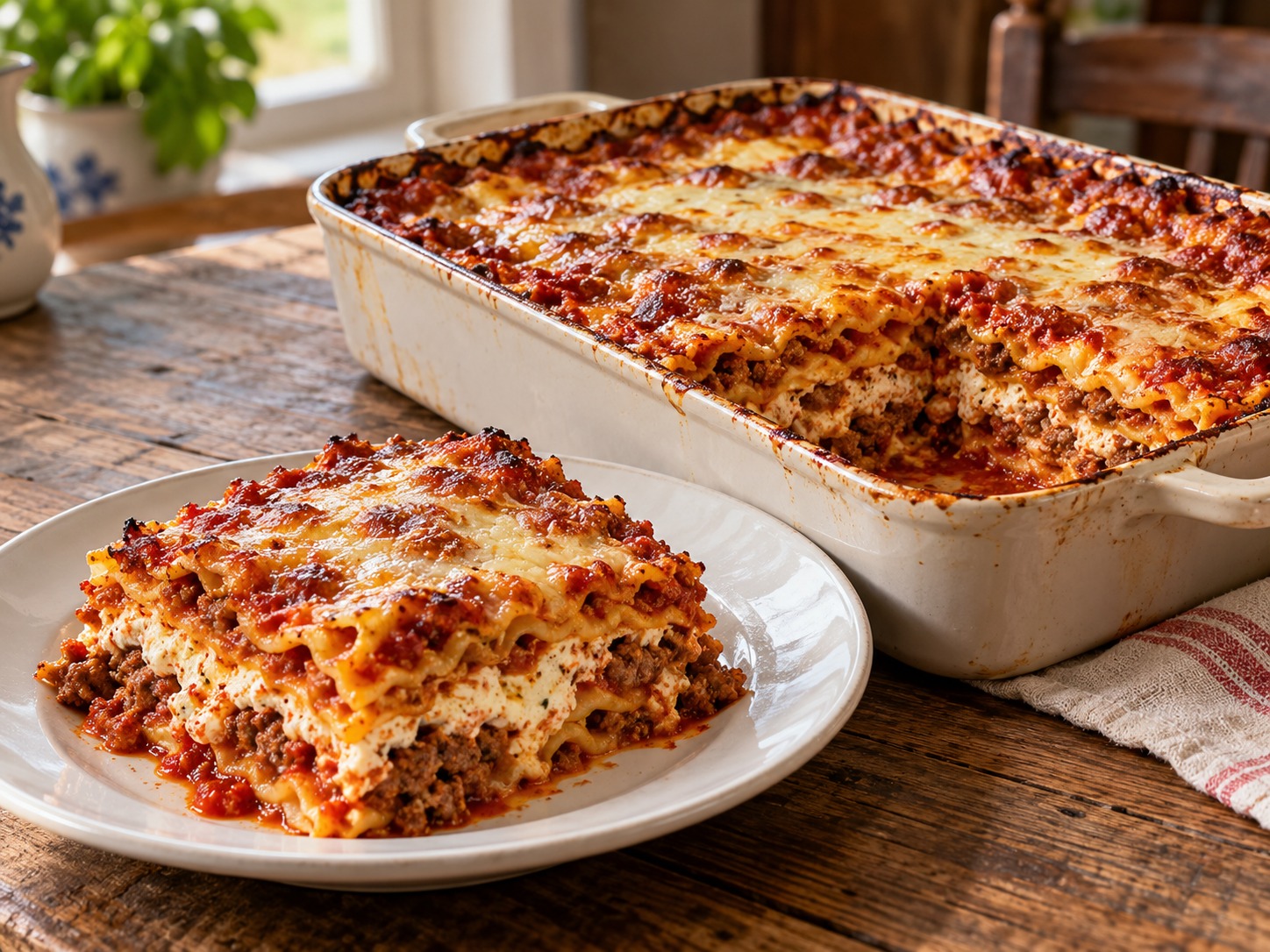
FROM THE OVEN
Layers of Bolognese, ricotta, mozzarella, and Locatelli • Serves 12 • About 2 hours (with sauce made)
As the lasagna browned, people began finding reasons to come into the kitchen. Nobody asked for anything. They just checked the oven on their way through. This is Mariuch’s everyday lasagna, the one that came out of the oven at Italian Express in trays big enough to feed a church. Layers of rich Bolognese, creamy ricotta, mozzarella, and Locatelli, baked until the edges are crispy and everybody fights for the corner piece.
Ingredients
| • 1½ pounds lasagna noodles | • 8 cups Mariuch & Reek-ee’s Bolognese |
|---|---|
| • 3 pounds whole-milk ricotta | • 2 eggs |
| • 1½ cups grated Locatelli Pecorino Romano, divided | • ¼ cup chopped parsley |
| • ½ teaspoon black pepper | • 2 pounds whole-milk mozzarella, shredded |
| • Fresh basil |
THE METHOD
1. Cook the noodles.
Boil the noodles 2 minutes less than the package says. Lay them flat on oiled sheet pans.
2. Mix the ricotta.
Stir the ricotta, eggs, 1 cup of the Locatelli, the parsley, and the pepper together.
3. Build it.
Heat the oven to 375°F. In a deep 9 × 13-inch pan, spread 1½ cups of sauce. Layer noodles, a third of the ricotta, a quarter of the mozzarella, and sauce. Repeat twice.
4. Top it.
Finish with noodles, the rest of the sauce, the last of the mozzarella, and the rest of the Locatelli.
5. Bake.
Cover with foil (tent it so it doesn’t touch the cheese) and bake 45 minutes. Uncover and bake 20 to 25 minutes more, until bubbling and browned and the center reaches 165°F.
6. Rest it.
Let it rest at least 30 minutes before cutting.
MARIUCH SAYS
The corner piece goes to whoever did the dishes last time. That’s the law in this house.
REEK-EE SAYS: Build it the night before and refrigerate it. It goes in the oven cold, so allow about fifteen extra minutes covered and check the center for 165°F. A lasagna can be hot on top and lying to you in the middle. |
|---|
FROM THE OVEN
Lasagna alle Verdure (Vegetable Lasagna)
Roasted vegetables, ricotta, and marinara • Serves 12 • About 2 hours
One guest asked what meat I was serving before he sat down to vegetable lasagna. He asked for another piece before I had finished mine. A lasagna for the people who swear they don’t need meat, and for the people who need a break from it. Roasted zucchini, peppers, mushrooms, and onion are layered with ricotta, mozzarella, and Mariuch’s marinara. Nobody misses the meat. Almost nobody.
Ingredients
| • 1½ pounds lasagna noodles | • 2 zucchini, sliced |
|---|---|
| • 2 bell peppers, sliced | • 1 pound mushrooms, sliced |
| • 1 red onion, sliced | • ⅓ cup olive oil |
| • Kosher salt and black pepper | • 6 cups Mariuch’s Marinara |
| • 2 pounds whole-milk ricotta | • 1 egg |
| • 1 cup grated Locatelli Pecorino Romano, divided | • 1½ pounds whole-milk mozzarella, shredded |
| • Fresh basil |
THE METHOD
1. Roast the vegetables.
Heat the oven to 425°F. Toss the vegetables with the oil, salt, and pepper on two sheet pans. Roast 25 minutes, until browned at the edges.
2. Cook the noodles.
Boil 2 minutes short of the package time and lay flat on oiled pans.
3. Mix the ricotta.
Stir the ricotta, egg, ½ cup of the Locatelli, and torn basil together.
4. Build it.
Lower the oven to 375°F. Layer sauce, noodles, ricotta, vegetables, mozzarella, and sauce. Repeat three times. Top with noodles, sauce, mozzarella, and the rest of the Locatelli.
5. Bake and rest.
Cover and bake 40 minutes. Uncover and bake 20 minutes more, until bubbling. Rest 30 minutes.
MARIUCH SAYS
It has vegetables, so it’s healthy. Have a second piece.
REEK-EE SAYS: Roast the vegetables first. Raw zucchini is mostly water, and it will hand every drop of it to your lasagna in the oven. |
|---|
FROM THE OVEN
Lasagna agli Spinaci (Spinach Lasagna)
Spinach and three cheeses in a white sauce with marinara • Serves 12 • About 1¾ hours
Mariuch kept an old towel for squeezing spinach. I offered her a newer one once, and she asked what was wrong with the one she had. A lighter lasagna built on spinach, ricotta, and a creamy white sauce, with a ribbon of marinara running through it. It is green, white, and red when you cut it, like the flag, and it is a favorite at Easter and on Fridays.
Ingredients
| • 1½ pounds lasagna noodles | • 2 pounds frozen chopped spinach, thawed and squeezed very dry |
|---|---|
| • 2 pounds whole-milk ricotta | • 2 eggs |
| • 1 cup grated Locatelli Pecorino Romano, divided | • Pinch of nutmeg |
| • White sauce: 4 tablespoons butter | • ¼ cup all-purpose flour |
| • 3 cups whole milk | • Salt and white pepper |
| • 3 cups Mariuch’s Marinara | • 1½ pounds whole-milk mozzarella, shredded |
THE METHOD
1. Make the white sauce.
Melt the butter, whisk in the flour, and cook 1 minute. Slowly whisk in the milk and cook, stirring, until thick, about 6 minutes. Season with salt, pepper, and nutmeg.
2. Make the filling.
Mix the spinach, ricotta, eggs, and ½ cup of the Locatelli.
3. Cook the noodles.
Boil 2 minutes short of the package time.
4. Build it.
Heat the oven to 375°F. Spread white sauce in the pan. Layer noodles, spinach-ricotta, a ribbon of marinara, mozzarella, and white sauce. Repeat three times, finishing with white sauce, mozzarella, and Locatelli.
5. Bake and rest.
Cover and bake 40 minutes, uncover and bake 20 more, until golden. Rest 30 minutes.
MARIUCH SAYS
Squeeze the spinach until your arms hurt. Then squeeze it again.
REEK-EE SAYS: Wring the spinach out in a clean kitchen towel. Both arms. When you think it's dry enough, squeeze again. Mariuch did not raise us to make lasagna soup. |
|---|
FROM THE OVEN
Ziti al Forno (Baked Ziti)
Ziti baked with sauce, ricotta, and melted mozzarella • Serves 10 • About 1 hour
More than once, I rode to a family gathering with a warm pan of ziti on my lap, watching the road as carefully as the driver. Baked ziti is the dish that shows up at every christening, graduation, and wake. Ziti tossed with Sunday sauce and dollops of ricotta, covered in mozzarella, and baked until the top is golden and crispy. It feeds a crowd and travels well.
Ingredients
| • 2 pounds ziti | • 8 cups Mariuch’s Sunday Sauce or Marinara, divided |
|---|---|
| • 2 pounds whole-milk ricotta | • 1 egg |
| • 1 cup grated Locatelli Pecorino Romano, divided | • ¼ cup chopped parsley |
| • 1½ pounds whole-milk mozzarella, shredded | • Fresh basil |
THE METHOD
1. Cook the ziti.
Boil the ziti 2 minutes short of al dente. Drain.
2. Mix the ricotta.
Stir the ricotta, egg, ½ cup of the Locatelli, and parsley together.
3. Toss.
Toss the ziti with 6 cups of the sauce and half the mozzarella.
4. Layer.
Heat the oven to 375°F. Spread half the ziti in a deep 9 × 13-inch dish. Dot with spoonfuls of the ricotta. Add the rest of the ziti, the remaining sauce, mozzarella, and Locatelli.
5. Bake.
Cover and bake 25 minutes. Uncover and bake 15 to 20 minutes more, until bubbling and golden on top.
MARIUCH SAYS
Make two. One for the party, one for the people who show up after the party.
REEK-EE SAYS: Pull the ziti two minutes early. It finishes in the oven. Cook it all the way in the pot and it comes out of the oven tired. |
|---|
FROM THE OVEN
Manicotti al Forno (Baked Manicotti)
Pasta tubes stuffed with ricotta, baked in sauce • Serves 8 • About 1¼ hours
Mariuch filled manicotti without looking up from the conversation. I needed both hands, complete silence, and considerably more time. Large pasta tubes filled with a creamy, cheesy ricotta filling and baked under Sunday sauce and mozzarella. It is the kind of dish that looks like a lot of work and isn’t, and everybody gets their own.
Ingredients
| • 1 box (8 ounces, 14 tubes) manicotti shells | • 2 pounds whole-milk ricotta |
|---|---|
| • 1½ cups shredded mozzarella, plus 1 cup for the top | • ¾ cup grated Locatelli Pecorino Romano, divided |
| • 1 egg | • ¼ cup chopped parsley |
| • ¼ teaspoon nutmeg | • Salt and black pepper |
| • 5 cups Mariuch’s Sunday Sauce or Marinara |
THE METHOD
1. Parboil the shells.
Boil the manicotti 4 minutes, just until bendable. Drain and lay them flat on an oiled sheet pan so they don’t stick.
2. Make the filling.
Mix the ricotta, 1½ cups mozzarella, ½ cup Locatelli, egg, parsley, nutmeg, salt, and pepper.
3. Fill them.
Spoon the filling into a zip-top bag, snip the corner, and pipe it into each shell.
4. Bake.
Heat the oven to 375°F. Spread 2 cups sauce in a baking dish. Line up the manicotti, cover with the rest of the sauce, and top with mozzarella and Locatelli. Cover and bake 30 minutes, uncover and bake 15 more, until bubbling.
MARIUCH SAYS
Use the plastic bag. Who has time to fill a hundred tubes with a teaspoon?
REEK-EE SAYS: Generations of Italian women, and the best tool in this recipe turned out to be a zip-top bag. Snip the corner. Three minutes. |
|---|
Conchiglioni Ripieni (Stuffed Shells)
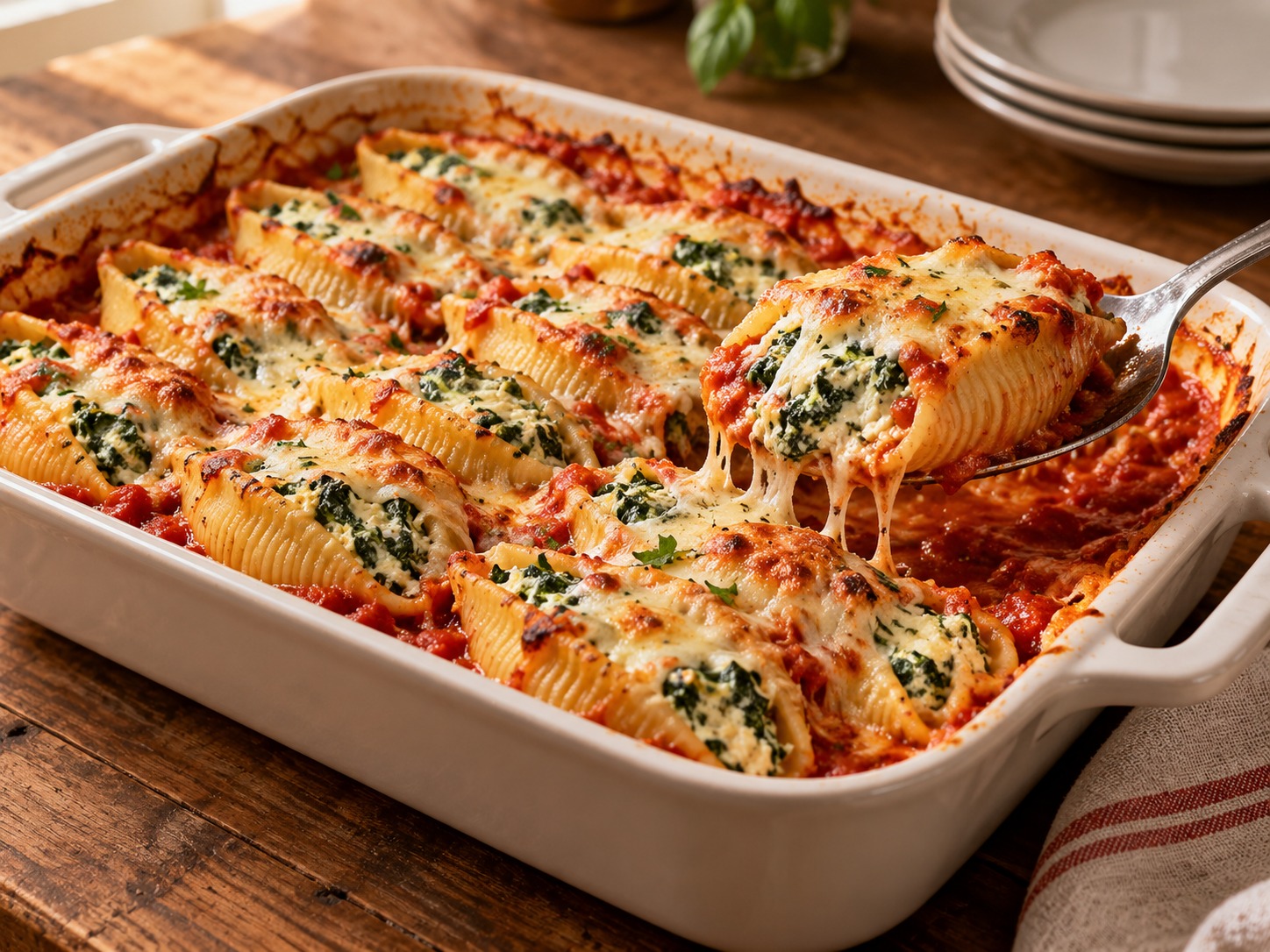
FROM THE OVEN
Jumbo shells stuffed with ricotta and spinach, baked in sauce • Serves 8 • About 1¼ hours
I put my broken shells at the back of the pan. Mariuch noticed, filled them anyway, and served herself one when they came out of the oven. Jumbo pasta shells filled with a creamy ricotta, spinach, and Locatelli filling, lined up in rows in Sunday sauce, and baked under mozzarella. They look beautiful in the pan and even better on the plate.
Ingredients
| • 1 box (12 ounces) jumbo pasta shells | • 2 pounds whole-milk ricotta |
|---|---|
| • 1 package (10 ounces) frozen chopped spinach, thawed and squeezed dry | • 1½ cups shredded mozzarella, plus 1½ cups for the top |
| • ¾ cup grated Locatelli Pecorino Romano, divided | • 1 egg |
| • 2 garlic cloves, minced | • Salt and black pepper |
| • 5 cups Mariuch’s Sunday Sauce or Marinara | • Fresh basil |
THE METHOD
1. Cook the shells.
Boil the shells 2 minutes short of the package time. Drain and lay them open side down on an oiled sheet pan.
2. Make the filling.
Mix the ricotta, spinach, 1½ cups mozzarella, ½ cup Locatelli, egg, garlic, salt, and pepper.
3. Stuff them.
Spread 2 cups sauce in a 9 × 13-inch dish. Fill each shell with a heaping tablespoon of filling and line them up in rows.
4. Bake.
Heat the oven to 375°F. Spoon the rest of the sauce over, top with mozzarella and Locatelli. Cover and bake 25 minutes, uncover and bake 15 more. Finish with torn basil.
MARIUCH SAYS
Cook a few extra shells. Some always break. That’s the cook’s snack.
REEK-EE SAYS: Line the shells up tight, like soldiers. They hold each other up, and the pan comes out of the oven looking like you knew what you were doing the whole time. |
|---|
FROM THE OVEN
Rigatoni Ripieni (Stuffed Rigatoni)
Rigatoni filled with ricotta and sausage, baked in sauce • Serves 8 • About 1½ hours
The first pan of stuffed rigatoni took me longer than I care to admit. I kept standing up another tube instead of looking at the clock. Every big rigatoni is filled one by one with a ricotta and sausage filling, then stood upright in the pan, covered in sauce and cheese, and baked. It takes some patience, but when you cut into it, every piece is full. It is a showpiece for a holiday table.
Ingredients
| • 1 pound large rigatoni | • 1 pound sweet Italian sausage, casings removed |
|---|---|
| • 1½ pounds whole-milk ricotta | • 1 cup shredded mozzarella, plus 1½ cups for the top |
| • ¾ cup grated Locatelli Pecorino Romano, divided | • 1 egg |
| • ¼ cup chopped parsley | • 5 cups Mariuch’s Sunday Sauce or Marinara |
THE METHOD
1. Cook the rigatoni.
Boil 3 minutes short of the package time. Drain and toss with a little oil.
2. Make the filling.
Brown the sausage, breaking it up very fine, cooked through to 160°F. Cool, then mix with the ricotta, 1 cup mozzarella, ½ cup Locatelli, egg, and parsley.
3. Fill them.
Put the filling in a zip-top bag, snip the corner, and pipe it into each rigatoni.
4. Stand them up.
Spread 2 cups sauce in a round 10-inch pan or a 9 × 13-inch dish. Stand the rigatoni upright, packed tightly like a honeycomb.
5. Bake.
Heat the oven to 375°F. Pour the rest of the sauce over, top with mozzarella and Locatelli. Cover and bake 30 minutes, uncover and bake 15 more. Rest 15 minutes.
MARIUCH SAYS
Standing them up takes longer. That’s how people know you love them.
REEK-EE SAYS: Pack them in tight. Rigatoni standing up are very proud and very unstable. One falls, they all fall. |
|---|
Mariuch’s Sausage and Peppers
The road to the greatest grinder of all time
Use the same pan in which you cooked the sausage.
Leave the oil, juices, browned bits, and everything else exactly where they are.
Ingredients
| • Cooked Mariuch’s Hot Italian Sausage | • A generous amount of garlic, roughly chopped rather than finely minced |
|---|---|
| • About 10 large yellow onions, sliced | • About 2 tablespoons hot red-pepper flakes |
| • About 15 Cubanelle peppers | • Salt, to taste |
| • Excellent extra-virgin olive oil, up to about ½ cup more as needed | • Heinz ketchup, to taste |
The onions and peppers should end up roughly 50/50 by volume.
That matters more than whether you have exactly ten onions or exactly fifteen peppers.
THE METHOD / PEPPERS AND ONIONS
1. Start with the onions.
Add the sliced onions to the sausage pan.
Cook for about 3 minutes.
You are not trying to make them translucent.
They should begin becoming tender while still retaining some structure.
2. Prepare the Cubanelle peppers.
Cut away the stems.
Remove the white interior and most of the seeds.
Do not become obsessive about it.
Slice the peppers lengthwise into long strips.
3. Add the peppers.
Add the sliced Cubanelle peppers to the onions.
Cook for another 3 minutes or so.
4. Add more olive oil as needed.
Pour in additional excellent olive oil as the pan needs it—up to roughly ½ cup.
This is done by eye.
5. Add the garlic and heat.
Add the roughly chopped garlic and about 2 tablespoons hot red-pepper flakes.
Season with salt to taste.
Continue cooking until the onions and peppers are tender but still al dente.
They should still have life in them.
6. Bring the sausage back.
Return the cooked sausage links to the pan.
Turn everything together so the sausage is coated with the peppers, onions, garlic, oil, and pan juices.
7. Heinz. To taste.
Add Heinz ketchup to taste.
Not a cup.
There is no measuring cup for this.
Add enough. Cook it. Look at it. Taste it.
You will know.
And it must be Heinz.
Not Hunt’s. Not another brand. Heinz.
Cook everything together for about 5–10 minutes, until the ketchup loses its straight-from-the-bottle taste and becomes part of the pan sauce.
It does not become tomato paste.
The finished sauce remains glossy, rich, beautifully drippy, and loose enough to coat the sausage, onions, and peppers.
Then serve.
OR MAKE THE GRINDER
Mariuch invented this one.
How?
Nobody knows.
She took the sausage and peppers and turned them into something else entirely.
First, take a good Italian grinder roll and toast it.
This is essential.
Do not put that wet, glorious sausage-and-pepper mixture onto an untoasted grinder roll unless you would like to watch your dinner disintegrate in your hands.
Toast the bread first.
Then pile in the sausage, onions, and Cubanelle peppers.
Spoon some of that lovely dripping sauce over everything.
Cover it with mozzarella.
Do not be shy.
Put the grinder into the oven until the mozzarella melts, bubbles, and turns golden brown.
Then eat it.
Italian Express served the grinder to people who had no idea that Heinz ketchup was hiding somewhere inside all that sausage, pepper, onion, garlic, olive oil, sauce, toasted bread, and melted mozzarella.
The local newspaper called it the greatest sausage and pepper grinder of all time.
We saw no compelling reason to argue.
THE GRINDER EVERYBODY TALKED ABOUT
Reek-ee at New London Sailfest Week, circa 2012 • 900 grinders served in three hours. |
ITALIAN EXPRESS IN THE NEW LONDON PRESS • 2013 In its 2013 review naming Italian Express one of the top 10 best places to eat, The Day wrote: “The house-made sausage and peppers knocked my socks off and I’ve made it my mission to recommend it to as many folks as possible.” — Marisa Nadolny, The Day, 2013 “The Day picked Italian Express as one of its favorite places to eat and serves up ‘what might be the greatest sausage and peppers grinder of all time.’” — Covert Cuisine |
|---|
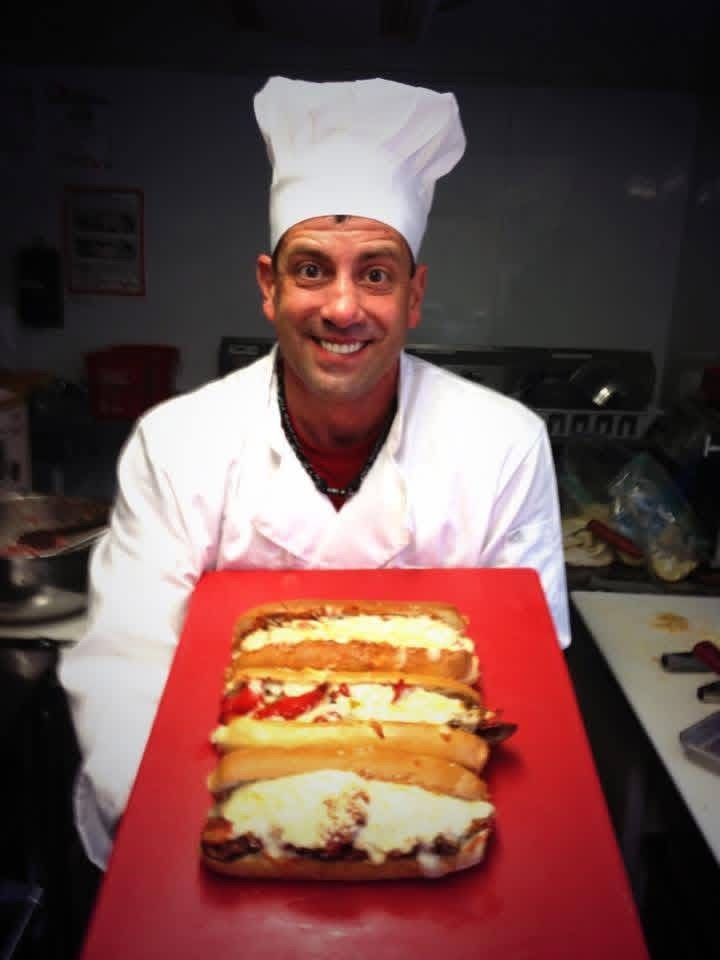
Stata zeet. Mangia.
Shut up and eat.
OPTION FOUR / TOMORROW MORNING
If you somehow manage not to eat all the sausage, refrigerate a few cooked links.
The next morning, slice them into an Italian omelet.
And if grated Locatelli Pecorino Romano goes anywhere near it, there is only one answer in Mariuch’s kitchen:
Locatelli Pecorino Romano.
It is the Locatelli Pecorino Romano she uses.
Locatelli Pecorino Romano is produced in Italy from sheep’s milk, with much of its production coming from Sardinia. The broader Locatelli Pecorino Romano PDO permits production in Sardinia, Lazio, and part of Tuscany.
Or forget the omelet and eat the sausage before breakfast gets made.
Nobody is checking.
We are adaptable people. We don’t waste food.
THE LOCATELLI FINISH
At the very end—whether it is the sausage on a plate, sausage and peppers, the grinder, or the omelet—finish with a good shower of Locatelli Pecorino Romano.
Don’t be shy. It’s just cheese.
Mariuch’s rules
| • Double down on the fennel. Hot Italian sausage is supposed to taste like fennel. | • Heinz ketchup to taste. You will know. | |
|---|---|---|
| • Real Hungarian paprika. We are Italian. But the paprika has to be Hungarian. Anything else, well, it isn’t Italian. | • The ketchup remains a sauce—glossy, rich, and drippy. | |
| • No coriander. | • Toast the grinder roll before filling it. | |
| • If you do not feel like making sausage, buy excellent hot Italian sausage from a real Italian market. Lazy is permitted. Bad sausage is not. | • Mozzarella means mozzarella. Do not be shy. | |
| • Brown the sausage until the casing is crisp before adding the water. | • When grated Locatelli Pecorino Romano is called for in Mariuch’s kitchen, it is Locatelli. | |
| • Water goes into the pan only after the sausage has developed its crust. | • Finish everything with a good shower of Locatelli Pecorino Romano. Don’t be shy. It’s just cheese. | |
| • Save the pan. The browned bits belong to the peppers and onions. | • Sausage headed to Sunday Sauce goes in about 30 minutes before serving. | |
| • Onions and Cubanelle peppers are roughly 50/50. | • Save some for tomorrow if you can manage not to eat it first. | |
| • Cook the vegetables until tender but still al dente. | ||
REEK-EE SAYS Make the sausage first—or let the Italian market do it if Lazy Mary, you better get up, has taken over. After that, you have choices: Sunday Sauce, sausage and peppers, the grinder, breakfast tomorrow, or a six-inch link on a plate. Just don’t waste it. |
||
REEK-EE SAYS If it’s not made from a goat, it’s not Pecorino. |
||
Mariuch’s Sausage & Pepper Grinder
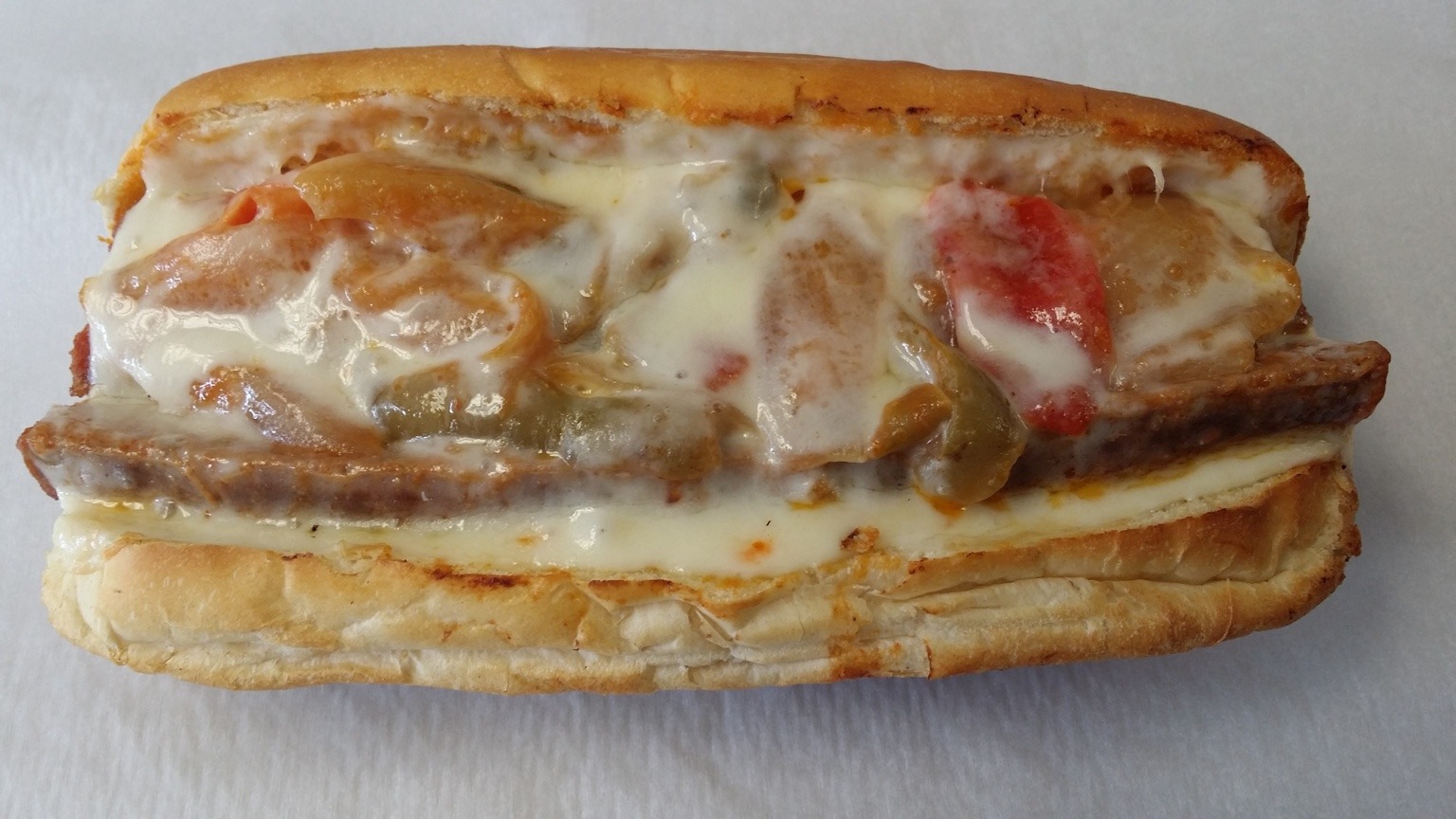
THE GRINDER EVERYBODY TALKED ABOUT
Italian Express grinder • Assembly only • The sausage and peppers are already done
Mariuch made the problem larger.
The sausage and peppers were already dangerous enough on their own.
Then Mariuch did what any sensible Italian woman would do: she put them on toasted bread, covered them in mozzarella, and made the problem larger.
That was the whole genius of it.
Not more complication. Better judgment.
The roll had to be toasted or the whole thing would collapse in your hands like bad testimony.
The sauce had to stay glossy and drippy.
The cheese had to melt like it meant it.
And once people started eating these, the matter was settled.
The local paper practically called it the greatest sausage and pepper grinder of all time.
We saw no reason to object.
THE METHOD / ASSEMBLY
Toast it. Load it. Melt it.
YOU NEED • Mariuch’s Sausage and Peppers, hot • A good Italian grinder roll • Mozzarella • Some of that lovely dripping pan sauce • Locatelli Pecorino Romano 1. Toast the roll. This is essential. Do not put that wet, glorious sausage-and-pepper mixture onto an untoasted roll unless you would like to watch your dinner disintegrate in your hands. 2. Pile it in. Load the toasted roll with sausage, onions, and Cubanelle peppers. 3. Spoon on the sauce. Get some of that lovely dripping sauce over everything. 4. Cover it with mozzarella. Do not be shy. 5. Finish it in the oven. Bake until the mozzarella melts, bubbles, and turns golden brown. 6. Locatelli. Finish with a good shower of Locatelli Pecorino Romano. Don’t be shy. It’s just cheese. |
Reek-ee at New London Sailfest Weekend, ITALIAN EXPRESS IN THE “The house-made sausage and peppers knocked my socks off and I’ve made it my mission to recommend it to as many folks as possible.” — Marisa Nadolny, The Day, 2013 “what might be the greatest sausage and peppers grinder of all time.” — Covert Cuisine |
|---|
Reek-ee’s rules
| • Toast the roll first. This is not optional. | • Use a good Italian grinder roll. The filling deserves structural support. | |
|---|---|---|
| • Spoon on some of that lovely dripping sauce. Dry is not the goal. | • Mozzarella means enough mozzarella to matter. | |
| • Finish with Locatelli Pecorino Romano. | • Eat it hot, before structural integrity becomes a memory. | |
REEK-EE SAYS: If it falls apart in your hands, you skipped the first instruction. Go back and toast the bread. STATA ZEET. MANGIA. • SHUT UP AND EAT. |
||
Reek-ee’s Italian Steak Grinder
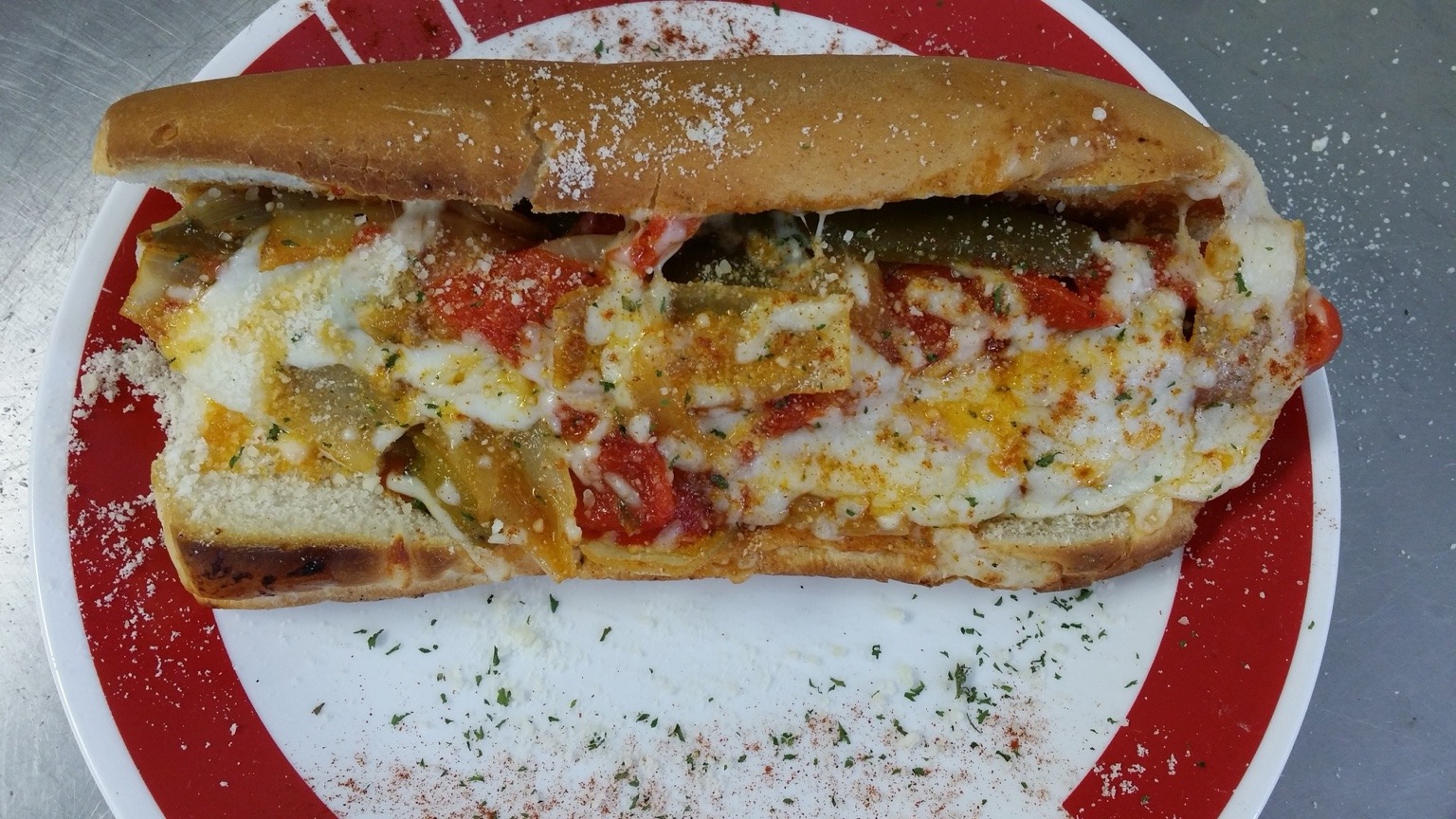
THE ULTIMATE STEAK GRINDER
Yield: 8 massive grinders
One day Reek-ee was sitting there thinking: How can I make the ultimate steak grinder?
There was no grand plan. No sacred family recipe. No committee.
He just started throwing things into the skillet.
A little of this. A little of that.
Taste it. Needs something. Add more. Taste it again.
Better.
Then came the red peppers. Then the pepperoncini. Then the hot cherry peppers. Then the sweet red cherry peppers. Garlic. Olive oil. Fresh basil. Pecorino.
Taste. Adjust. Taste again.
And somewhere along the way, the thing suddenly became ridiculous.
It had a little kick. It had sweetness. It had richness. It had that glossy sauce coating the steak and vegetables. It had everything Reek-ee loved in one grinder.
He tasted it. Wow. This was good.
And then Reek-ee had one more thought: How can I make this even better? Easy.
Melt a ridiculous amount of whole-milk mozzarella over the top.
Then, when it comes out of the oven, throw an absolutely unreasonable amount of Locatelli Pecorino Romano over the whole thing.
And that was it. One of the best grinders Reek-ee had ever tasted. Period.
The ultimate steak grinder
| YIELD | STYLE | COOKING METHOD |
|---|---|---|
| 8 massive grinders | Shaved steak, red peppers, onions, mushrooms, pepperoncini, hot and sweet cherry peppers, fresh basil, whole-milk mozzarella, and Locatelli Pecorino Romano | Skillet, then brick oven or regular oven for the bread and final melt |
Ingredients
For the bread • 8 large Italian grinder rolls • Excellent extra-virgin olive oil, for toasting For the steak • 4 pounds shaved steak, ribeye or top round, shaved paper-thin • Kosher salt, to taste • Crushed red-pepper flakes, to taste • Excellent extra-virgin olive oil, as needed |
For the vegetables and sauce • 4 medium yellow onions, sliced • 4 large red peppers, sliced • 4 cups sliced mushrooms • 12 cloves fresh garlic, minced • 1 cup sliced green pepperoncini • ½ cup chopped hot cherry peppers • 1 cup sliced sweet red cherry peppers • Fresh basil, torn • Locatelli Pecorino Romano, 1 or 2 generous handfuls—or however much the skillet tells you • Excellent extra-virgin olive oil, about ½ cup total to start, plus more as needed • Kosher salt, to taste For finishing • 2 pounds whole-milk mozzarella, shredded • Locatelli Pecorino Romano, grated generously over the finished grinders |
|---|
THE METHOD
1. Toast the rolls.
Split all 8 grinder rolls lengthwise, keeping the hinge intact.
Open them flat. Drizzle the cut sides generously with excellent extra-virgin olive oil.
Brick oven:
Toast the rolls in a cooler area of the brick oven, around 500°F to 550°F, for about 2 to 3 minutes, until the inside surface becomes pale golden and crisp.
Regular oven:
Toast them cut-side up in a hot conventional oven until the inside is lightly golden and crisp.
You are building a barrier.
Later, that steak mixture is going to have sauce in it. If the bread is not toasted first, the grinder can collapse in your hands.
Set the rolls aside.
2. Start the onions and red peppers.
Heat a very large heavy skillet over medium-high heat.
Add a generous pour of excellent extra-virgin olive oil.
Add:
• sliced onions • sliced red peppers
Season with kosher salt to taste. Do not be shy with the salt, but do not overpower the food. Salt brings out flavor.
Cook for about 3 to 4 minutes, stirring frequently, until the onions and peppers are tender but still al dente.
Taste them.
If they need more kosher salt, add it. If the skillet needs more olive oil, add it.
3. Add the mushrooms.
Now add the sliced mushrooms.
Cook until they begin to soften and brown but still retain some texture.
Keep tasting. Keep adjusting. Add more olive oil if the skillet needs it.
You are already beginning to build the sauce.
4. Add the garlic and peppers.
Once the onions, red peppers, and mushrooms are where you want them, add:
• 12 cloves minced fresh garlic • 1 cup sliced green pepperoncini • ½ cup chopped hot cherry peppers
• 1 cup sliced sweet red cherry peppers
Cook for about 2 minutes more.
The garlic goes in now because if you put it in too early, it burns. And burned garlic ruins everything.
Taste again.
Salt if needed. Add more olive oil if needed.
5. Take the vegetable mixture out — but leave the skillet alone.
Now remove the entire vegetable mixture from the skillet and transfer it to a very large mixing bowl.
The onions come out. The red peppers come out. The mushrooms come out. The garlic and all the rest of peppers come out.
But this is important: Do not clean the skillet. Do not wipe it. Do not rinse it. Do not pour out what is left behind.
Leave every bit of:
• olive oil • pepper juices • garlic flavor • seasoning • browned bits • whatever sauce remains on the bottom of the skillet, right where it is.
The vegetables come out. The flavor stays.
6. Cook the shaved steak separately in that same skillet.
Turn the heat up high. Get the same skillet very hot.
The steak is now going directly into all that flavor left behind by the vegetables.
Add more excellent extra-virgin olive oil if the skillet needs it. Do not be shy.
Add about half the shaved steak.
Season with kosher salt and crushed red-pepper flakes to taste.
Cook aggressively for about 3 minutes, using a sturdy metal spatula to chop, turn, separate, and move the meat continuously so it sears instead of steaming.
When the first batch is browned, remove it and set it aside.
Do not clean the skillet. Add more olive oil as needed.
Then cook the second half of the steak the same way.
Season it. Taste it. Adjust it. Again, these measurements are estimates.
The skillet will tell you.
7. Bring the steak and vegetable mixture back together.
Once all of the steak is cooked, return the first batch of steak to the skillet if you removed it.
Then add the entire bowl of cooked vegetables back into the skillet.
Now everything finally comes together:
• shaved steak • onions • red peppers • mushrooms • garlic • green pepperoncini • hot cherry peppers
• sweet red cherry peppers • all the juices from the vegetables • all the juices from the steak • all the olive oil
• all the browned bits and flavor left in that skillet
Toss everything together thoroughly. Now you are making the final sauce.
8. Build the sauce.
Look at the mixture.
Taste it.
The steak and vegetables should be coated in a glossy, rich sauce made from the olive oil, meat juices, vegetable juices, peppers, garlic, and everything that has developed in that skillet.
It should not be dry. If it looks dry, add more excellent extra-virgin olive oil.
Do not be shy.
You may use around ½ cup total across the entire recipe.
You may use more. Who knows?
The skillet will tell you.
The mixture can be rich.
It can even be a little oily.
A little of that sauce is supposed to soak into the toasted bread later. But you do not want a puddle of oil sitting underneath the food.
A little oily is good. Greasy is not.
The sauce should coat everything. The steak and vegetables should carry it. They should not swim in it.
9. Add the basil and Pecorino.
Tear in a generous amount of fresh basil. Then add a generous handful of Locatelli Pecorino Romano.
Maybe one handful. Maybe two. Who knows?
Stir it through the hot steak mixture.
Taste it.
If it needs another handful, add another handful. If it needs more kosher salt, add it.
If it needs more olive oil, add it. If it needs more pepper heat, adjust it.
This is Italian cooking. It is not baking.
The measurements are estimates.
You add. You taste. You adjust. You taste again.
Once it tastes great, you’re done.
10. Stuff the grinders.
Open the toasted grinder rolls.
Using tongs, fill each one heavily from end to end with the hot steak mixture.
Make sure every grinder gets some of everything:
Steak. Onions. Red peppers. Mushrooms. Pepperoncini. Hot cherry peppers. Sweet red cherry peppers. Fresh basil. Pecorino.
And that beautiful sauce.
Get some of the sauce into the bread. That is why you toasted it.
Do not make one magnificent grinder and seven disappointing ones.
11. Add the whole-milk mozzarella.
Top each grinder generously with shredded whole-milk mozzarella.
Use about 2 pounds total for all 8 grinders.
That works out to roughly 1 cup per grinder.
No reduced-fat mozzarella.
No nonfat mozzarella.
Whole milk.
Period.
12. Melt and brown the mozzarella.
Brick oven:
Place the open grinders in a cooler area of the brick oven, around 500°F to 550°F.
Bake for about 2 to 3 minutes, until the whole-milk mozzarella is completely melted, bubbling, and beautifully golden brown.
Regular oven:
Place the grinders on baking sheets and bake in a hot conventional oven until the mozzarella is melted and browned.If necessary, finish briefly under the broiler. Watch them carefully. You have come too far to burn the grinder now.
13. Finish with Locatelli Pecorino Romano.
As soon as the grinders come out of the oven, give each one an absolutely unreasonable shower of Locatelli Pecorino Romano. Don’t be shy. It’s just cheese.
Serve immediately while the mozzarella is bubbling, the bread is still crisp, and the sauce is soaking into the toasted roll.
Reek-ee’s Rules
| • Toast the roll first. The sauce belongs in the bread, not through it. | • Don’t clean the skillet. The vegetables come out. The flavor stays. |
|---|---|
| • Don’t be shy with the olive oil. You want a glossy sauce that coats everything. A little oily is fine. Greasy is not. | • Cook the steak in batches. Brown it. Don’t steam it. |
| • Garlic goes in late. Burned garlic ruins everything. | • Whole-milk mozzarella only. |
| • Locatelli Pecorino Romano goes in the mixture if the skillet wants it—and all over the top when it’s done. | • This is Italian cooking, not baking. Taste it. Adjust it. Once it tastes great, you’re done. |
REEK-EE SAYS: This is Italian cooking, not baking. The amounts get you into the neighborhood. \ After that, taste the food. Add more olive oil. Add more kosher salt. Add more peppers. Add more Pecorino. Keep working it until the sauce coats everything and the whole thing tastes great. Once it does, stop. You’re done. |
|
FROM THE ITALIAN EXPRESS COUNTER
Classic Italian Grinder
Layered Italian cold cuts on a crusty roll • Makes 4 grinders • About 15 minutes
At the counter, customers would ask us to wrap half their grinder separately for later. Sometimes they came back for that half before they left. The grinder that started it all at the counter. Salami, capocollo, ham, and provolone stacked on a crusty roll with lettuce, tomato, onion, hot peppers, oil, and vinegar. It is not complicated. It just has to be built right.
Ingredients
| • 4 long Italian sub rolls | • ½ pound Genoa salami, thinly sliced |
|---|---|
| • ½ pound hot capocollo, thinly sliced | • ½ pound boiled ham or prosciutto cotto, thinly sliced |
| • ½ pound sharp provolone, thinly sliced | • 2 cups shredded iceberg lettuce |
| • 2 ripe tomatoes, thinly sliced | • ½ red onion, thinly sliced |
| • ½ cup sliced hot cherry peppers or pepperoncini | • Extra-virgin olive oil |
| • Red wine vinegar | • Dried oregano |
| • Kosher salt and black pepper |
THE METHOD
1. Open the rolls.
Split each roll, leaving one side attached like a hinge. Pull out a little bread from the top half so the fillings have room.
2. Cheese goes first.
Line the bottom of each roll with provolone. It keeps the bread from getting soggy.
3. Stack the meats.
Fold the salami, capocollo, and ham loosely on top of the cheese. Loose folds, not flat sheets. That is what makes it tall.
4. Add the toppings.
Lettuce, tomato, onion, and hot peppers.
5. Dress it.
Drizzle with olive oil and a splash of vinegar. Sprinkle with oregano, salt, and pepper. Close, press down, and cut in half on an angle.
MARIUCH SAYS
If the oil isn’t running down your arm, you didn’t make a grinder. You made a sandwich.
REEK-EE SAYS: Fold the meat, don't lay it flat. Same meat, twice the sandwich. It's the only magic trick a deli counter knows, and now you know it too. |
|---|
Mariuch & Reek-ee’s Italian Express Pizza
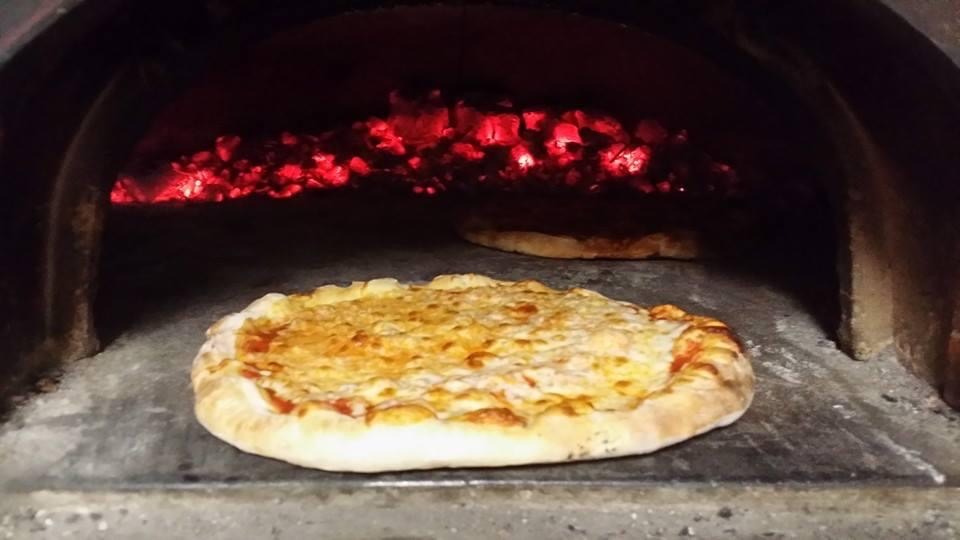
THE PIZZA GODS OF NEW LONDON
Neapolitan-style brick-oven pizza • 4 dough balls • 14 Italian Express house pies
The pizza gods of New London
When Italian Express was still a food truck, there was another truck selling brick-oven pizza.
Reek-ee tried it.
He had one thought: Hmm. I can make this a lot better.
This was probably not the beginning of peaceful relations between local food trucks.
So Reek-ee went back to Mariuch.
They started experimenting.
Dough. Water. Yeast. Fermentation.
How much sauce. How much cheese.
How much was too much—which, in that family, was always a difficult question.
They tested toppings. They changed combinations. They learned what could survive the heat and what had to be cooked first. They figured out that wet vegetables could destroy a crust, that a brick floor and the oven dome were two completely different kinds of heat, and that once a pizza went into a properly fired oven there was no time left to stand around discussing anything.
Then Italian Express became a restaurant.
And Mariuch and Reek-ee did exactly what they had threatened to do.
They bought a brick oven.
Not an imitation. Not a conveyor belt.
A real brick oven with fire in it.
Then they started making the pizzas they had been working on.
Mariuch had the Classico Italia and the Bianco. Reek-ee eventually came up with the Agita.
Then came the others—meat, vegetables, ricotta, sausage, eggplant, artichokes, buffalo chicken, bacon, pesto-minded ideas, and combinations that probably would have caused serious concern in Naples.
Nobody seemed particularly worried. The oven was hot. People were hungry.
And before long, Italian Express had become very good at pizza.
Possibly too good.
There was even a slight problem with terminology.
Italian Express sold pizza by the slice.
Except one “slice” was apparently two pieces.
We were generous people.
Or terrible at fractions.
Either explanation works.
The fire kept going. The dough kept disappearing. And somewhere between the food truck, all those experiments with Mariuch, and the brick oven inside the restaurant, we reached the only reasonable conclusion:
We had become the pizza gods of New London.
Not officially.
There was no ceremony.
But we had a brick oven, fourteen pizzas, and absolutely no intention of asking permission.
ITALIAN EXPRESS / NEW LONDON |
THE BRICK OVEN YEARS |
|---|
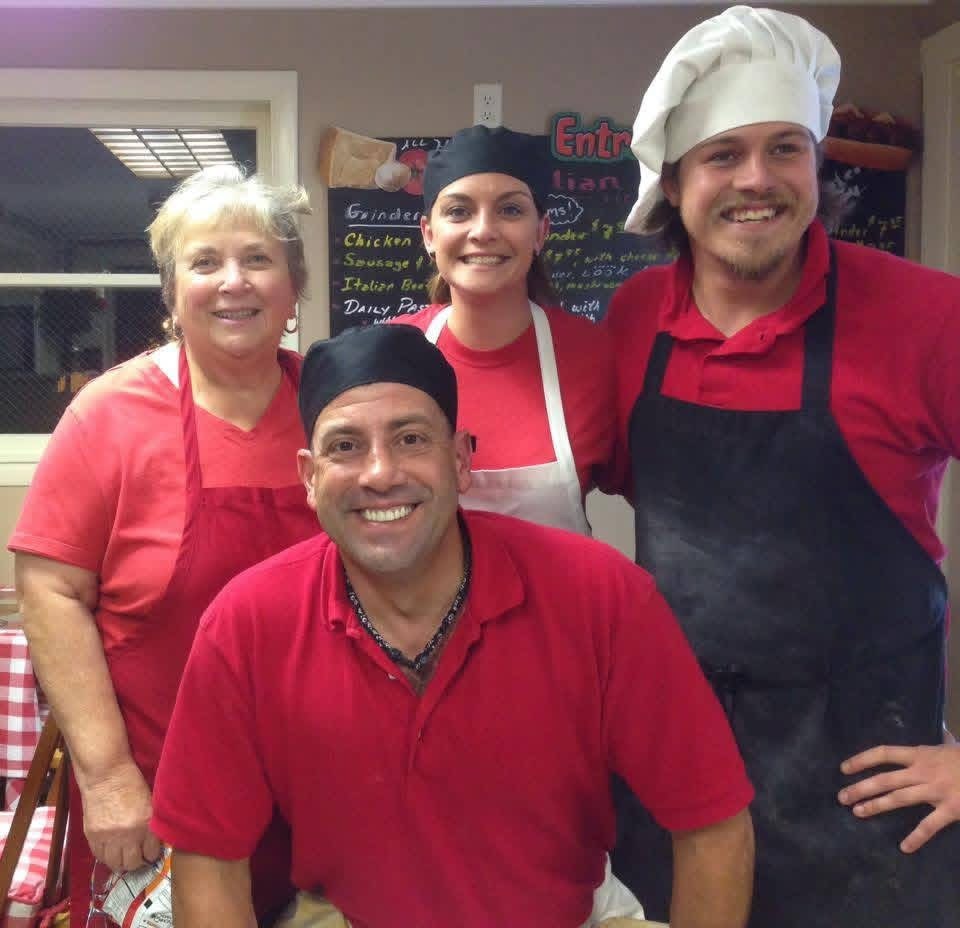
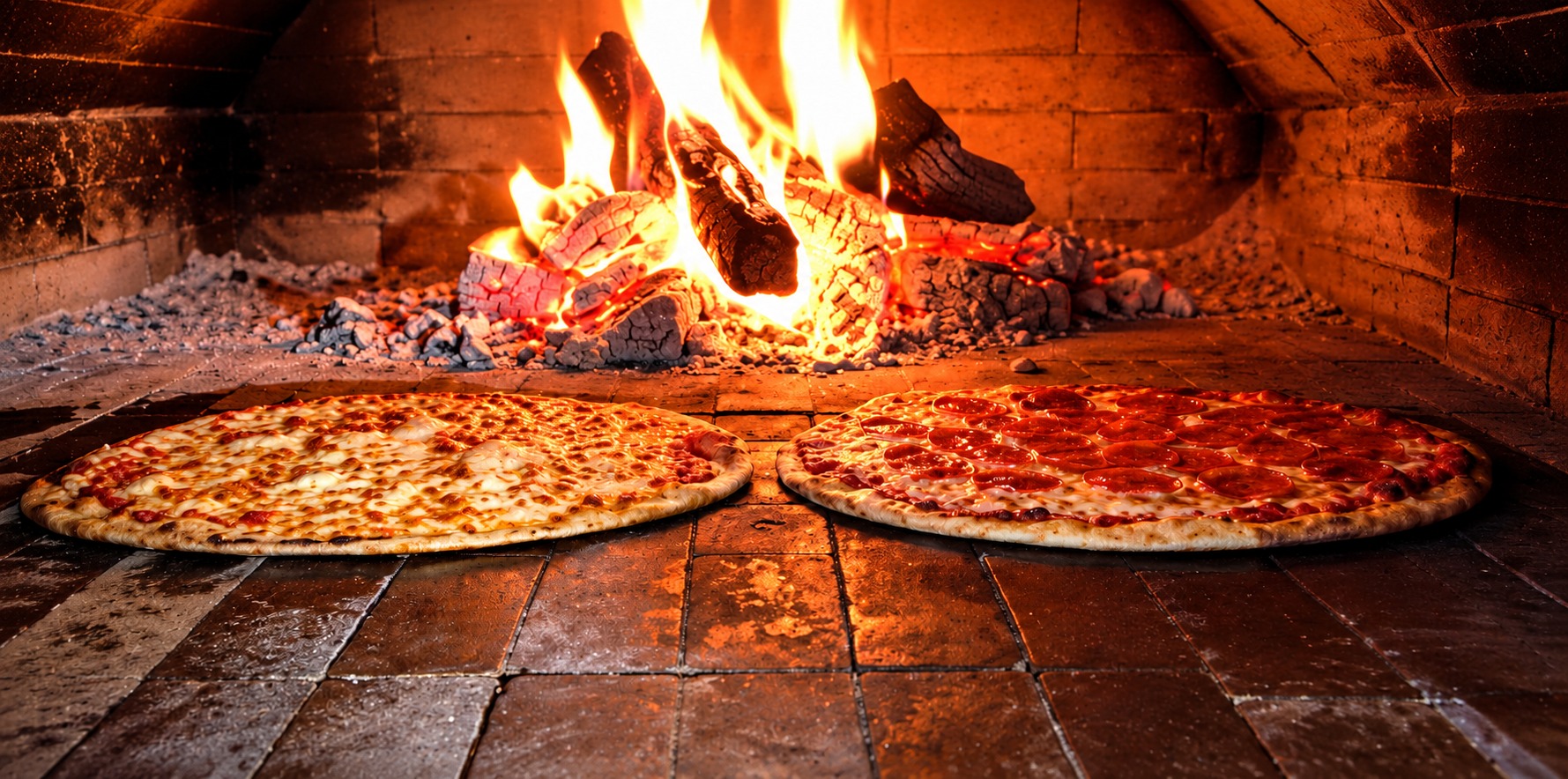
THE FIRE WAS REAL. SO WAS THE PIZZA.
Mariuch & Reek-ee’s Italian Express
THE DOUGH / PART ONE
Four dough balls. No excuses.
| YIELD | BALL SIZE | FERMENT |
|---|---|---|
| 4 dough balls | About 9 oz each | 24–48 hours |
Ingredients
| Type 00 flour | 21.2 oz • about 4¾ cups, scooped and leveled |
|---|---|
| Cool water | 13.8 oz • about 1¾ cups |
| Fine sea salt | 0.5 oz • about 2½ tsp |
| Fresh cake yeast | 0.25 oz • about 1½ tsp, crumbled |
1. Dissolve the yeast.
Measure the cool water into a large mixing bowl. Crumble the fresh yeast directly into the water and stir until completely dissolved.
2. Add the salt, then the flour.
Stir the sea salt into the water. Gradually add the Type 00 flour, mixing with your hands until a shaggy ball forms.
3. Knead it.
Turn the dough onto the counter and knead for 8–10 minutes, until smooth and elastic.
4. Give it a bulk rest.
Cover the dough with an inverted bowl or a damp towel and leave it at room temperature for 1½ hours so the gluten relaxes and the fresh yeast gets to work.
5. Make four balls.
Divide the dough into four equal pieces. Each should weigh about 9 ounces. Roll and tuck each piece into a tight, smooth ball.
6. Cold ferment.
Place the balls in individual lightly oiled containers or a covered proofing tray. Refrigerate at 35°F–39°F for 24–48 hours.
7. Wake them up.
Remove the dough from the refrigerator exactly 2 hours before you plan to bake. Cold dough fights back. Warm dough cooperates.
REEK-EE SAYS Weight wins. Cups are here because normal people own measuring cups. If you have a scale, use it. |
|---|
THE PIZZA STATION
Prep everything before you stretch anything.
Neapolitan pizza gives you about 60–90 seconds to get it right. Once the first dough ball is stretched, this is not the time to discover that the sausage is raw, the spinach is wet, or the ricotta is still hiding behind the milk.
The three core bases
• San Marzano tomato sauce: Hand-crush three 28-ounce cans of whole peeled San Marzano tomatoes. Mix with 1½ teaspoons fine sea salt and a few torn basil leaves. Do not cook it.
• Mozzarella: Shred or small-cube 3–4 pounds low-moisture whole-milk mozzarella. If using fresh mozzarella, slice it and drain it in a colander for 2 hours first.
• Garlic oil: Finely mince 2 whole heads of fresh garlic. Stir half into 1 cup excellent extra-virgin olive oil for white pies. Keep the other half dry for sprinkling.
Station A / Pre-cooked meats
• Brown and crumble 1 pound Italian sausage; drain excess fat. • Fully cook 6–8 meatballs and slice them thin. • Fry 1 package bacon until crisp; chop into bits. |
• Cook chicken tenderloins until crisp and fully cooked; cut into bite-size pieces. • Cook chicken breast for the Buffalo pie; dice it and toss thoroughly with buffalo sauce. |
|---|
Station B / Deli meats
• Pepperoni, ham, Genoa salami and hot capicola: slice thin enough to heat through quickly and crisp at the edges.
Station C / Vegetables
• Mushrooms and red onions: shave paper-thin. • Eggplant: slice thin, brush with olive oil and pre-grill or roast until tender. • Broccoli: cut into tiny florets, blanch 60 seconds, shock in ice water and dry completely. • Spinach: wilt, then squeeze out every possible drop of water. |
• Vine-ripened tomatoes: slice thin for the Rustico. Dice separate tomatoes for the Fattoria. Drain both on paper towels. • Roasted red peppers: drain thoroughly and slice into strips. • Artichoke hearts and pineapple: drain them like you mean it. |
|---|
THE PIZZA STATION / PART TWO
The wet stuff loses.
Station D / Cheese, fruit and finishing sauces
• Ricotta: keep chilled with a small spoon or piping bag for easy dollops. • Blue cheese: crumble and use with restraint. This is pizza, not a dare. • Locatelli Pecorino Romano: grate finely for finishing and for the Formaggio. |
• Homemade ranch: keep cold and add only after the Fattoria leaves the oven. • Buffalo sauce: use to coat the cooked chicken; extra may be drizzled after baking. |
|---|
BRICK OVEN RULES
The oven does not negotiate.
• Pre-cook every meat. A 60–90 second bake is not a miracle. • Dry wet toppings thoroughly. Water belongs in the dough, not pooling in the middle of the pizza. • Slice onions and mushrooms paper-thin so the live fire can actually soften them. • Use a light hand with San Marzano sauce. The pizza should bend; it should not require a ladle. |
• White pies begin with garlic oil. No tomato sauce. • Aurora Buffalo di Pollo gets no tomato sauce: mozzarella, buffalo chicken and blue cheese, with extra buffalo sauce after the bake if you want it. • Fattoria Pollo e Bacon gets no sauce in the oven. Ranch and fresh diced tomatoes go on after the bake. |
|---|
FIRE THE OVEN
Floor first. Dome second.
1. Stoke it.
Build a live fire until the dome turns white. Keep a small active flame burning at the side; do not let the oven fall back to dead coals.
2. Check the floor.
Use an infrared thermometer and aim at the exact center of the brick where the pizza will land. Target about 750°F–800°F.
3. Know the danger zone.
If the floor is over about 850°F, the bottom can burn before a heavily topped pie is ready.
4. Adjust the bricks.
If the floor is too hot, sweep the cooking surface with a slightly damp brass-bristle oven brush. If it is too cool, pull hot coals over the cooking spot for about 5 minutes, then sweep them back.
5. Launch and turn.
Launch directly onto the clean brick floor. Wait 20–30 seconds for the crust to set and puff, then turn the pizza 180 degrees. Continue turning as needed.
6. Dome it when necessary.
If the crust is ready but a heavy pie needs another few seconds, lift it toward the dome on the peel. The radiant heat will finish melting and crisping without sacrificing the bottom.
REEK-EE SAYS Buy the infrared thermometer. Guessing at an 800-degree brick floor is how you turn dinner into carbon. |
|---|
THE ITALIAN EXPRESS PIES / PART ONE
Red pies
For every red pie: stretch one dough ball, use a light layer of San Marzano sauce, add mozzarella, then the toppings listed below. Unless a finish is specified, it goes straight from the oven to the table.
FORMAGGIO
San Marzano tomatoes • mozzarella • Locatelli Pecorino Romano
Finish with torn basil and a drizzle of excellent olive oil.
CLASSICO ITALIA
Pepperoni • ham • Genoa salami • hot capicola • paper-thin red onions • roasted red peppers
CARNE ITALIA
Pepperoni • cooked crumbled sausage • sliced cooked meatball • crisp bacon • ham
RICARDO’S AGITA
Cooked crumbled homemade sausage • roasted red peppers
VALATTA SUPREMO
Pepperoni • cooked sausage • thin onions • thin mushrooms • peppers • small dollops of ricotta
HAWAIIANO
Ham • very well-drained pineapple
MOUSSAKA
Sliced cooked meatball • pre-cooked eggplant • dollops of ricotta
CLASSICO VERDURA
Thin mushrooms • roasted red peppers • thin red onions • squeezed-dry spinach
Finish with cold sliced vine-ripened tomatoes.
THE ITALIAN EXPRESS PIES / PART TWO
White pies and the ones that refuse to behave
For white pies, brush the stretched dough lightly with garlic oil before adding mozzarella. Specialty pies follow their own rules because apparently fourteen pizzas were not enough opportunities for disagreement.
MARIUCH BIANCO
Garlic oil • mozzarella • pre-roasted eggplant • blanched broccoli • extra fresh garlic
ERICO SPECIALE
Garlic oil • mozzarella • crisp bacon • roasted red peppers
MEDITERRANEO A LA RHONALDA
Garlic oil • mozzarella • drained artichoke hearts • roasted red peppers • squeezed-dry spinach • dollops of ricotta
AURORA BUFFALO DI POLLO
Mozzarella • cooked buffalo-marinated chicken • blue cheese crumbles
No tomato sauce. Finish with extra buffalo sauce if desired.
FATTORIA POLLO E BACON
Mozzarella • cooked crispy chicken tenderloins • crisp bacon
Bake without ranch. Finish with cold diced tomatoes and homemade ranch.
REEK-EE PIZZA RUSTICO / RED
San Marzano tomatoes • mozzarella • fresh minced garlic
After baking, add cold sliced vine-ripened tomatoes and torn fresh basil.
REEK-EE PIZZA RUSTICO / WHITE
Garlic oil • mozzarella • fresh minced garlic
After baking, add cold sliced vine-ripened tomatoes and torn fresh basil.
MARIUCH’S RULES
• Type 00 flour means Type 00 flour. We have fourteen pizzas waiting. This is not the moment for a flour identity crisis.
• Cold ferment the dough 24–48 hours, then give it the full 2 hours to warm up. Dough remembers when you rush it.
• Raw meat does not become cooked because the oven is hot. Cook it first.
• Drain the artichokes, peppers, pineapple, tomatoes, mozzarella and spinach. Wet toppings are how good pizza becomes soup.
• Onions and mushrooms go paper-thin. The pizza is only in there for about a minute; they do not have time to reconsider their life choices.
• Use San Marzano sauce lightly. More is not always more. Yes, we said it. Write down the date.
• White pies get garlic oil. Buffalo gets no tomato sauce. Ranch stays out of the oven.
• Locatelli Pecorino Romano is the house Pecorino. Don’t be shy. It’s just cheese.
• Keep a live flame in the oven. Coals alone are not going to give you the top heat these pies need.
• Check the floor with the infrared gun before every launch. The oven has opinions and the thermometer translates.
• Start with a simple pie before you attempt the Carne Italia or Valatta Supremo. Learn to turn the dough before you load it like a moving truck.
• If the bottom is done and the top needs help, dome it. Five or ten seconds near the roof can save the pie.
REEK-EE SAYS: At Italian Express, one slice was two pieces. We were either generous people or terrible at fractions. Nobody complained. |
|---|
MARIUCH’S RULE: Get everything ready before you stretch the first dough ball. Once the pizza hits the brick, the oven is in charge. |
| REEK-EE APPROVED RECIPE • ONE DOUGH. FOURTEEN PIES. ABSOLUTELY NO RESTRAINT. |
Reek-ee’s Calzone
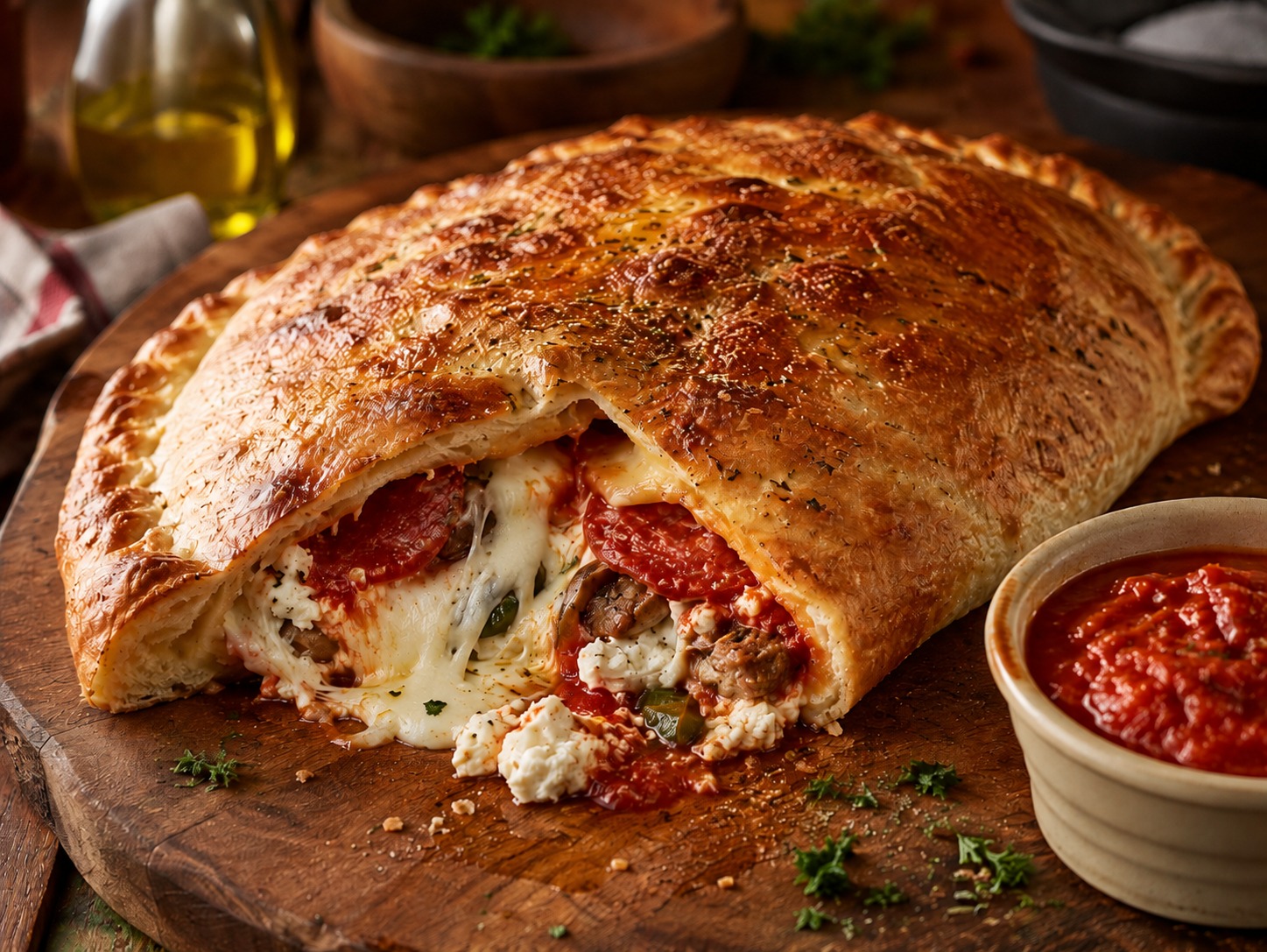
WHATEVER FLOATS YOUR BOAT
THIS ONE’S MINE
Brick-oven stuffed calzones • Makes 4 large calzones
Whatever floats your boat
Nobody ever said a calzone had to behave itself. Start with the cheese, add whatever sounds good, and if you suddenly decide it needs sausage, mushrooms, peppers, or something nobody else in the family would have thought of, go for it. The only real rule is that when you take a bite, you should want another one.
MAKES 4 large calzones |
DOUGH 4 × ~9 oz balls |
STYLE Fill it your way |
|---|
Ingredients
| • 4 balls Italian Express pizza dough, about 9 ounces each | • Thinly sliced ham, optional |
|---|---|
| • 2 pounds whole-milk ricotta | • Pepperoni, optional |
| • 1 pound low-moisture whole-milk mozzarella, shredded | • Cooked and crumbled hot Italian sausage, optional |
| • 1 cup freshly grated Locatelli Pecorino Romano | • Cooked meatballs, chopped, optional |
| • 2 large eggs | • Sautéed mushrooms, optional |
| • ¼ cup fresh flat-leaf parsley, finely chopped | • Roasted peppers, optional |
| • 2 tablespoons fresh basil, torn or chopped | • Cooked spinach, squeezed very dry, optional |
| • 3–4 cloves fresh garlic, minced | • Cooked broccoli rabe, chopped and squeezed dry, optional |
| • ½ teaspoon kosher salt | • Excellent extra-virgin olive oil, for finishing |
| • Freshly ground black pepper | • Freshly grated Locatelli Pecorino Romano, for finishing |
| • Pinch crushed red pepper flakes, optional | • Mariuch’s Marinara, served hot on the side |
| • 1 can whole peeled San Marzano tomatoes | • Sunday Sauce can work |
| • 1 teaspoon kosher salt |
Build what you love.
1. Make the internal San Marzano sauce.
Put the whole peeled San Marzano tomatoes and 1 teaspoon kosher salt in a blender. Blend until completely smooth. Set aside.
2. Make the cheese filling.
Put the ricotta in a large bowl. Add the mozzarella, Locatelli Pecorino Romano, eggs, parsley, basil, garlic, salt, pepper, and red pepper flakes if using. Mix until thoroughly combined. The filling should be creamy but firm enough to stay where you put it. If the ricotta is very wet, drain it first.
THE METHOD / PART ONE
3. Bring the dough to room temperature.
Take the dough balls from the refrigerator about two hours before baking, just as you would for pizza. Keep them covered while they warm.
4. Heat the oven.
For the brick oven, bring the floor into the same general range used for Italian Express pizza—hot enough to blister the dough quickly without burning the bottom. For a home oven, heat a pizza stone or steel at the oven’s highest setting for at least 45 minutes.
5. Stretch the dough.
Working with one ball at a time, gently stretch it into a round approximately 11 to 12 inches across. Do not roll it paper-thin. You need enough structure to hold the filling.
6. Fill it.
Place a generous amount of ricotta mixture over one half of the dough, leaving roughly a 1-inch border. Add whatever additional filling you are using. Then spoon about ¼ to ⅓ cup of the blended San Marzano sauce over the filling. Do not put too much. It is a touch of internal flavor, not enough to make the calzone wet or prevent it from sealing. Do not overload it. A calzone that cannot close is not a calzone. It is an argument.
THE METHOD / PART TWO
Fold it, seal it, bake it.
7. Fold and seal.
Fold the empty half of the dough over the filling. Press the edges together firmly, then crimp or roll the edge over itself to create a strong seal. Cut two or three small vents in the top so steam can escape.
8. Oil it.
Brush the top lightly with excellent extra-virgin olive oil. A little Locatelli Pecorino Romano over the top before baking is good too.
9. Bake.
Slide the calzone into the brick oven. Turn it as necessary so the crust colors evenly. Bake until the outside is deeply golden and blistered and the dough around the seam is fully cooked. In a home oven, bake on the preheated stone or steel until puffed, browned, and crisp, usually about 10–15 minutes, depending on oven temperature.
10. Let it sit.
Give it several minutes before cutting into it. The filling is molten. Italian food should hurt your feelings occasionally. It should not remove the roof of your mouth.
11. Serve.
Finish with a little grated Locatelli Pecorino Romano. Serve Mariuch’s Marinara hot on the side for dipping or spooning over each bite. Sunday Sauce can work, but Marinara is the standard choice.
REEK-EE’S RULE Be creative. Whatever floats your boat and whatever tastes good belongs in there. Your taste buds will guide you. |
|---|
Insalata Antipasto (Antipasto Salad)
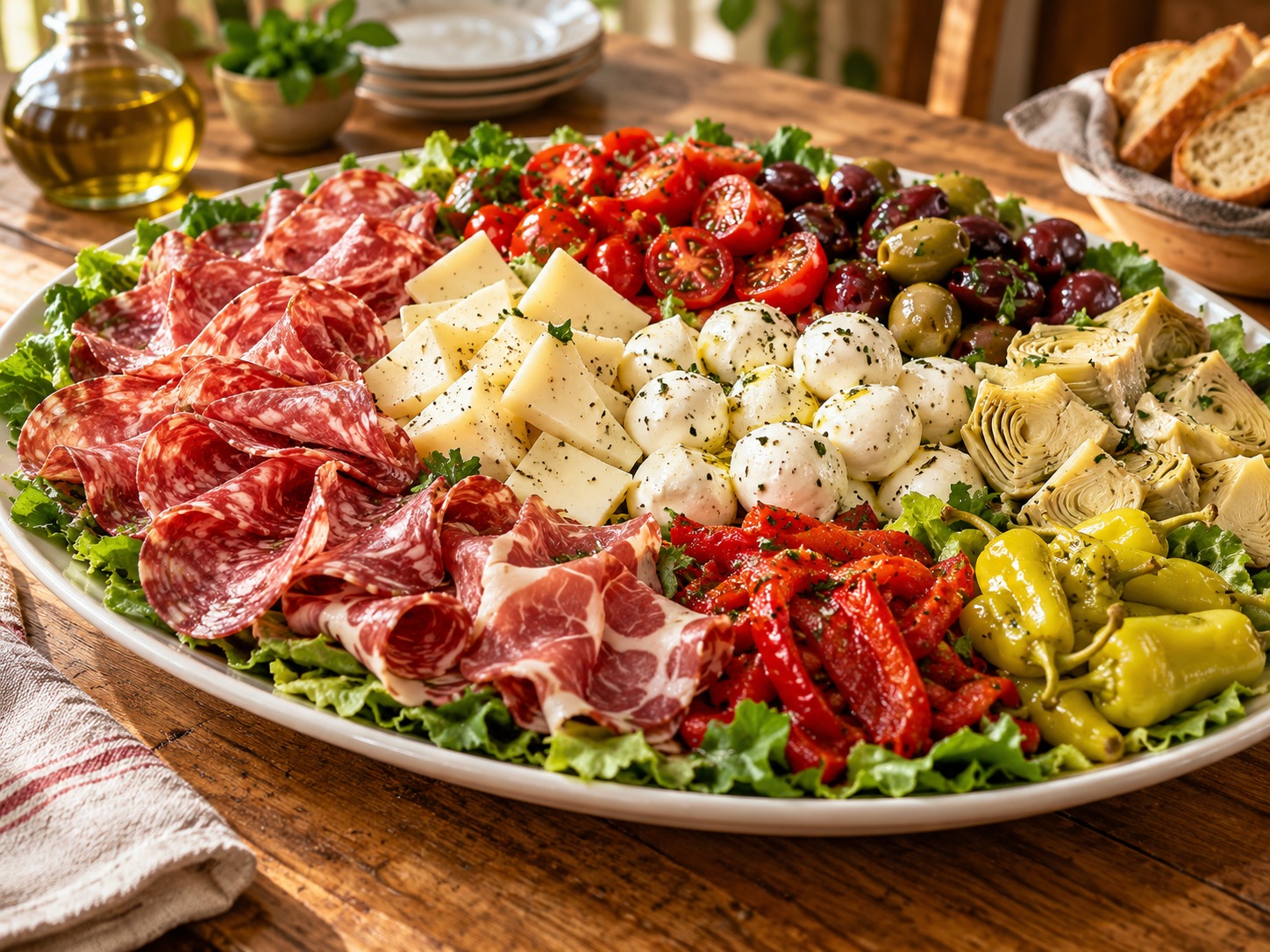
STARTERS & SALADS
Cured meats, cheeses, and pickled vegetables over crisp greens • Serves 8 • About 20 minutes
One customer ordered the antipasto salad because she wanted a light lunch. When it arrived, she looked at the platter, laughed, and asked for another napkin. The antipasto platter, on top of a salad. Salami, capocollo, provolone, olives, roasted peppers, artichokes, and chickpeas piled over crisp lettuce and tossed with a sharp red wine vinaigrette. It was a meal on its own at the counter, and the most colorful thing on the menu.
Ingredients
| • 2 heads romaine, chopped | • 1 small head radicchio, sliced |
|---|---|
| • ¼ pound Genoa salami, sliced into strips | • ¼ pound hot capocollo, sliced into strips |
| • ¼ pound sharp provolone, cubed | • 1 cup fresh mozzarella balls (ciliegine) |
| • 1 cup roasted red peppers, sliced | • 1 cup marinated artichoke hearts, quartered |
| • 1 can (15 ounces) chickpeas, rinsed | • ½ cup Kalamata olives |
| • ½ cup pepperoncini | • 1 pint cherry tomatoes, halved |
| • Dressing: ½ cup extra-virgin olive oil | • 3 tablespoons red wine vinegar |
| • 1 teaspoon dried oregano | • 1 garlic clove, minced, salt, and pepper |
THE METHOD
1. Make the dressing.
Shake the oil, vinegar, oregano, garlic, salt, and pepper in a jar.
2. Build the base.
Spread the romaine and radicchio on a big platter.
3. Pile it on.
Arrange the meats, cheeses, peppers, artichokes, chickpeas, olives, pepperoncini, and tomatoes in rows or piles on top.
4. Dress and serve.
Drizzle the dressing over right before serving, or toss it all together at the table.
MARIUCH SAYS
It’s a salad because it has lettuce. Don’t ask any more questions.
REEK-EE SAYS: Lay everything out in rows on the platter before you toss it. Let people see it first. This salad deserves a little applause before it gets eaten. |
|---|
STARTERS & SALADS
Caesar Salad
Crisp romaine, garlic croutons, and a real Caesar dressing • Serves 8 • About 25 minutes
Mariuch handed the spoon back to me when my Caesar dressing needed more lemon. She waited while I tasted it a second time and reached for the other half. A real Caesar, with homemade garlic croutons and a dressing built from anchovy, garlic, lemon, and plenty of Locatelli. The Caesar salad was born in Tijuana, Mexico, in the 1920s, from an Italian immigrant chef, and it has been on Italian tables ever since.
Ingredients
| • 3 hearts of romaine, chopped | • Croutons: 4 cups cubed Italian bread |
|---|---|
| • ¼ cup olive oil | • 2 garlic cloves, minced |
| • Dressing: 4 anchovy fillets | • 2 garlic cloves |
| • 2 pasteurized egg yolks (or 3 tablespoons mayonnaise) | • 2 tablespoons fresh lemon juice |
| • 1 teaspoon Dijon mustard | • 1 teaspoon Worcestershire sauce |
| • ½ cup olive oil | • ½ cup grated Locatelli Pecorino Romano, plus more for the top |
| • Black pepper |
THE METHOD
1. Make the croutons.
Heat the oven to 375°F. Toss the bread with the oil and garlic and bake 10 to 12 minutes, until golden and crunchy.
2. Make the dressing.
Mash the anchovies and garlic into a paste. Whisk in the yolks, lemon juice, mustard, and Worcestershire. Slowly whisk in the oil until thick. Stir in the Locatelli and pepper.
3. Toss.
Toss the romaine with the dressing until every leaf is coated. Add the croutons and shave more Locatelli on top.
MARIUCH SAYS
You don’t like anchovies? You’ve been eating them in the dressing for forty years. Sit down.
REEK-EE SAYS: Use pasteurized eggs or mayonnaise for the dressing. Same flavor, and nobody spends the night worrying about raw yolks. That includes me. |
|---|
STARTERS & SALADS
Insalata di Tortellini (Tortellini Pasta Salad)
Cheese tortellini with salami, vegetables, and Italian dressing • Serves 10 • About 30 minutes
At a graduation party, I went to put the tortellini salad away and found a cousin standing over the bowl with a fork. There was very little left to refrigerate. Cheese tortellini tossed with salami, fresh mozzarella, cherry tomatoes, olives, and roasted peppers in a zesty Italian dressing. It is the pasta salad that empties first at every cookout and graduation party.
Ingredients
| • 2 pounds cheese tortellini, fresh or frozen | • ¼ pound Genoa salami, diced |
|---|---|
| • 1 cup fresh mozzarella balls | • 1 pint cherry tomatoes, halved |
| • ½ cup black olives, sliced | • 1 cup roasted red peppers, chopped |
| • ½ red onion, thinly sliced | • ½ cup fresh basil, torn |
| • ½ cup grated Locatelli Pecorino Romano | • Dressing: ⅔ cup olive oil |
| • ¼ cup red wine vinegar | • 1 teaspoon dried oregano |
| • 1 garlic clove, minced | • Salt and pepper |
THE METHOD
1. Cook the tortellini.
Boil until just tender. Drain, rinse under cold water, and toss with a little oil so they don’t stick.
2. Make the dressing.
Shake everything for the dressing in a jar.
3. Toss.
Toss the tortellini with the salami, mozzarella, tomatoes, olives, peppers, onion, and half the dressing.
4. Chill and finish.
Chill at least 1 hour. Right before serving, add the rest of the dressing, the basil, and the Locatelli.
MARIUCH SAYS
Make extra. There’s always somebody standing at the bowl with a fork.
REEK-EE SAYS: Save half the dressing for right before you serve it. Overnight in the fridge, tortellini drink dressing like they just walked in from the desert. |
|---|
STARTERS & SALADS
Classic Elbow Macaroni Salad
Old-fashioned creamy macaroni salad • Serves 10 • About 30 minutes, plus chilling
Our summer table had sausage and peppers, Italian bread, and a big bowl of macaroni salad. We passed all three without discussing which country they belonged to. The macaroni salad from every summer of our lives. Elbow macaroni in a creamy, tangy dressing with celery, onion, peppers, and hard-boiled eggs. Not fancy. Not Italian. Absolutely required.
Ingredients
| • 1 pound elbow macaroni | • 1½ cups mayonnaise |
|---|---|
| • 2 tablespoons white vinegar | • 1 tablespoon yellow mustard |
| • 1 tablespoon sugar | • 1 teaspoon kosher salt |
| • ½ teaspoon black pepper | • 3 celery ribs, finely chopped |
| • ½ red onion, finely chopped | • ½ red bell pepper, finely chopped |
| • 3 hard-boiled eggs, chopped | • 2 tablespoons sweet pickle relish |
| • Paprika for the top |
THE METHOD
1. Cook the macaroni.
Boil until just tender. Drain and rinse under cold water until cool. Drain well.
2. Make the dressing.
Whisk the mayonnaise, vinegar, mustard, sugar, salt, and pepper.
3. Mix.
Fold the macaroni, celery, onion, pepper, eggs, and relish into the dressing.
4. Chill.
Cover and refrigerate at least 2 hours. Stir and add a spoonful of mayonnaise if it looks dry. Dust with paprika.
MARIUCH SAYS
It’s not Italian, but neither is half this family. Make it anyway.
REEK-EE SAYS: Keep it cold. Give it no more than an hour on the picnic table, then back in the cooler. Above 90°F, serve small batches and keep the rest on ice. This is the one rule at the cookout I will actually enforce. |
|---|
Arancini (Fried Rice Balls)
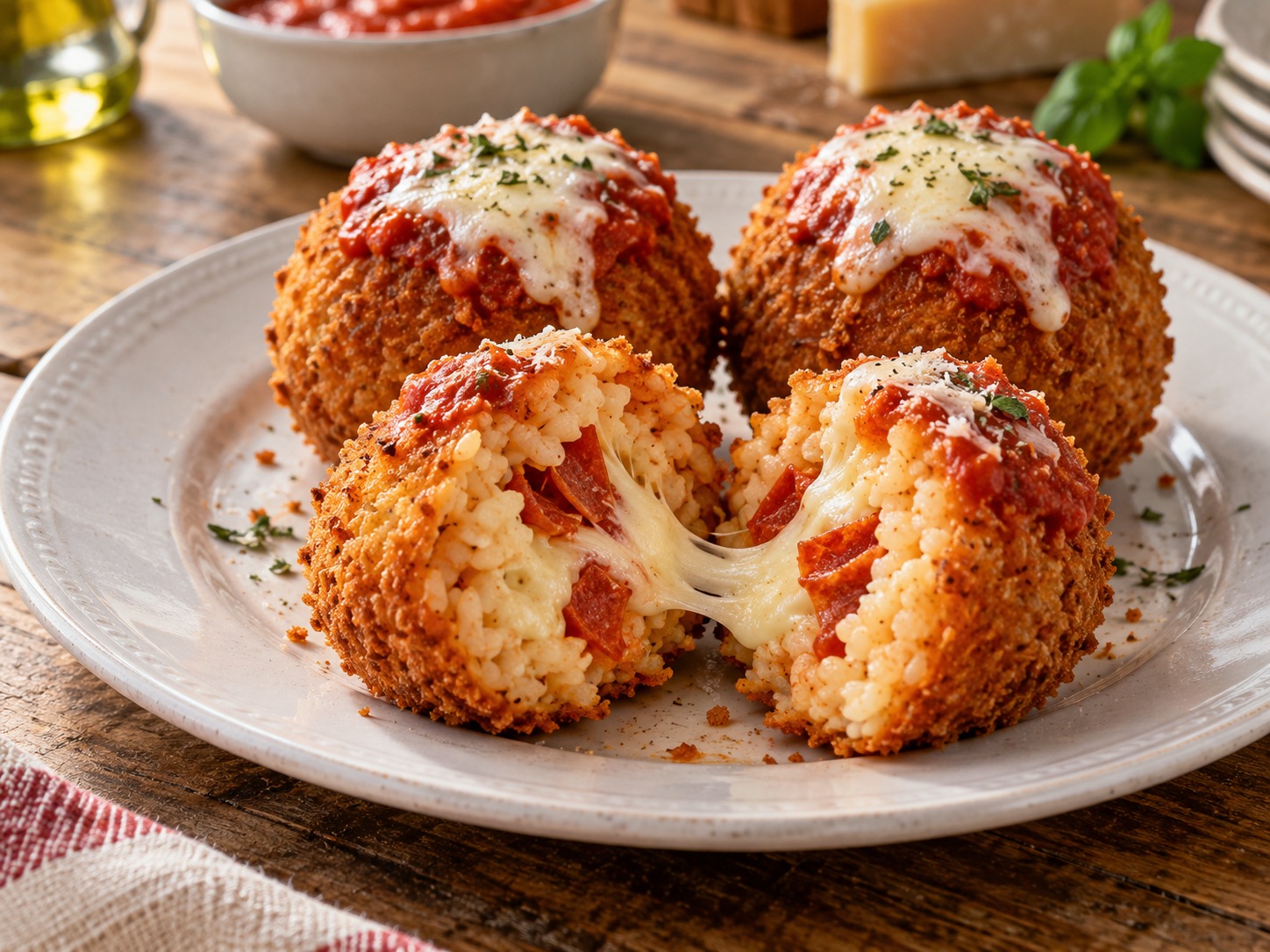
BEFORE EVERYBODY SITS DOWN
Panko-coated rice balls with mozzarella and pepperoni • Makes about 20 • About 1½ hours, plus chilling
When a customer asked what was inside our rice balls, I cut one open. The mozzarella stretched between the halves before I could explain the pepperoni. Arancini means little oranges, because that is what they look like coming out of the fryer. At Italian Express, the rice is rolled around mozzarella and pepperoni, coated in panko, and deep-fried golden. Sauce and more mozzarella go on top. Break one open and the cheese pulls in long strings.
Ingredients
| • 2 cups Arborio rice | • 5 cups chicken broth |
|---|---|
| • 2 tablespoons butter | • 1 cup grated Locatelli Pecorino Romano |
| • 2 eggs, plus 3 eggs for breading | • Pinch of saffron (optional) |
| • 4 ounces pepperoni, finely diced, for the center | • 8 ounces mozzarella, cut into ½-inch cubes |
| • 1 cup all-purpose flour | • 3 cups panko breadcrumbs |
| • Vegetable oil for frying | • 2 cups Mariuch’s Marinara and 1 cup shredded mozzarella, for topping |
THE METHOD
1. Make the rice.
Simmer the rice in the broth with the saffron, stirring often, about 18 minutes, until thick and creamy. Stir in the butter and Locatelli. Spread on a sheet pan and chill until cold, at least 2 hours or overnight.
2. Shape them.
Beat 2 eggs into the cold rice. With wet hands, flatten a scoop of rice in your palm, add a cube of mozzarella and some diced pepperoni, and close the rice around it into a ball.
3. Bread them.
Roll each ball in flour, then beaten eggs, then panko.
4. Fry.
Heat 3 inches of oil to 350°F. Fry a few at a time, 4 to 5 minutes, until deep golden and hot in the center. Drain on a rack.
5. Serve.
Spoon warm Mariuch’s Marinara over the hot arancini and scatter the shredded mozzarella on top. Put them under the broiler briefly, just until the mozzarella melts. Serve right away.
MARIUCH SAYS
Cold rice. If the rice is warm, the ball falls apart, and so do I.
REEK-EE SAYS: Make the rice the day before and chill it. Too much risotto is not a tragedy. In this family, it's tomorrow's arancini. |
|---|
BEFORE EVERYBODY SITS DOWN
Bruschetta
Grilled bread with fresh tomatoes, garlic, and basil • Serves 8 • About 20 minutes
The tomatoes came into the kitchen warm from the sun. I usually ate one with salt over the sink before I began making the bruschetta. Thick slices of grilled Italian bread rubbed with garlic and piled with chopped ripe tomatoes, basil, and good olive oil. It is the simplest thing in this book and one of the best, as long as the tomatoes are ripe.
Ingredients
| • 1 loaf crusty Italian bread, sliced ¾ inch thick | • 4 cups ripe tomatoes, diced (about 6 plum tomatoes) |
|---|---|
| • ¼ cup fresh basil, torn | • 1 garlic clove, minced, plus 2 whole cloves for rubbing |
| • ⅓ cup extra-virgin olive oil, plus more for brushing | • 1 tablespoon red wine vinegar or balsamic |
| • Kosher salt and black pepper | • Locatelli Pecorino Romano for shaving (optional) |
THE METHOD
1. Make the topping.
Toss the tomatoes, basil, minced garlic, oil, vinegar, salt, and pepper. Let it sit 15 minutes so the juices come out.
2. Grill the bread.
Brush the bread with oil and grill or broil until golden and crisp on both sides.
3. Rub with garlic.
Rub one side of each hot slice with a cut garlic clove.
4. Top and serve.
Spoon the tomatoes on at the last minute so the bread stays crisp. Shave Locatelli over the top if you like.
MARIUCH SAYS
If the tomato doesn’t smell like a tomato, wait till August.
REEK-EE SAYS: Top them right before they go out. Bruschetta that's been sitting for half an hour isn't an appetizer anymore. It's wet toast with a past. |
|---|
BEFORE EVERYBODY SITS DOWN
Funghi Ripieni (Stuffed Mushrooms)
Mushroom caps stuffed with sausage, breadcrumbs, and cheese • Makes about 24 • About 45 minutes
I learned to put the stuffed mushrooms on a platter and carry them out immediately. Leaving them on the counter gave everybody permission. Bite-sized mushroom caps filled with sausage, garlic, breadcrumbs, and Locatelli, then baked until golden. They disappear off the tray faster than you can carry it into the room.
Ingredients
| • 24 large white or cremini mushrooms | • ½ pound sweet Italian sausage, casings removed |
|---|---|
| • 2 tablespoons olive oil, plus more for drizzling | • 3 garlic cloves, minced |
| • ½ cup Italian breadcrumbs | • ½ cup grated Locatelli Pecorino Romano |
| • 2 ounces cream cheese, softened | • 2 tablespoons chopped parsley |
| • Salt and pepper |
THE METHOD
1. Prep the mushrooms.
Heat the oven to 400°F. Wipe the mushrooms clean, pop out the stems, and finely chop the stems.
2. Cook the filling.
Brown the sausage in the oil, breaking it up fine, until cooked through. Add the chopped stems and garlic and cook 5 minutes.
3. Mix.
Off the heat, stir in the breadcrumbs, Locatelli, cream cheese, parsley, salt, and pepper.
4. Stuff and bake.
Mound the filling into the caps. Set on a sheet pan, drizzle with oil, and bake 18 to 20 minutes, until golden and the mushrooms are tender.
MARIUCH SAYS
Wipe the mushrooms, don’t wash them. They drink water like a sponge and then they cry in the oven.
REEK-EE SAYS: Bake them on a rack over the sheet pan. Mushrooms let go of their juice in the oven, and they shouldn't have to sit in it like a kid in a wet bathing suit. |
|---|
BEFORE EVERYBODY SITS DOWN
Uova Ripiene (Deviled Eggs)
Creamy deviled eggs with an Italian touch • Makes 24 • About 30 minutes
People liked to keep me company while I filled the deviled eggs. They stood close enough to take one without interrupting the conversation. Classic deviled eggs, made the Italian Express way with a little Locatelli and a sprinkle of paprika and parsley on top. Every holiday table has a plate of these, and every holiday table runs out.
Ingredients
| • 12 large eggs | • ½ cup mayonnaise |
|---|---|
| • 1 teaspoon Dijon mustard | • 1 teaspoon white vinegar |
| • 2 tablespoons finely grated Locatelli Pecorino Romano | • Salt and white pepper |
| • Paprika | • Chopped parsley or chives |
THE METHOD
1. Cook the eggs.
Put the eggs in a pot, cover with cold water by an inch, and bring to a boil. Turn off the heat, cover, and let sit 12 minutes. Move to ice water until cold.
2. Halve them.
Peel the eggs and cut in half lengthwise. Pop the yolks into a bowl.
3. Make the filling.
Mash the yolks with the mayonnaise, mustard, vinegar, Locatelli, salt, and pepper until smooth.
4. Fill and finish.
Spoon or pipe the filling into the whites. Dust with paprika and sprinkle with parsley. Keep cold until serving.
MARIUCH SAYS
Make two dozen. One dozen is for the table. The other dozen disappears in the kitchen while you’re making them.
REEK-EE SAYS: Use eggs that have been in the fridge about a week. Fresh eggs hang onto their shells and you end up serving deviled craters. This is the one time older is better. I'm choosing to take that personally. |
|---|
Cannoli
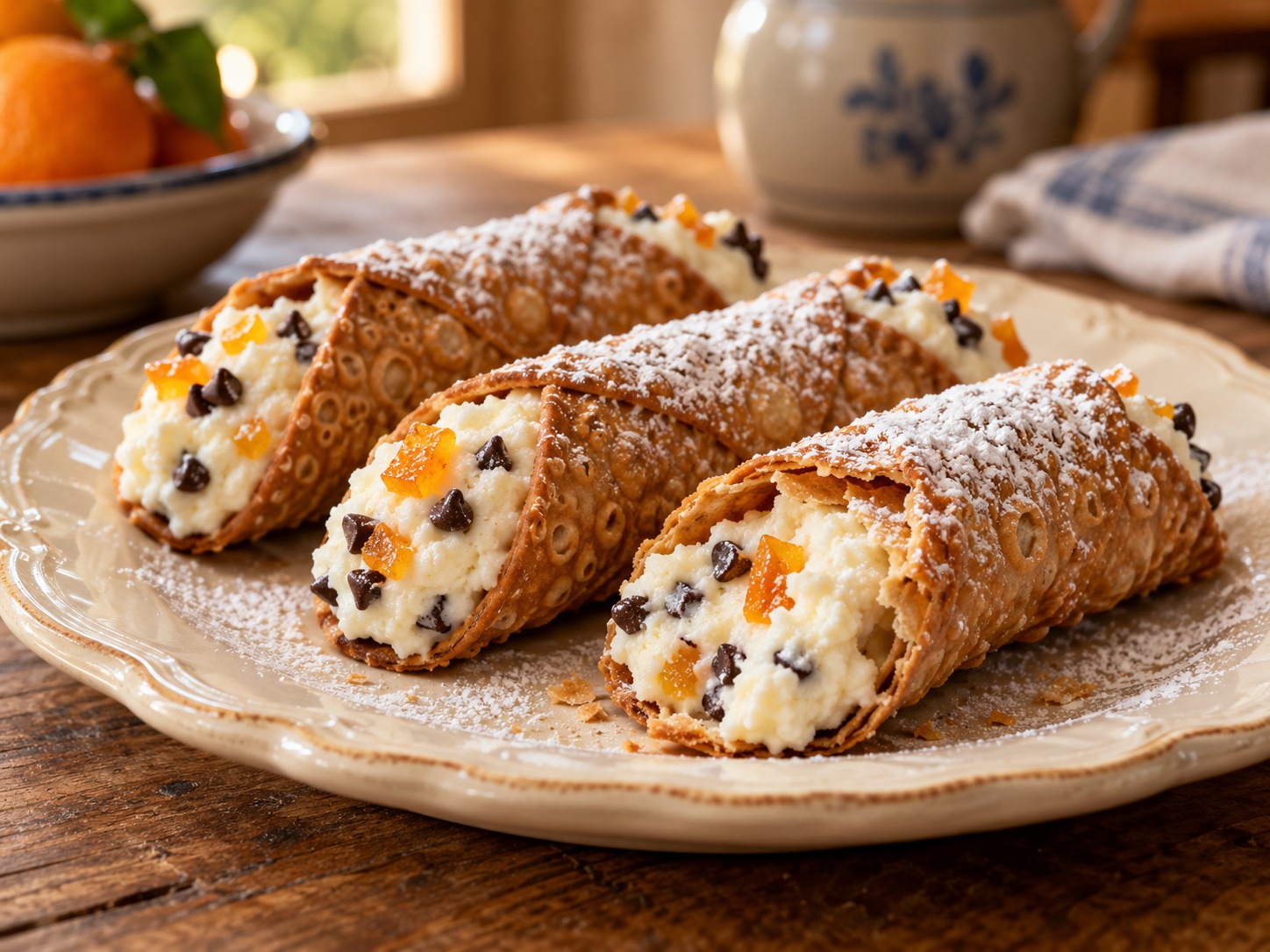
SAVE ROOM
Crisp fried shells with sweet ricotta cream • Makes about 24 • About 2 hours, plus chilling
Behind the counter, I filled cannoli while customers watched. Once the ricotta reached the second end, they generally stopped asking whether we had anything smaller. Crisp, bubbly fried shells filled with sweet, creamy ricotta, chocolate chips, and a hint of orange, with the ends dipped in pistachios. Fill them right before serving, and you will understand why people stand in line for them.
Ingredients
| • Shells: 2 cups all-purpose flour | • 2 tablespoons sugar |
|---|---|
| • 1 tablespoon unsweetened cocoa powder | • ½ teaspoon cinnamon |
| • Pinch of salt | • 3 tablespoons butter, cold |
| • 1 egg, plus 1 egg white for sealing | • ½ cup sweet Marsala wine |
| • Vegetable oil for frying | • Filling: 2 pounds whole-milk ricotta, drained overnight |
| • 1¼ cups powdered sugar, plus more for dusting | • 1 teaspoon vanilla |
| • Zest of 1 orange | • ¾ cup mini chocolate chips |
| • ½ cup chopped pistachios | • Cannoli tubes |
THE METHOD
1. Make the dough.
Mix the flour, sugar, cocoa, cinnamon, and salt. Cut in the butter. Add the egg and Marsala and knead into a firm, smooth dough. Wrap and rest 1 hour.
2. Roll and wrap.
Roll the dough very thin. Cut 4-inch circles, wrap each around a cannoli tube, and seal the overlap with egg white.
3. Fry the shells.
Heat 3 inches of oil to 350°F. Fry 2 to 3 minutes, until blistered and golden. Cool slightly, then slide the shells off the tubes.
4. Make the filling.
Beat the drained ricotta with the powdered sugar, vanilla, and orange zest until smooth. Fold in the chocolate chips. Chill.
5. Fill and serve.
Pipe the filling into the shells right before serving. Dip the ends in pistachios and dust with powdered sugar.
MARIUCH SAYS
Fill them when people sit down, not in the morning. A soggy cannoli is a crime in this family.
REEK-EE SAYS: Drain the ricotta overnight in a strainer over a bowl. It's the easiest step in the recipe. All you have to do is go to bed. |
|---|
Tiramisù
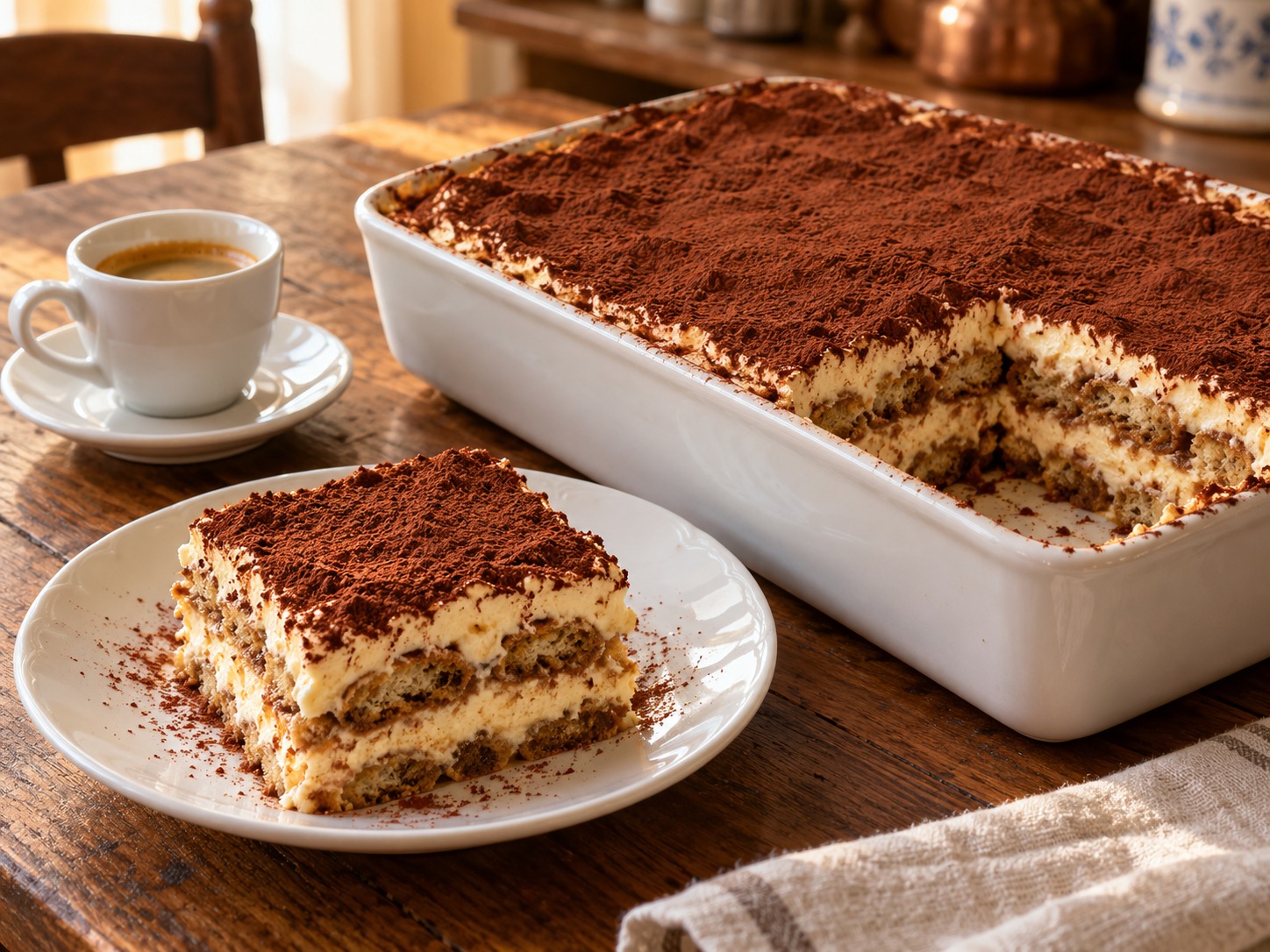
SAVE ROOM
Espresso-soaked ladyfingers with mascarpone cream • Serves 12 • About 40 minutes, plus overnight
A spoon mark appeared in the corner of the tiramisù overnight. At breakfast, everybody agreed it must have been somebody else. Tiramisù means pick me up, and with all that espresso, it does. Ladyfingers dipped in strong coffee are layered with a light mascarpone cream and finished with a dusting of cocoa. It has to sit overnight, which is the hardest part of the recipe.
Ingredients
| • 6 egg yolks (pasteurized eggs recommended) | • ¾ cup sugar |
|---|---|
| • 1 pound mascarpone, at room temperature | • 1½ cups heavy cream, cold |
| • 2 cups strong brewed espresso, cooled | • 3 tablespoons coffee liqueur or Marsala (optional) |
| • 2 packages (7 ounces each) Italian ladyfingers (savoiardi) | • Unsweetened cocoa powder for dusting |
| • Shaved dark chocolate (optional) |
THE METHOD
1. Make the cream.
Whisk the yolks and sugar in a bowl over simmering water until thick and pale and the mixture reaches 160°F on a thermometer. Cool. Beat in the mascarpone until smooth.
2. Whip the cream.
Whip the heavy cream to stiff peaks and fold it gently into the mascarpone.
3. Dip the ladyfingers.
Mix the espresso and liqueur. Dip each ladyfinger quickly, one second per side, and lay them in a 9 × 13-inch dish.
4. Layer.
Spread half the cream over the ladyfingers. Repeat with a second layer of dipped ladyfingers and the rest of the cream.
5. Chill.
Cover and refrigerate at least 8 hours, or overnight. Dust heavily with cocoa right before serving.
MARIUCH SAYS
One second in the coffee. Two seconds and it’s a sponge. Three and it’s soup.
REEK-EE SAYS: Cook the yolks and sugar over simmering water, whisking steadily, until a thermometer reads 160°F. It makes the cream silkier, too. This is the one step I won't let you skip, and I let you skip a lot. |
|---|
SAVE ROOM
Torta al Limoncello e Mascarpone (Limoncello Mascarpone Cake)
Lemon sponge layered with limoncello mascarpone cream • Serves 12 • About 1½ hours, plus chilling
After dinner, a guest handed me the back of an envelope and asked me to write down what was in the cake. Limoncello was the first word I wrote. Light lemon cake layers brushed with limoncello and filled with a fluffy mascarpone cream. It tastes like a summer afternoon on the Amalfi Coast, and it is the dessert people ask about after they leave.
Ingredients
| • Cake: 2½ cups all-purpose flour | • 2 teaspoons baking powder |
|---|---|
| • ½ teaspoon salt | • 1 cup butter, softened |
| • 1½ cups sugar | • 4 eggs |
| • Zest of 2 lemons | • ¼ cup fresh lemon juice |
| • ¾ cup whole milk | • Syrup: ⅓ cup limoncello and ⅓ cup sugar, warmed together until dissolved |
| • Cream: 1 pound mascarpone | • 1½ cups heavy cream, cold |
| • ¾ cup powdered sugar | • 3 tablespoons limoncello |
| • Zest of 1 lemon |
THE METHOD
1. Bake the cake.
Heat the oven to 350°F and grease two 9-inch round pans. Beat the butter and sugar until fluffy. Beat in the eggs one at a time and the zest. Add the flour, baking powder, and salt alternately with the milk and lemon juice. Divide into the pans and bake 25 to 30 minutes, until a toothpick comes out clean. Cool completely.
2. Make the cream.
Beat the mascarpone, cream, powdered sugar, limoncello, and zest until thick and fluffy.
3. Soak and layer.
Slice each cake in half to make four layers. Brush each layer with the limoncello syrup and spread with the cream.
4. Finish and chill.
Cover the top and sides with cream. Chill at least 2 hours. Decorate with lemon zest or thin lemon slices.
MARIUCH SAYS
A little limoncello in the cake, a little limoncello for the baker. It’s called balance.
REEK-EE SAYS: Let the cake cool all the way before the cream goes on. A warm cake melts mascarpone into a puddle. Have a little limoncello while you wait. Mariuch would call that balance. |
|---|
SAVE ROOM
Mariuch’s Cheesecake
Creamy ricotta and cream cheese cheesecake • Serves 12 • About 1½ hours, plus overnight
I hovered while Mariuch checked the cheesecake, wanting a definite answer about whether it was done. She watched the center move and closed the oven again. A cheesecake that sits right between New York and Italy: cream cheese for richness, ricotta for lightness, a graham cracker crust, and a touch of lemon and vanilla. It bakes slowly, cools slowly, and rests overnight. Good things take time.
Ingredients
| • Crust: 1½ cups graham cracker crumbs | • ¼ cup sugar |
|---|---|
| • 6 tablespoons butter, melted | • Filling: 2 pounds cream cheese, at room temperature |
| • 1 pound whole-milk ricotta, drained | • 1¼ cups sugar |
| • 5 eggs, at room temperature | • ½ cup sour cream |
| • 2 tablespoons all-purpose flour | • Zest of 1 lemon |
| • 2 teaspoons vanilla |
THE METHOD
1. Make the crust.
Heat the oven to 350°F. Mix the crumbs, sugar, and butter and press into the bottom of a 9-inch springform pan. Bake 10 minutes. Lower the oven to 325°F.
2. Make the filling.
Beat the cream cheese and ricotta until completely smooth. Beat in the sugar, then the eggs one at a time on low speed. Mix in the sour cream, flour, zest, and vanilla.
3. Bake it gently.
Wrap the outside of the pan in foil and set it in a roasting pan. Pour in the filling. Add hot water to the roasting pan halfway up the sides. Bake 1 hour 15 minutes, until the edges are set and the center jiggles slightly.
4. Cool slowly.
Turn off the oven, crack the door, and leave it inside 1 hour. Then refrigerate overnight.
MARIUCH SAYS
Everything at room temperature. Cold cream cheese makes lumps, and lumps are not invited.
REEK-EE SAYS: Once the eggs go in, beat on low. Too much air and the top cracks like the Grand Canyon. You can cover it with fruit, but we'll all know. |
|---|
SAVE ROOM
Mariuch’s Bread Pudding
Day-old Italian bread baked in a cinnamon custard • Serves 10 • About 1¼ hours
Yesterday’s bread stayed on the counter until Mariuch set a baking dish beside it. Then she sent me to the refrigerator for the eggs. Nothing went to waste in Mariuch’s kitchen, and that includes yesterday’s bread. Day-old Italian bread soaks in a rich custard of eggs, milk, cream, cinnamon, and vanilla, then bakes until puffed and golden on top and soft in the middle. Serve it warm with a drizzle of caramel or a spoon of whipped cream.
Ingredients
| • 1 loaf (about 1 pound) day-old Italian bread, cut into 1-inch cubes | • 4 tablespoons butter, melted |
|---|---|
| • 6 eggs | • 2½ cups whole milk |
| • 1 cup heavy cream | • ¾ cup sugar |
| • 2 teaspoons vanilla | • 1 teaspoon cinnamon |
| • ¼ teaspoon nutmeg | • Pinch of salt |
| • ½ cup raisins (optional) | • Caramel sauce or whipped cream for serving |
THE METHOD
1. Prep the bread.
Toss the bread cubes with the melted butter and spread them in a buttered 9 × 13-inch dish. Scatter the raisins if using.
2. Make the custard.
Whisk the eggs, milk, cream, sugar, vanilla, cinnamon, nutmeg, and salt.
3. Soak.
Pour the custard over the bread and press it down. Let it soak 30 minutes so every piece drinks it up.
4. Bake.
Heat the oven to 350°F. Bake 45 to 50 minutes, until puffed, golden, and set in the center (160°F).
5. Serve warm.
Let it cool 10 minutes. Serve warm with caramel or whipped cream.
MARIUCH SAYS
Stale bread is not garbage. It’s dessert waiting for its chance.
REEK-EE SAYS: Use bread that's a day or two old. Fresh bread falls apart in the custard. Stale bread holds its shape. Finally, something in this kitchen gets better by doing absolutely nothing. |
|---|
The Feasts
Plans, stories, and recipes for gathering through the year
Carnevale • St. Joseph’s Day • Easter • Labor Day
San Gennaro • Christmas • New Year’s Eve
Carnevale
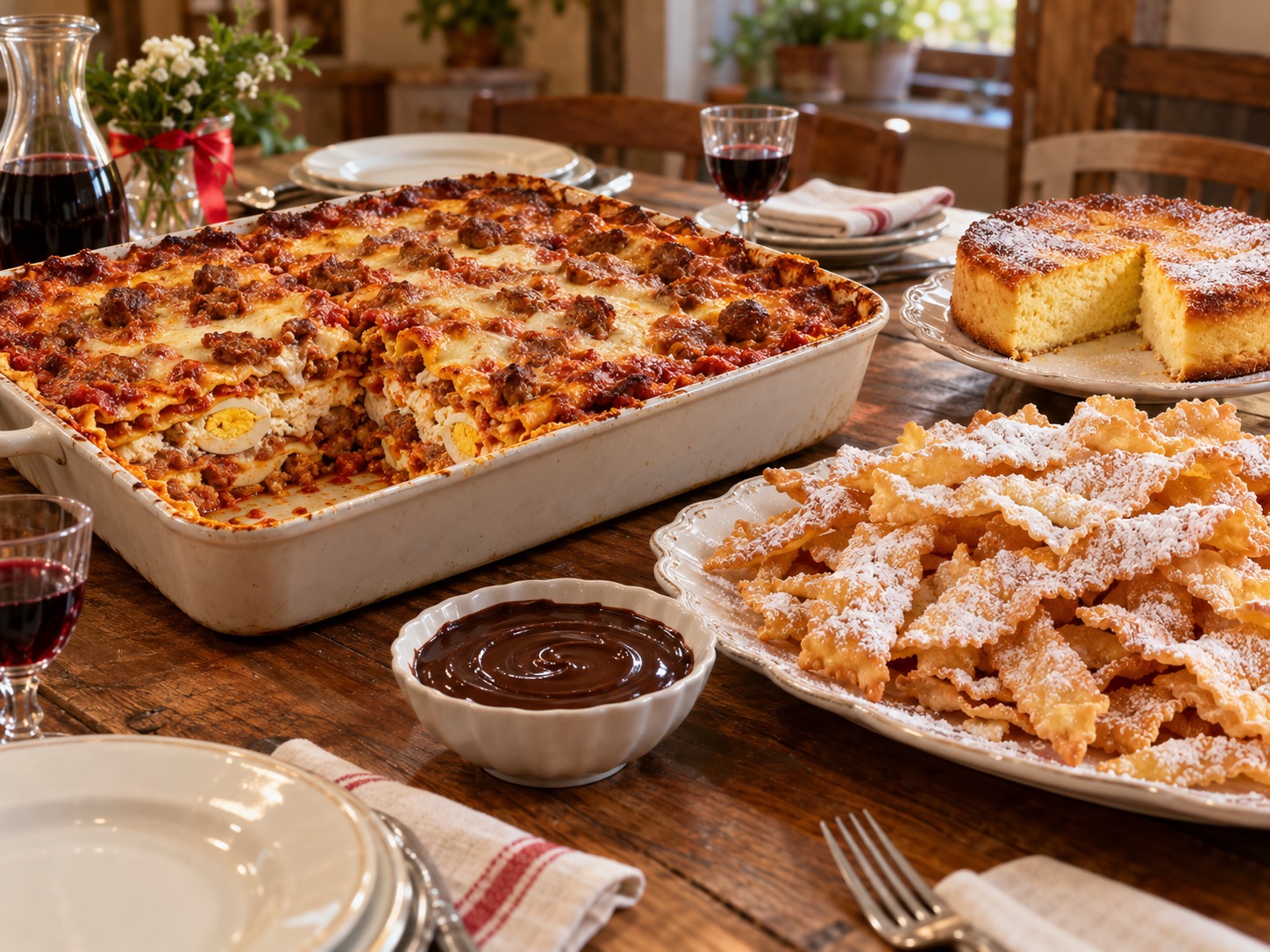
FROM MARIUCH'S KITCHEN
The last big feast before Lent, Naples style, for about ten people
LASAGNA DI CARNEVALE | CHIACCHIERE | SANGUINACCIO | MIGLIACCIO
GETTING READY
The Plan
Carnevale ends on Martedì Grasso, Fat Tuesday, the day before Ash Wednesday. The lasagna is a weekend project, so the ragù is made on Saturday, the lasagna is built on Monday, and it bakes Tuesday while the house fills up. The sweets are all made a day ahead.
SATURDAY
Make the ragù. It needs about three hours. Divide it into shallow containers and refrigerate within two hours.
SUNDAY
Make the little meatballs and cook the sausage through. Refrigerate promptly after cooking.
Hard boil the eggs.
Set the ricotta for the migliaccio in a strainer in the fridge to drain.
MONDAY
|
|
|---|
MARTEDÌ GRASSO (FAT TUESDAY)
Keep the lasagna refrigerated until the oven is ready. Bake it until the center reaches 165°F, then let it rest 30 minutes.
Dust the chiacchiere with powdered sugar and set them out with a bowl of sanguinaccio for dipping.
Slice the migliaccio for dessert with coffee.
BEFORE LENT
Anything Goes at Carnevale
Carnevale is the party before the fast. The name is often linked to old Latin words for "taking away the meat." In the older fasting tradition, the weeks beginning on Ash Wednesday meant giving up much of the rich food on the table. The last days before Lent were for using it up, with masks, parades, pranks, and generous cooking. Italians say "a Carnevale ogni scherzo vale," at Carnevale, every joke is fair game. In Naples, the mask of Carnevale is Pulcinella, the clever, hungry clown in white with the black half mask, who never met a plate of pasta he did not love.
|
|
|---|
CARNEVALE
Lasagna di Carnevale
This is the king of lasagne, the one Naples saves for the last feast before Lent. Layer after layer of pasta is filled with slow cooked ragù, tiny fried meatballs, sausage, ricotta, mozzarella, sliced hard boiled eggs, and grated cheese. It is everything Lent is about to take away, all in one pan. It takes a weekend to make and about ten minutes to disappear.
| SERVES 10 TO 12 (ONE 9 BY 13-INCH PAN AT LEAST 3 INCHES DEEP, OR TWO SHALLOWER PANS) |
|---|
RAGÙ
|
|
|---|
LITTLE MEATBALLS
|
|
|---|
LAYERS
|
|
|---|
THE METHOD
Make the ragù: warm the oil in a big heavy pot and brown the ribs and beef on all sides. Add the onion and cook until soft. Pour in the wine and let it bubble away.
Stir in the tomato paste for 1 minute, then add the tomatoes, basil, a pinch of salt, and a cup of water. Simmer, partly covered, about 3 hours, stirring now and then, until thick and dark. Take out the meat and serve it another day, or shred some into the sauce.
Make the meatballs: mix everything except the frying oil with your hands. Roll into tiny balls the size of a marble. Fry in a little oil until browned and cooked through, reaching 160°F, then drain.
Brown the sausage in a skillet, breaking it into small crumbles. Cook through to 160°F, then drain.
Cook the lasagna sheets in salted boiling water 2 minutes less than the package says. Lay them flat on oiled sheet pans so they do not stick.
Stir a ladle of ragù into the ricotta to loosen it.
Spread a ladle of ragù in the pan. Lay down a layer of pasta. Dot with ricotta, then scatter meatballs, sausage, egg slices, mozzarella, and grated cheese. Spoon ragù over it all.
Repeat for about four or five layers, leaving room below the rim. If the pan cannot hold everything, use a second pan; do not force it into one. Finish with pasta, a generous layer of ragù, the last of the mozzarella, and a heavy shower of grated cheese.
Heat the oven to 375°F. For a deep, chilled lasagna, cover with foil and bake about 50 to 60 minutes, then uncover and bake 20 to 30 minutes more. Check the center reaches 165°F and the top is browned; shallow pans may finish sooner.
Let it rest at least 30 minutes before cutting, so the layers hold.
REEK-EE AND MARIUCH SAY Little meatballs. You should find several in a slice, not one large meatball announcing that it owns the whole pan. Give it the full half hour. The layers need to settle. The people hovering over the pan can settle too. Build it Monday and keep it in the refrigerator. Tuesday already has enough work without asking you to construct dinner while everybody watches. |
|---|
THE SWEETS
Chiacchiere (Crisp Fried Ribbons)
Chiacchiere means "chatter," and these are as light as gossip. Thin sheets of sweet dough are cut into ribbons, fried in seconds until blistered and golden, then buried in powdered sugar. Every region of Italy makes them and calls them something different, but in Naples they are chiacchiere, and they are always served with a bowl of chocolate sanguinaccio for dipping.
| MAKES ABOUT 60 |
|---|
WHAT YOU NEED
|
|
|---|
THE METHOD
Mix the flour, sugar, baking powder, and salt. Add the eggs, butter, wine, and zest and knead into a smooth, firm dough, about 5 minutes. Wrap and rest 30 minutes.
Cut the dough into four pieces. Roll each one paper thin, about the thickness of a playing card. A pasta machine makes this easy; go to the second thinnest setting.
With a fluted pastry wheel or a knife, cut into strips about 2 by 5 inches. Cut a small slit in the middle of each one.
Heat 2 inches of oil to 350°F.
Fry a few at a time, 20 to 30 seconds per side, just until blistered and light golden. They cook in a blink.
Drain on paper towels. When cool, pile them high and cover with powdered sugar.
REEK-EE AND MARIUCH SAY Thin enough that you begin to doubt yourself. That is where crisp lives. A thick ribbon has become a cracker. Stay beside the pot. This is not the moment to answer the door and hear somebody’s whole story. Cool them fully, keep them dry in a tin or paper bag, and save the powdered sugar for serving. Steam and crisp pastry are a bad marriage. |
|---|
THE SWEETS
Sanguinaccio (Chocolate Cream for Dipping)
Sanguinaccio is the thick, spiced chocolate cream Naples serves with chiacchiere at Carnevale. The name comes from the Italian word for blood: older versions combined pig's blood from the winter butchering with chocolate, sugar, and spices. This version leaves out the blood. It is rich, dark, and scented with cinnamon and orange. The history can wait until everyone has tasted the chocolate.
| MAKES ABOUT 5 CUPS |
|---|
WHAT YOU NEED
|
|
|---|
THE METHOD
In a heavy saucepan, whisk together the sugar, cocoa, cornstarch, and cinnamon.
Whisk in the milk a little at a time so there are no lumps.
Cook over medium heat, stirring constantly, until the mixture thickens and starts to bubble, about 8 to 10 minutes.
Take it off the heat. Stir in the chopped chocolate, orange zest, and vanilla until smooth. Stir in the candied peel if using.
Transfer to a shallow container, press food-safe wrap onto the surface, and refrigerate within two hours. Chill at least 4 hours; keep chilled until close to serving.
Serve cold in a bowl in the middle of a platter of chiacchiere.
REEK-EE AND MARIUCH SAY Scrape the bottom while you stir. The chocolate down there is not interested in how nicely you are moving the top around. Make it Monday and keep it cold. Tuesday, put the bowl beside the ribbons and let people discover why you made both. Wait until the kids ask for seconds, then explain the name. They can make their faces with chocolate still on them. That is Carnevale. |
|---|
THE SWEETS
Migliaccio (Semolina and Ricotta Cake)
Migliaccio is the Neapolitan cake of Carnevale, made from semolina cooked in milk, then mixed with sweet ricotta, eggs, and citrus and baked until golden. It is somewhere between a cake and a custard, soft and creamy inside with a light crust outside. It was once made with millet, which is where the name comes from, and it is still one of the simplest and most comforting desserts in Naples.
| MAKES ONE 10-INCH CAKE, ABOUT 10 TO 12 SLICES |
|---|
WHAT YOU NEED
|
|
|---|
THE METHOD
Bring the milk, water, butter, zests, and salt to a simmer in a saucepan.
Pour in the semolina in a slow stream, whisking constantly. Switch to a wooden spoon and cook 3 to 4 minutes, until very thick. Spread it in a bowl and let it cool.
Heat the oven to 350°F. Butter a 10-inch round pan and dust it with semolina.
Beat the ricotta and sugar until smooth. Beat in the eggs one at a time, then the vanilla.
Add the cooled semolina and beat until everything is smooth, with no lumps.
Pour into the pan and smooth the top.
Bake about 50 to 60 minutes, until golden on top and set in the center; check the center reaches at least 160°F.
Cool in the pan, then refrigerate within two hours of baking. Dust with powdered sugar before serving; bring out only the portions you need shortly before the meal.
REEK-EE AND MARIUCH SAY Let the semolina cool before the eggs arrive. We are making a cake, not finding a new way to scramble breakfast. It does not need frosting, decorations, or an announcement. Cut a slice. The ricotta and citrus will introduce it. Let it spend the night in the refrigerator. Bring a slice out shortly before serving and put an espresso beside it. That is enough ceremony. |
|---|
GOOD TO HAVE
A Few Things You Can Buy
Masks and confetti for the kids. Carnevale is for dressing up.
A bottle of Marsala, for the chiacchiere dough and for the cook.
Good Italian bread for the leftover ragù.
The Feast of San Giuseppe
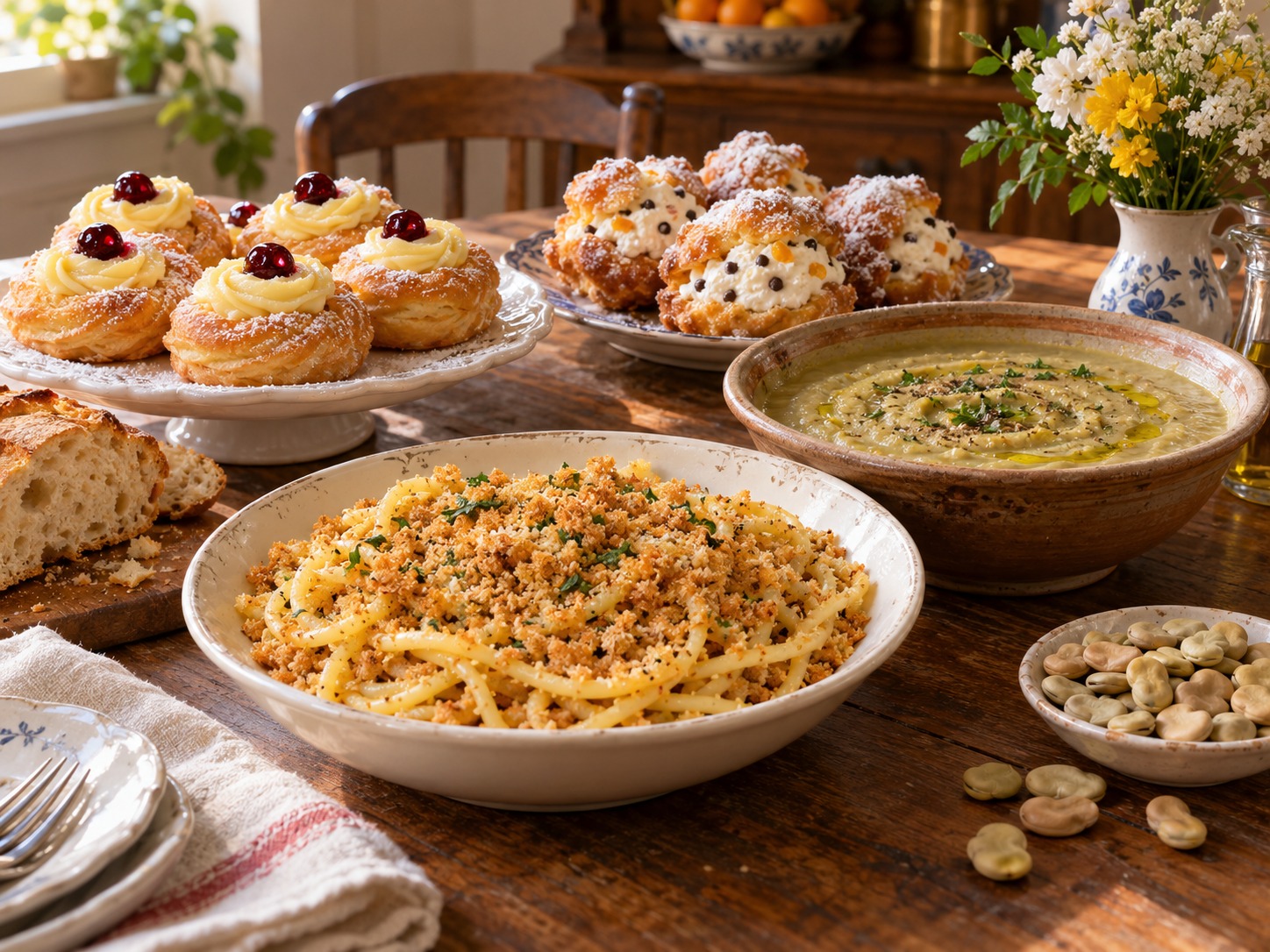
FROM MARIUCH'S KITCHEN
St. Joseph's Day, March 19: the table, the pasta, the soup, and the pastry, for about eight people
PASTA CON LA MOLLICA | MACCU | ZEPPOLE | SFINGE
GETTING READY
The Plan
St. Joseph's Day falls in the middle of Lent, so the table is meatless and the cooking is humble, until dessert. The pastry cream and the ricotta filling are made the day before, and the beans soak overnight. On the day itself, you cook the pasta, warm the soup, and fry the pastry as close to serving as you can.
TWO DAYS BEFORE
Set the ricotta in a strainer in the fridge to drain.
Order a St. Joseph's bread from an Italian bakery if you want one for the table.
THE DAY BEFORE
Soak the fava beans and dried chickpeas separately in cold water in the refrigerator for the maccu. If using canned chickpeas, drain them on the day of cooking.
Make the pastry cream for the zeppole and the ricotta cream for the sfinge. Chill both.
Toast the breadcrumbs for the pasta and keep them in a jar.
MARCH 19, MORNING
Cook the maccu. It reheats beautifully.
Make the choux dough and fry or bake the zeppole and sfinge.
MARCH 19, DINNER
Cook the pasta con la mollica and bring it to the table with the breadcrumbs on the side.
Fill the pastries just before serving so they stay crisp.
MARCH 19
The St. Joseph's Table
St. Joseph is the patron saint of fathers, carpenters, and the poor, and March 19 is Father's Day in Italy. The story goes that during a terrible drought in Sicily, the people prayed to St. Joseph for rain and promised him a feast if it came. It rained, the crops grew, and they kept their promise with a table full of food shared with anyone who was hungry. Families still build that table at home and in churches, piled with bread, meatless dishes, and sweets. Every guest takes home a dried fava bean, the "lucky bean," to keep in a pocket or wallet so they never go without.
|
|
|---|
THE TABLE
Maccu di San Giuseppe (Fava Bean Soup)
Maccu is a thick Sicilian soup of dried fava beans, cooked down with wild fennel until it turns creamy and soft. On St. Joseph's Day it is made with whatever dried beans were left in the pantry at the end of winter, a way of cleaning the shelves for spring. It is the humblest dish on the table and one of the most comforting.
| SERVES 8 |
|---|
WHAT YOU NEED
|
|
|---|
THE METHOD
The night before: soak the fava beans and the dried chickpeas in separate bowls of cold water in the refrigerator. Skip the chickpea soaking if using canned.
Drain them. In a large heavy pot, warm the oil and cook the onion, celery, and fennel 8 to 10 minutes, until soft.
Add the favas, soaked dried chickpeas, lentils, and water. Bring to a boil, then lower to a gentle simmer. If using canned chickpeas, hold them until the last 20 minutes.
Cook 1 1/2 to 2 hours, stirring often and scraping the bottom, until the favas fall apart into a thick, creamy soup. Add a little hot water if it gets too thick.
Mash with a potato masher or a wooden spoon for a smoother texture. Stir in the chopped fennel fronds, then season well with salt and pepper.
Serve in bowls with a good drizzle of olive oil on top.
REEK-EE AND MARIUCH SAY Stir all the way down. Moving the top of the soup around does nothing for the beans stuck to the bottom. A scorched pot will tell on you. Cool leftovers in shallow containers and refrigerate within two hours. Tomorrow, slice the firm maccu and fry it in olive oil until hot throughout, reaching 165°F. Yesterday’s soup has another job. |
|---|
THE PASTRY
Zeppole di San Giuseppe
This is the pastry of St. Joseph's Day in Naples, and the reason half the city lines up at the bakery on March 19. A ring of choux dough is fried (or baked) until puffed and golden, then filled with a swirl of lemony custard and crowned with a dark amarena cherry. They are best the day they are made, so they are made the day of.
| MAKES ABOUT 12 |
|---|
PASTRY CREAM
|
|
|---|
CHOUX DOUGH
|
|
|---|
TO FINISH
Amarena cherries in syrup
Powdered sugar
THE METHOD
Make the cream the day before: heat the milk with the lemon peel until steaming. In a bowl, whisk the yolks, sugar, and cornstarch until pale. Slowly whisk in the hot milk, then pour it all back into the pot.
Cook over medium heat, whisking constantly, until it thickens and bubbles, about 2 minutes. Take out the lemon peel and stir in the vanilla.
Transfer the cream to a shallow container, press food-safe wrap onto the surface, and refrigerate promptly, within two hours. Chill at least 4 hours and keep refrigerated until filling the pastries.
Make the dough: bring the water, butter, sugar, and salt to a boil in a saucepan. Dump in the flour all at once and stir hard with a wooden spoon until the dough forms a ball and pulls away from the sides, 1 to 2 minutes.
Move the dough to a bowl and let it cool about 5 minutes, until warm rather than hot. Beat in the first three eggs one at a time, fully mixing each before the next. Beat the fourth egg separately and add only enough to make a smooth, glossy dough that falls slowly from the spoon in a thick V. Beat in the lemon zest.
Cut 12 squares of parchment, about 3 1/2 inches each. Using a pastry bag with a large star tip, pipe a ring about 2 1/2 inches across on each square, then pipe a second ring right on top.
To fry: heat 2 inches of oil to 340°F. Lower each zeppola into the oil, paper side up. After a minute, pull the paper off with tongs. Fry 3 to 4 minutes per side, until deep golden and puffed. Drain on a rack.
To bake instead: bake on a sheet at 400°F for 20 minutes, then lower to 350°F for 15 minutes more, until deep golden. Turn off the oven and leave them inside with the door cracked for 10 minutes so they dry out.
When cool, pipe a big swirl of pastry cream into the center of each one. Top with an amarena cherry and a little of its syrup, and dust with powdered sugar. Fill close to serving and keep filled pastries refrigerated; do not leave them out longer than two hours, or one hour above 90°F.
REEK-EE AND MARIUCH SAY Keep the oven door closed while they rise. Looking at them will not help. Let the dough do what you went to all that trouble to teach it. Use the thermometer. A beautifully browned outside means nothing if the middle is still dough. Keep the oil near 340°F and give them their time. Fill them when the coffee is nearly ready. The shell worked hard to become crisp; do not make it carry custard all afternoon. Fried or baked, they still need that cream and that cherry. Make both if you like. Nobody at this table has ever objected to another pastry. |
|---|
THE PASTRY
Sfinge di San Giuseppe
Sfinge are the Sicilian cousin of the zeppola. The same choux dough is dropped by the spoonful into hot oil and fried into big, craggy puffs. Each one is split and filled with sweet ricotta cream, chocolate chips, and candied orange, then finished with chopped pistachios and a cherry. Where the zeppola is elegant, the sfinge is generous.
| MAKES ABOUT 16 |
|---|
RICOTTA CREAM
|
|
|---|
CHOUX DOUGH
|
|
|---|
TO FINISH
Chopped pistachios
Candied orange slices or candied cherries
Powdered sugar
THE METHOD
Make the filling the day before: push the drained ricotta through a strainer, or beat it until smooth. Beat in the powdered sugar and vanilla, then fold in the chocolate chips and candied orange. Cover and chill.
Make the dough: bring the water, butter, sugar, and salt to a boil. Dump in the flour all at once and stir hard until it forms a ball and pulls away from the pan, 1 to 2 minutes.
Move to a bowl and cool until warm rather than hot, about 5 minutes. Beat in the first three eggs one at a time. Beat the fourth egg separately and add only enough for a smooth, glossy dough that falls slowly from the spoon in a thick V. Beat in the orange zest.
Heat 2 inches of oil to 340°F.
Drop the dough by heaping tablespoons into the oil, a few at a time. They will puff and turn themselves over as they cook. Fry 6 to 8 minutes, turning, until deep golden and light in the hand.
Drain on a rack and cool completely.
Split each puff open on the side, or cut off the top. Fill generously with ricotta cream.
Spread a little cream on the outside edge, press on chopped pistachios, top with candied orange or a cherry, and dust with powdered sugar. Keep the ricotta filling and filled pastries refrigerated until close to serving.
REEK-EE AND MARIUCH SAY Drain the ricotta overnight in the refrigerator. Water is not an ingredient in the filling. Let it leave before it ruins the pastry. Open the first puff and check the middle. It should be hollow and cooked through, not hiding a lump of wet dough. Then you know what the rest of the batch needs. Keep the filling cold and fill them just before serving. Be generous with the ricotta. That is what the pastry is there for. |
|---|
GOOD TO HAVE
A Few Things You Can Buy
A St. Joseph's bread from an Italian bakery, shaped like a staff, a beard, or a cross, for the center of the table.
A jar of amarena cherries in syrup, such as Fabbri. Maraschino cherries are not the same.
A bag of dried fava beans, so every guest can take one home for luck.
Fresh fennel, oranges, and lemons to dress the table.
A Traditional Neapolitan Easter
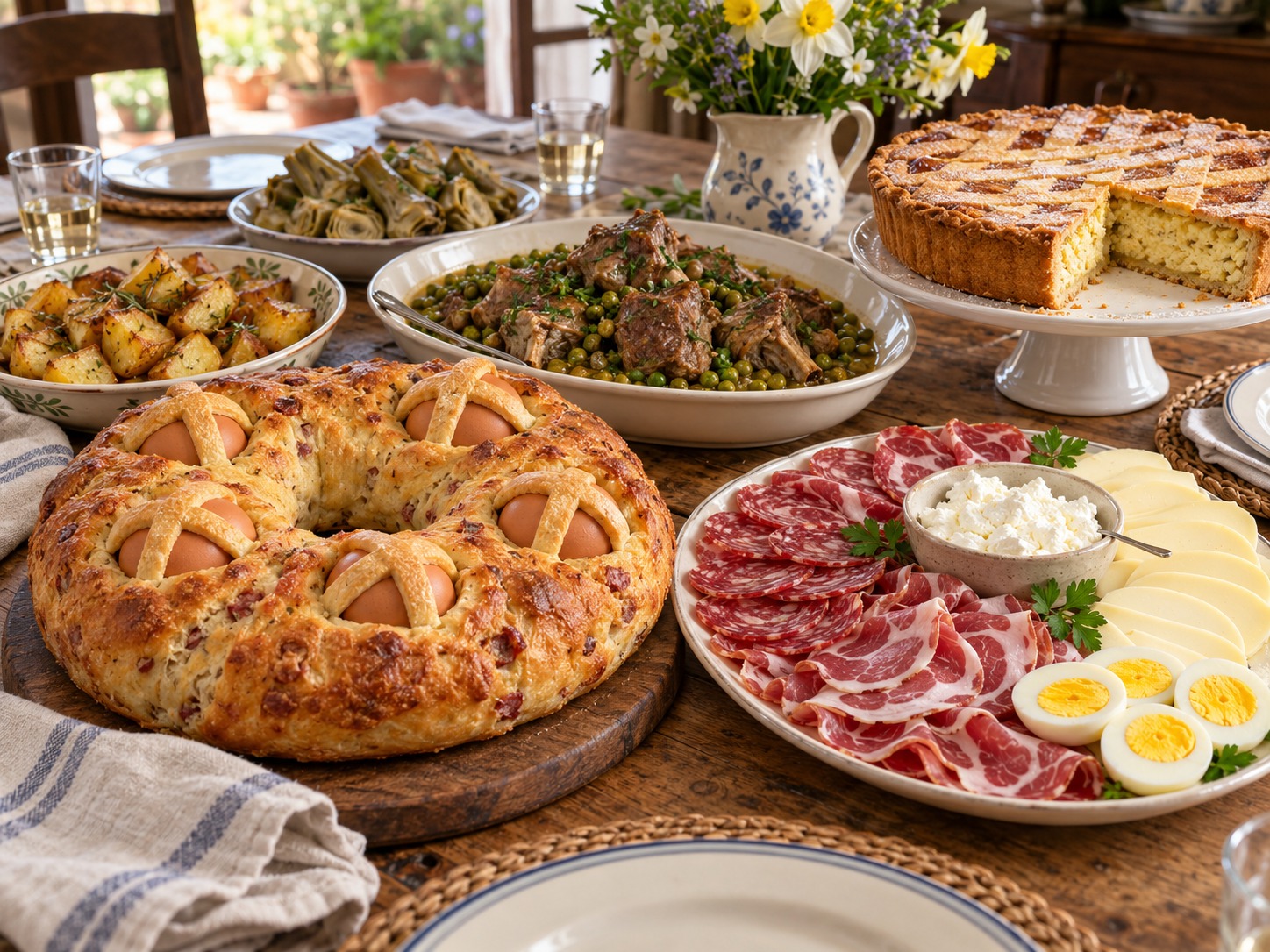
A traditional Neapolitan Easter is a long, generous meal that builds from a salty morning spread to roast lamb and ends with pastiera.
It usually starts with the fellata, a big platter of cured meats and cheeses like salami, capocollo, soppressata, fresh ricotta, provolone, and hard boiled eggs blessed at church. Alongside it comes casatiello, a rich bread made with lard, black pepper, cheese, and salami, with whole eggs baked right into the top crust and held down by crosses of dough. Its cousin, tortano, is the same idea but with the eggs chopped inside instead. Many families also make pizza chiena, sometimes called pizza rustica or Easter pie, a deep crust stuffed with eggs, ricotta, and cured meats.
The main course is almost always lamb. It is roasted with potatoes, or cooked as agnello cacio e uova, braised and finished with egg and grated cheese. Spring vegetables sit beside it, especially artichokes and fresh peas. Some households serve a pasta or a minestra first, but the lamb is the heart of the table.
Dessert is pastiera, the true symbol of Neapolitan Easter. It is a lattice-topped tart filled with cooked wheat berries, ricotta, eggs, candied citrus, and orange flower water, ideally baked a couple of days ahead so the flavors settle. A colomba, the dove-shaped sweet bread, often shows up too.
And the next day, Pasquetta, Easter Monday, everyone heads outdoors with the leftovers: casatiello, pizza chiena, and fresh fava beans eaten raw with pecorino.
A Neapolitan Easter Feast
Recipes and a cooking plan for about eight people
FELLATA | CASATIELLO | PIZZA CHIENA | AGNELLO CACIO E UOVA | PATATE AL FORNO | CARCIOFI | PASTIERA
The Plan
Most of this feast is made ahead. The pastiera actually tastes better after two days, and the breads and pies can be brought briefly toward room temperature for serving. Refrigerate the egg, meat, and dairy dishes promptly after cooling. Sunday morning you are only boiling eggs, setting out a platter, and cooking the lamb.
THURSDAY
• Bake the pastiera. Cool and refrigerate it within two hours. Set the ricotta for the pizza chiena in a strainer in the fridge to drain.
FRIDAY
• Shop for the salumi and cheeses for the fellata. Prep the dough for the pizza chiena if you like and refrigerate it.
SATURDAY
• Shape the casatiello Friday night for its slow refrigerated rise, then bake it Saturday morning. Bake the pizza chiena in the afternoon. Cool and refrigerate both within two hours; do not leave them out overnight.
EASTER SUNDAY
• Morning: hard boil the eggs and build the fellata platter with the casatiello. Keep perishables refrigerated until close to serving.
• About 2 1/2 hours before dinner: start the lamb. Put the potatoes in the oven about an hour before dinner and braise the artichokes alongside.
• Last 5 minutes: finish the lamb with the egg and cheese, checking the finished sauce reaches 160°F. Serve pastiera for dessert.
EASTER MONDAY (PASQUETTA)
• Pack the leftovers for an outdoor lunch: casatiello, pizza chiena, and raw fresh fava beans in the pod eaten with chunks of Locatelli Pecorino Romano. Transport perishables in a cooler with ice packs. Refrigerate within two hours, or one hour if it is above 90°F.
La Fellata (The Easter Morning Platter)
Before anybody touches the lamb, there is the fellata. This is the big Easter morning platter of sliced salumi, cheeses, and hard boiled eggs that Neapolitan families set out after Mass, with thick slices of casatiello on the side. Nothing here is really cooked. It is gathered, sliced, and laid out so everybody can pick while the kitchen gets going.
| SERVES 8 |
|---|
WHAT YOU NEED
• 1 1/2 lb mixed cured meats: Napoli salami, soppressata, capocollo, prosciutto • 1 1/2 lb cheeses: aged provolone, fresh ricotta, basket cheese or primo sale |
• 10 to 12 eggs, hard boiled (blessed at church if that is your family's custom) • Olives, and a bowl of fresh fava beans if you can find them |
|---|
THE METHOD
1. For the eggs: put them in a pot, cover with cold water by an inch, and bring to a boil. Turn off the heat, cover, and let sit 12 minutes. Move them to ice water, then peel or leave in the shell.
2. Slice the meats thin and the provolone into wedges. Fold or roll the meats on a big platter.
3. Add the ricotta in a small bowl, the other cheeses, the eggs halved or whole, and olives.
4. Set the casatiello beside it and let everyone help themselves.
REEK-EE AND MARIUCH SAY Buy the salumi sliced at the deli counter the day before, but buy the provolone whole and cut it yourself. Bring the cheese out shortly before serving so it loses its chill. Cold cheese has no flavor. Keep total time out of refrigeration under two hours, or one hour above 90°F. Hide a few slices for the cook. The platter goes fast. |
|---|
Casatiello
Casatiello is the Easter bread of Naples, and it is not shy. The dough is made with lard and a heavy hand of black pepper, then rolled up with salami, pancetta, provolone, and grated cheese. Whole eggs go right into the top, held down by little crosses of dough, and bake right along with the bread. It is made the day before and served alongside the fellata. Refrigerate it after cooling, then bring out only what you need for serving.
| MAKES ONE LARGE RING LOAF (A 10-INCH TUBE OR BUNDT PAN) |
|---|
DOUGH
• 4 cups bread flour • 2 1/4 tsp (1 packet) instant yeast • 1 1/4 cups warm water |
• 1 1/2 tsp fine sea salt • 2 tsp freshly ground black pepper • 1/2 cup lard, softened (butter works but is less traditional), plus more for the pan |
|---|
FILLING
• 1/2 cup grated Locatelli Pecorino Romano • 1/2 cup grated parmigiano • 5 oz Napoli salami, diced |
• 4 oz pancetta or cicoli, diced and lightly browned • 4 oz sharp provolone, diced |
|---|
TOPPING
• 5 raw eggs in the shell, clean and uncracked
THE METHOD
1. In a large bowl or stand mixer, mix the flour, yeast, and pepper. Add the warm water and mix until a shaggy dough forms. Add the salt.
2. Knead in the lard a spoonful at a time, letting each piece disappear before adding the next. Knead about 10 minutes until smooth and stretchy.
3. Pinch off a piece about the size of a golf ball and set it aside, covered, for the crosses.
4. Cover the big dough and let it rise in a warm place until doubled, 1 1/2 to 2 hours.
5. Grease the tube pan generously with lard.
6. Roll the dough on a floured counter into a rectangle about 16 by 10 inches. Scatter the two grated cheeses, the salami, pancetta, and provolone evenly over it.
7. Roll it up tightly from the long side into a log. Lay it in the pan and pinch the two ends together to close the ring.
8. Keep the reserved dough for the crosses covered in the refrigerator. The whole eggs will go on just before baking.
9. Cover and refrigerate overnight for a slow second rise. The next day, let the loaf stand at room temperature until puffy, up to two hours. For a same-day loaf, let the filled dough rise at room temperature for no more than two hours. Do not leave the meat-and-cheese-filled dough warm for a prolonged rise.
10. Press the 5 eggs into the top, spaced evenly, about halfway down. Roll the reserved dough into thin ropes and lay two strips in an X over each egg, tucking the ends into the loaf. Bake at 350°F for 55 to 65 minutes, until deep golden brown. If the top browns too fast, lay foil over it loosely.
11. Cool in the pan 15 minutes, then turn out. Refrigerate within two hours of baking; slice after it has cooled.
REEK-EE AND MARIUCH SAY Do not rush the second rise. This is a heavy dough full of meat and cheese, and it needs its time. The eggs bake through and should come out with firm whites and yolks. Eat them or leave them as decoration, your call. Wrapped well and refrigerated, it keeps three to four days. Bring portions briefly toward room temperature to serve. |
|---|
Pizza Chiena (Easter Pie)
Pizza chiena means full pie in Neapolitan, and the name tells the truth. A sturdy crust is packed with ricotta, eggs, cured meats, and three kinds of cheese, then baked until golden and left to rest overnight in the refrigerator. It is served in thick slices, brought briefly toward room temperature, and whatever is left goes to the Easter Monday picnic in a cooler.
| MAKES ONE DEEP 9 BY 13-INCH PIE (AT LEAST 2 INCHES DEEP) OR A 10-INCH SPRINGFORM (AT LEAST 3 INCHES DEEP), ABOUT 12 SLICES |
|---|
CRUST
• 3 1/4 cups all purpose flour • 1 tsp salt • 1/2 tsp black pepper |
• 1/2 cup cold lard or butter, cut in pieces • 3 eggs • 2 to 4 tbsp cold water, as needed |
|---|
FILLING
• 2 lb whole milk ricotta, drained overnight • 6 eggs • 1 cup grated Locatelli Pecorino Romano • 1/2 cup grated parmigiano • 7 oz salami or soppressata, diced |
• 5 oz capocollo or prosciutto cotto, diced • 7 oz basket cheese or well drained fresh mozzarella, diced • 5 oz sharp provolone, diced • Lots of black pepper |
|---|
FOR BRUSHING
• 1 egg beaten with a splash of milk
THE METHOD
1. Make the crust: mix the flour, salt, and pepper. Rub in the lard with your fingers until it looks like coarse crumbs. Add the eggs and enough cold water to make a firm dough. Wrap and chill 30 minutes.
2. Make the filling: beat the ricotta and eggs together until smooth. Stir in the grated cheeses, then the diced meats and cheeses and plenty of pepper. No salt needed; the meats and cheese bring it.
3. Heat the oven to 350°F and grease the pan.
4. Roll out two thirds of the dough and line the bottom and sides of the pan, letting a little hang over the edge.
5. Pour in the filling and smooth it out.
6. Roll the remaining dough into a top crust (or strips for a lattice). Lay it on, pinch the edges to seal, and cut a few slits. Brush with the egg wash.
7. Bake 60 to 75 minutes, until deep golden and the center is set and reaches at least 160°F.
8. Refrigerate within two hours of baking, then chill at least 4 hours or overnight before cutting. It slices cleanly once it has rested.
REEK-EE AND MARIUCH SAY Drain the ricotta overnight. Wet ricotta makes a soggy pie, and nobody wants that on Easter. No salt in the filling. The meats and cheese bring plenty. Do not cut it warm. Give it the night in the fridge and it slices clean. It keeps three to four days refrigerated; bring only the serving portions briefly toward room temperature. |
|---|
Agnello Cacio e Uova (Lamb with Egg, Cheese, and Peas)
Lamb is the Easter main in Naples, and agnello cacio e uova is the classic way to cook it. The lamb is browned, then braised low with white wine and rosemary until it falls off the bone, and sweet peas go in at the end. The finish is the trick: beaten eggs and Locatelli Pecorino Romano are stirred in off the heat, and they turn into a creamy sauce that coats every piece.
| SERVES 8 |
|---|
LAMB
• 4 1/2 lb bone in lamb shoulder or leg, cut into large chunks (ask the butcher) • 1/3 cup olive oil • 1 onion, chopped • 3 garlic cloves, sliced • 1 cup dry white wine |
• 2 sprigs rosemary • Salt and black pepper • 1 to 2 cups water or broth, as needed • 1 lb peas, fresh or frozen |
|---|
FINISH
• 4 eggs • 3/4 cup grated Locatelli Pecorino Romano • 1/4 cup grated parmigiano |
• A handful of chopped parsley • Black pepper |
|---|
THE METHOD
1. Pat the lamb dry and season well with salt and pepper.
2. Heat the olive oil in a large heavy pot. Brown the lamb in batches so it is not crowded, about 8 minutes per batch. Set aside.
3. Lower the heat, add the onion, and cook until soft, about 6 minutes. Add the garlic for one minute.
4. Return the lamb, add the wine, and let it bubble until reduced by half.
5. Add the rosemary and about a cup of water or broth. Cover and simmer gently 1 1/2 hours, until the lamb is very tender. Add a splash more liquid if it gets dry. You want a little sauce in the pot, not a soup.
6. Add the peas and cook 8 to 10 minutes more. Remove the rosemary stems.
7. Meanwhile, beat the eggs with the cheeses, parsley, and plenty of pepper.
8. Take the pot off the heat. Temper the egg mixture with a little hot braising liquid, then pour it over the lamb and stir gently for 1 to 2 minutes. Check the egg sauce reaches 160°F with a thermometer. If needed, return the pot to very low heat, stirring constantly, just until it reaches that temperature. Do not let it boil or the eggs will scramble.
9. Serve right away.
REEK-EE AND MARIUCH SAY Brown the lamb in batches. Crowd the pot and it steams instead of browning, and the color is the flavor. When the eggs go in, start off the heat. Use only gentle heat if the thermometer says it needs more; no boiling, or you will be serving lamb with scrambled eggs. The lamb can be braised Saturday. Refrigerate it promptly in shallow containers, then reheat to 165°F Sunday before adding the peas and the egg finish. |
|---|
Patate al Forno (Roasted Potatoes)
Every pot of lamb needs a pan of potatoes beside it. These are as simple as it gets: olive oil, garlic, rosemary, salt, and a hot oven. They go in about an hour before dinner and come out golden and crisp at the edges, ready to soak up the sauce from the lamb.
| SERVES 8 |
|---|
WHAT YOU NEED
• 4 lb yellow potatoes, cut in chunks • 1/3 cup olive oil • 4 garlic cloves, smashed |
• 2 sprigs rosemary, leaves pulled • Salt and pepper |
|---|
THE METHOD
1. Heat the oven to 425°F.
2. Toss the potatoes with the oil, garlic, rosemary, salt, and pepper on a large sheet pan, in one layer.
3. Roast 45 to 55 minutes, turning once halfway, until golden and crisp at the edges.
REEK-EE AND MARIUCH SAY One layer on the pan, no piling. Piled potatoes steam and go soft. Turn them once halfway, then leave them alone. |
|---|
Carciofi in Umido (Braised Artichokes)
Artichokes are the vegetable of a Neapolitan spring, and Easter is when they show up on the table. They are trimmed down to the tender heart, then braised slowly with garlic, parsley, mint, and a splash of white wine until a knife slides right through. They are just as good warm as they are at room temperature.
| SERVES 8 |
|---|
WHAT YOU NEED
• 8 medium artichokes • 1 lemon • 1/3 cup olive oil • 3 garlic cloves, chopped • A big handful of parsley, chopped |
• A few mint leaves, chopped • 1/2 cup dry white wine • 1/2 cup water • Salt and pepper |
|---|
THE METHOD
1. Fill a bowl with water and squeeze in the lemon. This keeps the artichokes from turning brown.
2. Snap off the tough outer leaves until you reach the pale yellow ones. Cut off the top inch, peel the stem, and halve each artichoke. Scoop out any fuzzy choke with a spoon. Drop each one into the lemon water as you go.
3. Mix the garlic, parsley, mint, salt, and pepper.
4. Heat the oil in a wide pan. Lay the artichokes in cut side down and sprinkle the herb mix over and between them.
5. Add the wine and water, cover, and simmer gently 25 to 30 minutes, until a knife slides easily into the base.
6. Uncover for the last few minutes so the liquid cooks down. Serve warm or at room temperature; refrigerate within two hours.
REEK-EE AND MARIUCH SAY Keep the lemon water close and work fast. A cut artichoke turns brown the minute you look away. Scoop out every bit of the fuzzy choke. It is called a choke for a reason. |
|---|
Pastiera Napoletana
Pastiera is the heart of Neapolitan Easter, and no table in Naples is finished without one. It is a lattice-topped tart filled with creamy cooked wheat, sweet ricotta, candied citrus, and orange flower water, which gives it a perfume like nothing else. Bake it two days ahead and let the flavors settle in the refrigerator. This is one dessert you are supposed to make early.
| MAKES ONE DEEP 9 OR 10-INCH PIE, ABOUT 10 TO 12 SLICES |
|---|
PASTRY (PASTA FROLLA)
• 4 cups all purpose flour • 1 cup sugar • 3/4 cup plus 2 tbsp cold butter, cubed (or half lard) |
• 2 eggs plus 1 yolk • Grated zest of 1 lemon • Pinch of salt |
|---|
WHEAT CREAM
• 1 jar (about 14 oz) cooked wheat, "grano cotto," from an Italian market • 3/4 cup whole milk |
• 2 tbsp butter • Grated zest of 1 lemon |
|---|
RICOTTA FILLING
• 12 oz sheep ricotta or well drained whole milk ricotta • 1 1/4 cups sugar • 3 eggs, separated • 1/2 cup diced candied orange peel and citron |
• 1 tbsp orange flower water • 1/4 tsp cinnamon • Grated zest of 1 orange |
|---|
TO FINISH
• Powdered sugar
THE METHOD
1. The night before (if you can): mix the ricotta with the sugar, cover, and refrigerate. This makes the filling smoother.
2. Make the pastry: mix flour, sugar, salt, and lemon zest. Rub in the cold butter until crumbly. Add the eggs and yolk and press into a dough without overworking. Wrap and chill 1 hour.
3. Make the wheat cream: put the wheat, milk, butter, and lemon zest in a pot and cook on low, stirring, 10 to 15 minutes until thick and creamy. Mash a little with a spoon. Let it cool.
4. Push the sweetened ricotta through a strainer (or beat it well) until smooth. Beat in the 3 yolks, orange flower water, cinnamon, and orange zest. Stir in the cooled wheat cream and the candied fruit.
5. Beat the 3 egg whites until stiff and fold them gently into the filling.
6. Heat the oven to 350°F. Butter and flour a deep 9 or 10-inch pie or cake pan, about 2 inches deep.
7. Roll out two thirds of the pastry about 1/4 inch thick and line the pan, trimming the edge. Pour in the filling.
8. Roll the rest of the pastry and cut strips about 3/4 inch wide. Lay them across the top in a diamond lattice (traditionally seven strips: four one way, three the other).
9. Bake on the lower rack 70 to 90 minutes, until deep golden and the filling is set with a slight wobble in the very center; check it reaches at least 160°F.
10. Turn off the oven, prop the door open, and allow an initial slow cool to help prevent cracking. Remove the pie and refrigerate within two hours of baking; do not leave it in the oven overnight.
11. Cover and refrigerate for 1 to 2 days before serving. Bring serving portions briefly toward room temperature and dust with powdered sugar.
REEK-EE AND MARIUCH SAY Mix the drained ricotta with the sugar the night before. The filling comes out smoother. Orange flower water is strong. Start with a little less and taste the wheat cream before adding raw eggs. Start cooling it slowly in the oven with the door propped open so the top does not crack, then refrigerate promptly. Cannot find grano cotto? Soak hulled wheat berries in the refrigerator for two days, changing the water, then simmer about an hour until tender. |
|---|
A Few Things You Can Buy
• Colomba, the dove shaped Easter cake, is almost always bought from an Italian bakery. Set one out with coffee.
• Chocolate eggs with a surprise inside for the children.
• Fresh fava beans in the pod and a wedge of Locatelli Pecorino Romano for Easter Monday.
REEK-EE THE MENACE
Mariuch’s Neapolitan Easter Frittata
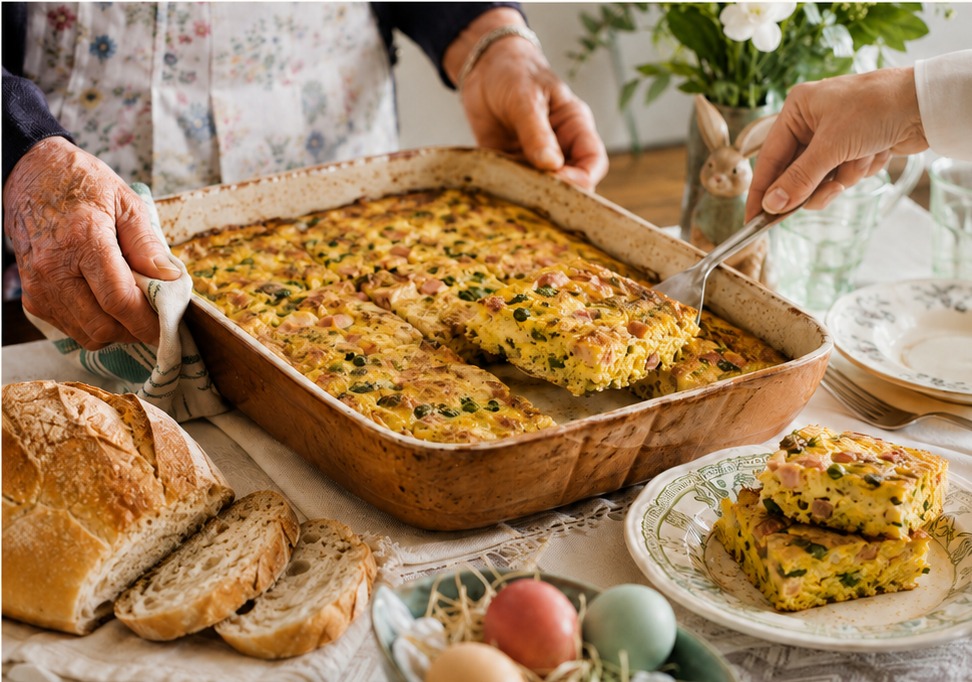
FOUR GENERATIONS AT THE EASTER TABLE
While I was building this cookbook to preserve everything my mother placed in my hands, Mariuch sent me one more recipe. No ceremony. No speech about inheritance. Just two dozen eggs, ricotta, soppressata, mozzarella, and a piece of the Pascale family I did not realize I was still missing.
My great-grandmother, Mumma Silvestrino, brought this recipe with her from Italy. The family always said Naples, although she sometimes claimed she was born over the hill in Avellino—depending on the day and probably her mood. She passed it to her daughter, Rafaella, whom everyone called Fanny. Fanny passed it to Mariuch. And now it is mine to pass on too.
In Norwalk, this frittata was Easter morning. It came out after the egg hunt in the yard, when everyone was still excited and ready for something real to eat. It was not Easter dinner and it was never merely another dish. It had its own place in the day.
Four generations have gathered around this frittata: whole-milk ricotta, thinly sliced soppressata and mozzarella, and Locatelli Pecorino Romano—because nothing else has ever been allowed in that bowl. The recipe has not needed updating. Some traditions survive because nobody is foolish enough to change them.
Mariuch’s Neapolitan Easter Frittata
The Pascale Family Easter Recipe
Ingredients
| • 2 dozen large eggs | • ½ pound fresh mozzarella, thinly sliced |
|---|---|
| • 1½ pounds whole-milk ricotta | • Salt and freshly ground black pepper, if desired |
| • ½ pound soppressata, thinly sliced | • Butter or olive oil for greasing the pan |
| • ¼ cup freshly grated Locatelli Pecorino Romano |
THE METHOD
The Method
1. Get the oven and pan ready.
Heat the oven to 375°F. Grease a 9 × 13-inch baking pan that is at least 2 inches deep. Grease the corners too. If you miss the corners, that is exactly where it will stick.
2. Beat the eggs.
Crack all 24 eggs into your largest mixing bowl. Beat them well with a fork or wire whisk until the yolks and whites are completely combined. You are mixing them, not trying to turn them into whipped cream.
3. Add the cheese.
Add the ricotta and Locatelli Pecorino Romano. Mix everything thoroughly. A few small pockets of ricotta are fine. This is a frittata, not wallpaper paste.
4. Build the bottom.
Arrange the thinly sliced soppressata across the bottom of the greased pan. Cover the bottom evenly so every square gets some. Layer the sliced fresh mozzarella over the soppressata.
5. Pour slowly.
Slowly pour the egg and ricotta mixture over the soppressata and mozzarella. Give it time to work its way into the layers. Do not dump everything into one corner and expect it to fix itself.
Sprinkle the top lightly with salt and black pepper, if desired. Remember that the soppressata and Pecorino already bring plenty of salt.
6. Bake it covered.
Cover the pan tightly with foil and bake for 45 minutes.
Remove the foil and continue baking for approximately 15 minutes, until the frittata has puffed beautifully and the center feels firm when lightly touched. It should not jiggle or look wet in the middle.
7. Leave it alone.
Remove the frittata from the oven and let it rest for at least 10 minutes before cutting. It needs that time to settle. If you cut it immediately because everybody is hovering around the stove, it will fall apart—and they can wait.
Cut into generous squares and serve warm with Italian bread.
Mariuch’s Rules
| • Whole-milk ricotta. This is Easter, not a diet. | • Do not oversalt before baking. The meat and cheese already know what they are doing. |
|---|---|
| • Slice the soppressata and mozzarella thinly so every piece gets everything. | • Let it rest before cutting. Ten minutes will not kill anybody. |
| • Locatelli Pecorino Romano only. Nothing else goes into that bowl. |
Labor Day on the Italian Coast
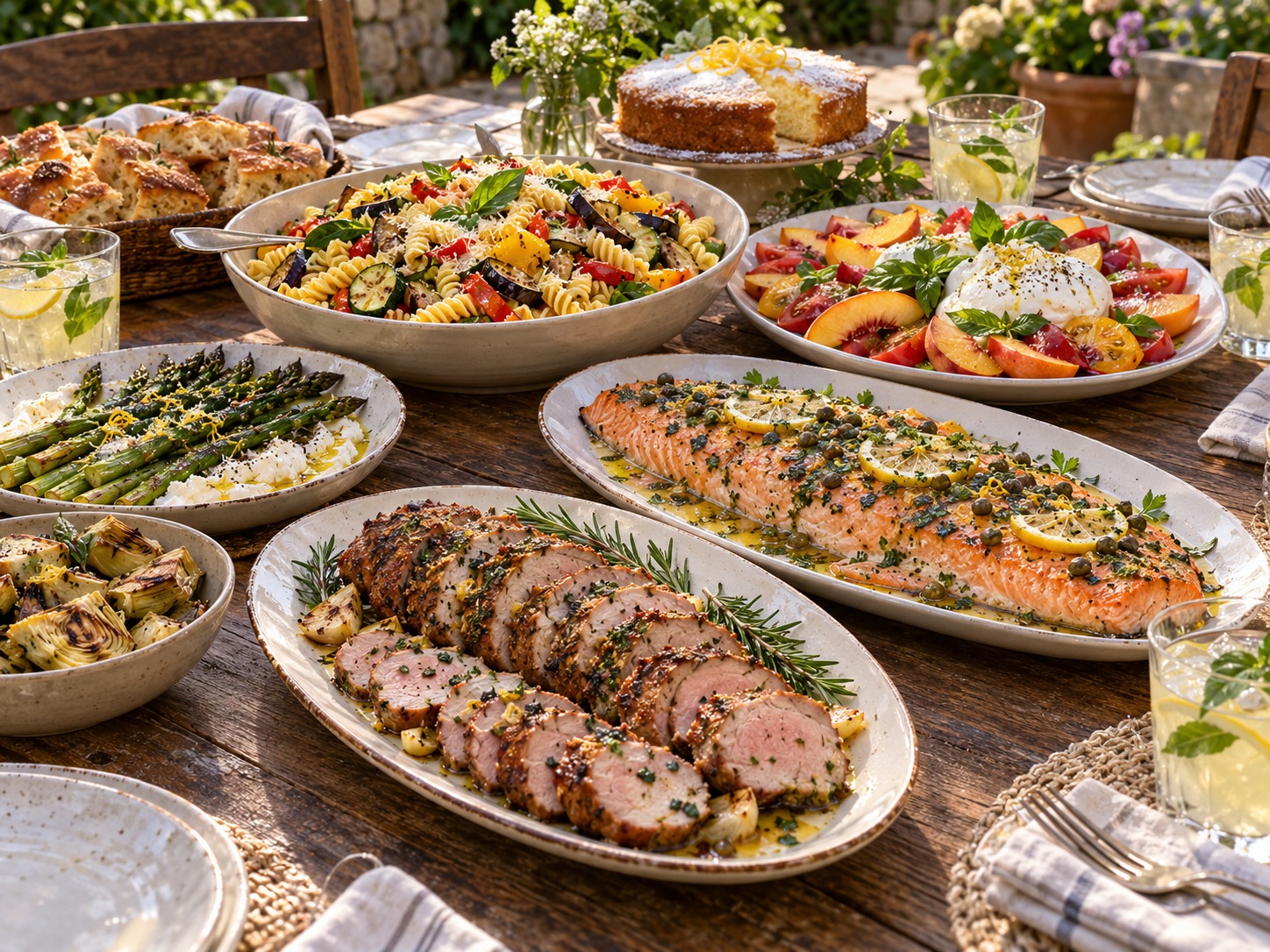
REEK-EE SETS THE TABLE
MARIUCH’S FLAIR, CARRIED FORWARD
A complete late-summer feast • Serves 10 • Two proteins • No added salt
The dishes are mine. The instinct is hers.
Let us establish something before Mariuch finds a way to correct the record.
She never made this Labor Day menu.
There was no weathered recipe card instructing me to grill artichoke hearts, roast a whole side of salmon, whip ricotta for asparagus, or put peaches beside heirloom tomatoes and burrata. Nobody carried this particular meal from Italy. It did not come from Mumma’s kitchen, Mariuch’s father, Aunt Eli on Staten Island, or the basement in 1969.
I made it up.
That does not mean I made it alone.
Mariuch taught me recipes, but recipes were never the whole inheritance. She taught me how to look at a table and know what it needed. Something rich needed something bright. Something soft needed something crisp. A heavy dish needed acid. A plate needed color. A meal needed enough food that nobody had to calculate whether taking another piece would leave too little for somebody else.
Most important, she taught me that tradition was not a museum exhibit. You did not preserve it by standing guard over it and refusing to let anything new through the door. You preserved it by learning its instincts so completely that you could carry them somewhere they had never been before.
Mariuch could encounter an idea that was not hers, study it, taste it, alter it, and make it belong at our table. She did not imitate. She absorbed. Then she added more garlic, better cheese, excellent olive oil, and enough food for three people who had not yet arrived.
I adapted her.
I took Mariuch’s flair—her generosity, her confidence, her refusal to serve anything timid—and used it to build a Labor Day meal that felt lighter, brighter, and a little more elegant than the usual parade of steaks, chicken, lobster, and everything else somebody could throw onto a grill.
The first idea was the lemon rotini.
I wanted pasta salad, but I did not want a bowl of cold noodles drowning in bottled dressing and waiting patiently beside a hamburger. I wanted something that tasted composed: grilled zucchini, blistered tomatoes, Castelvetrano olives, arugula, basil, parsley, mint, pistachios, lemon, excellent olive oil, and shaved Locatelli Pecorino Romano.
Once that dish existed in my head, it told me what the rest of the table had to become.
The pork tenderloin took its direction from porchetta: fennel, rosemary, sage, garlic, lemon, and enough black pepper to make itself known. It would be grilled, sliced, and served with a roasted garlic-rosemary salsa verde.
But not everybody eats pork, and inviting people to dinner should not require them to negotiate with the menu. So the table needed a second protein. A whole side of salmon, roasted with lemon and capers and finished with dill, parsley, and chives, gave the meal another center without competing with the first.
Each protein serves approximately eight. Together they feed ten generously.
That is not excessive. That is planning correctly.
The rest of the table followed the same logic. Grilled artichoke hearts with lemon-basil aioli opened the meal. Peaches, heirloom tomatoes, and burrata brought sweetness, acid, creaminess, and the colors of late summer. Grilled asparagus rested over whipped ricotta with lemon, herbs, and pistachios. Bakery focaccia went onto the grill after being brushed with garlic-rosemary oil because homemade bread is wonderful, but enjoying your own party is also wonderful.
Dessert became a lemon olive-oil cake with mascarpone cream and berries. It could be made the day before, which immediately made it a better dessert. The drinks followed the same bright line: a limoncello spritz for those who wanted one and a zero-proof lemon-basil spritz for anyone who did not.
Nobody gets handed a sad glass of plain sparkling water while everybody else celebrates.
There is no added salt in this menu. That was deliberate, not an omission. The capers, olives, Locatelli, focaccia, and other naturally seasoned ingredients already bring salt to the table. The food gets its intensity from lemon, garlic, herbs, pepper, smoke, good olive oil, and the ingredients themselves.
Salt was already at the party. There was no reason to invite it twice.
The entire meal was also designed to survive an actual gathering. Nearly everything can be served warm or at room temperature. The sauces can be made ahead. The cake is better the next day. The vegetables do not collapse if somebody arrives twenty minutes late. Only the salmon and focaccia require any meaningful last-minute attention.
A successful menu should not imprison the person who made it in the kitchen while everybody else sits outside drinking limoncello.
That part came from Mariuch too. Her food was generous, but it was never precious. It was meant to reach the table, feed the people around it, and allow life to continue while everyone ate. The point was not to demonstrate how exhausted the cook could become. The point was that somebody had made room for you.
Mariuch did not cook this Labor Day feast.
I did.
But I built it with the judgment she placed in my hands: make it beautiful, make it taste like something, give people choices, do not be timid, and make more than you think you need.
The dishes are mine.
The instinct is hers.
The table belongs to everyone.
Mangia.
REEK-EE SAYS A menu is not successful because every dish is impressive by itself. It succeeds because everything belongs on the same table. Lemon, herbs, garlic, olive oil, vegetables, pork, salmon, cheese, and enough food for the people who show up hungry. That is the plan. Do not start an argument with it. |
|---|
THE COMPLETE FEAST
Grilled Artichoke Hearts
Lemon-basil aioli • 10 appetizer servings • No added salt
YIELD 10 appetizers |
MAKE AHEAD Aioli: 2 days |
SERVE Warm or room temp |
|---|
Ingredients
| • 4 cans (14 oz each) whole artichoke hearts in water, drained | • 1/2 tsp freshly ground black pepper |
|---|---|
| • 1/3 cup extra-virgin olive oil | • 1 cup good mayonnaise |
| • 2 lemons: zest of both, plus 3 tablespoons juice | • 1 packed cup fresh basil leaves |
| • 3 cloves garlic, finely grated | • 1 tsp Dijon mustard |
| • 1 tsp dried oregano | • 1/4 cup shaved Locatelli Pecorino Romano, optional |
THE METHOD
Wake up the table.
1. Season the artichokes.
Pat the artichokes very dry and halve them lengthwise. Toss with ¼ cup olive oil, half the lemon zest, 1 tablespoon lemon juice, 2 garlic cloves, oregano, and pepper.
2. Make the aioli.
Blend the mayonnaise, basil, Dijon, remaining garlic, remaining lemon zest, 2 tablespoons lemon juice, and remaining olive oil until pale green and smooth. Refrigerate.
3. Grill them.
Heat the grill to medium-high. Grill the artichokes cut-side down for 3 to 4 minutes, turn, and grill 2 minutes more, until charred at the edges.
4. Finish the platter.
Arrange on a platter. Finish with Pecorino and a squeeze of lemon. Serve warm or at room temperature with the aioli on the side.
REEK-EE SAYS Use water-packed, not heavily marinated, artichokes so the lemon and smoke remain clean. Set out small cocktail forks or picks. |
|---|
| REEK-EE APPROVED • START BRIGHT. KEEP THE FORKS SMALL. |
|---|
PORCHETTA FLAIR / NO WHOLE PIG REQUIRED
Porchetta-Style Pork Tenderloin
Fennel, rosemary, sage, garlic & lemon • Serves 8 • No added salt
SERVES 8 people |
MARINATE 4–24 hours |
SERVE Warm or room temp |
|---|
Ingredients
| • 2 (1 1/4 to 1 1/2 lb each) pork tenderloins, silver skin removed | • 1 whole head garlic |
|---|---|
| • 2 tbsp fennel seeds, lightly crushed | • 1 packed cup flat-leaf parsley, finely chopped |
| • 2 tbsp fresh rosemary, finely chopped | • 2 tbsp fresh rosemary, finely chopped |
| • 1 tbsp fresh sage, finely chopped | • 2 tbsp capers, chopped |
| • 5 cloves garlic, finely grated | • 1 tbsp red wine vinegar |
| • 2 lemons, finely zested | • 1 tbsp fresh lemon juice |
| • 1/3 cup extra-virgin olive oil | • 1/2 cup extra-virgin olive oil, plus 1 teaspoon |
| • 1 tsp black pepper | • To taste black pepper and red pepper flakes |
| • 1/2 tsp crushed red pepper, optional |
THE METHOD
Give the pork time to become itself.
1. Build the rub.
Mix the fennel, rosemary, sage, garlic, lemon zest, olive oil, pepper, and crushed red pepper.
2. Marinate the pork.
Rub the mixture over the pork; cover and refrigerate for 4 to 24 hours.
3. Prepare the grill.
Remove the pork from the refrigerator 30 minutes before cooking. Heat the grill for two-zone cooking, with one side at medium-high and the other cooler.
4. Sear and finish.
Sear the pork over direct heat, turning every 2 minutes, until browned all around. Move to indirect heat, close the lid, and cook until the center reaches 140 to 142°F.
5. Rest and slice.
Rest for 10 minutes; carryover heat should bring the pork to at least 145°F. Slice into ½-inch medallions and arrange with grilled lemon halves.
6. Make the salsa verde.
Slice the top from the garlic, drizzle with 1 teaspoon oil, wrap in foil, and roast at 400°F for 35 to 45 minutes. Squeeze out the cloves, mash, then stir in the remaining salsa verde ingredients. Bring to room temperature before serving; loosen with a teaspoon of warm water if needed.
REEK-EE SAYS Serve the roasted garlic-rosemary salsa verde alongside. The pork is excellent warm, but it also holds beautifully at room temperature for about 30 minutes. |
|---|
| REEK-EE APPROVED • PORCHETTA FLAIR. NO WHOLE PIG REQUIRED. |
|---|
THE SECOND CENTER OF THE TABLE
Lemon-Caper Whole-Side Salmon
Fresh dill, parsley, chives & lemon-caper herb sauce • Serves 8
SERVES 8 people |
MAKE AHEAD Sauce: 1 day |
ROAST 15–22 minutes |
|---|
Ingredients
| • 1 side (3 to 3 1/2 lb) skin-on salmon, pin bones removed | • 1/2 cup extra-virgin olive oil |
|---|---|
| • 2 tbsp extra-virgin olive oil | • 1/4 cup fresh lemon juice, plus 1 teaspoon zest |
| • 3/4 tsp black pepper | • 3 tbsp capers, roughly chopped |
| • 2 lemons: 1 thinly sliced, 1 cut into wedges | • 1/3 cup mixed dill, parsley, and chives, chopped |
| • 3 tbsp capers, drained and patted dry | • 1 tsp Dijon mustard |
| • 2 tbsp chopped fresh dill | • 1/2 tsp honey |
| • 2 tbsp chopped flat-leaf parsley | • To taste freshly ground black pepper |
| • 1 tbsp chopped fresh chives |
THE METHOD
Let the salmon stay elegant.
1. Prepare the pan.
Heat the oven to 425°F. Line a rimmed sheet pan with parchment or lightly oiled foil. Place the salmon skin-side down and brush with olive oil.
2. Season it.
Season with black pepper. Lay the lemon slices over the center of the fish and scatter the capers around them.
3. Roast it.
Roast for 15 to 22 minutes, depending on thickness, until the fish flakes easily and reaches your preferred doneness. For fully cooked fish, the thickest part should reach 145°F.
4. Finish the platter.
Rest for 5 minutes. Transfer to a platter, scatter with dill, parsley, and chives, and serve with lemon wedges.
5. Make the lemon-caper herb sauce.
Whisk the olive oil, lemon juice and zest, capers, mixed herbs, Dijon, honey, and black pepper together. Let stand 20 minutes before serving; stir again just before spooning over the salmon. Bring to room temperature and loosen with a teaspoon of warm water if it tightens in the refrigerator.
REEK-EE SAYS Roasting is easier than grilling a whole side and gives you better control on a busy day. It is equally elegant served warm or just above room temperature. |
|---|
| REEK-EE APPROVED • TWO PROTEINS. NOBODY NEGOTIATES WITH DINNER. |
|---|
THE DISH THAT DECIDED THE MENU
Lemon Rotini with Grilled Vegetables
Fresh herbs, Locatelli & pistachios • Serves 10–12 • No added salt
SERVES 10–12 people |
MAKE AHEAD Two stages |
SERVE Near room temp |
|---|
Ingredients
| • 1 1/2 lb rotini or fusilli | • 5 oz Locatelli Pecorino Romano, shaved |
|---|---|
| • 2 medium zucchini, sliced lengthwise | • 3/4 cup shelled pistachios, toasted and chopped |
| • 2 pints cherry tomatoes | • 2/3 cup extra-virgin olive oil, plus more for grilling |
| • 3/4 cup Castelvetrano olives, halved | • 1/3 cup fresh lemon juice, plus zest of 2 lemons |
| • 5 oz baby arugula | • 1 tbsp Dijon mustard |
| • 1 cup torn basil leaves | • 2 tsp honey |
| • 1/2 cup flat-leaf parsley leaves | • To taste black pepper and red pepper flakes |
| • 1/3 cup fresh mint leaves, torn |
THE METHOD
This is not ordinary pasta salad.
1. Make the dressing.
Whisk the olive oil, lemon juice and zest, Dijon, honey, black pepper, and red pepper flakes.
2. Grill the vegetables.
Brush the zucchini and tomatoes lightly with oil. Grill the zucchini until marked and tender; blister the tomatoes in a grill basket. Cool slightly, then cut the zucchini into bite-size pieces.
3. Cook the rotini.
Cook the pasta in unsalted water until just al dente. Drain and immediately toss with two-thirds of the dressing.
4. Build the base.
Fold in the grilled vegetables and olives. Cool, cover, and refrigerate.
5. Finish it at the right time.
Thirty minutes before serving, bring the pasta toward room temperature. Fold in the arugula, basil, parsley, mint, Pecorino, pistachios, and enough reserved dressing to make it glossy. Adjust lemon and pepper.
REEK-EE SAYS Do not add the arugula, herbs, cheese, or pistachios the night before. That final-minute layer is what makes this taste like a composed summer dish instead of ordinary pasta salad. |
|---|
| REEK-EE APPROVED • PASTA SALAD WITH SELF-RESPECT. |
|---|
LATE SUMMER ON A PLATTER
Peach, Tomato & Burrata Platter
Heirloom tomatoes, basil & excellent olive oil • Serves 10
SERVES 10 people |
SLICE 1 hour ahead |
ASSEMBLE At the last minute |
|---|
Ingredients
| • 2 1/2 lb ripe heirloom tomatoes, assorted colors | • 1 tbsp white balsamic vinegar or fresh lemon juice |
|---|---|
| • 4 ripe but firm peaches | • To finish freshly ground black pepper |
| • 2 balls (8 oz each) burrata | • Optional balsamic glaze, used very lightly |
| • 1 packed cup fresh basil leaves | • Optional, separate 6 oz prosciutto for guests who eat pork |
| • 3 tbsp extra-virgin olive oil |
THE METHOD
Restraint is still a cooking skill.
1. Prepare the produce.
Cut the tomatoes into thick slices and wedges. Cut the peaches into slim wedges. Keep them separate and chilled until shortly before serving.
2. Build the platter.
Arrange the tomatoes and peaches loosely on a large platter, leaving small open spaces rather than stacking everything in one mound.
3. Add the burrata.
Tear the burrata into generous pieces and tuck it among the produce. Add basil, olive oil, vinegar or lemon, and black pepper.
4. Keep the pork separate.
If using balsamic glaze, add only a thin thread. Place the prosciutto on its own small platter so the main salad remains completely pork-free.
REEK-EE SAYS The burrata supplies the seasoning. Dress the platter only at the last moment so the tomatoes stay firm rather than turning soupy. |
|---|
| REEK-EE APPROVED • BURRATA DOES NOT NEED HELP. |
|---|
COOL, CREAMY, CHARRED
Grilled Asparagus over Whipped Ricotta
Lemon, pistachios & garden herbs • Serves 10 • No added salt
SERVES 10 people |
MAKE AHEAD Ricotta: 1 day |
GRILL Up to 2 hours ahead |
|---|
Ingredients
| • 2 1/2 lb medium asparagus, tough ends trimmed | • 1/3 cup finely grated Locatelli Pecorino Romano |
|---|---|
| • 2 tbsp extra-virgin olive oil, plus more to finish | • 1 lemon, zested and juiced |
| • 1/2 tsp black pepper | • 1/3 cup pistachios, toasted and chopped |
| • 2 cups whole-milk ricotta, well drained | • 1/4 cup fresh mint or basil leaves |
THE METHOD
Give the asparagus somewhere to land.
1. Whip the ricotta.
Blend the ricotta, Pecorino, 1 tablespoon lemon juice, and half the zest until smooth and airy. Spread over a broad serving platter and refrigerate.
2. Grill the asparagus.
Toss the asparagus with olive oil and black pepper. Grill over medium-high heat for 5 to 8 minutes, turning occasionally, until marked and crisp-tender.
3. Bring the temperatures together.
Let the asparagus cool for 10 minutes. Let the ricotta sit at room temperature for 20 minutes before topping it.
4. Finish the platter.
Arrange the asparagus over the whipped ricotta. Finish with the remaining lemon zest, a squeeze of juice, olive oil, pistachios, and herbs.
REEK-EE SAYS The contrast should be cool and creamy, not refrigerator-cold. |
|---|
| REEK-EE APPROVED • WHIPPED RICOTTA FIXES THE PLATE. |
|---|
BUY THE BREAD / MAKE IT YOURS
Garlic-Rosemary Grilled Focaccia
Bakery focaccia with lemon-infused olive oil • Serves 10
SERVES 10 people |
MAKE AHEAD Oil: 2 days |
GRILL At the last minute |
|---|
Ingredients
| • 2 large slabs good bakery focaccia, about 12 to 16 oz each | • 2 sprigs fresh rosemary |
|---|---|
| • 1/2 cup extra-virgin olive oil | • 1 tsp finely grated lemon zest |
| • 4 cloves garlic, lightly crushed | • To finish freshly ground black pepper |
THE METHOD
Spend the effort where it matters.
1. Infuse the oil.
Combine the olive oil, garlic, and rosemary in a small saucepan. Warm over low heat for 8 to 10 minutes without browning the garlic. Cool, strain, and stir in the lemon zest.
2. Prepare the focaccia.
Cut each focaccia slab into large rectangles. Brush the cut sides lightly with the infused oil.
3. Grill it.
Grill cut-side down over medium heat for 1 to 2 minutes, just until crisp and marked. Turn for 30 seconds to warm the crust side.
4. Bring it to the table.
Finish with black pepper. Cut into irregular pieces and pile into a cloth-lined basket. Serve the remaining infused oil alongside for dipping.
REEK-EE SAYS Use excellent bakery focaccia and spend your effort on the infused oil and last-minute grilling. This is one place where homemade does not materially improve the party. |
|---|
| REEK-EE APPROVED • BUY THE BREAD. MAKE THE OIL. ENJOY THE PARTY. |
|---|
BETTER TOMORROW
Lemon Olive-Oil Cake
Mascarpone cream & summer berries • Serves 10–12
SERVES 10–12 people |
BAKE AHEAD 1 day |
CREAM Up to 4 hours |
|---|
Ingredients
| • 2 cups all-purpose flour | • 2 lemons: finely grated zest and 1/4 cup juice |
|---|---|
| • 1 1/2 tsp baking powder | • 1 tsp vanilla extract |
| • 1/2 tsp baking soda | • 8 oz mascarpone, cold |
| • 3 large eggs, room temperature | • 1 cup heavy cream, cold |
| • 1 cup granulated sugar | • 1/3 cup confectioners' sugar |
| • 3/4 cup fruity extra-virgin olive oil | • 3 cups mixed berries |
| • 3/4 cup whole-milk Greek yogurt |
THE METHOD
Let dessert help the host.
1. Prepare the pan.
Heat the oven to 350°F. Grease a 9-inch springform pan, line the bottom with parchment, and grease the parchment.
2. Mix the dry ingredients.
Whisk the flour, baking powder, and baking soda.
3. Build the batter.
In another bowl, beat the eggs and sugar for 2 minutes. Stream in the olive oil; whisk in the yogurt, lemon zest and juice, and vanilla.
4. Bake it.
Fold in the dry ingredients just until smooth. Pour into the pan and bake for 40 to 50 minutes, until golden and a tester comes out with a few moist crumbs. Cool completely.
5. Whip the mascarpone cream.
Beat the mascarpone, cream, confectioners’ sugar, and a splash of vanilla at low speed, then medium speed, until soft peaks form. Do not overbeat.
6. Serve it.
Dust the cake lightly with confectioners’ sugar. Serve each slice with mascarpone cream and berries.
REEK-EE SAYS The cake is better the next day. Keep it covered at room temperature; refrigerate only the mascarpone cream. |
|---|
| REEK-EE APPROVED • MAKE IT TODAY. IT GETS BETTER TOMORROW. |
|---|
EVERYBODY GETS A REAL GLASS
Two Lemon-Basil Spritzes
Limoncello or zero-proof • Makes 10 drinks of each version
MAKES 10 of each |
MAKE AHEAD Chill everything |
ASSEMBLE At serving |
|---|
Ingredients
| • 1 bottle Prosecco, thoroughly chilled | • 1 1/2 cups fresh lemon juice |
|---|---|
| • 2 cups limoncello, thoroughly chilled | • 3/4 cup basil simple syrup |
| • 3 cups sparkling water, thoroughly chilled | • 6 cups sparkling water, chilled |
| • For serving ice, lemon wheels, and basil sprigs | • For serving ice, lemon wheels, cucumber ribbons, and basil |
THE METHOD
Build the bubbles at the last minute.
1. Make a limoncello spritz.
Fill a wine glass with ice. Add 1½ ounces limoncello, 2½ ounces Prosecco, and 2 ounces sparkling water. Stir once and garnish with lemon and basil.
2. Make the basil syrup.
Dissolve ¾ cup sugar in ¾ cup hot water, add a large handful of basil, steep 20 minutes, and strain.
3. Make a zero-proof spritz.
For each drink, combine 1¼ ounces lemon juice and ¾ ounce basil syrup over ice; top with about 5 ounces sparkling water. Garnish with lemon, cucumber, and basil.
4. Do not flatten the party.
Do not batch either drink with bubbles in advance. Set the chilled components together so guests can build their own spritzes.
REEK-EE SAYS The zero-proof drink gets the same good glass, the same garnish, and the same attention. Nobody gets handed a sad glass of plain sparkling water while everybody else celebrates. |
|---|
| REEK-EE APPROVED • EVERYBODY GETS A REAL GLASS. |
|---|
FOR THE ACTUAL HOST
Labor Day Game Plan
A relaxed timeline built around a 5:30 p.m. meal
REEK-EE SAYS Nearly everything in this feast can be served warm or at room temperature. Make the sauces ahead. Bake the cake the day before. Prepare the pasta in two stages. Save your last-minute attention for the salmon and focaccia. You are supposed to eat too. |
|---|
| TWO DAYS BEFORE | Make the lemon-basil aioli, infused focaccia oil, and basil syrup. Shop for shelf-stable ingredients and beverages. |
|---|---|
| ONE DAY BEFORE | Bake the lemon olive-oil cake. Make both protein sauces. Whip the ricotta. Toast all pistachios. Marinate the pork. Make the pasta dressing. |
| MORNING OF | Grill the zucchini and blister the tomatoes. Cook and dress the pasta; add vegetables and olives only. Drain and dry the artichokes. Wash and dry herbs. |
| 1:30 P.M. | Season the salmon. Slice the tomatoes and peaches separately. Set the table and arrange serving platters. |
| 3:30 P.M. | Grill the artichokes and asparagus. Hold both at cool room temperature. Assemble the asparagus platter shortly before guests arrive. |
| 4:30 P.M. | Bring sauces and whipped ricotta toward room temperature. Remove the pork from the refrigerator. Whip the mascarpone cream and refrigerate. |
| 5:00 P.M. | Grill the pork, then let it rest. Roast the salmon. Finish the pasta salad with arugula, herbs, Locatelli, pistachios, and reserved dressing. |
| 5:20 P.M. | Grill the focaccia. Assemble and season the peach-tomato-burrata platter. Slice the pork and dress both protein platters. |
| 5:30 P.M. | Put out the meal. Keep the prosciutto separate so the burrata platter remains pork-free. |
ONE TRIP / ONE COMPLETE TABLE
One-Trip Shopping List The entire Labor Day feast • Check the pantry before buying everything twice |
|
|---|---|
PROTEINS □ 2 pork tenderloins, 1¼–1½ pounds each □ 1 skin-on side of salmon, 3–3½ pounds □ 6 ounces prosciutto, optional and served separately PRODUCE □ 4 cans whole artichoke hearts in water □ 24–26 lemons, including juice, zest, wedges, and garnish □ 3 heads garlic □ 2 medium zucchini □ 2 pints cherry tomatoes □ 2½ pounds heirloom tomatoes □ 4 ripe but firm peaches □ 2½ pounds asparagus □ 5 ounces baby arugula □ 3 cups mixed berries □ 1 cucumber for zero-proof garnish |
FRESH HERBS □ 4–5 bunches basil □ 3 bunches flat-leaf parsley □ 1 bunch dill □ 1 bunch chives □ 1 bunch rosemary □ 1 small bunch sage □ 1 bunch mint DAIRY & EGGS □ Locatelli Pecorino Romano, 12–16 ounces □ 2 balls burrata, 8 ounces each □ 2 cups whole-milk ricotta □ 8 ounces mascarpone □ 1 cup heavy cream □ ¾ cup whole-milk Greek yogurt □ 1 cup good mayonnaise □ 3 large eggs |
ONE-TRIP SHOPPING LIST / CONTINUED
Finish the Cart
BAKERY & PASTA □ 1½ pounds rotini or fusilli □ 2 large slabs good bakery focaccia PANTRY □ About 6⅓ cups excellent extra-virgin olive oil □ ½ cup capers □ ¾ cup Castelvetrano olives □ About 1⅛ cups shelled pistachios □ Dijon mustard □ Honey □ Fennel seeds □ Dried oregano □ Black pepper □ Crushed red pepper □ Red wine vinegar □ White balsamic vinegar |
PANTRY / CONTINUED □ Balsamic glaze, optional □ 2 cups all-purpose flour □ Baking powder and baking soda □ 1¾ cups granulated sugar □ ⅓ cup confectioners’ sugar □ Vanilla extract □ Parchment paper or foil BEVERAGES □ 1 bottle Prosecco, 25.4 fluid ounces □ 1 bottle limoncello □ At least 2⅔ quarts sparkling water □ Plenty of ice |
|---|
| REEK-EE APPROVED • THE DISHES ARE MINE. THE INSTINCT IS HERS. EVERYBODY GETS FED. |
|---|
The Feast of San Gennaro
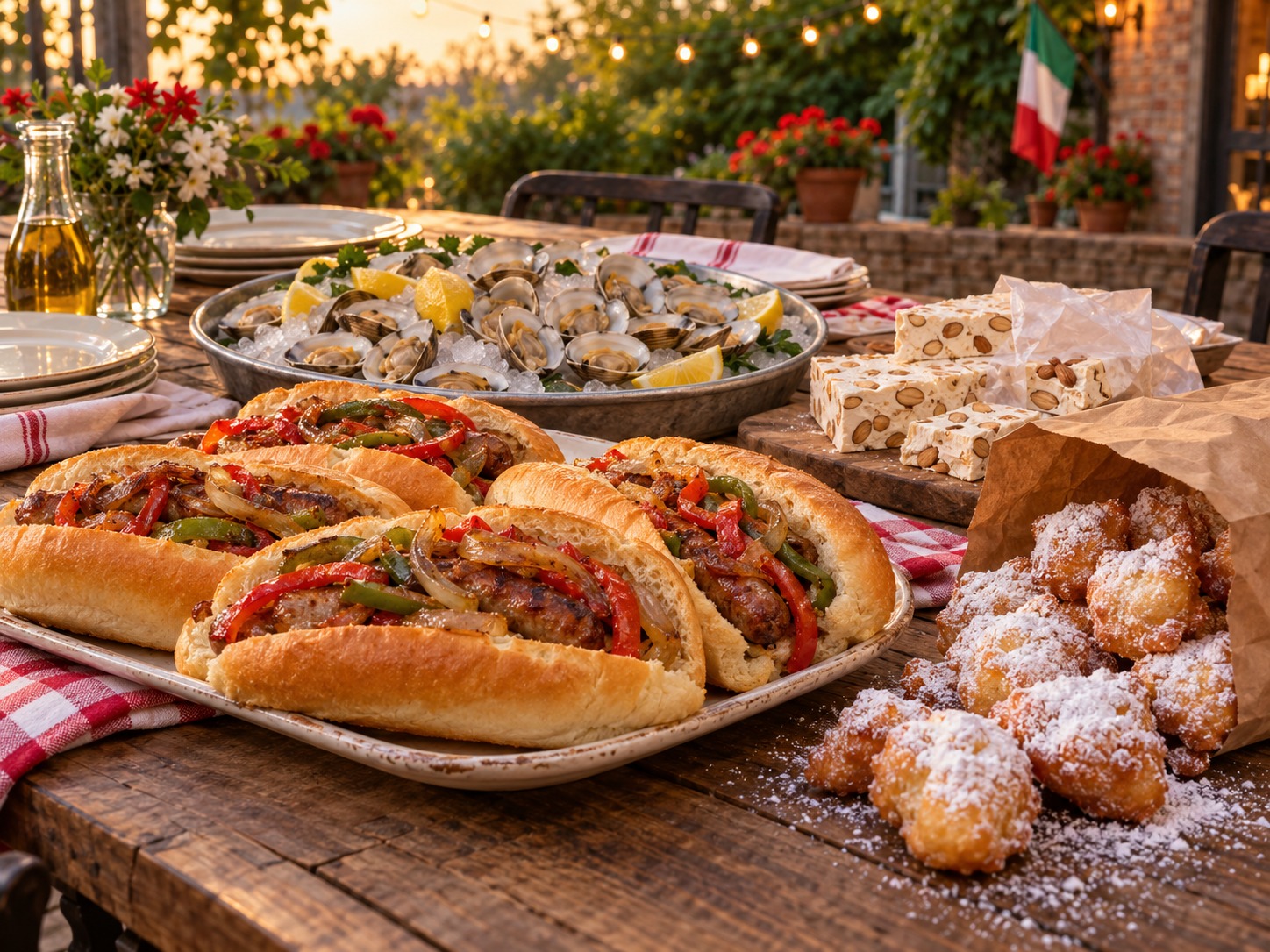
September 19: the patron saint of Naples, and the street feast on Mulberry Street
ZEPPOLE DELLA FESTA | VONGOLE CRUDE | TORRONE
The Plan
San Gennaro is street food, so this is a feast you can throw in the backyard. Put the sausage and peppers on the grill, set out clams on ice, and fry the zeppole to order, tossed in a paper bag with powdered sugar just like at the feast. The torrone is made the day before and cut into bars.
THE DAY BEFORE
• Make the torrone and let it set overnight.
• Shop for hot Italian sausage, peppers, onions, and rolls.
FEAST DAY, MORNING
• Buy the clams from a reputable licensed seafood dealer and keep them refrigerated.
• Prepare any other dishes you are serving and keep perishable fillings cold.
TWO HOURS BEFORE
• Make the zeppole dough and let it rise.
• Slice the peppers and onions.
WHEN PEOPLE ARRIVE
• Get the sausage and peppers going on the grill or the stove. Cook fresh sausage through to 160°F. • Shuck the clams close to serving and set them on crushed ice. Offer cooked clams as an alternative. |
• Fry the zeppole in batches and shake them in a paper bag with powdered sugar. • Cut the torrone at the end. |
|---|
The Saint of Naples
San Gennaro, Saint Januarius, was the bishop of Benevento, martyred around the year 305. He is the patron saint of Naples, and the city keeps a vial of what is believed to be his dried blood in the cathedral. The tradition of its liquefaction is closely tied to the city's hopes and fears, especially on his feast day, September 19.
Neapolitan immigrants brought the saint with them to New York. The Feast of San Gennaro on Mulberry Street in Little Italy began in 1926, and the street feast has become known for processions, music, and stand after stand of sausage and peppers, zeppole, cannoli, and torrone.
• Zeppole della Festa, the street fair zeppole
• Vongole Crude, clams on the half shell
• Torrone, honey almond nougat
Our Family on Mulberry Street
Mariuch’s father was born on Mulberry Street. His grandmother was born in Italy, came to New York, and pushed a cart on those same streets. That much we know. Nobody wrote down the rest, because nobody in our family ever wrote anything down. So this is how I see it, and I have been seeing it my whole life.
She is out before the sun. The cart is wood, with two big wheels and two handles worn smooth, and she pushes it over the cobblestones herself, because nobody else is going to. By seven o’clock it is loaded. Escarole and onions. Garlic braided by the neck. Dried beans sold by the scoop. A crate of whatever came in cheap that morning. She doesn’t trust anybody’s scale, so she uses her hands. A handful is a handful. If you are a regular, your handful is a little bigger.
Mulberry Street is loud. Everybody is selling something and everybody is shouting about it, in Neapolitan, in Sicilian, in an English that is still learning. She doesn’t shout. She doesn’t have to. The women on that block know her cart, and they know she will tell them the truth. The escarole is good today. The beans, not so much. Come back Thursday.
Her grandson is underfoot, a little boy who will grow up to be Mariuch’s father. He is the one sent running after a customer who came up a few pennies short, to tell her, “Pay me next week.” He is the one who gets the bruised tomato. And at night, upstairs in a kitchen too small for the people in it, he watches his grandmother turn whatever didn’t sell into dinner. The tired escarole. The broken beans. The last of the onions. Nothing went back on the cart, and nothing went in the garbage. It went in the pot.
That pot is pasta e fagioli, pasta and beans, and it was never a recipe. It was a habit.
He carried what he learned on that street the way you carry an accent, without thinking about it. Feed whoever is in front of you. Give the regulars a little extra. Tell people the truth about the food. Use everything. Measure with your hands, and trust them. And if somebody can’t pay today, they can pay next week.
Then he taught it to his daughter, standing beside her at the stove, the same way it was taught to him. Not with a card. With his hands. Mariuch learned the soup from him, and the meatballs, and all the rest of it that never made it onto a page.
Generations later, I stood next to Mariuch in a food truck in Connecticut, and I didn’t understand what I was looking at. I do now. It was the same cart. It had an engine and a menu board instead of two wheels and a pair of strong arms, but it was the same cart. Food on wheels, going to where the people were. A handful that was a little bigger for the regulars. Nothing wasted. Nobody sent away hungry.
Every September, when the Feast of San Gennaro fills Mulberry Street with sausage and peppers, zeppole, and torrone, I think about my grandfather’s grandmother pushing that wooden cart, the boy beside her, and the soup that went home with them at night.
Our family carried that way of feeding people from Mulberry Street to Connecticut. This cookbook preserves the recipes, our culture, and the family values that came with them: generosity, resourcefulness, and making room for another person at the table.
If my grandfather’s grandmother were still here, I like to think she would still be pushing that cart and making meals for everybody. Some of the recipes in this book she would recognize. Others we could show her. I imagine she would have opinions.
We would listen. Then we would cook.
Some of us just had better wheels.
Recipes from Our Family Kitchen
Zeppole della Festa (Street Fair Zeppole)
These are the zeppole of Italian street feasts in America: soft, yeasty puffs of fried dough, dropped hot into a paper bag full of powdered sugar and shaken until they are white all over. They are not the custard-filled pastry of St. Joseph's Day. These are messy and generous, eaten walking down the street with sugar all over your shirt.
| MAKES ABOUT 36 |
|---|
WHAT YOU NEED
• 4 cups all purpose flour • 2 1/4 teaspoons instant yeast, one packet • 2 tablespoons sugar • 1 teaspoon salt |
• 1 3/4 cups warm water • Vegetable or peanut oil for frying • Plenty of powdered sugar • Food-safe paper bags |
|---|
THE METHOD
1. Mix the flour, yeast, sugar, and salt in a large bowl. Add the warm water and stir hard with a wooden spoon until you have a soft, sticky dough.
2. Cover and let it rise in a warm place until doubled and bubbly, about 1 1/2 to 2 hours.
3. Heat 2 inches of oil in a deep pot to 350°F.
4. Lightly oil a dry tablespoon, scoop a rounded spoonful of dough, and use a second oiled spoon to lower it gently into the oil. Keep your fingers away from the hot oil.
5. Fry a few at a time, turning, about 3 to 4 minutes, until puffed, golden, and cooked through.
6. Drain on paper towels for a moment.
7. Put a big scoop of powdered sugar in a food-safe paper bag, drop in a handful of warm zeppole, fold the top, and shake. Serve them in the bag.
REEK-EE AND MARIUCH SAY The bag belongs to the experience. The sugar is supposed to land on the pastry, but it will find your shirt. That is part of the feast. Oil the spoon. Arguing with sticky dough has never made it less sticky. Have the people ready before you fry. A zeppola should spend more time being eaten than waiting on a plate. |
|---|
Vongole Crude (Clams on the Half Shell)
A clam knife, a line of people with lemons, and a platter on ice belong to many Italian American street feasts. Fresh littleneck clams, opened to order and served cold with lemon, taste like the ocean. Raw shellfish can carry harmful bacteria even when it looks and smells fresh. Cooking is the safer choice; lemon and hot sauce do not make raw clams safe.
| SERVES 8, ABOUT 6 CLAMS EACH |
|---|
WHAT YOU NEED
• 4 dozen littleneck clams, from a reputable licensed seafood dealer • Crushed ice • Lemon wedges |
• Hot sauce, optional • A clam knife, a thick towel, and a cut-resistant glove |
|---|
THE METHOD
1. Scrub the clams under cold water. Discard cracked shells and any clams that do not close when tapped.
2. Keep them refrigerated at 40°F or below until you are ready to open them. Do not store live clams submerged in fresh water or in an airtight container.
3. Protect your holding hand with a cut-resistant glove and a folded towel. Hold the clam securely on a stable work surface; use a proper clam knife.
4. Work the blade between the shells opposite the hinge and twist gently. Keep the blade directed away from your hand. If you are unfamiliar with shucking, ask the seafood dealer to demonstrate or open the clams for you close to serving.
5. Run the blade along the top shell to release the muscle, remove that shell, then loosen the clam from the bottom shell. Keep the juice.
6. Set the opened clams on crushed ice and serve immediately. Keep the platter cold and discard perishables left out longer than two hours, or one hour above 90°F.
REEK-EE AND MARIUCH SAY Buy them the day you serve them. Keep them cold. Fresh clams do not need an afternoon sitting in the sun to become a story nobody wants to tell. The knife gets a proper grip and your hand gets protection. Being in a hurry does not make either optional. Raw shellfish is not for everyone. Children, older adults, pregnant people, and anyone with a weakened immune system should choose thoroughly cooked clams instead. |
|---|
Torrone (Honey Almond Nougat)
Torrone is the candy sold in long slabs at Italian feasts, cut to order and wrapped in paper. Honey, sugar, and whipped egg whites become a thick, white nougat packed with toasted almonds, pressed between sheets of edible wafer paper. It is chewy, crunchy, and sweet, and it takes a candy thermometer and your full attention.
| MAKES ONE 8-INCH SQUARE PAN, ABOUT 32 BARS |
|---|
WHAT YOU NEED
• 1 cup honey • 1 1/2 cups sugar • 1/4 cup water • 2 egg whites from pasteurized shell eggs • Pinch of salt |
• 3 cups whole almonds, toasted and kept warm • 1 teaspoon vanilla extract • Grated zest of 1 lemon • Edible confectionery wafer paper, sold as ostia, or greased parchment • A candy thermometer |
|---|
THE METHOD
1. Line an 8-inch square pan with edible wafer paper, or with parchment brushed with a little oil. Have the pan, spatula, and almonds ready before heating the syrup.
2. In a stand mixer, beat the egg whites with the salt until they hold stiff peaks. Leave them in the bowl.
3. Heat the honey in a small saucepan to 250°F on the candy thermometer.
4. With the mixer running on medium, pour the hot honey slowly down the side of the bowl into the whites, avoiding the moving whisk. Keep beating.
5. In another saucepan, heat the sugar and water without stirring to 300°F.
6. With the mixer still running, pour the hot sugar syrup slowly down the side of the bowl.
7. Keep beating about 5 to 8 minutes, until the nougat is very thick, glossy, and holds its shape.
8. Beat in the vanilla and lemon zest, then fold in the warm almonds with a greased spatula.
9. Scrape into the pan and press flat with a greased spatula. Lay wafer paper or greased parchment on top and use the spatula to press again. Do not touch the hot nougat with bare hands.
10. Let it set at room temperature at least 6 hours or overnight. Once completely cool, cut into bars with a heavy knife wiped with oil.
REEK-EE AND MARIUCH SAY Put everything within reach before the sugar gets hot. This is not the recipe where you open three drawers looking for the spatula. Keep the almonds warm. Cold nuts can make the nougat stiffen before you have it in the pan. Wrap the cooled bars in wax paper and keep them dry in an airtight container. Cut them small enough that people can pretend they are only taking one. |
|---|
A Few Things You Can Buy
• Good hot Italian sausage from a real pork store.
• Soft Italian rolls for the sausage and peppers.
• Food-safe paper bags for the zeppole and wax paper for the torrone.
• String lights and an Italian flag for the yard. It is a feast.
A Neapolitan Christmas
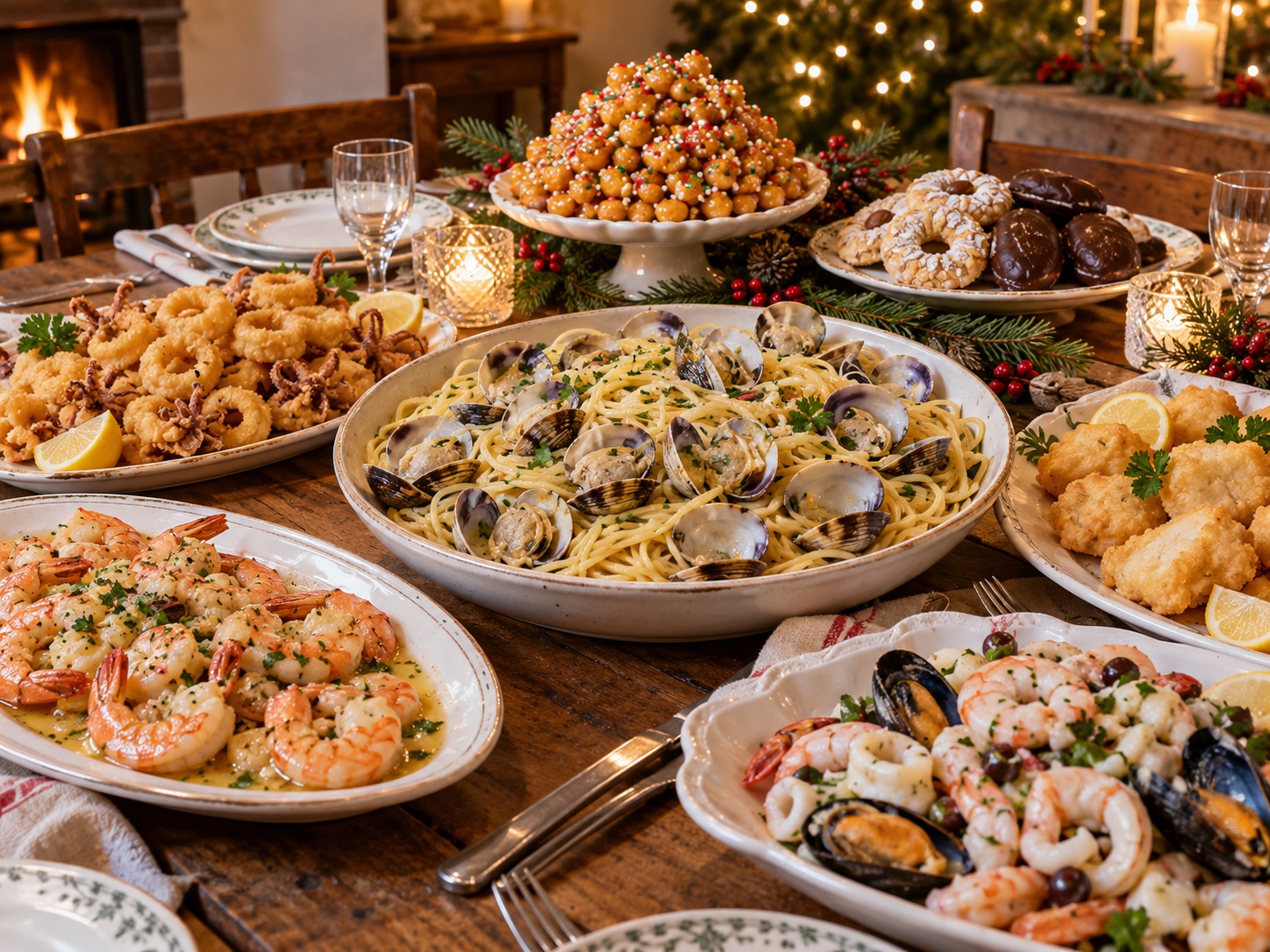
FROM MARIUCH'S KITCHEN
The Feast of the Seven Fishes, Christmas Day, and the Christmas sweets, for about eight people
CHRISTMAS EVE | CHRISTMAS DAY | THE SWEETS
GETTING READY
The Plan
Christmas in Naples is cooked over a whole week, not one day. The cookies can be made ahead, the salad improves after a day in the refrigerator, and the salt cod needs three days in water before it ever sees the frying pan. Spread the work out and Christmas Eve becomes frying and boiling pasta, not starting from scratch.
TWO WEEKS AHEAD
Bake the roccocò and store them in an airtight tin once completely cool. Bake the softer mostaccioli closer to Christmas, or freeze them now and thaw before serving.
Order the eel from the fish market if you are making it. It sells out.
DECEMBER 21
Start soaking the baccalà in cold water in the fridge. Change the water three times a day.
DECEMBER 22
Make the insalata di rinforzo and refrigerate it; use it within three to four days. Make the struffoli and cover once completely cool.
DECEMBER 23
Make the broth and meats for the minestra maritata. Divide into shallow containers and refrigerate within two hours; chill overnight.
Cook the octopus and make the insalata di mare. Cool promptly and refrigerate; keep chilled until serving.
CHRISTMAS EVE
Afternoon: buy the clams, shrimp, calamari, and smelts. Keep the seafood refrigerated. Scrub and briefly purge the clams in cold salted water in the refrigerator; discard cracked shells and clams that do not close when tapped.
Start the zeppoline dough about two hours before everyone arrives.
Fry in this order: zeppoline, smelts, calamari, baccalà, eel. Serve each as it comes out.
Last: the shrimp, then Mariuch’s Linguine alle Vongole.
CHRISTMAS DAY
Lift the fat off the broth, blanch the greens, and finish the minestra. Serve the soup, then the meats.
Set out the struffoli and cookies with espresso.
CHRISTMAS EVE
The Feast of the Seven Fishes
In Naples nobody calls it the Feast of the Seven Fishes. It is simply the Vigilia, the Christmas Eve vigil, a meatless supper of fish and fried things before midnight Mass. The families who carried it to America gave it the name and the number seven, and that is the version this kitchen grew up with. Some say seven for the sacraments, some say seven for the days of creation. Most families just say seven because that is what Mamma made.
Zeppoline (to start)
1. Baccalà Fritto
2. Calamari Fritti
4. Gamberi all'Aglio
5. Smelts Fritti
6. Insalata di Mare
7. Capitone Fritto
Insalata di Rinforzo (on the table all week)
CHRISTMAS EVE
Zeppoline (Fried Dough Puffs)
Before the first fish comes out, there are zeppoline. These are little puffs of yeasted dough dropped by the spoonful into hot oil, crisp outside and soft inside. Some families tuck a piece of anchovy into each one, some leave them plain with a shower of salt. Either way, they disappear while everybody is still taking off their coats.
| MAKES ABOUT 40 PUFFS |
|---|
WHAT YOU NEED
|
|
|---|
THE METHOD
Mix the flour and yeast in a large bowl. Add the warm water and the salt and stir hard with a wooden spoon until you have a sticky, stretchy dough. It should be too wet to knead.
Cover and let it rise in a warm place until doubled and bubbly, 1 1/2 to 2 hours.
Heat 2 inches of oil in a deep pot to 350°F.
Lightly oil a dry metal tablespoon. Scoop a spoonful of dough. If using anchovy, press a piece into the middle and fold the dough over it. Lower the dough gently into the oil; keep water away from the frying pot.
Fry in small batches, turning, 3 to 4 minutes until puffed and golden.
Drain on paper towels and sprinkle with salt right away. Serve hot.
REEK-EE AND MARIUCH SAY Keep the spoon lightly oiled and the dough slides right off. Water and a pot of hot oil are not friends. Do not crowd the pot. Too many at once and the oil cools down, and you get greasy puffs instead of crisp ones. These are best in the first ten minutes. Fry them as people arrive. |
|---|
CHRISTMAS EVE
Baccalà Fritto (Fried Salt Cod)
Baccalà is salted, dried cod, and on Christmas Eve it is the fish that cannot be missing. It starts out stiff as a board and salty as the sea, so it soaks for three days before it is ready. Then it is dipped in a light batter and fried until golden and flaky, with nothing more than a squeeze of lemon.
| SERVES 8 |
|---|
WHAT YOU NEED
|
|
|---|
THE METHOD
Three days before: rinse the cod and put it in a large container of cold water in the refrigerator. Change the water three times a day.
On the day, cook a tiny piece thoroughly before tasting it. If it is still very salty, give the remaining cod a few more hours in fresh water in the refrigerator.
Drain, pat very dry, and cut into pieces about 2 inches square. Pull out any bones or skin you find.
Whisk the flour, pepper, and cold sparkling water into a smooth batter about as thick as pancake batter.
Heat 2 inches of oil to 350°F.
Dip each piece in the batter, let the extra drip off, and fry about 4 to 5 minutes, turning once, until deep golden. Check the thickest piece reaches 145°F and flakes easily; timing varies with thickness.
Drain on paper towels and serve hot with lemon. No extra salt.
REEK-EE AND MARIUCH SAY Do not skip the soaking. Skip it and you will be drinking water until New Year. Pat it dry before battering. Wet fish and hot oil do not get along. Keep the batter cold. Cold batter fries up crisp and light. |
|---|
CHRISTMAS EVE
Calamari Fritti (Fried Calamari)
Nobody ever says no to fried calamari. Tender rings and tentacles go into a quick coat of flour and semolina, then into hot oil for barely two minutes. The whole secret is speed: cooked fast, calamari is tender; cooked too long, it is a rubber band.
| SERVES 8 |
|---|
WHAT YOU NEED
|
|
|---|
THE METHOD
Cut the bodies into rings about 1/2 inch wide. Leave the tentacles whole. Pat everything very dry.
Mix the flour, semolina, and salt in a bowl.
Heat 2 inches of oil to 375°F.
Toss a handful of calamari in the flour mix and shake off the extra in a strainer.
Fry about 1 1/2 to 2 minutes, until pale golden and the squid is opaque and cooked through. Small batches keep the cooking quick and even.
Drain, salt right away, and serve with lemon.
REEK-EE AND MARIUCH SAY Watch the squid closely. Walk away to answer the door and you are serving rubber bands. The clock is a guide; the squid still has to be cooked through. Small batches. The oil has to stay hot or the coating falls off. Calamari waits for nobody. Fry it and bring it straight to the table. |
|---|
CHRISTMAS EVE
Gamberi all'Aglio (Garlic Shrimp)
Big shrimp seared fast, then bathed in garlic, white wine, and lemon. This is the Italian American favorite on the Christmas Eve table, and the sauce is half the reason. Put out plenty of bread, because nobody is leaving a drop in the bottom of that pan.
| SERVES 8 |
|---|
WHAT YOU NEED
|
|
|---|
THE METHOD
Pat the shrimp dry and season with salt and pepper.
Heat the oil in a large skillet over high heat. Sear the shrimp in one layer, about 1 minute per side, until they begin to turn opaque. Move them to a plate; they finish cooking when they return to the sauce.
Lower the heat. Add the butter, garlic, and pepper flakes and cook 1 minute.
Add the wine and let it bubble until reduced by half. Add the lemon juice.
Put the shrimp back and toss in the sauce until the flesh is firm, pearly, and opaque throughout, about 30 seconds to 1 minute. Add the parsley.
Serve with bread for the sauce.
REEK-EE AND MARIUCH SAY Shrimp cook quickly. Look for firm, pearly, opaque flesh throughout; pink on the outside alone is not the test. Do not let the garlic brown. Burnt garlic is bitter, and there is no fixing it. |
|---|
CHRISTMAS EVE
Smelts Fritti (Fried Smelts)
Little silver smelts, dusted in flour and fried crisp, are eaten whole, bones and all. They are a Christmas Eve staple in Italian American homes and one of the simplest dishes on the table. Lemon, salt, done.
| SERVES 8 |
|---|
WHAT YOU NEED
|
|
|---|
THE METHOD
Rinse the smelts and pat them very dry.
Mix the flour, salt, and pepper in a bag or bowl. Toss the smelts in it and shake off the extra.
Heat 2 inches of oil to 350°F.
Fry in batches about 2 to 3 minutes, until crisp and golden and the fish is cooked through. Check a larger smelt reaches 145°F.
Drain, salt right away, and serve with lemon.
REEK-EE AND MARIUCH SAY Small smelts are traditionally eaten whole. Their fine bones become crisp, but check larger fish for bones and eat them the way you are comfortable. Ask the fish market to clean them for you. Life is short. |
|---|
CHRISTMAS EVE
Insalata di Mare (Seafood Salad)
A cold seafood salad of tender octopus, mussels, and shrimp, dressed with lemon, olive oil, garlic, and crunchy celery. It is the one fish course that is made ahead, which makes it the cook's best friend on Christmas Eve. It tastes better the next day, after everything has had time to soak up the dressing.
| SERVES 8 |
|---|
SEAFOOD
|
|
|---|
DRESSING
|
|
|---|
THE METHOD
Put the octopus in a pot of cold water with the bay leaves. Bring to a gentle simmer and cook 45 to 60 minutes, until a knife slides in easily. Let it cool briefly in its water, then cut into bite size pieces. For a make-ahead salad, chill promptly using an ice bath or shallow containers; refrigerate within two hours.
Put the mussels in a covered pot with a splash of water and steam 5 minutes, until open. Throw away any that stay closed. Take them out of the shells.
Drop the shrimp into simmering salted water for about 2 minutes, until firm, pearly, and opaque throughout. Drain.
Whisk the oil, lemon juice, garlic, salt, and pepper.
Toss the seafood with the celery, parsley, and dressing.
Cover and refrigerate at least 2 hours, or overnight. Taste for lemon and salt before serving. Keep chilled until close to serving, and use refrigerated leftovers within three to four days.
REEK-EE AND MARIUCH SAY Make it the day before. It is better, and you are busier than you think on Christmas Eve. Let the octopus cool briefly in its own cooking water. That keeps it tender. Then chill it promptly; do not leave a pot of seafood cooling on the counter for hours. |
|---|
CHRISTMAS EVE
Capitone Fritto (Fried Eel)
In Naples, the eel is the king of Christmas Eve. Eating capitone is said to bring good luck for the year ahead, and the fish markets of Naples are packed with it the week before Christmas. It is cut into chunks, floured, and fried until crisp outside and rich and tender inside.
| SERVES 8 |
|---|
WHAT YOU NEED
|
|
|---|
THE METHOD
Rinse the eel pieces and pat them very dry. Season with salt.
Dredge each piece in flour and shake off the extra.
Heat 2 inches of oil to 350°F. Drop a few bay leaves in for flavor if you like.
Fry in batches about 8 to 10 minutes, turning, until golden and cooked through. Check the thickest piece reaches 145°F. Be mindful of bones when eating.
Drain and serve hot with lemon.
REEK-EE AND MARIUCH SAY Order it early, and have the fish market skin and clean it. Trust us on this one. If half the table will not go near an eel, nobody calls the police. Swap in baked stuffed clams or a piece of fish in tomato sauce and you still have your seven. |
|---|
CHRISTMAS EVE
Insalata di Rinforzo (Reinforcement Salad)
This salad belongs on the holiday table from Christmas Eve through New Year. Cauliflower, olives, capers, anchovies, and pickled peppers sit in oil and vinegar, traditionally getting "reinforced" with a little more of this and that. Make fresh small batches through the week, keeping each refrigerated and using it within three to four days. Sharp, salty, and crunchy, it cuts right through all that fried fish.
| SERVES 8 TO 10 |
|---|
WHAT YOU NEED
|
|
|---|
THE METHOD
Boil the cauliflower in salted water 5 to 6 minutes, until just tender but still with some bite. Drain and cool.
Put it in a big bowl with the giardiniera, peppers, both olives, capers, and anchovies.
Whisk the oil and vinegar, pour it over, and toss.
Taste for salt and vinegar. Cover and let it sit at least a few hours, or overnight in the fridge.
Bring out a serving portion shortly before the meal so it loses its chill. Keep the rest refrigerated. Use each batch within three to four days; do not keep topping up an old serving bowl with fresh ingredients.
REEK-EE AND MARIUCH SAY Do not overcook the cauliflower. It should crunch, not collapse. Make it a day or two ahead. This salad likes to sit and think. |
|---|
CHRISTMAS DAY
Christmas Day
After a night of fish, Christmas Day brings the meat back to the table. The Neapolitan tradition is minestra maritata, a rich broth "married" to bitter winter greens, followed by the tender meats that made the broth. It is slow, simple, and made the day before.
Minestra Maritata (the soup, then the meats)
CHRISTMAS DAY
Minestra Maritata (Wedding Soup, Neapolitan Style)
Minestra maritata means married soup, because the meats and the greens are married in one pot. It is the ancestor of the Italian wedding soup most people know, but far heartier. Pork, beef, and sausage simmer for hours into a deep broth, then escarole, chicory, cabbage, and chard go in. The soup is served first, and the meats come after as their own course.
| SERVES 8 |
|---|
BROTH AND MEATS
|
|
|---|
GREENS
|
|
|---|
TO SERVE
Grated Locatelli Pecorino Romano
Crusty bread
THE METHOD
The day before: put the beef, ribs, pork shoulder, ham hock, and cheese rind in a large stockpot with the onion, carrots, celery, and cold water.
Bring slowly to a simmer, skimming off the foam that rises. Simmer gently, uncovered, 2 1/2 to 3 hours, until the meats are tender.
Add the sausage for the last 30 minutes.
Lift out the meats and strain the broth. Divide both into shallow containers; use an ice bath for the broth if needed and refrigerate within two hours. Chill overnight.
Christmas Day: lift the hardened fat off the broth. Taste it and add salt.
Wash the greens well and chop them. Boil each green separately in salted water 3 to 4 minutes to take away the bitterness, then drain.
Bring the broth to a boil, add all the greens, then simmer 20 to 30 minutes, until silky.
Slice the meats. Add some back to the soup if you like, and reheat the rest in a little broth until they reach 165°F.
Serve the soup with grated cheese, then bring out the platter of meats as the next course.
REEK-EE AND MARIUCH SAY Blanch the greens first. Skip it and the whole pot turns bitter. Make the broth the day before so you can lift the fat off. The broth will be cleaner and less greasy. Save the cheese rinds all year in the freezer. This is what they are for. |
|---|
THE SWEETS
The Christmas Sweets
No Neapolitan Christmas is finished without the sweets. They are made days or weeks ahead, set out on Christmas Eve, and nibbled straight through New Year with espresso and a glass of something.
Struffoli
Roccocò
Mostaccioli
THE SWEETS
Struffoli (Honey Balls)
Struffoli are the sweet that says Christmas in Naples. Tiny balls of dough are fried, tossed in warm honey, and piled into a wreath or a mound, then covered in colored sprinkles and candied fruit. Everybody picks at them all week, one sticky handful at a time.
| SERVES 10 TO 12 |
|---|
DOUGH
|
|
|---|
HONEY COATING
|
|
|---|
THE METHOD
Mix the flour, sugar, salt, and zests. Add the eggs, yolk, butter, and liqueur and knead into a smooth, soft dough. Cover and rest 30 minutes.
Cut off a piece at a time and roll into a rope about 1/2 inch thick. Cut into 1/2-inch pieces, about the size of a hazelnut.
Heat 2 inches of oil to 350°F. Fry in batches 2 to 3 minutes, until light golden. Drain on paper towels and cool.
In a large pot, warm the honey and sugar over low heat 3 to 4 minutes, until loose and shiny.
Turn off the heat. Add the fried balls and stir until every one is coated.
Pile them onto a platter as a mound or a wreath, using wet hands to shape it.
Cover with sprinkles and candied fruit while still warm. Let it set.
REEK-EE AND MARIUCH SAY Small is the whole point. If they are bigger than a hazelnut, they are not struffoli, they are golf balls. Wet your hands before shaping, or you will be wearing the honey. Make them a day or two ahead. Keep them covered at room temperature, never in the fridge. |
|---|
THE SWEETS
Roccocò (Almond Christmas Rings)
Roccocò are hard, crunchy rings full of whole almonds, candied orange, and warm spices. They can be made ahead and keep well in an airtight tin. They are meant to be dunked in wine or espresso, because on their own they could break a tooth.
| MAKES ABOUT 24 |
|---|
WHAT YOU NEED
|
|
|---|
THE METHOD
Heat the oven to 350°F and line two baking sheets with parchment.
Mix the flour, sugar, spices, baking powder, and zest. Stir in the almonds and candied peel.
Add the water a little at a time and work it into a stiff, sticky dough.
Take a piece about the size of a small egg and roll it into a rope about 3/4 inch thick and 6 to 7 inches long. Bring the ends together into a ring.
Set on the sheets, flatten slightly, and brush with beaten egg.
Bake 20 to 25 minutes, until golden brown.
Cool completely and store in tins.
REEK-EE AND MARIUCH SAY They are supposed to be hard. Dunk them. That is what the wine is for. They keep for weeks, so make them early and get them off your list. |
|---|
THE SWEETS
Capodanno
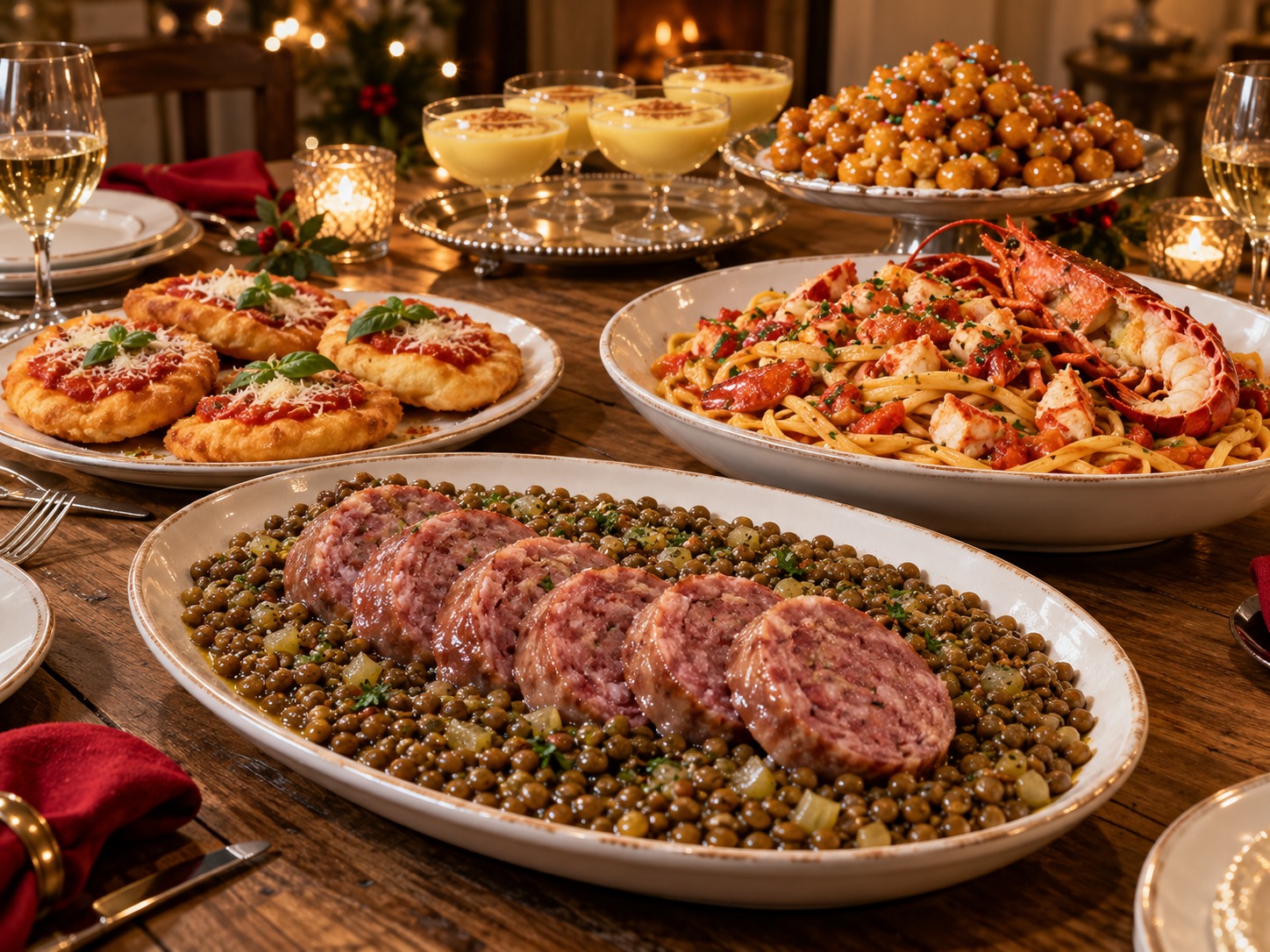
FROM MARIUCH'S KITCHEN
New Year's Eve, Italian style: a long night of food and luck, for about eight people
PIZZETTE FRITTE | LINGUINE ALL'ASTICE | COTECHINO E LENTICCHIE | ZABAGLIONE
GETTING READY
The Plan
New Year's Eve is a late night, so the food comes in waves. Little fried pizzas when people arrive, a big pasta for dinner, then lentils and cotechino right at midnight for luck. The lentils and the sausage are made in the afternoon and simply reheated, so the cook gets to see the ball drop too.
A FEW DAYS BEFORE
Buy the cotechino at an Italian market. The precooked kind is easiest.
Order the lobsters from the fish market. Pick them up freshly split on December 31 and keep refrigerated until cooking.
Put a bottle of prosecco and the Marsala in the fridge.
DECEMBER 31, AFTERNOON
Cook the lentils. Divide them into shallow containers and refrigerate within two hours; reheat them close to midnight.
Make the tomato sauce for the pizzette.
If your cotechino is raw, not precooked, start it now. It needs about three hours.
TWO HOURS BEFORE GUESTS
Make the pizzette dough and let it rise.
AS PEOPLE ARRIVE
Fry the pizzette and top them hot.
DINNER, AROUND NINE
Cook the linguine with lobster.
HALF AN HOUR BEFORE MIDNIGHT
Reheat the lentils to 165°F. Heat the cotechino according to its package directions. Slice it and set it on the lentils.
Everybody eats a spoonful of lentils as the clock strikes twelve.
JUST AFTER MIDNIGHT
Whisk the zabaglione and serve it warm with the leftover struffoli and a glass of prosecco.
DECEMBER 31
Luck at Midnight
In Italy, the last night of the year is about luck for the next one. At the stroke of midnight, everyone eats a spoonful of lentils, because the little round lentils look like coins, and the more you eat, the more money comes your way. The lentils are served with cotechino, a big, rich pork sausage, because pork stands for plenty. Plenty of Italians also wear something red for luck in love. In Naples, people once threw old dishes and broken things out the window at midnight to make room for the new; today the city does it with fireworks instead, loud enough to wake the dead.
|
|
|---|
NEW YEAR'S EVE
Pizzette Fritte (Little Fried Pizzas)
In Naples these are called montanarine: small rounds of pizza dough fried until puffed and golden, then topped with a spoonful of tomato sauce, grated cheese, and a basil leaf. They are the perfect thing to hand people as they come through the door on a long night. Fried pizza is a Naples street food, and once you taste one, you will understand why the city never gave it up.
| MAKES ABOUT 24 |
|---|
DOUGH
|
|
|---|
SAUCE AND TOPPING
|
|
|---|
THE METHOD
Mix the flour and yeast. Add the water, oil, and salt, and knead about 8 minutes into a soft, smooth dough. Cover and let it rise until doubled, about 1 1/2 to 2 hours.
Make the sauce: crush the tomatoes with your hands. Warm the oil and garlic, add the tomatoes and a pinch of salt, and simmer 15 minutes. Take out the garlic.
Divide the dough into pieces about the size of a golf ball. Let them rest 15 minutes under a towel.
Heat 2 inches of oil to 350°F.
Stretch each ball with your fingers into a round about 3 inches across.
Fry 2 or 3 at a time, about 1 minute per side, spooning a little oil over the top so they puff. Drain on paper towels.
Top each with a spoonful of hot sauce, a shower of cheese, and a basil leaf. Serve right away.
REEK-EE AND MARIUCH SAY Use your hands. The dough needs a little air left in it, not a lecture from the rolling pin. Have the plates ready before the first pizza hits the oil. People suddenly become very helpful when they smell fried dough. |
|---|
NEW YEAR'S EVE
Linguine all'Astice (Linguine with Lobster)
A big night calls for a big pasta. Lobster is cooked right in its shell in a sauce of garlic, white wine, and tomatoes, and the shells give the sauce a deep, sweet flavor of the sea. The linguine finishes in that sauce, and the lobster pieces go on top. It is a dish for celebrating, and New Year's Eve is the night for it.
| SERVES 8 AS A COURSE |
|---|
WHAT YOU NEED
|
|
|---|
THE METHOD
Cut the split lobsters into large pieces, keeping the meat in the shell. Crack the claws with a lobster cracker.
Bring a big pot of salted water to a boil.
In your widest pan, warm the oil with the garlic and pepper flakes until the garlic is pale gold.
Add the lobster pieces, meat side down, and cook 2 minutes. Add the wine and let it bubble 1 minute.
Add the cherry tomatoes and canned tomatoes and a pinch of salt. Cover and cook about 8 to 10 minutes, until the meat is firm, pearly, and opaque throughout; check the thickest piece reaches 145°F.
Lift out the lobster pieces and set them aside. Let the sauce simmer 5 more minutes.
Cook the linguine 2 minutes less than the package says. Save a cup of the pasta water.
Drain the pasta into the sauce and toss over the heat 2 minutes, adding pasta water if it looks dry.
Toss in the parsley, pile the linguine on a big platter, and lay the lobster on top.
REEK-EE AND MARIUCH SAY Let the fish market split the lobsters. You have a whole night of cooking ahead; this does not need to become a wrestling match. No cheese on this lobster pasta. Taste the sauce before you reach for anything. The shells already did their work. Put a bowl for shells on the table and plenty of napkins. The lobster came dressed for dinner. Somebody has to deal with its coat. |
|---|
NEW YEAR'S EVE
Cotechino con Lenticchie (Sausage with Lentils)
This is the dish of midnight. Little lentils, cooked slowly with onion, carrot, celery, and a touch of tomato, are piled on a platter and topped with thick slices of cotechino, a big, soft, rich pork sausage. A spoonful of lentils at the stroke of twelve means money in the new year, and the pork means plenty at the table. Nobody skips it, even if they are already full.
| SERVES 8 |
|---|
LENTILS
|
|
|---|
COTECHINO
2 cotechino sausages, about 1 lb each, precooked
THE METHOD
Rinse the lentils and pick out any little stones.
Warm the oil in a heavy pot and cook the onion, carrot, and celery 8 minutes, until soft. Add the garlic and tomato paste and stir 1 minute.
Add the lentils, bay leaf, and broth. Bring to a boil, then lower to a gentle simmer.
Cook 30 to 40 minutes, until the lentils are tender but still whole and there is a little broth left in the pot. Season with salt and pepper. Take out the bay leaf.
For precooked cotechino, follow the package heating directions. Some are sold in a sealed boil-in pouch; simmer in that pouch only if the label instructs it. Otherwise remove the packaging and heat as directed.
Open the package over the sink, slide the cotechino out, and cut it into thick slices.
Spoon the lentils onto a warm platter, lay the cotechino slices on top, and finish with a drizzle of olive oil and the parsley.
REEK-EE AND MARIUCH SAY A spoonful at midnight for whoever wants one. We are feeding a tradition, not demanding a second dinner. There is still dessert. Stop while the lentils still look like lentils. We asked for coins, not a pot of loose change melted into paste. For raw cotechino, follow the butcher’s or package preparation directions and simmer gently until cooked through, often about three hours. Check the center reaches 160°F. Refrigerate promptly if cooking it ahead. |
|---|
NEW YEAR'S EVE
Zabaglione (Warm Wine Custard)
Zabaglione is a warm, foamy custard of egg yolks, sugar, and Marsala, whisked over simmering water until it triples in size. It takes ten minutes and a strong arm, which makes it the perfect thing to make right after midnight while everybody is still celebrating. Serve it in glasses, with the leftover struffoli or a few cookies for dipping.
| SERVES 8 |
|---|
WHAT YOU NEED
|
|
|---|
THE METHOD
Set a heatproof bowl over a pot of barely simmering water. The bottom of the bowl should not touch the water.
Off the heat first, whisk the yolks and sugar in the bowl until pale and thick, about 2 minutes.
Whisk in the Marsala.
Set the bowl over the simmering water and whisk constantly, about 8 to 10 minutes, until thick and foamy. Check the custard reaches 160°F with a thermometer; timing alone is not the test. When you lift the whisk, it should leave a ribbon on top.
Spoon into glasses right away and serve with struffoli or cookies.
REEK-EE AND MARIUCH SAY Keep whisking. Somebody else can pour the toast. You have a bowl of yolks making plans if you stop. Gentle heat, steady whisking, and the thermometer. Foamy is lovely. Properly cooked is necessary. Hand the whisk to somebody who has been telling you how easy this looks. They can finish the demonstration. |
|---|
GOOD TO HAVE
A Few Things You Can Buy
Prosecco or spumante for the midnight toast.
Panettone or pandoro left over from Christmas, toasted for New Year's morning.
Something red to wear. For luck.
Grapes, dried figs, and nuts for the table while you wait for midnight.
Reek-ee’s Rules for Cooking Without a Recipe
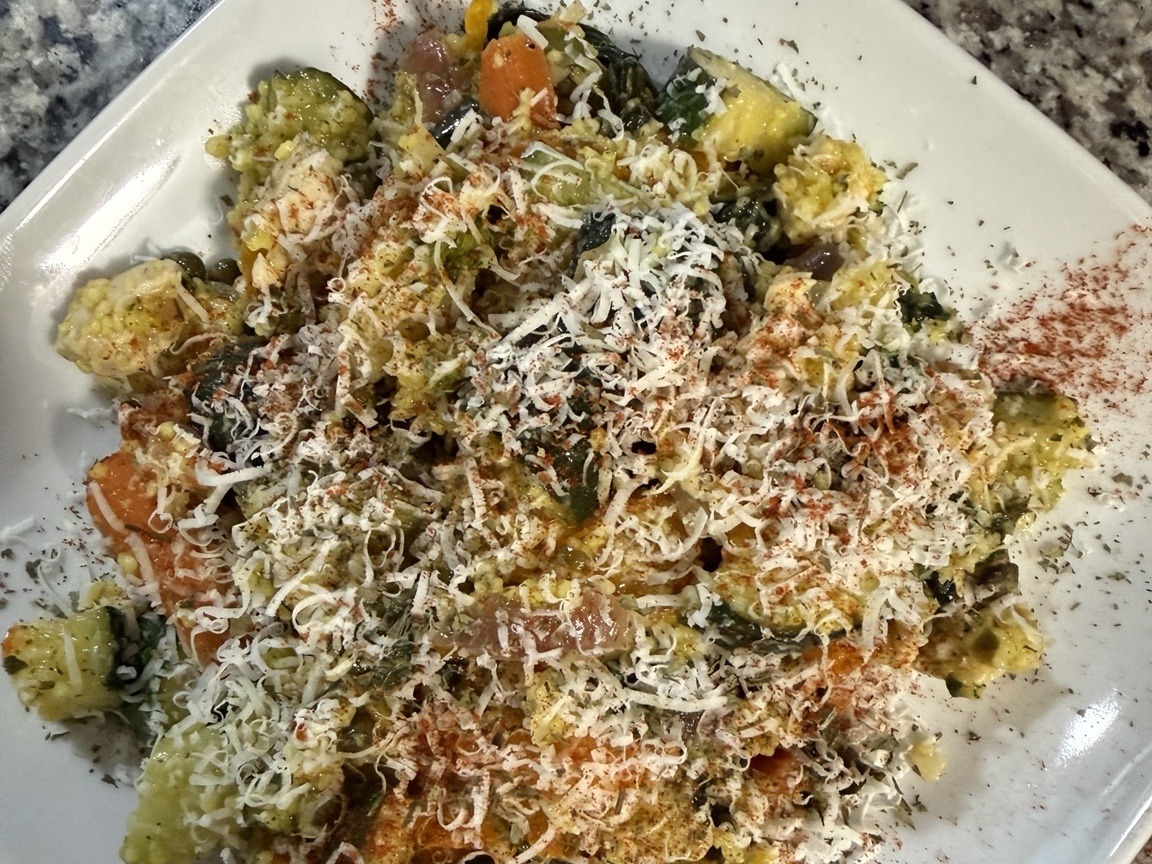
THE FRIDGE HAD NO PLAN. REEK-EE DID.
An improvised dinner from whatever was in the refrigerator
Some recipes begin with a recipe card. Others begin with opening the refrigerator, looking around, and trusting what you know. This dish became the proof: a little instinct, a little Mariuch, and dinner found its way to the plate.
REEK-EE'S RULES / PART ONE
Open the refrigerator and begin
1. Start with what you actually have. Look for the vegetables that need to be used, the half onion, the lonely pepper, the handful of spinach, and the chicken that can become dinner. Good food should not become garbage because nobody had a written plan.
2. Find the center of the dish. Something has to lead. Chicken, pasta, sausage, beans, or eggplant—once you decide what the dish is about, everything else has a job.
3. Build flavor before you build volume. Olive oil, onion, garlic, perhaps a little red pepper. The kitchen should smell good before the pan is crowded.
4. Everything does not belong in the pan at the same time. Broccoli is not spinach. Carrots are not zucchini. Give every ingredient the time it deserves.
5. Let the pan do some of the work. Stop stirring every five seconds. Browning is flavor.
6. Learn what “it needs something” means. Sometimes the answer is salt. Sometimes lemon. Sometimes cheese. Sometimes capers.
7. Fix it instead of panicking. Good cooks make corrections. A dry pan may need liquid. A flat dish may need acid. Dinner is not ruined because one decision needs another decision.
REEK-EE SAYS A recipe can teach you how to make one dish. Learning how to taste teaches you how to make dinner. |
|---|
REEK-EE'S RULES / PART TWO
Trust the pan. Finish the plate.
8. Texture is part of flavor. Something should be tender, something browned, something fresh, and something with bite.
9. Do not wash the best part down the sink. The browned bits in the pan are flavor. Loosen them with lemon, stock, wine, pasta water, or plain water and bring them back into the dish.
10. Give the starch a purpose. Rice, potatoes, bread, or couscous should catch the juices, oil, cheese, and sauce rather than sit beside them anonymously.
11. Finish after you think you are finished. Taste once more. Add basil, black pepper, lemon, capers, olive oil, or more Locatelli if that is what the dish asks for.
12. Make it look like you intended to make it. Food should still look like food, but there is a difference between plating something and dumping it.
13. Borrow great ideas. Cooks learn from restaurants, family tables, and other kitchens. Respect the source, then make the idea your own.
14. Know when tradition matters. If you call something traditional, honor the tradition. Tuesday-night dinner has more freedom.
15. When something works, remember it. Some recipes begin as instinct and become recipes only after the first bite proves they deserve another life.
HOW THIS ONE HAPPENED
What the refrigerator gave me
The dish that inspired these rules began exactly the way most of my improvised dinners begin: I opened the refrigerator. There was chicken, broccoli, zucchini, peppers, carrots, spinach, onion, garlic, fresh basil, lemon, capers, and Locatelli Pecorino Romano. There was Italian couscous in the cupboard. I was also convinced there was arugula in the refrigerator. There was not.
That did not change dinner. The chicken became the center of the dish. Onion and garlic built the base. The carrots and broccoli went in early. The zucchini and peppers followed later. The spinach went in near the end, and the basil was torn by hand for freshness. Lemon brought brightness. Capers brought attitude. The couscous caught the pan juices. Locatelli brought richness, salt, and the appropriate degree of Italian excess.
The dish, in Reek-ee logic
The center: Chicken
The vegetables: Broccoli, carrots, zucchini, peppers, onion, and spinach
The foundation: Olive oil, onion, and garlic
The fresh note: Torn basil
The acid: Fresh lemon
The attitude: Capers
The starch: Italian couscous
The finish: Black pepper, capers, and plenty of Locatelli Pecorino Romano
The ingredient that never reported for duty: Arugula
What Mariuch may have really taught me
Maybe that is where this ability came from. Mariuch gave me recipes, but underneath them she gave me something larger: use what you have, taste your food, fix what needs fixing, and feed people generously. Sometimes the inheritance is a recipe written on a card. Sometimes it is a way of knowing.
MARIUCH'S RULE
The recipe isn’t finished when the ingredients are measured. It’s finished when it tastes right.
| REEK-EE APPROVED • OPEN THE REFRIGERATOR. FIGURE IT OUT. FEED SOMEBODY. |
|---|