A Story of Fathers, Sons, and the Ghosts We Inherit
RICK NOVAK
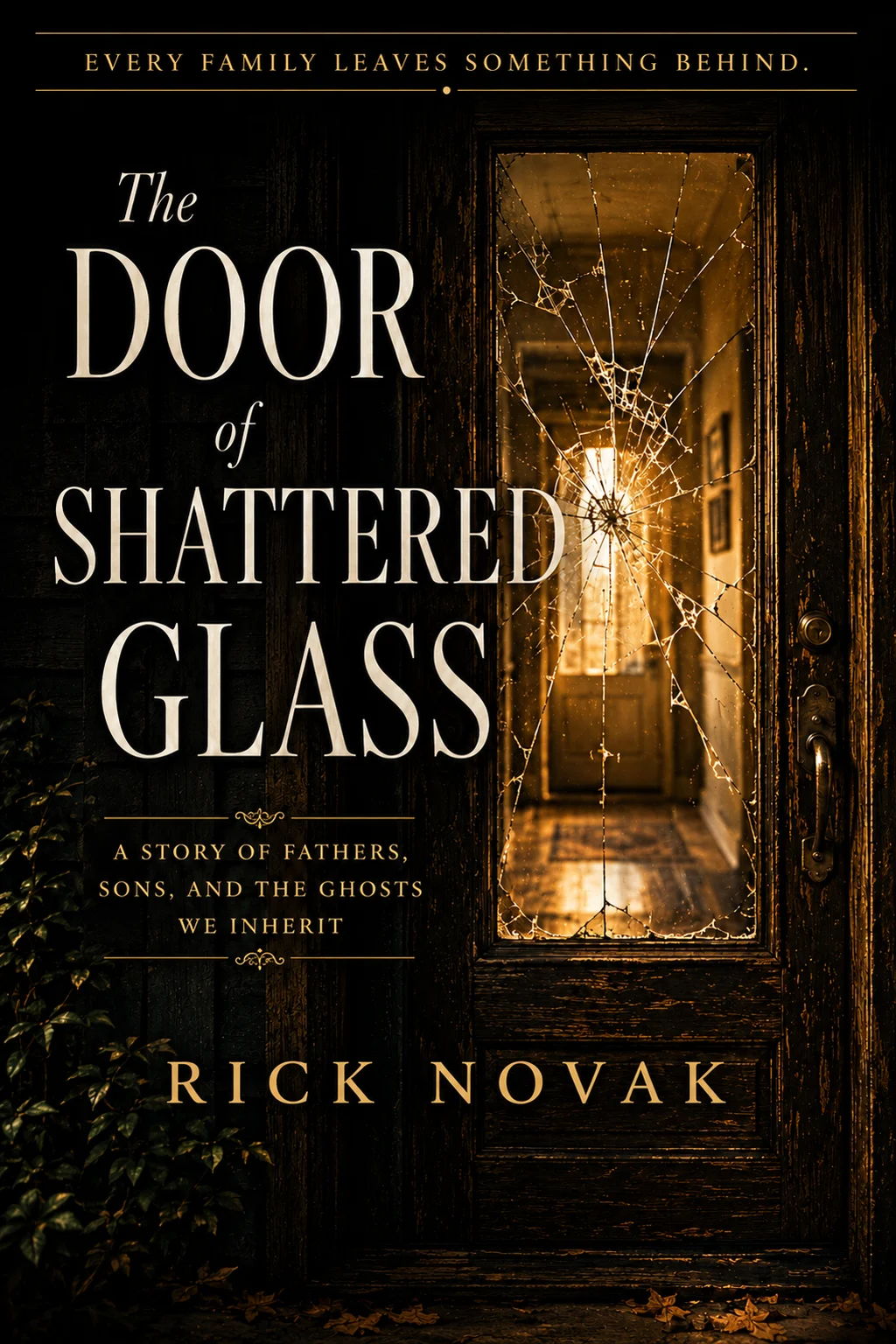

A Story of Fathers, Sons, and the Ghosts We Inherit
RICK NOVAK
The Door of Shattered Glass: A Story of Fathers, Sons, and the Ghosts We Inherit
Disclaimer: This is a work of fiction. Any resemblance to actual persons, living or dead, events, or locales is entirely coincidental. All characters, organizations, and incidents portrayed in this book are products of the author’s imagination or are used fictitiously.
All rights reserved.
Copyright © 2025 by Rick Novak
No part of this book may be reproduced, stored in a retrieval system, or transmitted in any form or by any means, electronic, mechanical, photocopying, recording, or otherwise, without the prior written permission of the publisher, except for brief quotations used in book reviews or scholarly journals.
Cover Design by Rebeca-Ira of Rebecacovers.
Published and Printed in the United States by Wolf Publishing, New Canaan, Connecticut.
First Edition
ISBN: 9798310878747
Library of Congress Cataloging-in-Publication Data: Novak, Rick.
LC Classification: HV6626.N69 2025 — Dewey: 813/.6, dc23
To my mother, my light through every storm, my strength in darkness, my compass when I was lost. Your unwavering presence has been my anchor when the world felt unsteady, a testament to unconditional love. The very love this story seeks to find.
To Wolfgang Sebastian, my beloved Wolf, who waits for me at the Rainbow Bridge. Your silent understanding and steadfast love carried me through my darkest days. You were more than a companion, you were my healer, my bridge from past to present. True love asks for nothing in return, and you gave it freely. Until we meet again, my boy, know that Daddy loves his Wolf.
This book is for all of you who dare to believe in second chances.
Under the dim glow of a porch light, Alex had once traced the outline of Max’s tiny fingers against his palm, his son’s sleepy giggle light as a breeze. For a brief moment, before the weight of history pressed in, he had believed he could be something different.
He had held so much in that tiny palm. It was his own second chance. But second chances were fragile, and Alex had never learned how to hold anything without breaking it.
Now, his fingers curled around something else: not Max’s tiny hand, not the warmth of something worth keeping, but the cold, empty weight of a bottle.
The whiskey seared its way down, hot and useless. The bottle teetered beside him, amber liquid sloshing in his unsteady grip. He let the bottle fall, the weight of it too much to hold. His pulse throbbed behind his eyes. The headlights carved long shadows across the street, stretching toward the house at the end of the cul-de-sac.
Sarah’s house. The house that used to be his.
It looked the same, clean white siding, neatly trimmed flowerbeds, the porch light shining as a sentinel above the front door. But it wasn’t the same for Alex. The warmth was gone, leaving behind a hollow shell of everything he’d lost.
He blinked hard, trying to steady his vision. The spilled whiskey washed over everything; the porch seemed to waver in his vision as if seen through heat rising off pavement. His eyes locked dully onto the door, where the brass handle reflected the streetlight in a taunting glint.
The lock. The first thing she changed. The last thing keeping him out.
His fingers fumbled for the crumpled papers on the passenger seat, clumsily smoothing them over his thigh. The words blurred, but he didn’t need to read them. He knew the line by heart now:
“I get scared when Daddy’s mad.”
Max’s words. His boy’s words. His shadow.
The same boy he had once tucked into bed with dinosaur stories. The child who had once wrapped tiny arms around his neck and whispered, “you’re the best dad ever.” Alex had wanted to believe those words so much.
Now that boy was hidden from him behind lawyers and locked doors. Sarah had done this. Taken Max. Filed for full custody, with only supervised visitation. Like he was a monster.
The pain hit fresh, sharp and sudden. The much-abused paper crinkled under his grip. His scarred knuckles stood out, pale against the deep creases of the page.
The word “Defendant” stared up from the paperwork, cold and impersonal, as if he were nothing more than a case file now, an entry on a judge’s docket.
The bottle now on the floorboard caught his eye again, golden liquid shimmering in the low light. He twisted the cap off and took another pull. The fire spread, deliberate and slow, winding deep into his gut. He wasn’t sure if he was trying to put himself out or set the whole night ablaze.
You let them lock you out. The words slithered in, like they always did. They always found a way back into his head.
Alex stiffened. He shook his head, trying to shove the voice back into the grave where it belonged.
Even after all these years, Frank Mason’s rough baritone still gnawed at the edges of his mind, chewing at him like rot beneath the floorboards.
Alex squeezed his eyes shut. He could even feel his father’s breath right there, hot against his ear. Men don’t beg, boy.
The porch light quivered, its faint glow straining against the dark. For a moment, jagged shadows twisted in a brief dance, reaching, resisting, before the glow vanished with a distant click. Someone inside had shut it off.
The light of the streetlamp barely reached him, leaving the car in a dim, murky haze. The darkness pressed closer.
Alex’s hand clenched against his thigh. Just go. Just drive away. Just take a step back.
Then Max’s voice came again. I get scared when Daddy’s mad.
His breath caught. His jaw locked. The custody papers shook in his grip. He exhaled hard, fingers tightening, then shoved the papers onto the passenger seat.
Enough. No more reading. No more thinking.
His boots hit the pavement before he’d made the conscious choice to move. The whiskey surged through his bloodstream, throwing his pulse into an uneven rhythm.
He pushed forward, past the sound of the car door slamming shut behind him, past the warning in his own head. Up the driveway.
The walkway blurred beneath him, shadows stretching long and thin under the streetlamp’s glow. His breath hitched as the porch steps loomed. One stride. Then another.
His boot caught on the last step, rattling the wood beneath him as he reached the door.
“Sarah!”
His voice split the night. He slammed his fist against the wood, once, twice.
“Open the goddamn door!”
The door didn’t budge. Only silence.
“Let me see my son!”
His voice cracked. The night shrank around him. Everything funneled down to one thing: that damn door. Unyielding.
Alex seized the handle and twisted hard. The brass chilled his palm, slick with sweat. He rattled it, as if force alone might break its resolve.
She’s locking you out. Like a child.
Alex staggered back. Slammed his fist into the door again.
“Sarah! Max needs me! You can’t do this!”
His breathing turned ragged. His hand drifted toward the porch chair, fingertips skimming the rough wood before pulling back.
A breeze stirred the porch, rustling the leaves. The house stared back, empty and indifferent. The lock held firm beneath the porch light, a silent barrier between him and everything he’d lost.
His fingers gripped the chair’s edge, splinters biting into his palm. Then, he pivoted. Hefting the chair high, he smashed it forward with everything he had.
The chair struck with a crack like a gunshot. Wood buckled and splintered. The lock jolted but held.
The violent sound split the quiet street open. The door’s glass cracked but didn’t give. Fractures spidered across the pane in a frozen explosion, jagged lines outlining shards that hadn’t fallen.
A small hole gaped near the center, surrounded by cracks. But the door still stood.
Alex lowered the chair, now hanging limp at his side. His chest heaved. Sweat clung to his brow despite the chill.
The porch had gone still. Unnaturally quiet.
Movement. Max.
The boy stood just inside the house, in the hallway, dinosaur pajamas clinging too tight around his wrists, bare feet flat on the wood floor. His hands hung stiff at his sides. He didn’t speak. Didn’t cry. Didn’t run. Just stared through the broken glass. Straight at his father.
Alex’s breath pulled short. “Hey, buddy,” he said softly. “It’s okay. I’m not mad. I just want to see you, that’s all.”
Max didn’t approach. His wide eyes flicked toward the hallway, quick, cautious. Looking for an exit. Looking for someone else.
Alex’s throat closed. Something sharp pulled deep inside his chest.Why does he look afraid of me?
Then he saw it. In the glass. The fractured pane reflected his face in shattered pieces. The face had blood on its lip, eyes wide and wild, jaw clenched so tight it pulsed. Alex didn’t recognize the man staring back.
The reflection didn’t flinch. Didn’t soften. It stared back, steady and accusing.
He knew that look all too well. The fury barely buried beneath the skin. The grim, hard line of the mouth. The same mouth that once shouted down a different boy, in a smaller house with cheaper walls and darker memories.
Not just his father’s face. His own.
New light filled the street behind him, blue, red, blinding. A siren burst once, sharp and electric, then cut out, leaving the cul-de-sac buzzing with its echo.
Alex stood still. Then he turned slowly as two officers stepped out of the cruiser, their shadows stretching long across the lawn.
“Sir,” one called, “step away from the house.”
His breath broke. Behind the broken glass, Max had vanished.
“You don’t understand,” Alex said, voice breaking. “She locked me out. I just wanted to see my son.”
“Hands where we can see them,” the other officer said, hand hovering near his belt as he inched closer.
Alex’s fists clenched. Splinters dug deeper into his palm.
“I didn’t break in,” he insisted. “I didn’t.”
“Sir. Now.”
His chest rose and fell in uneven bursts. He didn’t lift his hands. Not right away.
Another step. Boots creaking on wood.
“Don’t make this worse,” the officer next to him warned.
Alex shifted back. A hand closed on his shoulder, firm, controlled.
Alex twisted instinctively. “Get off me!”
The movement was clumsy, unbalanced. The second officer moved fast, arm across Alex’s chest, driving him to the boards. His knees hit hard. Pain burst through his ribs.
“Hands behind your back!”
His body resisted, not to fight, but to breathe. To slow it all down. A knee pressed between his shoulder blades. His cheek met the cold porch.
The handcuffs clicked. Tight. Final. The same sound his father’s belt once made. Sharp. Measured. Unavoidable.
Somewhere inside, Sarah’s voice rose. “I’m here.” Maybe she was speaking to Max. Maybe to herself.
Alex turned his face toward the door. Toward the splintered pane of glass. There was no father there. Only the jagged reflection of a man he didn’t recognize.
The front door slammed, rattling the kitchen window. Alex looked up from his math homework, pencil halted mid-equation. His mother, Anna, stiffened at the stove, the wooden spoon suspended above a pot of boiling rice, steam curling around her tense fingers.
Heavy footsteps filled the hall. The smell of sweat and whiskey rolled into the kitchen before the man himself appeared.
Alex’s father stood in the doorway, his solid frame filling the narrow space, shoulders slumped with exhaustion. His face was ruddy from the cold February wind and the bottle he’d nursed on the way home.
Anna forced a smile. “You’re home early.”
His father grunted and dropped his lunchbox onto the table. It landed with a metallic thud beside Alex’s notebook. He rubbed a hand across his face, the scrape of his calloused palm against his stubble the only sound in the kitchen for several long seconds. Then his bloodshot eyes shifted toward the stove.
“Where’s dinner?”
Anna stirred the rice. “Almost ready. Just a few more minutes.”
The muscles in his jaw twitched. Alex flinched inside but was careful not to let it show.
“Long day.” He ran a hand through his dark hair, disheveling it further. “Bust my ass out there for ten hours, and you can’t have a fuckin’ meal on the goddamn table when I walk in?”
“It’s almost done, Frank,” Anna said softly. “Just give me a minute.”
Frank’s fists clenched at his sides.
Alex’s pulse kicked against his ribs. He glanced at the clock, 6:42. He didn’t know why he memorized those numbers, only that he needed something, anything, solid to hold on to.
The spoon clattered against the pot as Anna turned toward the counter to reach for the salt. The motion was ordinary, harmless.
But Frank exploded.
He stepped forward and slapped the back of her head, hard. Anna stumbled against the counter with a small, startled cry. The pot of rice was jostled, water hissing as it splashed onto the burner.
Frank’s voice rose, sharp and slurred. “Don’t turn your back on me when I’m talking to you!”
She turned back toward him, muttering, “I wasn’t.”
The second slap cracked across her face, open-palmed and brutal. Her head whipped sideways, hair lashing against her cheek. She reeled back, colliding with the refrigerator, her breath rushing out in a sharp, uneven exhale. Knees buckling, she caught herself with one hand on the tiled floor, fingers splayed, trembling.
The sound of it, the flat, unmistakable crack of flesh on flesh, froze Alex in place. His fingers dug into his jeans beneath the table. His breath turned shallow, the air around him thick and unsteady.
Frank towered over her.
“You think you can ignore me? Disrespect me in front of my own son?” He jabbed an unsteady finger at Alex without looking. “This is what happens when you don’t listen. You need to show me respect, Anna. How the hell’s the boy supposed to learn if you don’t?”
Anna cupped her cheek and nodded through silent tears.
“I’m sorry.”
“Damn right.”
He straightened and turned to the table. His eyes landed on Alex.
“You watchin’, boy?”
Alex’s mouth opened, but nothing came out. His vision blurred as his eyes filled with tears. He blinked desperately, but the hot sting remained. His hands trembled beneath the table, his body shrinking instinctively into the chair.
Frank’s gaze sharpened when he saw the moisture in Alex’s eyes. His lips curled into something that wasn’t quite a smile.
“You crying?”
Alex shook his head quickly, but a traitorous tear slipped down his cheek.
Frank slammed his palm against the table. Alex jumped, the pencil rolling off his notebook.
“You listening, boy? You want to make it in this world, you toughen up. You hear me?”
Alex wiped the tear away with his sleeve and gave a shaky nod.
“Good.” Frank settled back in his chair and exhaled heavily. “That’s how the world works. Softness gets you hurt. You show them you’re weak, they’ll chew you up and spit you out.”
Anna knocked the spoon against the edge of the pot too loudly.
Frank shot to his feet.
“Jesus Christ, can’t you do one goddamn thing right?”
She raised her hands in instinctive defense as he lunged toward her. The pan slipped. Rice exploded across the tile.
There was silence for the space of a breath. Then the first blow came.
The sound of his father’s knuckles against his mother’s face cracked through the kitchen like thunder.
Alex jolted from his chair. “Go to your room, Alex!” Anna screamed through a mouthful of blood.
His legs wouldn’t move.
“Now!”
The force of her voice broke through the paralysis. Alex ran. His socks slid across the tile, sending him crashing into the hallway wall before he righted himself.
Behind him came the awful sound of his mother hitting the floor. Then the dull thud of his father’s boots stepping over her.
The hallway stretched forever, the walls seeming to bend and twist, a nightmarishly long tunnel. His bedroom door loomed ahead.
He grabbed the knob, threw himself inside, and locked it. His breath came hot and uneven in the darkness.
He curled beneath the bed, pressing his face into the dust-scented carpet. His heart hammered so hard it hurt.
He clamped his hands over his ears, but the sounds still seeped through, the crash of furniture, his mother’s muted cries, his father’s voice barking.
Then came the footsteps.
Heavy. Slow. Deliberate.
“You think a lock can stop me?” The voice was different now, colder, quieter.
The silence stretched thin.
Then the crack of wood giving way exploded through the hallway as his father’s boot smashed into the door. The first kick carved a long fracture down the frame, blue paint chipping, a sound so sharp it made Alex’s whole body flinch. The second sent splinters blasting across the room like flying teeth. The third hit with a force that made the bed shake, tearing the door completely off its hinges and hurling it into the wall before it collapsed in a broken heap on the floor.
Crack. Crack. Crack.
His father stood in the doorway, framed by the dim light of the hall. His silhouette was too big, too solid. Alex pressed himself tighter against the floor, willing himself to disappear.
“Come out,” his father said.
Alex didn’t move.
The man’s whisky-laden breath came heavier. He crouched, eyes searching the shadow beneath the bed. Their eyes met.
“Think you can hide from me?” The voice turned mocking. “Like a scared little girl.”
A hand shot out and latched around Alex’s ankle. The boy clawed at the carpet as he was yanked from his hiding spot, his fingernails tearing against the fibers, back scraping against the bedframe.
The first blow came fast. The leather belt whistled through the air and snapped across Alex’s back with a sound like a gunshot.
“Men don’t cry,” his father hissed, raising the belt again.
The second lash cut across the first, igniting the burning pain into something sharper. Alex’s body convulsed, but he didn’t scream. He knew it would make it worse. Instead, he bit his lower lip until he tasted blood.
“You hear me?” The belt snapped down again. “You want to survive in this world? You fight back when someone disrespects you! That’s how it works. You think life’s fair? It’s not. Weak gets you hurt!”
Alex’s cheeks were wet. He squeezed his eyes shut, hating the tears, hating himself.
His father knelt beside him, grabbed his wrist, and twisted it until Alex gasped.
“Say it,” the man demanded, voice low and deadly. “Say it or I’ll give you more.”
Alex’s vision blurred from the pain.
“Men don’t cry,” he whispered.
“Say it louder!”
“Men don’t cry!” Alex sobbed.
“Again!” The word snapped like the belt.
“Men don’t cry!”
The tears were gone.
The hand released him. The belt dropped to the floor with a dull thud. Alex heard his father’s footsteps retreating down the hall.
He lay on the floor, his back on fire, his wrist throbbing. He stared at the shattered doorframe, at the splinters littering the carpet.
From the kitchen, his mother’s muffled sobs drifted down the hall.
Alex wanted to cry himself to sleep, but the pain held him awake, and tears only brought more. Sleep found him. The tears never did.
The next morning, the door was gone from his room, its broken remains stacked against the wall. The kitchen was clean. His mother served scrambled eggs. His father read the newspaper, sipping coffee as though nothing had happened.
Alex sat at the table, his spine rigid with pain. He didn’t touch his food. His father looked up once, eyes meeting his across the table.
“That’s how you survive, boy,” he said softly, almost like a teacher offering wisdom. “You remember that.”
Alex didn’t respond. His eyes went to the dent in the wall behind his father’s shoulder.
He didn’t cry.
He prayed he never would again.
The police cruiser jerked to a stop in front of the county jail. The brakes screeched, loud in the quiet night. The engine sputtered once, coughed, then died.
Alex Mason sat rigid in the back seat, wrists cuffed behind him. Pain throbbed through his ribs. Dried blood cracked on his lower lip each time he breathed, and the cold vinyl seat pressed uncomfortably against his spine.
The officer drummed his fingers on the steering wheel. Tap. Tap. Tap. Each knock sent a vibration up Alex’s spine, sharp and splintering. His muscles tensed, wound tight like a drawn wire. The sound bored into his skull, burrowing deep until the car blurred into a soft gray haze.
The officer twisted in his seat, eyes glinting through the wire partition. “County lockup,” he said flatly. “Doesn’t look like much, but it’ll break you. Every time.”
Alex barely heard him. The tapping, steady and rhythmic, was filling his ears. His shoulders tightened. His mind drifted to places he didn’t want to go.
He was back under the bed. Pounding blows against a splintering door.
Think you can hide from me?
The officer sighed and stepped out of the car. The back door opened. The cold slapped Alex in the face as a rough hand clamped around his bicep. He jerked away instinctively, and his temple slammed into the cold metal of the partition.
“Jesus,” the officer muttered. “You havin’ a seizure or something?”
Alex’s heart was hammering. The jail loomed beyond the windshield; a box of cold brick and glass crowned with razor wire. He blinked rapidly, his pulse still skittering.
“I’m fine,” he said, voice unsteady.
“Let’s go, tough guy,” the officer said, hauling him to his feet.
The ground tilted, and his legs threatened to buckle, but the officer held him firm and jerked his arm. “Walk.”
Alex stumbled forward. The steel door dominated the building’s façade, its riveted surface reflecting the overhead lights in sharp, broken angles. The deadbolt beneath the handle was thick, scarred with scratches.
The officer stopped in front of the intercom box. The officer raised his fist and knocked once, sharp and jarring.
Alex’s breath caught.
For a split second, the world tilted. The steel door warped at the edges. The rivets blurred into splintered wood, chipped blue paint. The smooth surface darkened.
His stomach clenched. It wasn’t a steel door anymore. It was a kitchen table.
Frank’s fist slammed against it. The plates rattled. A cup wobbled beside Alex’s plate. Nine-year-old Alex froze mid-sentence; math worksheet crumpled in his hand.
Another blow.
Frank’s voice was low and cold. “Milk.” A pause. “All I asked for was milk with my goddamn dinner.”
Anna flinched, her knuckles whitening around her fork. “We’re out,” she said meekly. “I didn’t have time to…”
The empty glass flew across the table, shattering against the tile. Frank turned, eyes burning into Alex. “You saw the goddamn carton was empty. You didn’t think to say something?”
Alex’s knees knocked together beneath the chair. Say something. Fix it. “I, I didn’t know,” he whispered.
Frank’s fist slammed into the table again.
Intercom crackled. “Yeah?” a voice asked.
The present crashed back in.
“Incoming,” the officer said. “Mason, Alexander. Domestic violence. Drunk. Resisted us pretty good.”
The intercom hissed. “Copy,” the voice replied. The lock clicked with a heavy thunk and the door groaned inward.
“Inside,” the officer said, shoving Alex forward.
The hallway was narrow, lined with cinderblock walls painted pale institutional green. The air reeked, filled with the sour tang of unwashed bodies. Overhead lights buzzed, sharp and steady, like a wasp trapped in a jar.
The door clanged shut behind them, driving Alex forward.
The officer shoved him toward a counter where a guard waited, steel-gray hair slicked back, a permanent scowl etched in his face. His name tag read Porter. He tapped a pen against the counter, a rhythmic hollow sound, not loud and not sharp, but something about the sound still itched under Alex’s skin.
Like the soft rap of wood on metal.
Tap.
A wooden spoon struck the edge of a pot. Six-year-old Alex stood on a chair, hands gripping the counter for balance. Steam curled from the saucepan in front of him.
“Stir it gently,” Anna said, guiding his small hand on the handle. “Like this, see? No need to rush.”
Alex mimicked her motions, tiny fingers wrapping around the wooden spoon, careful but eager.
Behind them, the couch creaked. Alex froze. Frank shifted, the leather groaning beneath him. A cough, deep and gravelly, cut through the air.
Frank’s fist struck the doorframe. “You babyin’ him again?” he sneered.
“No,” Anna said quietly.
The clink of a belt buckle.
Frank slung it onto the table, heavy and final. “Weak men don’t survive.”
The kitchen blurred, swayed. Its warmth soon dimmed, swallowed by the weight of his presence. Alex stiffened at the rustle of fabric and the heavy scrape of boots against the floor. Then there was a thud.
“Clothes off.”
The guard’s voice dragged him back. Jail. Fluorescent lights. The counter.
Alex peeled off his clothes, hesitating at the belt. It had once been Frank’s belt, now worn and smooth at the holes. The cold air gnawed at his skin.
Porter inventoried each item. “Shirt. Belt, Jeans. Socks. Shoes.” He held up the gold wedding band. “Still married, huh?”
Alex swallowed. “Not really,” he mumbled.
Porter chuckled and dropped the ring into a plastic bag. “No woman worth a damn is scared of her husband,” he said, sealing the bag with a sharp click. “But you already know that, don’t ya?”
An orange jumpsuit hit the counter. “Pod three,” Porter said. “Enjoy the company.”
He tapped the counter one last time. Crack.
The hallway yawned open, endless and suffocating. At the pod door, Porter raised his baton. Alex braced himself as the lock clicked.
The pod was windowless, lined with metal bunks, most of them occupied. Inmates stared as he stepped inside.
The door closed. Thud.
Alex shuffled to his bunk and gripped the bedframe, cold and hard and familiar. The door blurred. The steel should have been gray, but for a second, just a second, it was blue.
Chipped. Splintered.
But it wasn’t his bedroom door. Not this time.
The metal held.
Cold. Unyielding. Locked.
The kitchen smelled of scorched bacon grease and stale cigarette smoke. The Mason house always carried a scent like that, like something burned and bitter. The clock above the refrigerator ticked with mechanical precision, each click cutting through the silence. Its plastic face was cracked, a scar from the night Frank hurled a beer bottle at the wall. The Mason family sat in their usual places, Anna at the stove, Alex with his cereal, Frank across from him, nursing black coffee from a chipped, oil-stained mug.
It was Sunday morning, and Sunday mornings were for lessons.
Frank’s gaze locked on Alex. His eyes were pale blue and cold, like frozen water beneath thin ice. “You know what today is, boy?” he asked.
Alex, eight, froze mid bite. That tone meant a lesson was coming. He set the spoon down carefully, making sure the metal didn’t clink against the bowl. “Sunday, sir.”
Frank’s mouth twitched, though it wasn’t a smile. “That’s right. And Sundays are for what?”
Alex’s throat constricted. He knew the answer but saying it always made him feel smaller. “To learn to be strong, sir.”
Frank tapped the edge of the table with his knuckle. The sound jolted through Alex, his pulse jumping. “Go get your shoes on,” Frank said.
Alex stood so quickly his chair scraped across the tile with a sharp screech. Anna turned from the stove. Her eyes darted toward Frank, then toward Alex. She opened her mouth, then shut it again. Frank’s gaze lingered on her for a second too long. She turned back to the stove, gripping the spatula hard. Eggs smoked on the pan, untouched. Alex’s heart sank. He’d hoped she’d say something, anything. Anna didn’t look at him as he passed.
Frank tapped the table again. Crack. “Go,” he said.
Alex obeyed.
The vacant lot sat half a block from their house, its grass patchy and brittle. Beer cans, cigarette butts, and shards of broken glass littered the ground. A rusted chain link fence stretched across the far end, sagging in places like it was too tired to stand straight.
Frank stood beside him, hands buried deep in his jacket pockets, breath clouding the cold air. “See that fence?” he asked. Alex nodded. “Go hit it.”
Alex blinked. “Hit it?”
“You deaf, boy?” Frank’s voice hardened. “I said hit it.”
Alex hesitated, stomach tight, eyeing the fence. It wasn’t the first time his father had told him to hit something, but this was different. The fence didn’t deserve it. It was just there. Alex shifted his weight. The fence loomed in front of him, still, silent, waiting. His fingers curled into tight knots as the cold bit into his skin. He didn’t want to do this, but he knew better than to say no.
“What the hell are you waiting for?” Frank snapped.
Alex tightened his grip and swung. The impact jarred his arm. The chain link rattled with metallic protest and pain shot through his wrist.
Frank gave a curt nod. “Again.”
Alex hit the fence again. The vibration traveled up his forearm.
“Harder.”
He hit it. The fence shivered and the links clanged in protest. The diamond pattern cut into his skin. Pain flared across his hand.
“Good.” Frank grabbed Alex’s wrist and squeezed. The pain intensified. “You feel that?” Frank asked.
Alex nodded silently.
“That’s weakness leaving your body. Pain’s just fear trying to stay put. You hit hard enough, long enough, and people get scared. And when people are scared of you, they can’t hurt you.” He squeezed tighter. “Got it?”
“Yes, sir.”
Frank released his wrist and clapped his shoulder. Alex’s knees buckled under the force. “That’s how you get strong,” Frank said.
The skin on Alex’s hands had split where knuckles met wire. Later it would crust, scab, and tear open again the next time he swung too hard at something.
The scars stayed.
Frank had acquired this truth a long time ago. It was a family heirloom, cracked and bloodstained. Frank Mason grew up in a house without locks. He told Alex the story once when Alex was ten. They sat on overturned crates in the garage, surrounded by the sharp scent of motor oil and the metallic tang of old tools.
“My old man said locks were for cowards,” Frank said, cigarette dangling from his lips. “Told me if you need a lock to feel safe, you’re already dead.”
Alex sat cross legged on the concrete floor, watching his father’s hands. Frank’s fingers were thick; the skin scarred from years of fights and hard work.
“One night,” Frank continued, “I heard glass shatter in the kitchen. Someone busting in. I was about your age. My mom screamed. The old man grabbed his bat and went after the bastard. Broke the guy’s ribs and threw him right through the screen door.” Frank took a drag and exhaled slowly. “Then he turned around and gave my mom a beating for screaming.” His eyes narrowed as if saying something no one else could. “Said her fear invited the bastard in.”
Alex didn’t know what to say.
Frank flicked ash onto the floor. “Fear is like an open door,” he said. “Leave it open and bad things come through. You want to survive? You shut that door. You lock it from the inside.”
He reached out, gripping the back of Alex’s neck, not hard, just firm. The press of his fingers was warm and deliberate.
“You understand?”
Alex nodded stiffly, voice frozen in his throat.
Frank tapped the side of his beer can. Alex swallowed hard.
By the time he was fifteen, Alex had stopped apologizing. By eighteen, he had stopped hesitating. By twenty, he had stopped flinching.
Years later, when Alex lay on his prison bunk, gripping the cold steel bedframe, he’d remember the way Frank’s fingers tightened around his wrist. He’d remember the rule.
Men don’t cry. Men take control. Alex exhaled, slow and measured. His scarred knuckles pressed into the mattress, bloodless and stiff.
The lock was his.
And this time, nothing, not fists, not fear, would break through.
The night air was crisp, biting against her skin. Sarah stood at the front door, one hand on the knob, unmoving. Inside, the house was silent and still. Her fingertips traced the strap of her purse in a quiet, soothing rhythm. Left, right, left. A small anchor in an unsteady world. The porch light buzzed, casting a dull glow over the doorframe.
Beyond it, the house waited, and inside, memories from long ago stirred, pressing against the edges of her mind. Her father, Tom Godwin, loomed over her, broad-shouldered and unyielding. His breath reeked of beer. His knuckles curled at his sides, already pink from whatever had set him off before this.
“Finish setting the table,” Tom said, his voice sharp.
Sarah hesitated, looking toward the front door. “But Mom said…”
“Don’t argue with me!”
“I’m not.”
His jaw clenched. “Then what the hell do you call it.”
“No, I wasn’t…”
The slap came, sharp and sudden, no time to brace herself. For a second, there was no pain, just a burst of white and a ringing in her ears. Something inside her broke loose, and then the heat bloomed. Tom’s face twisted in disgust. “What did I tell you about back talk.”
Sarah’s seven-year-old body went rigid, her small shoulders tight with the effort of not recoiling, not showing weakness. She could still taste the word on her tongue, a single word that had set him off. No.
At the stove, Mary Godwin stirred the soup. She didn’t turn or react. The spoon made soft, rhythmic circles in the pot, the only sound in the room besides the faint humming of the refrigerator. Sarah’s fingertips traced the cool, smooth counter in a quiet rhythm. Left, right, left. Mary had taught her that as a little girl, something small to focus on when the walls closed in. A quiet anchor when everything else shifted.
She wanted to scream. To throw something. To make Mary look at her. Do something. But Mary only turned off the burner, her face blank, as if that was all she could do. “Come sit down, Sarah.”
Tom sat first, like nothing had happened. Then Mary. Then, finally, Sarah. The silence stretched across the table, thick and suffocating, an unseen presence among them. Sarah’s cheek throbbed, but she sat because that was the rule. You don’t challenge the man of the house. You keep your voice low. You swallow your pain. And when it is over, you sit down for dinner like nothing happened.
That night, Sarah lay in bed, staring at the ceiling. The ghost of the slap still lingered on her cheek, more memory than pain now. The old mattress was thin, the springs pressing into her spine, but she didn’t move, didn’t let herself shift too much. Shifting made noise. She traced quiet circles onto her pillowcase with her fingertip. Left, right, left. This time, not for comfort but defiance.
Through the thin walls, Mary’s voice drifted, soft and pleading. “She’s just a child, Tom.”
“She’s a mouthy one,” Tom muttered. “If she don’t learn now, she never will.”
A pause. Then Mary’s voice, even smaller. “Maybe we should…”
A loud clatter followed by a slammed cabinet cut her off. “You questionin’ me now, too?”
Silence followed. Sarah’s stomach clenched tight, the weight of it pressing against her ribs. The wood groaned under shifting weight as Tom’s steps moved, slow and deliberate. Sarah held her breath. He stomped past her door. A minute later, Mary’s door clicked shut. Sarah exhaled. Not relief. Just waiting. Her fingertips tapped against the mattress, matching the rhythm of her heartbeat.
The next morning, the house smelled like burned toast. Mary made breakfast like always, standing at the stove like nothing had happened. No one mentioned the slap. Sarah sat at the table, her fork scraping against her plate, the sound too loud in the quiet.
Then, without thinking, she did something she had never done before. She stood.
Tom looked up from his plate, a slow, deliberate movement. The tension snapped tight, invisible threads pulling the air thin. “Where do you think you’re going.”
Sarah swallowed. The inside of her mouth tasted like salt and metal. Mary’s eyes widened in a silent plea to sit. Just sit. Instead, Sarah met Tom’s gaze. Her voice came out steadier than she expected. “I’m full.”
The air in the kitchen thickened. Tom’s fork scraped against his plate. “Sit down.” Sarah’s pulse pounded so loud she swore she could hear it. She didn’t sit but turned and walked toward the hallway. Her whole body was braced for impact. She expected the hit. The slap. The fingers gripping her wrist and yanking her back. But it never came.
Behind her, Mary’s voice broke. “Sarah.”
She didn’t stop. She walked to her room and closed the door.
The memory peeled away, dissolving into the dim glow of the kitchen as Sarah turned the knob and stepped inside. The scent of burned toast faded, replaced by the familiar warmth of the present: soft overhead lighting, the faint smell of dish soap and garlic, the hum of the refrigerator. Max was asleep upstairs. The house was quiet.
Her house.
No shouting. No footsteps to brace for. No man to manage or fear. Just the kitchen. Just her hands. Just the breath she could finally take without flinching. She stirred the sauce and set the water to boil. Her fingertips brushed the counter. Left, right, left.
The shift hadn’t been clean. Like her own childhood home, this kitchen had known raised voices, shattered glass, a slammed door that never reopened. But it had also known Max’s laughter, birthday candles, and late-night cocoa after nightmares. Maybe blood didn’t change. But choices did.
Alex was gone now, arrested, facing what couldn’t be undone. And Sarah stayed.
She stirred the sauce, and she stayed.
Alex Mason was twelve when he first broke someone’s nose. It was behind the middle school gym, during lunch. Todd Brown had been circling him for weeks, taunting, sneering, calling him “crazy Mason” and “son of a drunk.” That day, Todd had shoved too far.
“Hey, Mason.” Todd grinned, voice loud enough to draw a crowd. “Your dad teach you how to hit fences? Or just your mom?”
Laughter slapped the air. Alex’s pulse spiked. His hands clenched at his sides.
Respect is the foundation, his father had said. If they don’t give it, you take it.
Todd started to turn away, already searching for his next victim. Heat rushed through Alex’s veins, and he lunged.
Alex’s fist cracked into Todd’s jaw. The boy lurched back, but Alex kept going. Cartilage crunched. Something gave. Blood splashed on the pavement. The blow echoed, loud and final, like something that could not be taken back.
Todd staggered, clutching his nose as red streamed through his fingers. Alex stood over him, his heart pounding so fast it hurt. The other kids backed away. Their fear was unmistakable. Alex knew exactly what it looked like.
The principal dragged Alex into his office ten minutes later. Anna arrived shortly after, her face pale and pinched. “Why, Alex,” she whispered after the principal stepped out. “Why did you do this?”
He stared at the blood under his fingernails. “He disrespected me.” Anna flinched. Her lips parted, then pressed shut.
When Frank picked him up later, he said nothing in the car. Once they got home, Frank clapped Alex on the back. “Good job,” Frank said, voice filled with rare pride. “Now they’ll think twice.”
Adolescence arrived with violence and silence. Alex grew taller and stronger, but the lessons from childhood remained unchanged.
He learned that laughter could mask humiliation, that kindness invited exploitation, and that tears were weapons others would use against you. He became a master of emotional camouflage.
His mother tried to reach him in rare silences, but her voice no longer carried the same weight as his father’s. “Don’t be like him, Alex,” she pleaded one afternoon when Frank was at the bar. She sat across from him at the kitchen table, wringing her hands. “You’re not your father.”
Alex stared at her. His knuckles rested on the table’s surface, the faint scars from the fence lessons still visible against his skin. “Then why does it feel like I’m just like him,” Alex asked. Anna looked away.
Frank Mason saw adolescence as an opportunity to mold his son into a man. When Alex was old enough, Frank’s lessons took over their entire weekends.
Knuckles against heavy bags. Lectures about power and control. Stories laced with the bitterness of his own past.
One night, after an argument with Anna, Frank dragged Alex into the garage and slammed the door. “Sit,” Frank ordered, pointing to an old wooden stool. Alex obeyed.
Frank paced, his breath ragged from shouting. “You see your mother?” he asked. “Weak. That’s what softness gets you.” Alex stared at the floor. Frank stopped pacing. “Look at me, boy.” Alex lifted his eyes.
“You want to survive in this world, you learn to control it. You want to control it, you gotta be harder than it. No exceptions.” Frank stepped closer and tapped the side of Alex’s head with two knuckles.
“Got it.” Alex nodded. “Got it, sir.”
By now, Alex had stopped crying altogether. When his father hit him, he didn’t even blink. When his mother begged him to open up, he stared in silence.
Alex focused on sports instead. Football, wrestling, track. Activities where aggression was an asset and his father’s lessons became strengths rather than liabilities.
During one wrestling match in ninth grade, Alex pinned his opponent in under thirty seconds. His coach cheered. Frank watched from the bleachers, arms crossed. Alex barely heard the applause. He was waiting for his father to nod. But he didn’t.
Later, in the car, Frank said, “You hesitated on that first move.”
“I still won,” Alex said.
Frank’s hand lashed out. Alex’s skull snapped forward, a sharp jolt snapping his teeth. The burn of the slap lingered, pulsing across his scalp.
“You could have been faster,” Frank said. “You win by dominating from the start. No mercy. Remember that.”
Alex stared out the window, willing the tears away with an ease borne of practice. Frank was right. Hesitation was weakness.
Alex started picking fights beyond the mat. He justified it the way his father taught him. “They asked for it.”
At fifteen, he broke a boy’s arm during a schoolyard fight. He hadn’t actually meant to go that far. Hadn’t meant to feel the snap beneath his grip.
The boy screamed, a sound that cut through him. Alex recoiled. The boy’s arm hung at the wrong angle.
The silence that followed was worse. Alex had him pinned, knuckles digging into ribs, heartbeat roaring in his ears. The boy had stopped fighting, gone limp. Beaten.
But Frank’s voice pressed through his mind. You win by dominating from the start. No mercy.
Alex’s grip tightened. The boy flinched.
He met his eyes and saw no defiance, no fight. Only fear.
A sick twist knotted in his stomach. This isn’t the same. He’s already down.
A part of him wanted to stop. Walk away.
But the other part, the louder part, felt Frank’s words digging into his ribs like a fist. Control isn’t given. It’s taken.
The principal called Anna, who arrived breathless, hair in a rushed ponytail. “What happened,” she asked. Alex’s knuckles throbbed. The scream still echoed in his head. He swallowed hard and forced his voice steady. “He wouldn’t stop running his mouth.” Anna turned to the principal. “I’ll handle this,” she said through gritted teeth.
That night, Anna sat on the edge of Alex’s bed, her hands trembling. “You don’t have to do this,” she said softly.
“Do what.”
“Be like him. Hurt people to feel safe.”
Alex shrugged. “It works.”
Anna shook her head. “For a while, maybe. But someday you’ll hurt someone you love. And then what?”
“Then I make it right,” Alex said stubbornly.
He wouldn’t meet her eyes. Anna reached out, but he shifted away.
The fights got worse. The nights of silence grew longer. Frank grew angrier.
Then one night, Frank came home drunk and slapped Anna. This time, Alex charged. The kitchen blurred as he hit his father with his shoulder, driving him backward into the wall. Frank’s head hit the plaster with a dull thud.
Frank recovered quickly. He brought his elbow down on Alex’s back, sending him to the floor. Frank yanked his belt free in one violent motion.
The belt sliced through the air with a sharp hiss before snapping across Alex’s back. Alex lay motionless, cheek on freezing tile, each breath scraping his ribs as shadows coiled at the edges of his vision. For a moment, he was five again, a smaller body enduring what it couldn’t fight.
Then Frank grabbed Anna’s wrist and dragged her toward the garage. Alex pushed himself up. He wasn’t five anymore. His body screamed in protest, but he followed through the hallway, past the laundry room, into the garage where Frank was shoving Anna against the workbench. She yelped in pain and fear.
Alex’s eyes darted across the cluttered bench. His fingers closed around the first thing he found, a wrench.
Alex swung.
The wrench connected. Something crunched. Frank let out a strangled sound, half snarl and half gasp, before crumpling like a felled tree.
Frank collapsed. Anna screamed. Alex stared at the blood pooling beneath his father.
Alex waited for him to get up, but Frank didn’t move.
Alex Mason wasn’t watching the girl at the corner table. Not yet. At least, that’s what he told himself. The cafeteria buzzed with end-of-lunch chatter, trays clattering, chairs scraping.
There she was alone at the far table, swirling her straw through her chocolate milk, unconcerned that no one had invited her. She was appealingly unkempt. Her blonde ponytail was slightly crooked, her sweatshirt too big, her sneakers untied.
None of that should have caught his attention, yet something about her held him still. Maybe it was the way her lips curled in a private smile or the way her shoulders shook with a quiet, amused chuckle, as if the joke in her head was too good to keep to herself.
Alex had spent years learning that laughter meant mockery. It meant kids pointing at the scars on his knuckles from the fence-punching lesson. It meant his father standing over him, sneering, as his mother cowered by the stove. Laughter was a blade wielded by the cruel.
But Michelle Becker laughed like it wasn’t something dangerous, like she had never had to be afraid of it. She should have been. She just hadn’t learned any better.
“You’re staring,” Jason muttered from across the table. Alex forced his attention back to his untouched food. “No, I’m not.” Jason tilted his head, amused. “Yeah, you are. Just go talk to her.”
Alex scoffed and shoved his math homework aside, as if that was the problem. The last time he’d approached a girl he’d frozen mid-sentence, stomach knotting as he imagined her realizing who he was.
That he was Frank Mason’s son. That his father had been arrested for beating his mother while he watched.
“She’s just new,” Alex muttered. “Nothing special.”
Jason shrugged but didn’t argue. Michelle’s voice wove through the cafeteria noise, a quiet thread that caught and held his attention.
After school, Alex was heading to his locker when he spotted Michelle struggling with hers, frustration pinching her brows as she twisted the dial in vain. He hesitated, then leaned against the locker next to hers.
“They stick sometimes,” he said. Michelle startled, shoulders stiffening before she turned to him. “What?”
“Your lock,” Alex said, nodding toward it. “They’re old. You have to go left, right, left. Try it.”
She did. The lock clicked open.
Her whole face brightened. “You just saved me from committing locker homicide.”
Alex allowed himself a small grin. “Happy to help.”
Michelle shut her locker and extended her hand. “I’m Michelle.”
Alex hesitated, heartbeat in his ears, before shaking it. Her grip was warm, light but sure. “I’m Alex.”
Her expression shifted, recognition dawning. “Wait aren’t you the guy who broke Todd Brown’s nose last year?” His stomach twisted. There it was. That was all anyone remembered about him.
“Yeah,” he muttered. But Michelle didn’t pull away. Instead, she grinned. “Good. Todd Brown’s an ass.”
Alex blinked. “Yeah. He is.”
She slung her backpack over one shoulder. “See you around, tough guy.” Alex watched her walk away, pulse hammering. She didn’t know who he really was. Not yet. But she’d seen a little and she hadn’t flinched.
Weeks passed. Michelle’s presence was no longer just a flicker on the edge of his awareness anymore; it was something he sought out. She had this way of shaking the weight off things, making even a flat tire feel like an adventure.
They walked everywhere together now, their conversations stretching between classes, across sidewalks, through the quiet pockets of town where no one cared about last names or rumors.
But sometimes, when another guy made her smile, a quiet pressure settled deep in Alex’s chest. At lunch once, she smirked at something Jason muttered. After school, she tossed her hair back at Drew Wallace’s off-hand comment near the vending machines outside the gym.
It wasn’t jealousy, not exactly. It was just awareness.
He started walking closer, angling himself between her and other guys without thinking. He wasn’t trying to be weird. It was instinct. Just instinct. Protecting what was his.
She never said anything. Not at first. Why should she? He was just looking out for her.
Then one day, she did. “You know, I can walk myself to class,” she joked, nudging him with her elbow. Alex exhaled a soft laugh. “I know.”
Michelle smiled, but it was thinner this time, like she had just now noticed his possession of the space between them. She brushed it off. He was just looking out for her. That was all.
But a few days later, it happened again. Michelle had mentioned heading home, so when Alex saw her at the library instead, hunched over a book with Drew Wallace, something inside him pulled tight.
He stayed quiet, walked up, and set his bag down on the table beside her. Michelle startled. “Oh, hey. I didn’t know you were coming.” Alex shrugged, ignoring Drew as if he weren’t there.
“I was around.” Her smile flickered. Still, she closed her book and started packing up. Drew glanced between them but said nothing. Neither did Michelle.
That night, Alex saw her at the gas station. She hadn’t mentioned going out, but there she was near the coolers at the back of the store, shoulders loose, her laugh easy as she talked to Jason. This time, Alex didn’t think. He marched inside. He headed toward the snacks, pretending to browse, but his eyes stayed locked on them. Jason looked up first, his smile faltering. “Hey, man.”
Michelle turned, her face lighting up too bright, too quick. “Hey. What are you doing here?”
“Needed a snack,” Alex said flatly.
He walked past the aisle toward the coolers, stopping a few feet from them. His eyes flicked to Jason. “Didn’t know you two were hanging out.”
Michelle hesitated. Too long. Then she shrugged. “We just ran into each other.”
Jason scratched the back of his neck. “Yeah, we were just talking.”
Alex just stared. A second too long.
Jason’s voice trailed off. Michelle tucked a loose strand of hair behind her ear and glanced toward the door for just a second.
Alex smiled. She didn’t. “You ready to go?” he asked. Michelle blinked. “Yeah, but-” Alex had already turned toward the counter. Jason looked at her. She didn’t answer. She just followed Alex.
Three months later, they were at the county fair, packed in a rickety wheel carriage that swayed with every gust of wind. Michelle leaned forward. “Oh wow. You can see everything from up here.”
Alex stopped breathing. Not at the view. At an image in his mind. Her foot slipping, her body tumbling, bones snapping against metal. Danger.
His hand clamped around her wrist. Hard.
“Stop!” Michelle gasped. “Alex, I was just looking.” The carriage rocked beneath them. “Alex, you’re hurting me.”
Alex’s fingers didn’t release her. Not at first. Then, too late, he let go.
That night, Michelle sat in her room, scrolling through her phone. She started typing a message to Alex, then erased it. She rubbed her wrist slowly, pressing her fingers against the faint bruises. They weren’t that bad. It wasn’t like he meant to hurt her. He just overreacted. He was just being protective. Right?
Her screen lit up with a message from Cara.
Hey. You okay? You were quiet today.
Michelle hesitated, then typed.
Yeah. Just tired.
Cara replied almost immediately.
Is it him again?
Michelle stared at the screen. Her thumb hovered. A few weeks ago, she had told Cara just a little. How Alex got tense around other guys. How he showed up wherever she went without asking. How it didn’t feel like protection anymore. She hadn’t said much, just enough to plant a seed.
Michelle typed:
It’s fine.
There was a long pause. Then Cara sent another message.
Sending you something. Just read it, okay?
A link popped up. Michelle didn’t click it right away. Her laptop sat open across the room. She copied the link and emailed it to herself, then walked over and opened it there.
The article loaded slowly. She skimmed the beginning, but one section stopped her cold.
He isolates you. He gets jealous over little things. He watches you. He punishes you with silence. He grabs you too hard and you make excuses for it.
Michelle swallowed hard. She typed a new message to Alex.
I can’t do this anymore.
She sent it. Alex didn’t reply. Not that night. Not the next morning.
Not ever.
Three days later, she saw he had unfollowed her and blocked her number. It was like she had never existed. She should have felt relief.
Instead, she felt watched.
Alex sat in his car, staring at his hands. Michelle was gone. She wasn’t the right one. She didn’t listen. She laughed when she shouldn’t have. She wasn’t careful.
She was never meant for him. He knew that now. But someone else would be.
There, across the parking lot, another girl sat alone. Same quiet confidence. Same distracted little smile.
Alex’s breath evened out. It wasn’t Michelle. But it didn’t have to be. She was just the next one. He simply had to find the way in.
Crack.
The rain had stopped, but the ground was still heavy with it, darkened earth, worms curling on the sidewalk like spilled thread. Water clung to the edge of the gym roof and dripped in slow, deliberate taps into a rusted trash can below.
Alex sat on the crumbling steps out back, where the concrete was slick with rainwater and cracked from years of wear, and the sky hung low like it hadn’t made up its mind about what to do next.
His knuckles stung under the bandages. The skin had split again during drills. Bear crawls across the gym floor, each stride grinding old scar tissue against old pain. The floor smelled like dust and sweat and industrial cleaner. He hadn’t slowed down. He never did.
He didn’t look up when footsteps approached.
Most people knew better than to come near him.
But she came anyway. Sarah’s shoes whispered against the wet concrete, her soles too clean to belong in a place like this. Her jacket was too thin for the cold air, a pale corduroy thing with frayed cuffs. Her hair was pulled back in a loose knot, curls escaping in soft, stubborn spirals that stuck to her cheek in the damp.
“You’re bleeding,” she said.
Alex didn’t move. Not a flinch. Not a nod. Just a flicker in his jaw.
Not “what happened.” Not “are you okay.” Just a fact. Like she was reporting the weather.
“I’ve seen you fight,” she added after a pause. “You don’t even try to block.”
“I don’t need to,” he muttered, without looking up.
“Still hurts, though.”
There was no edge to her voice. No softness either. Just a quiet recognition, like she’d learned not to speak unless she meant it.
Sarah lowered herself to the step beside him. Not too close. Not touching. But near enough for him to catch the faint scent of soap on her skin, lemon-something, artificial and a little too sharp.
Her knees were scarred, pink-ringed, scabs lining the edges. She didn’t try to hide them. Just picked at one with her thumbnail like it was a habit she’d long stopped thinking about.
“I used to come here, too,” she said. “Before they put up the cameras.”
Alex said nothing. He wasn’t sure where this was going.
The wind lifted a corner of the chain-link fence behind the field. It rattled like bones in a loose pocket.
His pulse thudded in his hands.
“People see what they expect,” she continued. “They don’t always wait for the rest.”
Alex glanced at her, sideways. “And what do they see when they look at me?”
She didn’t look at him. “Someone who hits first. Someone who wants to be alone.”
“Is that what you see?”
Sarah peeled off a flake of dried paint from the step between them and let it fall. “I haven’t decided.”
Something heavy settled in the space between them. Not tension. Not quite.
A bird landed on the railing a few feet away, shaking water off its wings in a quick flutter. It looked at them, decided they were unimportant, and flew off again.
Sarah stood first. “Keep your hands clean,” she said. “Scars are fine. But infection spreads.”
She didn’t wait for an answer. Just walked away, slow, steady steps fading into the gray.
Alex stared at the empty space beside him. Like heat left in a seat after someone gets up.
Three days later, he saw her again, outside the art room, perched on the low retaining wall like she belonged there. Her knees were pulled up, sketchbook propped across them, pen darting in quick strokes as if it was chasing something invisible.
A breeze cut across the courtyard, carrying the sharp smell of wet leaves and sidewalk chalk. Her coat sleeves were pushed to her elbows. Purple ink smudged the inside of her wrist like a shadow.
He almost kept walking. Then he didn’t.
“Hey,” he said.
She didn’t look up. “Guys only say that when they want something.”
Her tone wasn’t angry. Just flat. Like she was giving him a test.
“I don’t want anything,” he said.
He shifted, fists buried deep in his hoodie pocket. His palms were still raw, but starting to heal.
“I just...” The rest of the sentence caught in his throat.
Sarah looked up. A curl had fallen loose again, clinging to her cheek. Her eyes were rimmed with exhaustion.
“You just...?” she prompted, after he stood in silence for a moment.
“I thought maybe you didn’t want to be alone.”
A beat. Then the ghost of a smile, thin, unreadable, passed through her face.
She nudged the sketchbook to the side. Just enough to make space.
Alex sat.
Silence rolled over them like fog. Not empty. Dense.
The gauze on his palms had frayed at the edges, yellowed with old blood and gym sweat.
Sarah looked over, quiet.
“You still haven’t cleaned those properly.”
Alex grunted. “They’ll just scar.”
“They already have,” she said. “But they’re not healing right.”
His silence said enough. He just watched her with surprise as she pulled a small bottle and some gauze squares from her bag.
“Why do you have that stuff?”
“Because sometimes people don’t take care of themselves.”
He blinked. “You don’t have to.”
“I know.”
He peeled the bandages back. The skin underneath was less angry now. Still red, still tight, but the wounds were closing. Finally. Her fingers were steady as she cleaned the edges, wound the fresh wrap, pressed it into place.
Her touch was steady and unflinching. “You’re healing,” she said.
“I guess.”
She didn’t let go right away. “You’re not what people think you are,” she said. “You’re not even what you think you are.”
Alex looked at her, something inside him suddenly still. “I don’t know what to do with that.”
“You don’t have to yet,” she said. Then she let go.
Sarah went back to her drawing. He watched her fingers move, sharp, sure, clean lines cut into the paper like she knew exactly what she wanted and wasn’t afraid to take it.
“Do you always draw?” he asked.
“Only when I’m trying not to feel something.”
He nodded. “Is it working?”
She didn’t answer. Just kept drawing.
When she shifted the book slightly, he caught a glimpse of the page. A figure, hood pulled up, body hunched, arms folded in on themselves. No face. No details. Just posture and attitude.
Him.
“Why’d you draw that?” he asked.
She didn’t stop moving her pen. “Because I know what it’s like to disappear,” she said. “But still want someone to notice.”
Alex swallowed. His throat felt tight. Like breathing had become a choice.
“I’m not good at this,” he admitted.
“I noticed.”
He exhaled. Not quite a laugh. Not quite a sigh.
“But you’re still here,” she said, eyes still on her page. “So maybe I’ll stay this time.”
And with that, he left.
They never planned anything.
They just kept ending up in the same place, mostly behind the storage shed where the vents hummed warm air into the cold and the gravel muted their steps. No one ever came looking there.
She always drew. Sometimes they talked. Most times they didn’t.
Alex watched her hands more than her face. There was a steadiness in the way she moved, like each mark had already existed before she touched the page.
She wasn’t creating. She was remembering.
Things didn’t shift all at once. It moved the way ink spreads in water, slow, unsure, impossible to take back.
A seat saved in the back of biology. A granola bar slid across the table. Her jacket around his shoulders on a cold morning, no words.
They never called it anything. But they didn’t leave the space they’d created for one another.
Even on the days when Alex broke things just to feel the noise. Even when Sarah went silent in that way that meant don’t ask me why.
They remained.
And somewhere between the silence and the staying, between not-talking and almost-touching, something formed.
Not a rescue. Not a promise.
Just a place to rest.
Fall came early in their second year of college. The leaves in Maple Ridge turned brittle and red, and the days grew colder in the little apartment Alex and Sarah now shared off campus.
Most nights were quiet, filled with shared leftovers, homework at the kitchen table, the hum of Sarah’s diffuser filling the silence. But some things hadn’t changed.
Especially the way Alex watched her when she smiled at other people.
The first time Alex told Sarah he loved her, she laughed. It wasn’t mocking or dismissive, just surprised. They were sitting in his car, parked at the edge of Maple Ridge Bluff.
The cool air seeped through the cracked windows, carrying the scent of damp leaves and woodsmoke. Below them, the town’s streetlights glimmered like a constellation scattered across the earth.
Sarah leaned her head against the passenger window, tracing invisible patterns in the fogged glass. Drawing. Alex, gripping the steering wheel with both hands, blurted it out without planning to.
“I love you.”
Sarah turned to him, eyes wide. “What?”
“I mean it,” Alex said. “I love you.”
Her mouth twitched, and then came the sound, a soft, startled chuckle, quick and unintentional, before she could stop it. Part of him flinched.
“Sorry!” she said quickly, shaking her head. “I’m not laughing at you. I swear. I just, I didn’t expect that.”
It struck him low in the ribs, sharp and cold. The moment stretched, brittle and sharp. His father’s voice rose from memory.
They laugh when they think they’re in control. Don’t let ‘em.
He swallowed. Smiled. “It’s okay. It surprised me too.”
Sarah reached across the console and squeezed his hand. “I love you too, Alex. I mean, I think I do.”
The warmth of her hand softened something in him unexpectedly. He held on tightly, even when she tried to pull away.
From the bluff below came the sound of wood cracking as the wind pressed against a sagging fence. That sound followed Alex home that night.
Lying in bed, he tapped his knuckles against the headboard in time with the memory.
Tap.
That moment. The uncertainty in her voice.
Love shouldn’t be unsure, he thought. It’s absolute. Unshakable. Permanent.
He didn’t tell Sarah how much her laughter had unsettled him, but the feeling stayed with him. In the weeks that followed, he became more attuned to the people around her, especially other men.
One afternoon, he walked into the college campus library and saw Sarah sitting across from John. The sight of them talking sent heat rushing to Alex’s face. He ducked behind a bookshelf and watched.
John gestured toward something on Sarah’s notebook. She leaned in, listening, her lips curving as she jotted something down.
Alex’s hand curled into a fist against the book spines. She never looks like that when we study.
Something heavy settled in his ribs. The feeling was all too familiar. A gas station. A soda machine. Jason’s easy grin. Michelle shifting her weight, tucking a strand of hair behind her ear.
She had laughed, too. And she had left.
Not Sarah. Sarah wouldn’t leave.
He was still standing there when Sarah packed up her things and left the library. He followed at a distance, watching.
That night, he asked casually, “So…what’d you do today?”
“Library,” Sarah said, pulling her sweatshirt over her head. “Studied chemistry for like three hours. I was dying of boredom.”
It was partly true. But she hadn’t looked bored. The lie settled into his gut like a lead weight. “Anyone there with you?” he asked, keeping his voice light.
“Not really. Just people coming and going,” she said, slipping into bed beside him. The lie solidified into something heavier. The air in the room felt thinner.
Alex stared at the ceiling. His father’s voice murmured.
They all lie eventually. You gotta stay ahead of ‘em.
The next morning, Alex found Sarah’s phone on the counter while she was in the shower. He hesitated for barely a second before unlocking it.
Her messages with John were harmless, mostly about school. But John had sent a smiley face after one of his texts. And Sarah hadn’t mentioned running into him at the library.
His pulse pounded. His fingers hovered over the screen. His vision sharpened on every word. A slow heat banked in his chest.
Then, he exhaled slowly. Smiled. Easy. Controlled.
When Sarah walked into the kitchen, towel wrapped around her hair, Alex set the phone down and smiled. “You want pancakes?” he asked.
Three months later, Alex walked into Jensen’s Jewelry Emporium and bought a diamond ring with three small stones. The clerk called it a “past, present, and future” setting.
Alex liked the symbolism. It meant Sarah’s past didn’t matter. Her present and future belonged to him.
He carried the ring in his jacket pocket for a week, rehearsing what he’d say. On Saturday, he drove Sarah back to Maple Ridge Bluff, the same place where she had first been caught off guard by his “I love you.”
The sky was clear that night, the stars sharp and bright. Alex laid out a blanket near the edge of the bluff that overlooked the city. Sarah sat beside him, pulling his jacket tighter around her shoulders.
“This is where you caught me off guard,” she said, giving him a small, uncertain smile. “Remember?”
Alex forced a chuckle. “Yeah. I remember.”
Now was the time. He shifted onto one knee and took the box from his pocket. The hinge creaked as he opened it.
Sarah’s eyes widened. “Alex?”
“Marry me,” he said. His voice was low and firm. “You belong to me, Sarah.”
Sarah went still. Rigid. Unblinking.
Alex’s eyes flickered. Just for a second. He realized what he’d said.
Then, his voice softened. “With me,” he corrected himself. “You belong with me.”
Sarah’s lips parted. The air thinned. Her fingers curled into her palms. Her eyes didn’t leave his. There was no smile this time.
Alex’s hand didn’t move. The wind rattled the fence below.
Snap.
“Say yes,” he murmured, not wanting to plead, not able to accept the possibility of a no.
Sarah exhaled, slow and trembling.
“Okay,” she whispered.
The moment the word left her mouth, his grip locked around her hand.
Cold. Final.
She wasn’t sure what she had just agreed to.
As they drove home, Sarah turned the ring on her finger. The metal was cold. Heavy. The weight pressed into her skin, leaving a faint indentation.
She inhaled once, shallow. Her breath wouldn’t come. She looked at Alex. He was smiling.
She smiled back. Barely.
The Mason living room was steeped in soft, muted light, the afternoon sun filtering through half-drawn curtains. Shadows stretched across the worn-out rug, slipping over the coffee table stacked with unopened mail and the small figure seated on the carpet.
Max Mason, four years old and far too careful for his age, sat cross-legged, his tiny frame hunched over his coloring book. The pages were filled with half-finished dinosaurs, bright shapes carefully contained inside thick black outlines.
Max held the crayon so still it felt fused to his palm, his wrist locked in place. His tongue poked out slightly in concentration as he traced the curve of the dinosaur’s tail.
Slow. Deliberate. Stay in the lines. Stay in the lines.
Then the crayon slipped. A vivid green streak slashed across the pristine white space beyond the border.
A prickling heat crawled up his neck, spreading to his cheeks like a slow burn. The smell of crayon wax was so thick he could almost taste it, bitter and wrong. He rubbed at the green streak, but the color only sank deeper, a stain that wouldn’t wash away.
No, no, no. He curled his fingers into a fist, then unclenched them, searching. For what? An eraser? A way to undo it? A way to make it right?
“Maybe Daddy won’t see,” he whispered, barely a breath. But even at four, he knew better.
Daddy always sees.
Max clutched the coloring book, squeezing his eyes shut. If he didn’t see it, maybe it wasn’t real. Maybe if Max drew another one, one without mistakes, he’d say ‘good job, buddy.’
But when Max tried to picture Alex Mason’s smile, it seemed faint and imaginary. A dream that slipped away the moment he woke up.
Alex leaned against the kitchen counter, coffee mug, hot, warming his palm. His gaze drifted through the open doorway into the living room. Max sat hunched on the floor beside the coffee table, small and rigid, his fingers gripping the coloring book too tightly.
“Daddy doesn’t like messes,” Alex heard his boy mutter frantically.
The words cut deep. Precise. Unavoidable.
They sounded innocent and light, but landed heavy, pressing into his chest like a steel beam. His gaze locked onto Max, whose small, rigid, hands were struggling to fix the unfixable.
Something in Alex knotted, a slow, sickening pull low in his gut. For a second, the room felt off, tilted, stretched, like a picture hanging just slightly askew. His grip hardened around the mug, ceramic smooth and unyielding beneath his fingers.
The heat should’ve burned. It didn’t. He was somewhere else, just for a moment.
It’s just a crayon. Just a drawing. Just a kid coloring on the floor.
But the old voice, Frank’s, creeping in from the past wrapped around him, thick and suffocating like the stale burn of cigarette smoke that never really fades.
Weakness starts small.
Not his words. They never were. They had been hammered into him long ago, each syllable landing sharp, like the snap of a belt.
You let it grow, and you’ll never control a damn thing.
Through the doorway, Max still hadn’t moved. He held the coloring book tight to his chest, small hands gripping the edges so hard the paper crumpled.
Alex exhaled sharply. He was suddenly aware that the mug now burned against his palm, and he let it go. Too fast. The sound landed hard, a dull crack that sent ripples through the silence. He felt like he was watching himself from a distance.
Clunk.
Max flinched. The breath in Alex’s throat went still.
He watched as his son scrambled to close the coloring book, pushing it aside like hiding the page would erase the mistake. His voice cracked with panic.
“I, I’m sorry, Daddy. I didn’t mean to. I’m sorry.”
Alex had said those same words once. Different living room. Different man standing in the kitchen.
But the fear was the same.
In the kitchen, Sarah stilled. The scrape of ceramic against the counter. Silence stretching too long.
Even the television had gone quiet. It felt like the moment before impact, heavy, electric, inevitable. She didn’t need to see what had happened. She felt it in the drop of her stomach, in the way the house seemed to shrink around her.
Her focus had been on the cutting board, the repetitive motion of the knife, the rhythmic slicing keeping her mind and hands busy.
But now, something was wrong. The house had changed, something fragile pulled too tight.
She gripped the knife harder. The handle had gone slick in her palm.
This was how it always started. Not in shouts. Not in slammed doors. In silence.
There was always a line that got crossed. And then another. And another. Until, one day, there was nothing left to cross.
A shiver crawled up her spine, the familiar sensation unwelcome. Sarah carefully wiped her hands on a dish towel and stepped into the living room, her footsteps light.
She sat beside Max, holding him close, whispering silent promises to the little boy who deserved so much more. Max was curled in on himself, arms wrapped around his coloring book like it was a shield. His tiny shoulders were overshadowed by his bowed head.
Alex stood by the counter, weight shifting, like movement alone could steady him. The coffee mug sat in front of him, a dull rivulet of liquid running down the side where it had sloshed over the rim.
No one spoke. Sarah felt the absence of words, thick and pressing, like humidity before a storm. She had lived in that silence.
Alex swallowed. “It’s fine,” he muttered. His voice sounded wrong.
Max didn’t move.
Sarah brushed a curl on Max’s forehead, her touch light, careful. “It’s okay, baby,” she whispered. “It’s just a coloring book. No big deal.”
Max’s wide eyes flickered to hers. Uncertain. Disbelieving. He had already realized that wasn’t true.
Alex exhaled roughly behind her, running a hand down his face. She didn’t look at him. Not yet. She focused on Max, smoothing a hand over his back.
“You’re not in trouble,” she said softly.
His lip trembled. His fingers stayed curled tight around the book.
Alex shifted his weight again. “Yeah,” he added, the word raw in his throat. “It’s… it’s fine, buddy.”
But Max still didn’t move.
Alex took a step back, as if the extra space would make a difference. As if distance could undo the moment.
Sarah pressed a kiss to Max’s temple. He didn’t relax, not really, but after a long moment, his grip on the book loosened slightly.
The storm held back, heavy and waiting with something unspoken. Not this time.
Alex remembered the night like it had just happened. How the walls had felt too close, the air too thick. How he and Sarah had stood in the kitchen of their old apartment, voices rising, each of them talking over the other.
He couldn’t even remember what they had been arguing about. Something stupid. Something that hadn’t mattered. But at the time, it had felt like everything.
Sarah had thrown up her hands. “You’re not listening to me!”
“I am listening,” he snapped.
“No, you’re just waiting for your turn to talk.”
The words struck deep, touching something raw inside him. His body moved before he realized it. The beer bottle in his hand moved before he could stop it. It hit the wall with a sharp crack. Glass rained onto the tile.
Sarah flinched. For one awful second, silence swallowed everything.
The worst part wasn’t the mess. Not the sting in his knuckles or the reek of alcohol. It was her eyes.
Wide. Measured. Like she wasn’t sure if the bottle had been meant for the wall, or for her.
A sickening jolt twisted in his gut. A flash of awful recognition.
Frank Mason’s son, standing in his own kitchen, with broken glass at his feet.
“Fuck.” The word rasped out, barely audible. His pulse slammed in his ears. “I…” He exhaled sharply, dragging a hand over his face. “I didn’t mean that.”
Sarah nodded, too quickly. “I know.”
And she did. She’d stepped carefully around the glass. “Let me get the broom.”
Alex caught her wrist before she could move. Not tight. Not rough. But firm enough that a shallow gasp escaped her lips.
Her pulse fluttered beneath his fingers. She looked up at him. Searching.
And he saw it, the moment she measured the risk and chose silence instead.
Slowly, much too slowly, he let go.
The next morning, he bought her flowers. Kissed her forehead. Told her he was sorry. Told her he loved her.
And Sarah had believed him. Because she had wanted to.
Because love was supposed to mean forgiveness. Because he wasn’t his father.
But later that night, as she lay beside him in the dark, she could still feel the ghost of his fingers around her wrist. She hadn’t mentioned it to him. She never told anyone.
Because it wasn’t that bad. Not yet.
The present wrapped around Alex like smoke.
Max was still sitting at the coffee table, his movements too careful. He was lining up his toy cars in a neat row.
One by one. Slow. Precise.
Alex’s pulse was relentless. The fear in his son’s posture, the careful way he moved, he knew it. He had lived it.
Decades ago. A different living room. A different little boy.
The rug beneath Alex’s small legs had itched against his skin, coarse and scratchy like it wanted him gone. The air was heavy with the gluey scent of something sour he couldn’t name. He kept his breathing shallow, like taking up less space might make him invisible. Maybe today, Frank wouldn’t notice. Maybe if he just kept lining up the cars, red, blue, yellow, perfect, he wouldn’t ruin something.
A shadow fell over him.
The acrid smell of alcohol filled Alex’s nose before Frank Mason spoke. It clung to the air, a menacing odor, sinking into the walls like it belonged there.
“Play normal, boy. You’re lining them up like a damn girl.”
Alex’s fingers stilled, the red car balanced between his thumb and forefinger. The plastic felt slick with sweat, the tiny wheels pressing indentations into his palm.
“I, I just like them neat.”
The beer bottle in Frank’s grip tilted, liquid sloshing inside. He let out a low, humorless chuckle.
“Neat don’t matter when the world crushes you, son. Life ain’t fair. You think you can control everything? You think you can make things perfect? You’re gonna fail. And when you do?”
The bottle slammed onto the table, making Alex jump.
“Don’t come cryin’ to me.”
Alex stayed frozen, fingers curled around the red car, the cheap plastic biting into his palm. He hadn’t let go. Not even when Frank left the room. Not even when his vision blurred.
The past crashed into the present again, sharp-edged and inescapable. Alex jolted, too fast, too much. His lungs burned, ribs locking tight. He knew he wasn’t in that house. He wasn’t that boy anymore. But his body hadn’t gotten the message.
Frank’s voice still lingered, old and unshakable, pressing against his ribs like a weight he couldn’t shake. The pressure built, the walls shifting just enough to feel wrong.
A sound, low and familiar, itched at the edge of his mind. The hum of the television. The faint creak of floorboards. A child’s breath, quick and unsteady. Not his.
Alex blinked. The world snapped back into place.
Then, a toy truck tumbled off the table and hit the floor.
Crack.
Max sucked in a sharp breath. His hands clenched into fists at his sides.
“No. No. No.” His voice was a whisper, trembling, barely there. He didn’t move. His eyes were fixed on the toy as if it had betrayed him.
Alex swallowed hard. His throat felt tight, raw, as if he’d been yelling.
His son’s tiny shoulders braced for something. Waiting. Preparing. Holding his breath just like Alex used to.
Alex knew that stance. Felt it in his bones.
No. No, he wouldn’t be that man.
He had to turn away. He walked toward the front door, gripping the handle so tightly his knuckles ached. He needed air.
Space. Distance.
The door creaked as it opened. The hinges groaned, deep and uneven, as if resisting. The wood pressed against his palm, rough and splintered from years of neglect. It felt like the whole world had sharp edges.
He stepped outside and leaned against the wall, dragging a shaking hand through his hair. He lit a cigarette with unsteady fingers. The smoke curled around him, thick and suffocating.
Control everything, Frank’s voice whispered, or you’ll lose it all.
Alex closed his eyes.
Sarah sat beside Max again, holding him close, whispering the promises children should never have to need. She pressed a kiss to his temple, then slowly pulled away. Her legs felt stiff as she stood. She hesitated for a second, then walked into the kitchen.
Her gaze landed on the calendar pinned to the fridge. There was a date circled in red. A deadline. A decision. A way out.
She reached up, hesitated, then dragged the pad of her thumb over the circle. The ink smeared, bleeding into the page. Slowly, deliberately, she reached for a pen and traced over it, pressing harder this time. Darker. Permanent.
Exhaling softly, she turned and walked back into the living room.
“Come on, baby,” she murmured, smoothing Max’s hair. “Let’s put your cars away.” Sarah crouched and offered her hand.
Max hesitated. His fingers ghosted over hers, uncertain, waiting, then finally, he took hold.
Fragile. Steady.
Alex watched from the doorway, the cigarette burning to the filter, heat kissing his fingertips. He let it drop. But he wasn’t sure if he could let it go.
And as Sarah led Max down the hall, disappearing into the soft glow of his bedroom light, Alex stayed where he was, on the outside looking in, rooted, shaking, hollowed out by the weight of what he almost was.
The door stood open.
Outside, the night stretched beyond, vast and empty. Inside, the weight of the past waited.
A breath, just one, rattled through him. Then he turned back inside.
He wasn’t ready. Maybe he never would be. But he stepped inside anyway.
And in the spaces between love, fear, and control, the fragile, shifting lines blurred, too fragile to hold forever.
The kitchen breathed warmth, filled with the scent of garlic and butter that lay heavy as a wool blanket draped over every surface. The air shimmered slightly above the stove where a pan hissed, its golden pool of melted butter popping softly. The rich aroma curled into the wooden cabinets, settled into the grooves of the tiled floor, clung to Sarah’s skin like the ghost of something familiar and unshakable.
She stood at the counter, her knife moving in precise, rhythmic strokes. Each slice of onion released a sharp bite into the air, making her eyes sting, not enough to water but just enough to blur her vision at the edges. She normally found comfort in the simple act of chopping, in the steady, predictable motion of the blade, but instead, her grip had turned rigid. The handle bit into her palm, her knuckles white.
The blade thunked against the cutting board.
Again.
And again.
A slow, methodical cadence.
The sound was no different from the one before it, yet it struck something inside her like a dropped glass fracturing against tile.
She inhaled sharply, forcing herself to focus on the knife, on the vegetables in front of her.
Not here. Not now.
Across the room, Max sat on the kitchen floor, his small frame swallowed by the dim glow of the overhead light. The light above them flickered, just once, barely noticeable, but enough to cast a quick, strange shift in the shadows. The soft blue of the evening bled in through the window over the sink, stretching long and cool across the tile.
Max’s tiny fingers, still tacky from the apple she had given him earlier, worked with practiced patience as he meticulously lined up his marbles in the bed of his toy dump truck. Each one gleamed under the warm glow of the kitchen light, miniature, captured worlds of swirling color.
He tipped the truck’s bed slightly.
Too much.
The marbles balanced on the edge for a brief, weightless moment before they tumbled free. They scattered across the floor in a shower of tiny collisions of glass on tile.
Clink.
Against the fridge.
Tink.
Against the leg of the table.
One small green orb rolled away in a slow arc and disappeared into the shadows beneath the cabinets.
Max giggled, the sound small, like it had been pressed between his lips before being allowed to escape.
A test. A flicker of joy. Then, almost immediately, his eyes darted toward the door.
He didn’t move. Didn’t speak. Just listened.
She forced herself to keep slicing, though her grip tightened, her wrist stiffening.
When nothing happened after a long moment, Max reached for a marble and pressed it to his ear. He looked like he was holding his breath, his small fingers turning the glass sphere in slow circles against his skin.
Sarah wiped her hands on a dish towel. “What are you doing, honey?”
Max didn’t look up. “Seeing if it talks.”
A strange stillness filled the air.
Sarah hesitated, glancing at him, at the way his little brows pinched together in focus.
“What do you think it would say?” she asked softly.
Max shrugged, finally lowering the marble, rolling it between his fingers. “You said they carry secrets. Maybe it would tell me one.”
Her stomach twisted.
She had indeed told him that once.
A bedtime story, earlier last year. She could still hear her own voice, whispering the words against the shell of his tiny ear, tucking the idea into his mind like a secret only they shared.
Back when his world had been simpler.
Safer.
Before she could say anything else, the front door creaked open with a hollow groan of wood and metal.
Her knife froze mid-slice.
One, two, three.
The boots on the hardwood followed.
Heavy. Measured.
Max didn’t move. His fingers hovered just above the last remaining marble.
Sarah wiped her hands again, though they were already dry.
Alex stepped into the kitchen.
The air shifted.
His presence filled the space before he even spoke.
He moved like a force pressing inward, the edges of the room folding just slightly under the weight of him. He smelled of sweat and sawdust, of the cool night air still clinging to his jacket. His baseball cap sat low over his brow, casting his face in shadow, obscuring the sharpness of his jawline carrying a tension that almost never went away.
His keys hit the counter with a careless flick of his wrist.
They skidded off the edge. Tumbled. Hit the floor.
Sarah’s breath caught.
Max flinched.
She forced herself to smile, thin and breakable as spun sugar.
“You’re home early.”
His voice was clipped, sharp. “Foreman screwed up the schedule. Could’ve lost my job.”
His eyes flicked downward.
Max.
Marbles scattered across the floor.
Sarah saw it then, the way Max’s small hands curled protectively around his toy truck, surrounded by marbles, as if it might shield him from whatever mood came through the door.
Alex’s lip curled. Not quite a sneer. Not quite a smile. Just something colder.
“What’s all this?”
Max hesitated.
He didn’t answer right away.
Sarah knew why. He was weighing his words, evaluating the tension, waiting for the right moment to speak.
Finally, his voice came, small and uncertain. “Playing trucks.”
Alex exhaled, shaking his head.
“Looks like you’re trashing the kitchen.”
Max hunched his shoulders. “Sorry, Daddy.”
Alex’s knuckles drummed against the fridge, slow, deliberate.
Not a loud sound. Not sharp or forceful. But very deliberate.
Sarah’s pulse ticked up.
“Clean it up,” Alex said. “Now.”
Max froze, his hands hovering over the scattered marbles. His fingers trembled, his small chest rising and falling too fast. He reached for the nearest marble.
Sarah didn’t think. She moved.
She bent down, scooping up the same marble Max had been reaching for. Rolled it between her fingers. Didn’t hand it to Max. Didn’t hand it to Alex. Just held it.
The kitchen went silent.
“Alex,” she said, not a plea, but a warning. “He’s just a kid. This isn’t a big deal.”
“Not a big deal?” His voice was quieter now, but no less dangerous. “Today it’s marbles and trucks. Tomorrow, it’s a kid who doesn’t listen.”
Sarah didn’t break eye contact. Slowly, deliberately, she placed the marble back down, not with Max, not in the truck, but in front of herself.
The message was clear.
Max froze, his small fingers curling around the last marble.
Sarah watched as he made himself small, shoulders rounding, chin dipping downward.
No.
She bent down, her movements deliberate, picking up the last of the scattered marbles.
Then, slowly, she placed them back down in front of Max, in the truck.
Max looked at her, wide-eyed, uncertain.
She held his gaze. Steady. Unwavering.
“Max,” she said, voice even, “go play in the living room.”
Max hesitated.
His gaze flickered to Alex, then back to Sarah.
Then he grabbed his truck and hurried away.
The moment he was gone, Sarah straightened. Exhaled through her nose.
She turned to Alex. “You scared him.”
Alex twisted the cap off his beer with a quick, sharp hiss, not seeing or not wanting to see the change in the atmosphere between them.
“Good,” he muttered. “Maybe next time he’ll listen.”
Sarah didn’t back down.
She didn’t blink.
Her voice stayed quiet but unyielding.
“Is that what your dad used to say?”
Alex’s breath paused, his shoulders tensed, his entire body locking in place as if bracing for a blow that never came.
The shift was almost imperceptible.
But Sarah saw it. Felt it ripple through the air between them.
For a split second, something flickered behind his eyes.
Anger. Hurt. Something else.
Then it was gone.
“Don’t start, Sarah.”
She said nothing.
Max was watching from the hallway, his small face half-hidden in the dim light.
Sarah forced a soft smile.
Max disappeared into the shadows.
That night, Sarah lay in bed, staring at the ceiling.
The room was cloaked in shadows, the faint glow of the streetlamp outside filtering through the thin curtains. The light pooled in soft, uneven patches across the ceiling, stretching and shifting as a car passed, headlights cutting through the dark.
She looked at the cracks, hairline fractures in the paint, fine as spiderwebs. She traced them with her eyes, following their crooked paths across the plaster, wondering if they had always been there or if they were getting worse, deepening in the silence.
Beside her, Alex’s breathing was steady, even.
Too even.
It wasn’t the slow, drifting breath of true sleep; it was too even, too steady, a rhythm that mimicked rest but never fully surrendered to it.
She knew because she had spent too many nights listening to it, waiting for it to shift.
Her body tensed involuntarily as she focused on the space between them, the emptiness of it. The bed felt cold, the blankets unmoving, stiff with silence, the sheets stretched too tight.
Then…
Tap. Tap. Tap.
His fingers drummed against the nightstand.
Sarah stiffened.
The sound was soft, almost insignificant, yet it landed like a blow, sending a shiver crawling over her skin.
The tapping was thoughtless, subconscious. A thing Alex probably didn’t even realize he was doing.
A thing he had learned.
She closed her eyes.
The rhythm of it lingered, as if it had sunk into the walls, the mattress, the air itself.
A dull ache built behind her temples, pressing down with an invisible weight. She pushed a slow breath through her nose, willing herself to settle, but it did nothing to quiet the unsettling thoughts creeping into the edges of her mind.
Max’s laughter used to bubble out of him uncontained. Now, it came slower, tested, as if he had to measure each sound before letting it escape.
Sarah’s fingers curled into the sheets, gripping the fabric so tight it barely gave beneath her touch.
He’s forgetting how to be happy.
A sharp ache gathered in her chest, the kind that came not from a singular moment but from an accumulation of them, tiny, quiet heartbreaks, stacked one on top of the other.
She turned away from Alex, her body shifting toward the edge of the mattress.
A few inches.
A little more.
Her back faced him now, the warmth of his presence still there but distant. Separated by something invisible and unmovable.
Her arms curled inward, pulling the blanket higher around her shoulders.
She opened her eyes again, staring bleakly into the dimly lit hush of the bedroom.
The clock on the nightstand cast a faint orange glow, its numbers stark and unrelenting.
She exhaled slowly, pressing her lips together as if to keep something from escaping.
Behind her, Alex shifted slightly, his fingers twitching once more.
Then…
Crack.
Sarah squeezed her eyes shut.
Another night.
Another silence.
When Sarah finally drifted off, Alex slipped out of bed.
In the living room, the television flickered, casting an uneven wash of shifting blues and shadows that stretched and contracted across the walls. The glow pulsed against the window, reflecting faintly in the glass before vanishing with each new scene that flicked across the screen.
A beer bottle sat in Alex’s palm, slick with condensation, his grip barely tight enough to keep from dropping it. A single droplet of water slipped down the side, tracing a slow, winding path before pooling on the wooden surface of the coffee table.
The house was silent.
Then a sound broke the silence. Soft. Muffled. Fragile.
A whimper.
Alex’s shoulders tensed. His fingers curled slightly around the bottle.
The noise had come from down the hall. From Max’s room.
A chill traced its way up Alex’s spine, slow and insidious. He exhaled, rolling his shoulders as if to shake it off, but the tension had already settled deep, digging into his muscles like it belonged there.
His father’s voice slithered through his mind, smooth as oil, thick as tar.
Men don’t flinch, boy. Men fight.
Without realizing, his knuckles tapped the side of the glass.
He set the bottle down. The moisture from the condensation left a perfect ring on the table, a faint imprint that would dry and disappear, as if nothing had been there at all.
He pushed himself upright.
The hallway stretched before him, dark except for the sliver of dim light bleeding from Max’s cracked door. The wooden floor creaked under his weight, an old sound, familiar and worn.
The air in the house felt still, unmoving.
Alex hesitated at Max’s door.
For a moment, he considered turning back, letting the silence swallow whatever nightmare had stirred his son.
But then he heard it again. A small, broken sound.
Alex pushed the door open just enough to see.
Inside, Max lay curled beneath a tangled mess of blankets, his small frame swallowed by the fabric.
Alex stood there a moment, watching the slow rise and fall of his son’s back. Then he spoke.
“What were you dreaming about, buddy?” His voice was soft, muted, cautious.
Max stirred slightly.
His little fingers clutched the edge of his pillow, his breath hitching as he shifted, rolling onto his side. His lashes fluttered, still caught somewhere between sleep and waking.
For a moment, Alex thought Max wouldn’t answer.
Then an answer came, barely above a whisper.
“The door.”
Alex frowned.
“What door?”
“The broken one.”
Alex went rigid.
The words landed in his chest like a weight thrown into deep water, dragging him under.
His father’s voice echoed in his skull, between gritted teeth, wrapped in whiskey and rage.
Doors don’t break on their own, boy.
His pulse kicked up. Max didn’t know that story.
Alex swallowed hard, his throat dry.
“What broken door?” he asked, in a voice that strained to sound normal.
But Max was already turning away, pulling the blankets tighter around himself.
Retreating.
Alex suddenly felt too big, too heavy for the doorway. Silence settled between them, thick and unmoving.
He let out a slow breath, stepping back.
His fingers twitched.
Without thinking, his knuckles brushed against the doorframe.
Next morning, the kitchen was bathed in early light, the soft golden glow from the window casting faint geometric shadows onto the tiled floor. Outside, the sky was a pale wash of blue, streaked with the last lingering traces of dawn. The world beyond their walls was waking up, cars rumbling down the street and birds perching along the telephone wires. Their faint songs carried through the glass. The world was spinning into motion.
Inside, everything felt suspended. Still. Stretched thin, as if the air itself had gone taut and waiting.
Sarah stood at the stove, stirring eggs without thinking, the spatula scraping absently against the pan. The butter sizzled loudly beneath the yellow folds, but she barely registered the sound.
Her mind was elsewhere.
She felt Alex’s presence before she heard him. She realized that she always did.
He leaned against the counter, his arms folded over his chest. His posture was casual, but his face unreadable. His eyes weren’t on her, weren’t on the stove; they were unfocused, locked on something distant, something she couldn’t see.
“Did Max say anything about a bad dream last night?” His voice was low, quiet, carefully even.
Sarah hesitated.
Something about the way he asked sent a ripple through her, a subtle shift in the air that tightened around her ribs.
“Yeah,” she said, slowly. “Something about a broken door.”
His gaze flickered around the room, his fingers twitching slightly against the countertop before they stilled.
The soft tap, tap, tap of his knuckles met the granite.
The sound barely registered at first, just a small, idle habit. But then…
“I never told him about the door.”
Alex’s voice had changed. It was lower now. Strained.
Sarah froze.
Her grip on the spatula faltered. The eggs hissed in the pan, bubbling and starting to scorch, but she didn’t move, didn’t stir. Her pulse started pounding, though.
“What door?” she asked, though she already knew she wasn’t going to like the answer.
Alex swallowed. He exhaled slowly, like someone bracing for impact.
“The one my dad broke.” His voice was hollow, the weight of the words unfamiliar on his tongue, like something spoken aloud for the first time. A secret seeing the light of day.
For a moment, neither of them moved. The world inside the kitchen, inside the house, shifted.
It wasn’t just the words. It was the way he said them, the weight behind them, the quiet dread threading through his voice like something fragile and breaking.
The spatula slipped from Sarah’s fingers, hitting the stove with a dull clang. She didn’t reach for it.
“That’s not possible,” she whispered.
But Alex didn’t answer. He wasn’t looking at her anymore.
He wasn’t looking at anything anymore. His gaze had dropped, fixed onto the countertop, but he wasn’t seeing it.
He was somewhere else.
All he could see was splintered wood, jagged and raw. His father’s shadow looming in the dim hallway. The sound of a doorframe snapping beneath the weight of a rage too big to be contained. Max had never heard that story.
No one had.
Alex exhaled again, the sound hollow, like something emptied out.
“I know,” he said. “That’s what scares me.”
His knuckles tapped against the counter again, a slow, subconscious rhythm.
Sarah caught his hand in a firm, unyielding grasp.
“Stop.”
Her voice was barely above a whisper, but it was solid.
Final.
The tapping ceased.
For a long moment, neither of them spoke.
Smoke was curling up from the eggs burning in the pan. But neither of them moved.
That night, the house was quiet. Too quiet.
The kind of stillness that stretched across the walls like a thin film, suffocating in its oppressive silence.
Sarah sat on the edge of Max’s bed, her weight barely sinking into the mattress. The soft, rhythmic rasp of his breathing filled the room, light and steady, but she could feel the unevenness that lay beneath the surface, the tiny, sharp inhales which showed that fear still lived in his lungs.
Her fingers ghosted over his wrist, over a faint red mark blooming against his pale skin.
It wasn’t deep. Wouldn’t bruise. But it was there.
Her thumb traced the imprint absentmindedly, as if she could erase it, smooth it out, undo it.
But she couldn’t.
Max stirred slightly, shifting in his sleep. His little hands curled into loose fists against his chest, tucked close to his body as if shielding himself.
Sarah swallowed past the tightness in her throat.
She didn’t move right away. Didn’t pull the blankets higher. Didn’t brush the hair from his forehead.
She just sat there, staring at Max, memorizing him.
How small he looked beneath the weight of the covers. How the shadows from the nightlight danced across his cheek, soft and flickering. How his eyelashes fluttered faintly, the way they used to when he was a baby, dreaming of nothing more than the warmth of her arms.
How had they gotten here?
The question sank into her bones, settled into the marrow like something heavy and inescapable.
She blinked, eyes damp, tearing her gaze away from her son and towards her phone, which sat on the nightstand. The screen was dark.
Waiting.
She reached for it slowly, her fingers brushing the cold glass. As she turned it in her hand, the screen woke with a soft glow, illuminating the room in long, pale shadows.
She opened the browser.
The cursor blinked at her expectantly.
Her fingers hovered over the tiny keyboard, then she tapped in a search query.
How to leave an abusive relationship when you have children.
The words stared back at her, stark against the screen, startling her.
She hadn’t planned to type them. She hadn’t even realized she was doing it until they were there in black and white. Her breath hitched.
Her finger hovered over the Search button.
Everything inside her locked up, the weight of that one small motion pressing against her like gravity suddenly tripling in force. If she pressed it, if she searched, if she looked, it would mean something irrevocable.
A fracture in the foundation. A line drawn. A step she couldn’t take back.
Max shifted again, his body curling deeper into the blankets.
Sarah’s vision blurred for a moment. She exhaled.
Pressed it.
The screen blinked, loading a list of results as easily as if she’d entered a search for a local restaurant.
She barely looked at them.
Her chest wouldn’t open, like her lungs had forgotten how to expand fully. The window rattled softly in the wind. She heard a low groan of wood. A whisper of air slipping through the cracks. Normal sounds for a house, but in this home none of the sounds felt normal.
Sarah’s fingers trembled slightly as she placed the phone back down on the nightstand, screen down so she wouldn’t have to look yet.
She turned back toward Max, but the moment felt different now.
Unsteady.
Something had shifted, something fundamental.
Then she heard a gentle, hollow knock.
A quiet, familiar rhythm. Soft. Unassuming. Almost imperceptible. But she heard it. She couldn’t not hear it.
Tap tap tap.
Sarah’s breath paused, caught somewhere between inhale and exhale.
She didn’t turn toward the sound. Didn’t move.
She just sat there, her fingers curling into the blankets, her heartbeat pulsing fiercely against the silence.
The preschool classroom bubbled with children’s laughter, punctuated by the clatter of tumbling blocks. Sunlight streamed brightly through wide windows, warming crayon drawings, alphabet charts, and a parade of paper-animal cutouts taped to the walls. Voices rose and fell in bursts, everywhere except one corner, where Max Mason sat motionless at a small table.
At almost five years old, Max should have been in the thick of things, racing with friends or stacking mismatched blocks into wobbly towers. Instead, he hunched over his paper, dragging a black crayon in heavy strokes. His tongue poked out in concentration, his grip too tight. The blunt waxy tip pressed deep into the page, the lines building darker and darker until they felt as heavy as what he carried inside.
His drawing showed three stick figures. One towered over the others, its outline thick, dark, swallowing the space around it. The two smaller figures were faint, barely there, thin lines sketched so lightly they looked like they could vanish if he breathed wrong. Max’s brows drew together as he traced the large figure again, widening its shadow, making sure it was big enough. Making sure it couldn’t be ignored.
“Max?”
The voice was soft and extremely careful.
He still flinched.
Miss Bennett knelt beside him, her hands folded neatly in her lap. Her smile was small and steady, the kind grown-ups used when they didn’t want to scare you. Like she already knew something.
“That’s a very good picture, Max,” she said. “Can you tell me about it?”
His fingers tightened around the crayon. He should have hidden the drawing. He hastily scanned the room. No one was looking, but that didn’t mean they wouldn’t.
He curled his shoulders inward, heels pushing against the floor.
Then, barely above a whisper:
“That’s my Daddy.”
Snap.
The crayon broke between his fingers, the sharp sound jolting through him. Too loud. Too much. He stared at the pieces, unmoving, his heart lurching in panic, hoping that if he stayed still enough, Miss Bennett wouldn’t notice.
She did.
He felt the tiny hesitation in her breath. But she didn’t say anything about the crayon.
“And who are these two?”
His voice scraped out even smaller. “Me and Mommy.”
He traced the faint lines of the smaller figures with the lightest possible touch, as if pressing too hard might erase them.
“We’re little.”
Miss Bennett’s voice softened. “Why are you so little compared to your Daddy?”
Max’s shoulders rose in a small, tight shrug. The broken crayon sat between them.
“Daddy gets really loud,” he murmured.
Miss Bennett’s heart clenched. She had seen fear show up in children’s drawings before, but something in Max’s rigid posture, his white-knuckled grip, the way he shrank into himself, pressed deeper, setting off alarm bells inside.
“Do you get scared when Daddy’s loud?”
He nodded, barely a movement. His gaze stayed glued to the paper. “I get scared when Daddy’s mad.”
A burst of laughter from another table rose behind them, children blissfully unaware of the tense moment unfolding here.
Miss Bennett placed a gentle hand on his shoulder. He stiffened, then slowly allowed the touch.
“Does that happen a lot, sweetie?”
Max swallowed, his fingers curling toward the paper’s edge. “Mommy gets scared too.”
This wasn’t just fear. This was a household rhythm.
She gently squeezed his shoulder, warm and deliberate. “Thank you for telling me, Max. I promise, it’s going to be okay.”
Max didn’t nod. He didn’t speak.
He sat still, the way children do when they don’t trust the promise.
It was the kind of thing Mommy said when she didn’t know what else to say. Soft words, careful smiles, touches meant to make him feel safe even when they couldn’t make the words true.
He risked a glance at Miss Bennett, waiting for the shift. Grown-ups always changed after moments like this. First came the quiet, then the sigh, then the tightening around the mouth. The same tightening Daddy had before the yelling started.
He waited.
But Miss Bennett didn’t frown or sigh. She didn’t tell him he was wrong or being dramatic. She just listened.
That didn’t mean the shift wouldn’t come.
Daddy didn’t always get mad right away either. Sometimes it was later. Sometimes it was so much later that Max already forgot what he did wrong. And that was worse.
His stomach clenched.
Miss Bennett wasn’t supposed to see. Same as Daddy wasn’t supposed to see when he colored outside the lines.
Max’s fingers hovered toward the page, ready to flip it over. Hide it. If she couldn’t see it, it couldn’t get him in trouble.
But Miss Bennett reached out first. She picked up the broken crayon and set it gently on the desk, not like it was ruined, but like it still had a purpose.
Max blinked up at her. It was a nice thing to do. But nice didn’t always mean true.
Will it?
Will it really be okay?
He remembered the nights Daddy wasn’t loud, when he laughed, when he put Max on his shoulders and let him touch the ceiling, when he built forts and didn’t care if Max knocked them over.
He missed that Daddy.
That Daddy never stayed long.
If he was really good, maybe that Daddy would come back.
Maybe Miss Bennett’s quiet wouldn’t stay either. Maybe she was just waiting. The worst kind of mad was the kind that came after waiting.
He stared at the drawing again, at the thick black lines, at how big Daddy was.
He wondered if Mommy would see it. If she’d understand.
Somewhere far from Max’s quiet classroom, a phone began to ring.
Sarah’s hand trembled around her cellphone, the preschool’s number glowing on the screen. She listened to Miss Bennett recount Max’s confession in a gentle steady voice.
When the call ended, silence closed around her like a fist.
Sarah stared at the phone, Max’s words ringing in her ears.
I get scared when Daddy’s mad. Mommy gets scared too.
Her fingers tightened around the phone.
No. Max shouldn’t think that. He shouldn’t know that.
But he did. And it wasn’t the first time.
The memory hit fast.
Max had spilled his cereal. A splash of milk, loops of color rolling across the tile. The accident was small. Harmless.
Alex’s reaction was anything but.
His fist drove into the wall beside the table, a violent blow that tore through drywall. The impact rattled dishes; the cereal bowl skidded. The sound hit Sarah like a shockwave, deep, splintering, impossible to shake.
Max had burst into tears, curling his whole body into her shirt. She whispered reassurances into his hair, but her own heart was hammering wildly, her breath thin and shaking.
Later that night, after Max finally slept, Sarah sat in the kitchen alone in the dark.
The hole in the wall stared back at her.
A wound. Raw.
She heard Max’s voice again, fragile, apologetic.
It’s okay, Mommy. I’ll be careful next time.
A shaky inhale slipped from her.
No child should learn to shrink.
She had told herself so many things. That Alex hadn’t meant it. That it wasn’t like that. That he promised he would change.
How many times had she heard that promise?
Her hand lifted toward the stove light. She flicked it on.
A soft amber glow pushed back the shadows. Shapes emerged. Then color. Then clarity.
Her gaze found the fridge.
It was adorned with small, colorful handprints Max had painted last year. Tiny fingers outlined in blues, reds, yellows. The colors were meant to be joyful. Sarah now found them unbearably heavy.
She traced one with her fingertip.
She had spent so long convincing herself the good moments outweighed everything else.
Max’s laughter on Alex’s shoulders. The rare gentle nights. The promises. The idea that love, even broken, was still enough.
But she had come to realize that fear left deeper marks than kindness. And Max, tiny, careful Max, was already learning to live small.
Her stomach twisted.
Her eyes drifted upward to the calendar pinned above the handprints. The red-circled date stared back, the ink pressed too hard, bleeding at the edges. Weeks ago that circle had been a safety net. A what-if.
Max’s voice echoed again.
Mommy gets scared too.
Not what-if. Not someday.
Now.
I get scared when Daddy’s mad.
The sound of Max’s voice echoed deep within her.
In a different place, weeks later, in the dim quiet of the garage, those same words echoed like a curse Alex couldn’t outrun.
Alex had been served. His hands trembled, the document seeming to sear into his fingers.
His breath stalled. His grip on the divorce papers tightened, the edges warping.
No. Max didn’t mean that. He couldn’t.
But the words kept ringing.
I get scared when Daddy’s mad.
His own father’s voice seeped in, slick and poisonous.
Men don’t beg, boy. They take control.
Alex shook his head.
You let a woman walk out, she’ll make you weak.
You gonna let her lock you out? Like a dog?
His pulse thudded against his skull, each beat sharper than the last. The words on the page blurred.
I get scared when Daddy’s mad.
Only weak men let their women take what’s theirs.
The papers sagged in his grasp.
No.
No, no.
He wiped his palms on his jeans and read the papers again, the letters cutting like glass.
Petition for Dissolution of Marriage.
Sarah was leaving him.
“No.”
It couldn’t be real, but the words remained unforgivingly sharp.
He squeezed the papers harder, fighting the rising heat flooding his veins. Panic, rage, and disbelief all twisted into something electric.
The garage spun around him: tools, shelves, the smell of oil. A world he recognized, but couldn’t anchor to.
She can’t leave me.
She can’t take Max.
His fingers brushed the cool steel of a wrench, steady, solid, something real. A dark and familiar feeling flickered across his mind, unasked for and unwelcome.
He thought of Max’s laughter dancing through the walls of his home. Light. Innocent. Too pure for this moment.
I’m not like him.
I’m not Frank.
But the crumpled papers said otherwise, in unfeeling black and white, the complex language of an unfriendly legal system.
A memory surged. Unwanted, thick as smoke.
Alex at twelve, pressed to the wall.
Frank’s rage boiling over.
His mother’s shaking hands.
The rip of paper. Divorce papers.
Then…
Crack.
Frank’s belt slammed into the wall.
His mother sobbed, and Frank laughed.
Alex’s fingers tightened around the wrench, knuckles going white.
She thought she could leave me?
His father’s voice twisted inside him.
Never let them take what’s yours.
Alex braced himself as if battered by a hurricane, a whirlwind of thoughts roiling inside. Present and past collided, indistinguishable.
Sarah’s taking Max.
She’s turning him against me.
The garage seemed smaller. The air too heavy to breathe. Tools lined the walls, no longer impartial but witnesses to a moment that nobody should see.
She’s making me the bad guy.
She’s taking everything.
Alex squeezed his eyes shut. The acrid smell of whiskey, the crack of the heavy leather belt, the mocking laughter.
This isn’t then.
I’m not him.
But the doubt sat there. Waiting.
A phantom sound.
The belt again. And in the spaces between the ugly sound of the leather striking, his own breath, small and frightened.
When he opened his eyes, the world was still trembling.
He flipped through the pages, eyes skipping from section to section. One line stopped him cold.
Request for Emergency Protective Order. Granted.
His stomach dropped.
A restraining order. Against him. Against his seeing Max.
His pulse pounded in his ears.
Order to Show Cause. Possible permanent order.
The words blurred in his sight, but their meaning stayed razor-sharp.
She wasn’t just leaving. She was erasing him.
She had gone to a judge behind his back. Without a word. And she had taken Max.
His hands shook. The papers trembled. No, they rattled, like they carried a verdict already passed.
“Fucking bitch,” he muttered, voice low, gravel-rough.
The garage swayed, shadows moving with his breath. Oil, cold metal, the hum of the old light, it all pressed in on him with an intolerable weight.
She can’t do this.
Rage crawled up his throat. Did she think a piece of paper could keep him from his son?
His father’s voice oozed back.
Only weak men let their women walk all over them.
The words tightened around his ribs. He hated how easily they slipped in. Hated how right they sounded.
Frank had been right.
Hadn’t he?
Alex had waited. And waited. And waited.
He’d told himself things would change. Told himself Sarah just needed some space. Told himself she still loved him.
He had tried. He had been patient. Patient like a fool.
And now she thought she could just walk away? Decide when a family ended? Take Max and cut Alex out like he was nothing?
Who was she to do that?
She didn’t get to decide. She didn’t get to take his son. She didn’t get to turn Max against him with her quiet judgmental looks, her trembling weak hands, her lies.
She didn’t get to erase him.
Not after everything he’d given them. Not after everything he suffered. Not after everything he was owed.
No.
His grip loosened. The papers nearly slipped from his grasp, but he caught them before they fell, fingers tightening.
His feet had started moving before his mind caught up, his body snapping rigid, pulled forward like a wire drawn tight, spurred into action.
Sarah was not taking Max.
He folded the papers once, hard, and shoved them into his jacket pocket. The motion felt final.
Then he stormed outside through the side door, barely noticing the sound of it slamming behind him.
The papers pressed sharply against his chest with every step. A crumpled reminder of why he was here, why he was done waiting, why nothing mattered except…
Sarah.
His boots moved across the floor in heavy, deliberate thuds. Through the hallway. Into the kitchen.
Sarah stood at the sink, rinsing a plate under running water.
She hadn’t heard him come in. But she felt him. She always felt him.
Her shoulders stiffened, a tiny, involuntary pull.
Alex saw it.
She knew.
She turned, slow and cautious. Their eyes met, and something in the room shifted.
The wildness in his stare. A pressure simmered under his skin, trembling, contained only by a thin thread.
Sarah’s breath hitched. “Alex?”
“You think you can do this to me?” His voice was low, hoarse, thick with something heavier than anger.
He stepped forward.
Sarah stepped back.
“You’re not supposed to be here,” she said, trying to steady her voice, which was laced with panic and something else. “You need to leave.”
Alex barked a humorless laugh. Hard. Bitter.
“You serve me restraining papers and now you tell me to leave?”
Sarah’s fingers curled around the counter. Stay calm. Don’t escalate.
“Alex, please.”
“Where’s Max?” His voice sliced through the room.
Sarah’s eyes darted involuntarily toward the hallway. Max’s door.
Alex’s stomach clenched.
She’s trying to get to him first.
Something lurched inside his chest, hot and electric.
His hand hit the counter, hard. Sarah flinched.
A line broke inside him.
He saw her recoil. Saw her fear. Felt something snap. His father’s voice slid in again.
Show ‘em who’s in control.
Alex moved before he could stop himself.
His hand struck her cheek.
Smack.
The world fell silent.
Sarah stumbled back, hand flying to her mouth. Blood bloomed on her lip. Her body locked, rigid with shock. She looked at him, wide-eyed, disbelieving.
Alex’s hands hung uselessly at his sides, still shaking, still burning.
He had hit her.
No.
His stomach lurched, sick and sharp.
But then…
She made me do it.
Sarah’s lips parted, but no sound came. Her fingers trembled near her cheek.
The silence stretched painfully.
Her gaze darted past him to the phone.
Alex’s heart lurched.
Sarah moved fast, reaching for it. Cold panic shot through him. Immediate. Blinding.
“No. No, no, no.”
She lunged for the phone. So did he.
He was faster.
He grabbed her wrist hard. Yanked.
Sarah stumbled into him with a gasp. Her free hand pushed against his chest.
“Let me go!” she choked.
She clawed at him. Nails tore painfully into his arm. He hissed but didn’t release her.
Then a door creaked open.
“Mommy?”
Max stood in the hallway, clutching his stuffed dinosaur, eyes wide and glassy.
Alex’s stomach dropped.
Sarah suddenly pulled free, cradling her wrist. She scooped Max into her arms, holding him tight.
Alex took a step back. Then another.
What have I done?
Sarah’s voice trembled, but her words were sharp.
“Get out, Alex!”
Max buried his face in her shoulder, fingers gripping her shirt.
Alex recoiled, horror creeping through him.
His son was afraid of him.
In the reflection of the microwave door, another face stared back.
Frank.
Sarah’s hand shot toward the phone again. This time, Alex didn’t try to stop her.
He stumbled backward. Then he turned and ran. He didn’t look back.
Sarah didn’t move.
Max clung to her.
It was just them now.
A small voice whispered into her shirt:
“He’s not coming back, right?”
She exhaled slowly, holding him close.
“Yeah, baby. He’s gone.”
Crack. Crack. Crack.
The courtroom felt colder than Alex expected. The defendant’s table gleamed under fluorescent lights. His clammy hands rested in his lap, metal biting his wrists.
He focused on a tiny scratch in the varnish, willing it to swallow everything else. Paper shuffling. The hum of the ceiling fan. All of it blurred into a dull roar in his ears. But not loud enough to drown out Frank’s voice. Weakness is a crack. Let it grow, and it breaks you.
“All rise.”
Alex stood, the chains at his ankles clinking softly. He didn’t look up, didn’t want to see their faces.
“Alexander Mason,” the judge began, their voice steady and deliberate. “This court has considered the evidence presented, the testimony of the victims, and the nature of the charges against you.”
Alex clenched his fists, nails digging deep. His skin felt taut. He forced himself to take slow, shallow gulps of air, but the room pressed in, thick, suffocating.
From the corner of his vision, he saw Sarah gripping the edge of the wooden bench. She looked tired, exhausted, really, but her eyes were steady. Max sat much too still for a little boy. Hands folded in his lap. Eyes darting around but never landing on Alex.
Alex swallowed, but the lump stayed. He’d braced for this moment for months, but still, some part of him held on, some last, desperate hope that the judge wouldn’t say it. That all this wasn’t real.
“The Court finds you guilty of third-degree assault, endangerment of a minor, criminal mischief for the destruction of property, risk of injury to a minor for exposing your son to acts of violence, and violation of a lawful protection order, all committed in a domestic context involving a demonstrated pattern of coercive control,” the judge announced.
The words did not come all at once. They arrived one by one, deliberate and measured, impossible to interrupt. They sliced through the silence like a knife. Alex flinched. He knew it was coming, but hearing it still felt like a blow to the gut.
“For these offenses,” the judge continued, “this Court imposes a total effective sentence of ten years of incarceration, execution suspended after five years, followed by a period of supervised release.”
The courtroom remained still.
“Upon release,” the judge said, “you will reside in a structured halfway house approved by this Court and will be subject to strict parole supervision. You are further ordered to complete all court-mandated psychoeducational programming addressing domestic violence, coercive control, accountability, and anger regulation, as well as any additional counseling deemed appropriate by your parole officer. Failure to comply will result in immediate violation proceedings and possible return to custody.”
Ten years. Five served.
The words barely registered. He told himself he deserved it, but a part of him still whispered, What if I don’t?
His breath caught.
Frank was right.
Weakness gets you caught.
No. Screw that. This wasn’t about weakness. This was something else.
A sentence handed down long before today. A cell he’d been locked in long before the bars.
But if it wasn’t weakness, then what was it?
The gavel slammed down.
The sound echoed. It was the snap of Frank’s belt buckle. It was Alex’s fist pounding on Sarah’s door. It was everything breaking at once.
Crack. Crack. Crack.
Gasps rippled through the gallery. Alex didn’t move. He felt Sarah’s gaze on him, a look filled with relief, sadness, maybe even pity. He wanted to meet her eyes, to say something, anything.
Instead he turned away from Sarah’s eyes, from everything that might break him.
But not fast enough to miss Max’s face. Wide eyes. Trembling lips. Fear.
After the sentencing, they led Alex back downstairs.
The holding cell was cramped, the air thick with sweat and piss. He sat uncomfortably on the hard bench, wrists still cuffed, ankles still chained.
Hours passed.
No clock, no way to tell how long. Not that it mattered.
Just the occasional shuffle of feet, the murmur of guards, the distant echo of another door slamming shut.
Dinner came at some point. If a lump of mashed something could be called that. He didn’t touch it.
Somewhere in the back of his mind, he thought of Max. Thought of Sarah. Thought of Frank.
Time crawled.
Then, finally…
“Mason.”
A guard unlocked the cell. Hands gripped his arms. Chains rattled.
Night had fallen by the time they led him outside.
The prison van stank of the men who’d ridden it before him, ghosts soaked into the vinyl seats, permeating the stale air, clinging like regret.
Alex sat rigid, the cold cuffs chafing his wrists, the chain between his ankles rattling with every jolt. Nine other men were crammed in beside him. All were silent, unmoving, staring at nothing.
The van lurched forward. Every bump sent a sharp jolt through his bones. He tried to focus on the rhythmic growl of the engine, but Frank’s voice came through anyway.
You let them see it, and they’ll tear you apart.
A tight wave rolled through him, sharp and sudden. He shifted, not to escape, just to move. The chain dragged along the floor, loud in the silence.
No. It wasn’t about what they saw. It was about what he did. His own damn hands. His own choices.
The van slowed, tires grinding over gravel. Alex looked up through the small window. Towering concrete walls loomed ahead, topped with razor wire coiled thick as snakes. Watchtowers at every corner. Dark figures stood inside, rifles poised, tracking the van’s approach.
The first gate groaned open.
The van rolled forward.
A second gate, thicker, reinforced with steel bars, slammed shut behind them. A sharp clang echoed through the metal frame of the vehicle, rattling up Alex’s spine. The weight of it settled in his gut. This wasn’t county. This wasn’t temporary.
A shiver ran through his hands. Small, unsteady, almost hidden. His shoulders locked.
The van jerked to a stop.
Voices outside. Heavy footsteps. A grating metallic scrape as the doors opened.
“Let’s go.”
Cold air rushed in as the doors swung open. A flashlight beam cut across his face. Hands hauled them all out of the van, one at a time. Boots crunched against pavement as officers moved around the group, steering the inmates forward.
The yard smelled of damp concrete and something acrid, like burnt plastic. Above, floodlights cast harsh white circles onto the cracked pavement.
Then came the doors. Thick, solid steel. Waiting.
One of the officers nudged him forward. No hesitation. No ceremony.
The room reeked of bleach, blood, and something old. Fear had soaked into the walls.
Papers. Stamp.
Camera flash. Click.
Keys on an officer’s belt. Clink.
Alex kept his face blank. Refused to let anyone see him crack.
“Mason, Alexander,” he muttered when they asked for his name.
The officer smirked. “Mason, huh? Like father, like son.”
The words stung, but they shouldn’t have.
Frank Mason had in fact been here long before Alex was born. Same prison. Same damn walls.
Another Mason. Another crack.
Ink smudged his fingertips as they rolled them across the paper. The record permanently marked.
Just like him.
A pile of stiff, garish folded fabric landed on the counter in front of him. Alex hesitated before taking the orange jumpsuit.
“Change,” the officer ordered, already turning away.
The fabric felt rough between his fingers.
That old voice came creeping in, uninvited.
Real men don’t get locked up. They lock others out.
Frank’s voice whispered, but it echoed like a scream. Alex’s hands trembled.
And then, just like that, he was somewhere else.
Two years ago, Max had a fever. Alex had held him all night, his small body burning up in his arms.
“Daddy, I don’t feel good,” Max had mumbled.
“I know, buddy. Just rest, okay?”
He hadn’t called Sarah. Not that night. He’d told himself he could handle it, had to handle it. Because if she came, she might see what he already feared. That he wasn’t enough.
Max had slept against his chest. Alex had watched over him until morning.
He’d tried. In that moment and others.
But it hadn’t mattered. Not when the worst moments outweighed the best. He knew now with bitter certainty that even if he got the chance, Sarah would never trust him to care for Max again.
The memory faded like breath on cold glass.
A door buzzed open.
Footsteps. Voices.
Alex pulled the jumpsuit over his head. It was tight where it shouldn’t be, loose where it mattered, and wrong all over.
“Move.”
A firm hand clamped down on his arm, yanking him forward before he could brace himself.
Another door. More hands. Down the hall.
The cell door groaned open.
Metal bedframe. Thin mattress. Exposed toilet.
The door clanged shut behind him.
Slam.
Final. Absolute.
Alex sat, fingers hesitantly tracing the cold bedframe. The walls pressed in, indifferent. The faint scent of bleach lingered, mixing with something rank and buried. Old fear that had nowhere left to hide.
He closed his eyes, but Max’s voice filled the silence.
I get scared when Daddy gets mad.
A weight twisted deep in his gut. Like the drop before impact. Like standing at a graveside, staring into a hollow grave, knowing nothing will ever fill it.
Max had barely looked at him in the courtroom, his small hands folded, his body too still. Like he was bracing for something. Max hadn’t tried to run to Alex. He hadn’t cried.
And he hadn’t said goodbye.
Alex’s hands wrapped around the bed’s steel spine, the metal biting back like it remembered everything he’d done.
Trapped. No one to blame. Just himself.
Time blurred. Hours. Minutes. It didn’t matter.
If control isn’t strength, then what the hell is?
Frank’s voice whispered again. Show them a crack, and they’ll break you.
Heat crawled up his neck. He realized his brow was sweaty, ignored in the rush of everything else. His jaw ached from grinding his teeth. He wanted to scream, wanted to tell Frank to shut the hell up, but there was no one to hear him.
He exhaled, slow and steady.
The walls weren’t moving. But for once they didn’t feel like they were closing in.
Maybe Frank was right.
Maybe he was broken.
But he didn’t have to stay that way.
The sun was merciless in the prison yard, a glaring eye that watched every movement, every interaction, every shift of power. The concrete stretched endlessly, cracked and uneven, with patches of dirt and sparse tufts of grass clinging to life along the edges of the fence line. The heat pressed down on Alex Mason like a weight he couldn’t shake. His skin prickled with sweat beneath the rough fabric of his prison uniform, which stuck uncomfortably to his back.
He stood near the perimeter, leaning against the coarse concrete wall, eyes scanning the yard with the precision of a soldier surveying a battlefield. He had learned quickly that every cluster of inmates was its own kingdom, defined by silent codes and unspoken rules. The older prisoners, their faces etched with lines from years behind bars, sat near the fence in the shade, their conversations hushed but deliberate. The younger ones, loud and restless, gathered near the basketball court, the rhythmic thud of the ball echoing through the yard. Others, solitary like Alex, stayed on the fringes, observing carefully but never fully engaging.
Alex’s hands curled into fists, then loosened again, a quiet tell Frank had taught him to hide in plain sight. A nervous tick dressed up as control. A wolf baring its teeth to hide the quivering in its bones.
The cracked concrete beneath his feet felt all too familiar.
His fingers tapped against his thigh.
Weakness here isn’t punished with words, Alex thought. It’s punished with fists.
The thought didn’t comfort him. It grated against his mind, an uncomfortable truth that felt much too familiar. He shifted his weight from one foot to the other, eyes flicking from one group to another, constantly cataloging threats, noting alliances. It was necessary.
If someone disrespects you, you hit first, Frank’s voice hissed in his mind, as unshakable as his own shadow.
A bead of sweat rolled down his temple, and Alex wiped it away with the back of his hand, his muscles taut with the effort to appear calm. But calm wasn’t what he felt. The yard was too open, too exposed. Vulnerability gnawed at him, a sensation he despised but couldn’t suppress.
In the distance, an old, rusted bench stood empty, its paint chipped and peeling. Alex wondered how many men had sat there before him, feeling the same weight that he did now.
He didn’t move toward it. Just watched it, like a relic; it was too exposed, too central.
Prison wasn’t just walls and bars. It was a mirror that forced you to confront the parts of yourself you tried to bury.
Then his eyes locked onto a single figure across the yard.
He didn’t know the guy’s name, not yet, but he’d seen him before. A jagged scar ran across the man’s temple, ugly and sharp, like whatever made it hadn’t finished the job. His eyes were cold, calculating. And when they met Alex’s, a smirk followed, barely there, just enough to sting.
It wasn’t a smile. It was a promise. A challenge.
The air between them crackled with unspoken tension, a silent acknowledgment that this wouldn’t end until one of them broke.
Alex’s fists clenched tighter. Frank’s lessons echoed louder.
If they hit you once, you hit them twice! Control isn’t given. It’s taken.
But beneath that, a quieter voice whispered, uncertain and fragile.
And where did that get you?
The sun beat down harder, but Alex barely felt it. The yard faded into the background, the murmurs of inmates and the rhythmic bounce of the basketball lost in the static of his own mind. His pulse quickened, but he wasn’t sure if it was anticipation or dread.
He wasn’t ready to break.
Not yet.
The activity in the yard gave way to a more focused movement. Orders were barked out. A line was forming.
Lunch.
Alex followed the others, his steps automatic, the tension from his encounter in the yard still coiled in his spine.
The cafeteria was a turbulent sea of noise. The clatter of plastic trays against metal countertops, the scrape of chairs on the floor, the low hum of conversation that never quite masked the undercurrent of tension. The air smelled faintly of overcooked vegetables, stale bread, and something metallic that lingered unpleasantly in the back of Alex’s throat. There was no place in prison that smelled good.
He moved through the line, picking up a tray with mechanical precision. His shoulders were taut, muscles locked beneath the fabric of his uniform. He kept his head down, eyes scanning the room surreptitiously. Every glance, every movement, every shift in posture could mean something here. And Alex wasn’t about to be caught off guard.
The food on his tray was unappetizing, of course. A scoop of lumpy mashed potatoes, a slice of something that might have been meat, and a handful of limp green beans. But Alex didn’t care. He wasn’t hungry.
You didn’t eat first in a place like this. You listened. You watched. You made sure you would be able to walk out afterwards.
He found an empty table near the back, away from the loudest groups, and sat down, placing his tray in front of him with deliberate care. His fingers curled around the plastic fork, but he didn’t eat. Not yet. He could feel eyes on him, watching, waiting.
The tension in the room was palpable, a hum beneath the surface that never truly faded. Alex’s neck ached from holding himself so rigidly, but he didn’t dare relax.
A sharp voice cut through the noise. “Hey, Mason.”
He looked up. Jacob.
“Wife beater can’t even hold a tray,” Jacob sneered, loud enough for everyone to hear. His voice dripped with mockery, each word a calculated jab. “Bet your kid’s glad you’re locked up.”
Alex’s vision blurred with rage.
His heartbeat thundered in his ears, drowning out everything else. Frank’s voice roared in his head, louder than the noise around him, louder than his own thoughts.
Men take control!
Walk away.
Let it go. Just this once.
But Frank’s voice drowned out his own. The room tilted, and Alex moved without thinking.
He lunged, his fist connecting with Jacob’s jaw with a sickening crack that sent shockwaves up his arm. Jacob staggered back, but recovered quickly, swinging a punch that grazed Alex’s cheekbone. Pain flared, but Alex barely registered it.
The fight was brutal, primal. Fists met flesh with bone-jarring force, knuckles split, and blood smeared across skin. Alex’s breath came in short, ragged gasps, adrenaline surging through him.
Max, look away, Alex thought, a fleeting whisper in the chaos. Don’t see me like this.
Jacob’s fist collided with Alex’s ribs, and he grunted, the pain sharp and blinding. But he didn’t falter. He swung again, catching Jacob in the gut, and felt a grim satisfaction as the other man doubled over.
They crashed to the floor, struggling for dominance.
Then there was the sound of knuckles meeting bone. A sharp pop. Alex didn’t know if his hand or Jacob’s jaw had broken, but the sound was final.
Alex pinned Jacob down, his hand gripping the front of his uniform, teeth bared in a silent snarl.
“Don’t talk about my boy ever again,” Alex hissed, his voice low and dangerous.
For a moment, Jacob’s smirk faltered.
Then the guards were there, shouting orders, pulling them apart with rough hands and sharp commands. Alex’s muscles instinctively strained against their grip, but only for a moment; he knew better than to resist.
The fight was over.
For now.
A boot slammed into the back of his knee. He dropped. Hands wrenched his arms behind him, metal cuffs locking around his wrists with a brutal snap. Someone was shouting, maybe Jacob, maybe a guard, but Alex couldn’t hear them. The rage was still buzzing in his ears. Blood on his knuckles.
They hauled him up, dragging him down the corridor. The walls blurred past him in flashes of gray, then darkness. Then silence.
The rage was fading now, leaving something heavier in his veins. Something hollow. The cuffs bit into his wrists. His breath slowed, the fire in his limbs cooled to dull, aching embers.
Control isn’t granted. It’s claimed, Frank’s voice echoed.
Then why does it feel like I’ve lost everything?
The solitary confinement cell was a narrow box of concrete and shadows that made his usual cell look spacious. The walls pressed in on Alex, the silence thick and suffocating. The air was stale, tinged with the faint scent of sweat, dust, and something metallic that clung to his skin.
Alex sat on the cold floor, knees drawn to his chest, his head resting against the wall.
The silence pressed in, thick and unrelenting.
Not just silence. Absence. Of noise. Of comfort. Of anyone to reach for. That was the part Alex hated most.
Not the quiet itself. The crying. He’d always hated the sound of it.
It wasn’t the noise itself, it was what that noise meant. Crying was weakness. Crying meant you had already lost. At least, that’s what Frank had taught him.
And now, sitting here, hands curled into his hair, Alex saw it: Max learning the same lesson, swallowing the same pain.
It had been a warm fall afternoon, the kind where the air smelled like damp leaves and distant bonfires. Max had been three, maybe four, wobbling down the sidewalk on his little blue bike, his dinosaur helmet too big for his head.
“I can do it by myself!” Max had insisted, his small hands gripping the handlebars.
Alex had smiled. “I know you can, buddy.”
But independence came with consequences.
Max hit a crack in the pavement, and in an instant, the bike tipped. His tiny body crashed onto the concrete, palms scraping, knees colliding with the rough ground.
And then came the crying. A sharp, immediate sound.
Sarah had been inside, leaving them alone in the driveway. Max turned to him, tears welling up in his big brown eyes, the same eyes Alex had as a kid.
“I-It hurts!” Max hiccupped, his lip trembling.
Alex stepped forward automatically, ready to pick him up, to hold him.
But Frank’s voice slid into his head like oil. Men don’t cry, boy.
Alex’s fingers twitched. His body froze.
Max reached for him. A simple, instinctive plea for comfort. And Alex stepped back. Just slightly. Just enough.
“You’re okay, kid,” he said, keeping his voice light.
Max sniffled, his little hands curling into his scraped knees.
“But it hurts!”
Alex exhaled through his nose. His mind was warring with itself. His body wanted to kneel, to soothe, to tell Max it was okay to cry. But that wasn’t what he had been taught.
“Come on, bud,” Alex said, forcing a chuckle. “You’re tough, right? Wipe it off.”
Max hesitated.
Then, slowly, he swiped his sleeve across his wet cheeks, sniffling hard.
Something twisted in Alex’s gut. He knew that face. That moment of realizing tears wouldn’t get you comfort.
Max sniffled again and forced a small, wobbly grin.
“See? You’re fine,” Alex said, ruffling his hair and projecting a cheer he didn’t feel. “Tough guy.”
And just like that, it was over.
Or at least, it should have been.
But now, sitting in the cold silence of his jail cell, Alex remembered Max’s hesitation. The way his son had swallowed his sobs.
The way he had looked away instead of reaching for him again.
Alex clenched his fists. Frank’s words had come out of his own damn mouth.
Tough guy.
And Max had believed him. Because why wouldn’t he? Alex had learned that lesson at five years old, too.
And now, Max was carrying it with him.
Alex tapped a knuckle against the concrete in a soft, rhythmic pattern. A sound just loud enough to prove he was still here.
It hurt to do so. His knuckles throbbed, raw and split, dried blood crusting over the cuts. The skin had torn open again. The same place it always did. The old scar from the fence, reopened. Something that had healed.
Or pretended to.
Like him.
It was just another break. Another place that wouldn’t stay closed.
Time lost meaning in solitary. Minutes stretched into hours, hours into days. The silence was deafening, broken only by the distant shouts bleeding through concrete and steel.
And in the quiet, Alex’s thoughts spiraled.
What if I don’t want to fight?
The thought startled him every time it surfaced, fragile and unfamiliar.
It wasn’t Frank’s voice. It wasn’t his own voice, either.
It was Max’s.
Then a different sound came to mind. The dull thud of a baseball against a mitt. The first time Alex had tossed a ball with his father in the backyard.
For ten whole minutes, Frank had been patient, guiding Alex’s grip, showing him how to throw straight. Alex had felt something unfamiliar, approval. Until he missed a catch.
And just like that, it was gone. That flicker of pride vanished. A bruise without a blow.
Time blurred again. Solitary did that. Minutes into hours, hours into days.
Then, another memory crept in. Not new, but newly sharp.
Max’s laughter. Bright, high, piercing. It didn’t just cut through the summer air. It cut through Alex.
“Hold on, buddy,” he’d called, his breath ragged, his legs aching to keep up.
Max’s little hands were white knuckled on the handlebars, face tight with focus. Teetering. Recovering his balance.
“I’m doing it, Daddy!”
That voice. So full of joy, of belief.
Alex remembered how it had felt to smile without guilt. To cheer for something that hadn’t already slipped through his fingers. For a second, the world had held still.
But perfection never stayed.
The memory blurred, blending into the dark. Somewhere between thought and exhaustion, Alex drifted.
The cell door unexpectedly creaked open.
Alex jolted awake, wincing at the sudden flood of light. He blinked rapidly, his vision struggling to adjust. The memory slipped away.
Not from the cold. Not from the cell.
From the knowledge that Max had believed in him. And he’d taught his son to bury his pain.
Frank’s lessons didn’t prepare me for survival, he realized bitterly. They chained me to violence.
A guard grunted, gesturing for him to move.
Alex stepped forward. His body was stiff, knuckles still raw. The air outside the cell felt thinner, colder, like it belonged to someone else.
Then there was movement. A shadow shifting against the far wall. Watching. Waiting.
“First day, first fight,” the man said. “Predictable.”
Alex’s shoulders tensed, his body instinctively bracing. He turned toward the voice. The man didn’t flinch. He just smirked, arms crossed, eyes sharp with something unreadable.
Alex scowled. “What do you want?”
“Maybe to help,” the man shrugged, his expression unreadable. “Maybe not. Haven’t decided if you’re worth saving yet.”
Alex’s glare was sharp, but the man seemed unbothered.
“Greg.” He nodded once. Measured, unreadable. “Fists don’t make you strong. Surviving your own demons does.”
“Sounds like a fairytale you tell yourself to sleep at night,” Alex muttered.
Greg chuckled softly. “Maybe. Or maybe I’ve already faced mine.”
Those words lingered for some reason.
Alex pressed his thumb against his palm, the old habit returning. But this time, it wasn’t about control.
It was hesitation.
Back in his cell, Alex stared at the ceiling. For the first time, there were other words louder than Frank’s in his head.
What if fear isn’t weakness?
What if it’s just human?
His thumb tapped once against his palm.
Not for control.
Just to feel something that was his.
The room smelled like old coffee and bleach. Sharp, tired, and institutional. It was the kind of smell that seeped into your clothes, your skin, and stayed there, reminding you that this wasn’t a place anyone chose to be.
Overhead, the fluorescent lights buzzed with a low, sickly hum, casting a flickering glow that made everyone’s skin look like paper. The chairs were all wrong, too low, too hard, spaced just far enough apart to keep you from forgetting you were alone. A circle pretending to be a safe place. But Alex knew better. There weren’t any in here.
The only attempt at decoration was a warped, laminated sign on the far wall, curling at the corners.
HEALING STARTS WITH HONESTY
Sure. And pain starts with remembering.
The floor had been scrubbed a thousand times and still looked dirty. Years of restless feet and scuffed boots had carved patterns into the linoleum, lines Alex’s eyes kept tracing. They reminded him of the cracks in the prison yard pavement. The broken varnish on the courtroom table. The fractures inside himself.
He sat slouched in his chair, arms folded, eyes low. Every session was the same. Some state-mandated shrink pushing self-awareness on men who’d learned a long time ago that silence was safer.
Accountability. Growth. Change.
What bullshit.
Next to him, Greg sat with the ease of someone who’d already been cracked open and stitched back together. Legs stretched out, chair tilted just enough to piss off the guards if they were looking. He didn’t posture. Didn’t check corners. Just watched.
Alex didn’t get it.
Greg didn’t look like a man who had anything to prove. Just one who remembered what it cost.
Dr. Wells leaned forward, his hands folded loosely in front of him. He wasn’t a small man, but he moved like he’d learned how not to be threatening. Like he understood men who flinched at raised voices, at sudden movement, at anything that encroached on them. Basically, like he’d been doing this a long time.
“We’re not here to play tough,” he said in a calm, controlled voice. “We’re here to face what we’ve done.”
His fingers tapped once against his knee in a quiet beat. A rhythm. A way to hold the edges of himself together.
“No more lies. No more excuses.”
Alex scoffed. Quietly, but not quietly enough. Greg didn’t actually look at him, but Alex could feel him react. The flicker of a smirk. Not mocking. Knowing.
Dr. Wells didn’t blink. Just flipped open the folder sitting on the metal table beside him.
“We’re doing something different today.”
He pulled out a short stack of papers, clipped at the corner.
“These are victim impact statements.”
An uncomfortable reaction ran through the room. Subtle, but it was there. Shoulders tightening. Feet shifting. Air pulling tight like it didn’t want to be breathed.
Dr. Wells slowly flipped through a few pages. Deliberate. Then held a page up.
“Alex Mason.”
Alex didn’t move.
“This one’s yours.”
The paper hung there, suspended like a sentence.
“You’ll read it,” Dr. Wells stated. Not a threat. Not a request. Just a line he wasn’t going to step back from.
Alex’s name sounded different here. Not soft. Not loving. Not the way Sarah used to say it. Not the way Max used to giggle it.
It sounded stripped. Judged.
“Pass,” he muttered.
Dr. Wells didn’t blink. “Then you’ll sit here until you do.”
The silence that followed wasn’t blank. It had teeth.
Alex reached forward and snatched the paper from him. His grip crumpled the edge.
Men don’t apologize. Men don’t beg, sneered Frank’s voice.
Fine. Let’s get it over with.
Alex stared at the paper like it might bite him.
Then, with no ceremony, he read in a monotone. Flat. Mechanical. Like he wasn’t really there.
“I never knew which Alex I’d get. The one who made Max laugh, or the one who punched holes in walls.”
The words landed like fists. One after the other.
Alex’s grip tightened on the page.
“Max always stayed close to the door. Just in case.”
His voice caught on the last word, like it was a splinter he couldn’t swallow.
The room didn’t move. Neither did he.
But inside Alex, something did. A storm cracked open in his chest, every memory thundering back at once.
He saw Max, small and still, watching from the hallway with wide, unblinking eyes. One little hand curled tight around the doorframe, like it was something solid. Something safe. A way out.
Alex blinked, but the image held.
Then he saw him again, Max, cross-legged on the carpet. Crayons scattered around him. Drawing quietly. Not because he was focused. Not because he was happy. Because quiet was the safest sound in the house.
Alex’s hand trembled. Just a little. Like an old fault line waking up beneath the surface. The paper seemed to buzz between his fingers.
And then the room, the chairs, the circle of men, the low hum of the lights, faded.
He was back in the old house. The hallway. The thick smell of beer and motor oil soaked into the floorboards.
His back pressed against the bedroom door. Knees drawn to his chest. A plastic dinosaur clenched so tightly in his palm it left tiny ridges in his skin.
“Shh, baby. Just be still.”
His mother’s voice was just a whisper bleeding through the thin wall.
Frank’s boots thudded in the hallway, slow, deliberate. Like he had all the time in the world.
The doorknob rattled.
“You lockin’ me out, boy?”
He heard the sound of a belt sliding from a loop. Metal scraping leather.
“Think a lock makes you safe?”
His eyes squeezed shut.
He heard the crack of the doorframe as it buckled. His body curled tighter, trying to fold smaller. Quieter. Invisible. He didn’t even breathe.
“Little boys who hide behind doors? That’s weak.”
Alex’s stomach twisted. Not from hunger. From something older. Deeper. A nausea that lived in his bones.
And then, without meaning to, his voice slipped into the present, into the bleak room with the uncomfortable chairs and more uncomfortable silence, a whisper not meant to be heard.
“No, I’m not him.”
Just that. Nothing else.
There was no buildup. No confession. Just truth, uninvited.
The paper slipped from his hands and floated to the floor like it was done with him. He didn’t reach for it.
His hands covered his face. Palms against his eyes, elbows pressed to his knees. The kind of posture you took when you didn’t want to exist. Not in that room, not in your body, not anywhere.
It wasn’t dramatic sobbing.
Just shaking, quiet and sharp.
No one laughed. No one said a word. Because every man sitting in that circle had been there. Or somewhere close enough.
Even the ones who hadn’t said more than two words all session sat still, their eyes down, their shoulders drawn.
They knew the sound of a man cracking wide open.
This wasn’t loud breaking. This was a fracturing that happened under the skin. Alex had spent years sealing every fault line, welding every seam.
But this…
This wasn’t a leak.
This was the real punishment.
Not the courtroom. Not the cuffs. Not even the moment Sarah walked away.
It was seeing himself through Max’s eyes. And hating what he saw.
No one moved.
Somewhere across the circle, a chair creaked, thin and sharp, like the sound didn’t belong in the room.
Alex didn’t look up. He couldn’t.
The backs of his hands pressed hard against his eyes. Every inhale felt shaky, every exhale like it cost something.
He heard something scrape across the floor. A shoe, shifting.
Then Greg’s low, steady voice cut through the quiet.
“Next time, try being honest.”
Alex didn’t answer. He couldn’t. His mouth was dry, his tongue thick and useless.
He reluctantly dragged his hands from his face, slow and heavy, like every inch of movement carried a decade with it.
His eyes burned. Not from tears, never from tears. From the pressure. From the years of holding everything in until there was no room left.
He wiped at his face with the heel of his palm and muttered, “Thanks for the pep talk.”
His voice was hollow. Off-key. Like he was just borrowing it.
Greg didn’t smirk or deflect this time. He just leaned in slightly, his elbows on his knees, hands hanging between them.
“You’ve been fighting your whole life, Mason,” he said, voice steady. “But never the one thing that mattered. Yourself.”
Alex’s eyes dropped to the paper on the floor.
It lay face down, edges wrinkled, a smudge of sweat along the corner where he’d gripped it too hard.
The room around him was still.
Nobody pushed. Nobody told him to keep going. Not even Dr. Wells. The only sound was the buzz of the lights and the faint hum of air moving through the vent near the ceiling.
Somewhere behind him, someone shifted. A cough. A sniff. Then it was still again.
Greg spoke again, softer this time. Closer.
“Admitting it’s the first step. Now what?”
Alex didn’t answer, because he didn’t know.
What now?
He wasn’t even ready to stand up. Wasn’t sure he could. His arms felt too heavy. His legs were too loose, like someone had poured him out and forgotten to put him back together.
But something in him shifted.
It wasn’t big or loud.
Just a small click, like a door unlocking somewhere deep down.
And this time, when the words came in his head, they didn’t sound like Frank. They sounded like him.
I don’t want to be that man.
Alex bent forward and picked up the paper.
His fingers were steadier now. He wasn’t calm, but something close to it.
He didn’t flatten the paper. Didn’t smooth the crumples or wipe away the fingerprints pressed into the corners. He just held it.
Dr. Wells finally spoke up, in a low, measured voice.
“Read it again.”
Alex hesitated. His thumb lightly traced the fold in the paper like it might break open if he pressed too hard.
“I already read it.”
“You said it,” Dr. Wells said. “You didn’t read it.”
He almost snapped something back. Almost let the anger slip through. It was so easy, so natural.
But it didn’t come this time. He was too tired. Too hollowed out. And somewhere inside that exhaustion, a single thought hovered. You owe him this.
Max deserves this.
He inhaled. Shaky, but solid enough. Then he lifted the page.
This time, his voice came slower. Rough around the edges. He had to force each word out, like it had to fight past something thick and tangled in his throat.
“I never knew which Alex I’d get. The one who made Max laugh, or the one who punched holes in walls.”
His hand clenched. But he didn’t stop.
“Max always stayed close to the door. Just in case.”
His throat closed. The paper trembled.
Still, he spoke.
“I used to tell myself it wasn’t that bad. That I never hit her. Never hit Max. That I was better than my father.”
The word “better” landed like a lie he’d told himself too many times.
“But fear isn’t just fists. And I made my son afraid of me.”
There it was.
He didn’t look up when he finished. Just let the words settle in the space around him like ashes. He could feel the heat behind his eyes again, but this time he didn’t blink it away. He let it sit there. Let it burn.
Dr. Wells nodded once. He didn’t seem pleased. He wasn’t making a performative show of approval. He just acknowledged the weight of what Alex had done.
“Now you see it,” he said.
Alex didn’t reply. Because he did. He saw it clearly. And now he couldn’t unsee it.
The room was still again, except for Greg. This time, instead of leaning forward, he leaned back. Sat in it. Like the moment belonged to Alex now.
“I think that’s the first time you’ve been honest,” Greg said again, voice not as even now. A little rough. “And not just with us.”
Alex didn’t look at him. How could he?
Instead, he stared down at the paper in his lap, the edges curling now from the sweat in his hands.
He exhaled slowly through his nose, like something he hadn’t even known he was carrying had finally started to loosen its grip.
His voice was a whisper. Barely audible.
“Yeah,” he said. “It is.”
And for the first time in years, he didn’t rush to leave the room.
Alex didn’t stand when the session ended. The others shuffled out one by one. Chairs scraping against linoleum. Boots dragging. Murmured words traded in low tones. Some slapped each other on the back. Some just walked out like ghosts.
Alex stayed.
And so did Greg.
The page still sat in Alex’s lap. His hands hadn’t moved.
The words were etched into his skin now. He could feel them.
Burned into the sweat. Soaked into the cracks of his knuckles, like ink that would never wash off.
He stared at the floor.
Greg didn’t say anything. Didn’t push. He just stood nearby and stretched like he wasn’t in any hurry. Then he started toward the door. Only once did he pause to look back.
“You keep peeling that old skin off, Mason. Just don’t be afraid of what’s underneath it.”
Then he was gone.
And Alex was alone.
He sat there long after the others had gone, after the overhead lights dimmed slightly with the shift change, after the hallway outside fell quiet.
Even after Dr. Wells collected the last of the papers. The doctor closed his folder and said, “Take your time,” before stepping out.
The door clicked shut with a soft thud, leaving silence in its wake.
Alex leaned forward, his elbows resting on his knees, the paper limp in his hands.
His stomach was tight. Not from hunger, but something knotted and sharp. It twisted inside him like a slow-turning screw.
The paper crinkled beneath his grip.
He thought of Max.
Not the way he wanted to remember him, running through grass with a soccer ball, laughing so hard he hiccupped, but the way he looked just before the door clicked open.
The way his small body would go rigid. The way his eyes would flick to Sarah, then back to him, already bracing, like he was counting the steps to safety.
Alex ran a hand down his face.
His skin was hot. Flushed.
Embarrassment?
Shame?
He couldn’t tell anymore.
It all bled together. Sharp-edged but somehow indistinct, like trying to hold glass underwater.
He’d told himself for years that he’d done his best. That he’d protected Max from the worst of it.
But what if he hadn’t?
What if, no matter how hard he tried to be different, the rot had still gotten in?
Finally, footsteps echoed behind him. It was the guard, right on time. Alex looked up. The man gave him a silent nod toward the hallway.
Alex rose without protest.
The walk back to his cell felt longer than usual. Harsher somehow.
The high-pitched hum of the lights got inside his teeth. The smells of old concrete and metal, rust and sweat had something else beneath them.
Something like mildew and memory.
When the door to his cell clanked open, Alex stepped inside without a word.
He stood there for a second.
Then he sat on the edge of his bunk, and let the silence settle in. His hands pressed against his knees.
His throat felt raw, like he’d been shouting for hours even though he hadn’t raised his voice once.
He leaned back slowly, letting his spine meet the cinderblock behind him. His whole body was sore, shoulders tight, jaw aching from being clenched too long.
He tilted his head toward the ceiling. Cracks spiderwebbed through the plaster. A single insect, a moth or a gnat, he couldn’t tell, buzzed frantically against the light in the hallway, thumping itself to exhaustion against the grimy plastic cover.
Alex knew that sound. That rhythm. That desperate flutter.
He swallowed hard. Greg’s question echoed again.
Now what?
He didn’t have an answer. But he knew one thing.
If he didn’t do something with this pain, if he didn’t get it out of him, somewhere, somehow, it would take root again. It would wait. It would twist inside him.
He stood and moved toward the desk. The notebook they’d handed him the first week was still there, buried under a deck of cards and a dull pencil.
He brushed the dust off the cover with his sleeve.
The spine cracked when he opened it. The first page was still blank.
Alex stared at it for a long time.
The pen felt heavy in his hand, like a tool he wasn’t qualified to use, hovering over the page.
Alex stared at the blank space like it might judge him. Like it already knew.
His hand shook, not violently, but just enough to feel it in the muscles. The kind of tremor that came from exhaustion you couldn’t sleep off. The kind that came from fear you’d never say out loud.
The overhead light flickered in the hallway again. There was a long pause. Then a buzz. It was as if the building itself had gone still with him.
He put the pen down. Sat back.
What the hell am I even doing?
The notebook stared at him. It was still open, waiting. And in that silence, that thin veil of night where even the guards walked quieter, Alex let himself feel the edge of something he hadn’t dared to name:
Grief.
Not just for Max.
For the kid he had been.
The kid who had curled up behind that locked door with nothing but a plastic dinosaur digging into his hand and a hope that maybe, just maybe, this time the door would hold.
He swallowed hard, and picked up the pen again.
He didn’t plan the words. He just let them bleed.
Max,
I don’t know if you’ll ever read this.
Maybe it’s better if you don’t.
I used to think silence was strength. That as long as I didn’t raise my hand, I was different from him. That if I could just grit my teeth and keep it inside, it wouldn’t spill over.
But you know better now, don’t you?
I saw it in your eyes. The way you watched the door. The way you stayed near the edges of the room like you were calculating your escape.
You were too young to understand why you felt afraid.
But I wasn’t.
I knew what I was doing. I just didn’t want to look at it.
You deserved a father who softened when you were scared.
I was trying to be that man. But trying isn’t the same as being. And love...love isn’t supposed to make you flinch.
I’m not asking you to forgive me. That’s not what this is. That’s not your job.
This is just me, finally saying it out loud.
You didn’t deserve the weight I put on your shoulders.
You were a child. And I made you brace like a soldier.
I’m trying to change that. Even in here. Even if it’s too late.
I won’t ask you to believe in me. But I’ll keep showing up, if you ever want me to.
That’s all I’ve got.
Love,
Dad
When it was done, Alex stared at the page until the ink dried. His heart beat hard in his chest, not fast, but forceful. Like something had finally broken loose.
To his surprise, he realized that his hands were steady now.
He closed the notebook and slid it back into the small locker beside his bed. He wasn’t burying it out of sight or hiding it. He just placed it there, like something set down carefully after being carried too long.
Then he climbed back into the bunk, pulled the scratchy sheet over his body, and lay flat, staring up into the dark.
The quiet didn’t suffocate him the way it used to.
It wasn’t exactly peace. Not yet.
But it was space.
Greg’s voice came back to him again, not like a challenge this time, but like a thread.
You keep peeling that old skin off...don’t be afraid of what’s underneath it.
Alex didn’t know what it was underneath yet. But tomorrow, the gates would open. And the world would feel too wide.
Too bright.
Too much.
He knew that already.
But for tonight, the weight in his chest had shifted. It wasn’t gone. It wasn’t any lighter.
It just moved a bit.
Something inside him whispered…
Start here.
* * *
The gates of the state prison slid open with a slow, mechanical groan. Alex stepped forward, squinting into the morning sun. It hit like a spotlight. The light wasn’t warm; it was interrogative. Like it wanted something from him.
His boots hit the pavement. The ground felt wrong. Too open. Too clean.
This wasn’t freedom. Not really.
Just a different kind of confinement. No bars, no counts, no clanging doors. But there were still plenty of rules. The eyes watching him were more subtle, but they were still there.
He knew somewhere that the halfway house was waiting.
Five years behind walls. Now five more on a leash. Someone would always be holding the other end of the line.
The small canvas bag slung over his shoulder held everything he owned: a set of clothes, a toothbrush, a cheap razor, some legal papers, a folded letter from Greg. Frank’s belt. That was it.
Five years, boiled down to less than five pounds.
Even the air outside seemed different. Too alive. Sharp with exhaust and pollen, sunlight and grass clippings. A breeze tugged at his collar like it was trying to get under his skin. His lungs pulled it in greedily anyway. Real air. Real sky. No hum of recycled vent systems, no bleach, no metal.
But the space was too big.
He’d spent so long shrinking into corners, moving under the radar, folding himself in. Now there was nothing to fold into.
His pulse ticked in his throat.
Every step sounded loud. His shoulders twitched like someone was about to call him back, tell him it was a mistake. Part of him waited for a voice to tell him to turn around and walk back inside.
He rolled his shoulders once, hard. Adjusted the strap.
One step at a time, he moved.
Crack.
Not under his feet. Not in the pavement.
In his head. In his past. His father’s voice came back instantly, as if it had been waiting at the edge of the gates.
Out there, you’re on your own. No one to keep you in line. Let’s see how long you last.
He was eighteen again. Frank in the garage, half-drunk, hands gripped around Alex’s college acceptance letter like it was a threat.
“You think you’re too good for this house? You think you’ll make it out there without someone yanking your leash?”
Alex hadn’t answered. Just walked. But the voice had followed him. It still did. Through every missed chance.
And now, walking down this cracked sidewalk in shoes that didn’t quite fit anymore, his father’s voice was still there.
Let’s see how long you last.
The walk wasn’t far. But after years of pacing the same walled-in square footage, it felt like miles.
Every car that passed, every stranger on the sidewalk, felt like they were watching. Not looking. Watching.
His posture tightened. Shoulders square. Chin forward. A posture that said “don’t.”
By the time he reached the halfway house, he wasn’t even seeing the building. Just shapes and angles. Weak paint. Sagging porch. Bars on the windows, meant for keeping men in, or keeping people out? It didn’t matter.
It wasn’t a home. It was a checkpoint.
A test. A place for men like him to either pretend well enough to stay on the outside, or fail loudly enough to go back.
The door creaked open before he could knock.
A woman stood there. Mid-fifties, thick-armed, eyes that had heard every lie before it was spoken.
“Alex Mason?”
He nodded once.
She handed him a clipboard. “Rules. Read ‘em. Sign at the bottom.”
He read them.
Curfews. Therapy. Resolve Program. Job applications. Piss tests. No locked doors. No privacy. No alcohol. No drugs. No anything.
He signed anyway.
“You screw up once,” she said, voice flat, “you’re back inside. We clear?”
He smirked, an unnatural movement that felt like dragging rust across his own teeth. “Crystal.”
She didn’t return it. Just turned. “Room’s upstairs. Last door on the left.”
The stairs moaned under his boots. The hallway smelled like mildew and floor polish. Somewhere, a TV mumbled through a wall. He heard a cough. A laugh. A door slamming softly.
He reached the door and stepped inside his new cell.
The room was small. Barely big enough for the essentials. After years of sparse prison life, the space seemed crowded. There was a sofa shoved to the side, a narrow table with two chairs, a dresser crammed near the window, a bed and a small nightstand. The walls were dull and blank, though at least they weren’t concrete. A gray carpet that held the ghost of cleaner, like someone had tried to scrub the past out of it.
The fridge in the corner buzzed with the low hum of something half-broken. Its white surface was dented near the handle. The stove looked older than he was, with just two burners, one of them scorched black. There was a bar of soap on the edge of the sink. One plate. One mug.
The bed, if you could call it that, was a twin mattress on a steel frame. Sheets tucked tight, government-issued pillow already lopsided. A folded blanket sat at the foot. Thin. Just enough to say they gave you one. Better than the prison, but not by much.
He dropped the bag beside the bed and walked to the window. Barred.
His fingers rested on the sill.
Outside, the world didn’t know he’d returned. Cars passed. Headlights flashed. People walked and laughed and checked their phones.
He stared at the glass. His reflection barely looked like him. Thinner. Paler. Eyes sunken. Hands tighter than they needed to be.
He wasn’t sure what he’d expected to feel. Gratitude? Relief?
What he felt was the weight of every second still ahead of him.
But at least this room was his.
No slamming doors, no screaming. No broken glass. Just stillness.
He turned. His gaze landed on the table. There were two chairs. He stared at them. Swallowed.
Maybe one day, Max would sit there.
Just the two of them. Lunch on paper plates. A juice box. A napkin folded into a square he’d mess with while he talked.
Maybe they’d talk about dinosaurs, or which superhero could beat the others, or a dumb joke he told in class that made him laugh too hard to finish.
Nothing big, just something real. A moment that didn’t ask for anything.
That’s what he wanted. Not forgiveness.
Just that.
Alex exhaled. Rubbed the back of his neck.
He sat on the bed.
The mattress creaked. His shoulders didn’t uncoil.
Not yet.
Time passed. Alex hadn’t moved. He’d leaned back slightly, legs stretched, one heel bouncing on instinct, but his body still sat in that same half-braced posture. Bent, but not resting. The kind of position you held when your nervous system hadn’t gotten the memo that the war was over.
The room hadn’t changed. But something in him had shifted just enough for him to notice the quiet, the sort of quiet that you never found in a prison.
He looked over at the table in the corner.
Two empty chairs.
He felt the shape of that thought trying to come back. Max, sitting across from him, legs swinging, talking about something dumb and bright.
He turned away from it. That kind of hope was too much weight to carry on a day like this.
He leaned back again, farther this time. The bed creaked under him. His shoulders stayed tight. But at least the breath that left him didn’t catch.
Then came the knock at his door.
Three short raps. Not the timid knocks of someone half-afraid he’d open the door, not the harsh pounding of police. Just efficient, firm knocks.
Alex reflexively sat up straighter. He moved to the door and opened it. It was a simple action he hadn’t done for five years.
Ms. Callahan stood in the hallway, arms crossed, her face unreadable.
“Your parole officer’s downstairs. Intake meeting.”
He blinked once. “Now? I just got here.”
“Now,” she said. “Room A. Don’t keep him waiting.”
Then she turned and walked off, all angles and steel.
The hallway seemed quieter than it had before. The ambient noise, the TV, the occasional cough, the thud of movement behind closed doors, had settled into a low, muffled presence.
He walked slowly. Not out of reluctance, but calculated performance. This was the kind of place where you learned to move like you had nothing to prove.
Room A sat at the end of the corridor with its door half open. A thin strip of dull yellow light spilled into the hallway.
He stepped inside.
The air was cold for some reason. The walls had been painted too many times. It was beige now, but old colors bled through in scuffs on the baseboards, sloppy painting by the window. A single high window let in a sliver of dying afternoon light.
A folding table stood in the center. Two chairs, one of them occupied. The man at the table didn’t stand. Just nodded toward the empty chair across from him.
Alex sat.
The man looked like someone who didn’t waste time repeating himself. Mid-forties. Broad frame. Navy windbreaker zipped halfway, DOC badge clipped to his belt. Clean-shaven. Clipboard to his right, thick folder to his left. Alex didn’t need to ask whose file it was.
PO Velshi opened the folder and flipped through a few pages without looking up.
“I’m Velshi,” he said. “You’re mine for the next five years. Special parole status. One slip, you go back. Simple enough.”
Alex didn’t speak. Just held his posture.
“You’ll report to my office every Wednesday at 9:00 a.m. sharp. Lafayette building. Room 312. Don’t be late. Don’t reschedule. And definitely don’t disappear.”
He flipped to another page.
“You’ve got thirty days to get a legal job. I’ll want pay stubs, contact info, time sheets. I’ll check up on everything. You lie, you’re done. You don’t work, you don’t stay out.”
He didn’t sound angry, just stating facts mechanically.
“You’ll undergo random drug testing. By me. By the house. By the program. You fail a test, that’s it. You refuse one, same result. Doesn’t matter if it’s a poppy seed muffin or a panic attack.”
Velshi’s fingers moved like a machine.
Flip. Read. Flip again.
“You’ve been assigned to the Resolve Program. That’s your twenty-six-session batterer’s intervention course. You show up. You sit still. You engage. You miss a session, it’s a violation. You argue with the facilitator, it’s a violation. You breathe wrong, someone will write it up.”
Alex could feel the pressure building beneath his skin. Not from Velshi’s words, but from the space they took up inside him.
“You do have a right to see your kid. That’s court-ordered. But the first visits are supervised. Someone’ll be in the room, watching everything. You handle those clean, maybe you move to unsupervised. You screw it up, and visits are off.”
Velshi didn’t even blink. Alex wondered how many times he’d given this same speech to men like him.
“That kid so much as flinches? Monitor sees you give him the hairy eyeball? Hears your tone shift? You’re done. They write it up, and I pull the plug. No second chances.”
Alex swallowed.
“I don’t want to scare the kid,” he said quietly. “I just want to see him.”
Velshi raised his eyes and looked at him. Really looked, for the first time since Alex sat down. After a moment, Velshi continued.
“You get six clean visits, the court might review it. Maybe. But that’s not my call. You keep your shit together, they keep the door cracked open. You blow it once, it slams shut.”
The silence sat for a beat.
Then Velshi slid a form across the table with a cheap plastic pen. “Initial contact acknowledgment. Sign and date.”
Alex signed. His name came out crooked.
Velshi slid the paper back into the folder, clicked it closed, and stood.
“We’re done here.”
Alex rose slowly. No handshake was offered.
He made it halfway to the door before Velshi spoke again.
“One last thing.”
Alex turned his head slightly.
“You screw up,” Velshi said, “I won’t come knocking with a warning. I’ll come with a van.”
Alex didn’t respond. He just opened the door and stepped back into the hallway.
The walk upstairs felt different this time.
His legs moved, but it felt like they were carrying more than just his weight. Like the conditions themselves had form. Like he was weighed down by every rule Velshi had just listed, every time bomb. It felt like the conditions of his parole were stitched into his sleeves, his cuffs, the seams of his jeans.
He reached his room. Closed the door. Sat back on the bed.
The two chairs were still where he’d left them. Still empty. But the thought of Max sitting in one of them was still there too.
Just as far away. Just as impossible.
* * *
A few days had passed since his release. Long enough for the novelty to wear off, but not long enough for anything to feel normal.
Outside, the air was warm, the last stretch of afternoon sun dragging long shadows across the cracked sidewalk.
Alex stood on the porch for a second, watching cars pass on the street. A woman walked by with a toddler balanced on one hip. A teenager skateboarded down the opposite curb. A mother grabbed her son’s hand just before he could dart too close to the road. It all seemed so normal.
The world had kept moving without him.
For five years, it had all felt frozen. Still. Now it was too fast. Too open.
The last time he’d been free, Max had been five. A soft-voiced little kid who still held his mom’s hand. Who still kept stuffed animals on his bed. Who still thought Alex was someone worth looking up to.
Now?
He was ten. The stuffed animals were probably gone. He probably had a phone. Probably rolled his eyes when Sarah reminded him to brush his teeth. Probably had his own opinions about what kind of man Alex really was.
If he thought about that too long, his ribs started to feel like they were caving in. He flexed his fingers, dragging in a breath. Shaky. Slow.
Don’t spiral.
He needed to move.
The streets weren’t familiar anymore. The shops had changed. The signs looked sleeker. The billboards advertised things he didn’t recognize. Even the sidewalk felt different under his boots.
He passed a group of teenagers sitting on a stoop, laughing at something on a phone screen (man, those things were everywhere). They didn’t look up. Didn’t even register him.
For a moment, he felt like a ghost. Not invisible. Irrelevant.
He stopped at the corner of the next intersection, shoving his hands deep into his pockets. The city pulsed around him, honking horns, voices rising and falling, the deep mechanical breath of buses rolling through the streets. Life continued like he had never existed.
I don’t belong here.
The thought hit fast. No warning.
Not in prison. Not outside prison.
Nowhere.
His hands slipped out of his pockets without thinking. Control it. Fight back. Do something.
He could almost hear Frank’s voice.
You let people leash you, you might as well be a dog.
But another voice followed, quieter. Firmer.
Surviving your demons makes you strong. It was Greg’s voice. Not Frank’s.
Alex exhaled through his nose. Not all the way steady. But enough.
He wasn’t going to let this chew through him.
He turned away from the intersection and started walking back toward the halfway house.
He had check-ins. Rules. Appointments. A thousand tiny things pulling him forward.
But for now, it was just one step at a time.
By the time he got back to the house, the sun had dipped low behind the roofline. The boards on the porch creaked underfoot as he stepped up. The light flickered, casting a soft yellow glow across the peeling paint.
Inside, the house was quiet. A few men sat in the common room, talking in low voices. The TV was on, but no one was watching it.
He climbed the stairs, not looking at anyone. Not bothering to glance at the other rooms. He’d spent five years minding his own business, a habit that wouldn’t fade fast.
The mattress creaked under him as he sat. He rubbed a hand down his face, the day settling in his bones like cold.
So this was it. His new life.
It didn’t feel like freedom.
It didn’t feel like a beginning. Instead it felt like standing at the edge of something wide and bottomless, not knowing how far the drop was, or even if there was a bottom at all.
He lay back.
The ceiling blurred overhead.
And the silence held.
* * *
The silence still held. And then, the dream found him. Usually, the dark brought Frank and everything that came with him: Fists. Shouting. Doors splintering.
But tonight, it started quietly.
He was at the kitchen table. His own kitchen table. The light pouring through the window was soft and golden. It touched the grain of the wood and warmed the chipped blue mug in front of him, his favorite, the one Sarah used to tease him about.
Somewhere in the next room, Max laughed at something on the TV. It was a loose, bright, fearless laugh.
A door opened. Sarah walked in, basket of laundry on her hip, tucking a strand of hair behind her ear.
“You’re up early,” she said, smiling.
Alex blinked. His chest felt hollowed, as if someone had scooped something out of him.
“I, yeah,” he said. “I guess.”
She looked at him like he hadn’t broken anything. Like she still saw him. The house smelled like fresh laundry and coffee. Not beer. Not fear.
“You okay?” she asked gently.
He stared at her, amazed at the question, at the lack of flinch in her voice.
“Yeah,” he said, voice rough. “I think I am.”
Then something collided with his side. Small arms wrapping around his ribs. He looked down.
Max.
He was older now, but had the same bright smile.
“Dad, guess what?”
Alex swallowed hard, playing along. “What, buddy?”
“I beat level five on my game!”
He laughed, choking on it a little, but the sound came out real. Alex had no idea what that meant, but Max was clearly happy.
“That’s awesome, kid.”
Max hugged him tighter. Just like he used to, before the fear, before everything had an edge to it.
“You coming to the park with us later?” Max asked.
Alex opened his mouth to answer. But just then, everything changed.
The scent of coffee vanished. The warm sunlight disappeared. Smoke curled under the doorframe like fingers.
He turned to Sarah, but her smile had collapsed. Her eyes were wrong now. Hollow.
Max’s grip on his waist had turned stiff and desperate. He was clinging to Alex now. Not with affection or joy.
Fear.
Behind him, Alex heard a door creak open, slowly and deliberately.
“You think you can escape me?”
Frank’s voice scraped down his spine like steel dragging across bone.
Alex turned…
And the house disappeared. The kitchen walls cracked and fell away. The floor darkened, softening underfoot. The air turned rank. A new environment quickly took shape around him.
His childhood bedroom.
Frank stood in the doorway. Too tall, too imposing, too solid.
“You think pretending makes you different?” Frank growled. “You think you can erase me?”
Alex stumbled backward, barely breathing.
Max was still holding onto him somehow, having come with Alex back to this place. His arms clutched tightly, face buried against his ribs.
But something was wrong.
The weight felt different. The shape of the shoulders. The way he clung. It didn’t feel like a boy reaching for his father, but like a boy bracing for impact. Alex looked down.
It wasn’t Max anymore.
It was him.
Small. Bruised.
Terrified.
His own childhood face stared up at him, arms clutching his waist like a lifeline.
Frank’s voice hit again, with a crack like his belt.
“You raised him just like I raised you. You made him afraid. Just like she was.”
“Shut up,” Alex said, teeth clenched.
Frank barked a hard, humorless laugh. “You are me.”
Alex lunged at him. He caught Frank by the collar with one hand and swung with the other.
The punches landed hard, but instead of snapping back in a spray of blood, Frank’s face just crumbled. His skin fell to ash; in moments his body was dust, and then he was gone.
Now, Alex wasn’t hitting Frank anymore.
He was on Sarah’s porch. His fists slammed against the door, over and over, splinters biting his knuckles.
Max stood on the other side of the door, wide-eyed, frozen, silent. And this time, Alex saw what Max had seen.
His own terrifying face, twisted with rage and desperation.
Max wasn’t just afraid of him.
Max was afraid of becoming him.
Alex jolted awake.
His breath raced. The rasping pants were too loud and real in the quiet room. The ceiling above him was still.
But inside, inside, something had cracked open.
He pressed a shaking hand to his face. Wiped the sweat from his skin.
He couldn’t change what he’d done.
But if he didn’t do something, if he didn’t fight like hell to break the cycle, Max would wake up one day in the same nightmare.
Alone, ashamed, and afraid of what lived inside him.
No.
Not again.
No more.
The morning after the dream, Alex woke with his shirt clinging to him with sweat that had long since gone cold. The memory of Max’s face and his own face still echoed behind his eyes. It was sharper than anything prison had left behind.
He couldn’t sit still and just wait for someone to tell him what to do next.
That silence in the room, the one that had once just been quieter than the noise inside him, now gnawed at him.
He needed to move.
So, he got dressed. He walked two miles to the edge of the city, past bus stops and flickering neon, past a liquor store he didn’t let himself look at. He walked until he found a garage with both bay doors open and a busted ceiling fan turning slowly above the front counter.
The place smelled like burnt oil, metal, and sweat. The floor was cracked concrete, stained deep in places where something had leaked and never been cleaned right. Tools hung on pegboards, only half-organized. A dented soda machine buzzed loudly near the office door. One of the mechanics wiped his hands on a filthy rag that looked older than Alex’s sentence.
The radio in the back was playing a Zeppelin song, beneath the pulse of impact wrenches and the sharp clang of dropped tools.
It wasn’t much. But it was real.
Ray was leaning against a tool chest a few feet away, lighting a cigarette with oil-smudged fingers. A man in his sixties, with skin like leather and eyes that didn’t ask questions they didn’t want answers to.
“You work any shops before?” he asked.
Alex shook his head. “Just worked on my own car.”
Ray took a drag. “What was it?”
“‘97 Camaro. Piece of shit, but I kept it running.”
“You mess with it, or actually know your way around under the hood?”
Alex met his eyes. “If I didn’t, it’d be dead.”
Ray gave a dry snort, flicking ash into the rusted can. “Take a look at the Civic on the lift. Rear brakes are toast.”
Alex didn’t say anything. Just got right to it.
He picked up a wrench. The weight of it settled into his palm like it belonged there. Ray wasn’t exaggerating. The brakes were bad, rotors glazed, pads chewed down, bolts stiff from heat and time. It didn’t seem likely this car had driven here under its own power.
Alex’s hands worked slow, in a steady, mechanical rhythm.
Focus.
Not on the dream.
Not on the look in Max’s eyes.
Fix what’s wrong with the car.
Fix what failed.
By the time he stepped back, a long while later, sweat was sliding down his temple and the rag in his hand was streaked black. His arms ached. His shirt stuck to his back.
It wasn’t peace, or even relief. But there was less noise.
And for now, that was enough.
The rest of the shift moved like the air. Just a few beat-up cars waiting for parts, a couple of motorcycles tucked in near the fence. Across the street, a liquor store sign buzzed faintly, the neon flickering against the soft collapse of afternoon light.
Five years ago, he wouldn’t have thought twice about dropping his tools and walking over. Grab a bottle, let it burn the weight out of him.
Let it knock the sharp edges smooth.
If he did that now, his parole officer would have him back in a cell before the bottle even hit the floor.
He exhaled slowly, watching the smoke lift and twist lazily into the heavy summer air.
The door creaked open behind him.
“Didn’t peg you for a smoker,” Ray said, stepping outside.
Alex glanced over. “Figured it was mandatory in this line of work.”
Ray smirked, pulling out his own pack. “Fair point.”
They stood in silence, smoking and watching the street.
“You work hard,” Ray said eventually. “Most guys like you…” He hesitated, tapping his cigarette against the wall. “Most guys don’t.”
Alex didn’t flinch. Didn’t argue. He knew what Ray meant.
Most guys like him, the ones with records, with stories they couldn’t scrub clean, showed up late. They made excuses and drifted. He’d seen it inside, too. The men who already knew they’d been written off, so they leaned into it.
Alex wasn’t one of them.
Not anymore.
“Not planning on screwing this up,” he said.
Ray studied him a beat longer, then nodded. “Good. Then keep showing up.” He flicked his cigarette stub into the street and stepped back inside.
Alex stayed, finishing his smoke, letting the quiet settle around him.
Keep showing up.
He could do that.
By the time his shift ended, the sun had dropped low, casting long streaks of orange and gold across the cracked pavement. His body ached, elbows, wrists, shoulders, but it was the kind of ache that meant something good.
Not punishment or adrenaline. Not the ache of survival.
Work.
He wasn’t just killing time anymore waiting for the next explosion. He wasn’t bracing for the next collapse.
For the first time in a long time, he’d done something that didn’t come from fear.
It wasn’t much, but it was his.
Smoke and steel.
And if he kept showing up, kept his hands busy, his head down, maybe the past wouldn’t catch up. It seemed worth a shot.
He slung his bag over his shoulder, and didn’t look back.
* * *
The sun was setting by the time he made it back to the house, the sky bleeding orange across the cracked sidewalk. The creases of his fingers were dark with grease, sweat still drying on his collar. He didn’t wipe it off.
Not yet.
The porch creaked under his boots. The front door swung open without resistance.
And for a second, Alex paused, waiting for the day to catch up and flatten him the way it used to.
But it didn’t.
The day had asked something of him, and he’d answered.
The halfway house was quiet when he got back. A couple of guys sat in the common room, watching a game on the shitty old TV. Someone was boiling ramen in the kitchen, which smelled like stale dehydrated noodles.
Alex climbed the stairs, pushing open the door to his room. He dropped his bag on the floor, sat on the edge of his bed, and exhaled.
The ache in his body felt earned.
Not like the bruises in prison. Not like the exhaustion from spending hours pacing a six-by-eight cell.
He pulled a notebook from his nightstand. A leftover from his time inside.
Greg used to say if you couldn’t say it out loud, write it down. At the time, Alex had thought it was bullshit. Now, he wasn’t so sure.
He hadn’t written anything since the day he got out. But tonight, somehow, the words came easy.
Max,
I don’t know if I’ll ever get to tell you this, so I’m writing it down.
I got a job today.
It’s not much. Just a mechanic gig. Fixing brakes, changing oil, getting my hands dirty. But I didn’t screw it up. I showed up, did the work, and they didn’t throw me out.
That probably doesn’t sound like a big deal to you. But to me, it is.
I don’t know what you remember about me. If you remember anything good at all.
But I want you to know that I’m trying.
Not just for you.
For me.
Because if I don’t figure this out now, I’ll never be able to be the kind of father you deserve.
I hope you’re okay, Max. I hope you’re happy.
And I hope one day, you’ll let me tell you this in person.
Alex stared at the words, his vision blurring for a second.
His thumb smudged the ink slightly as he ran it over the page, as if touching the words could make them more real.
Then he closed the notebook, tucking it back into the drawer.
He lay down, staring at the ceiling. His hands still smelled like grease. His future was still a question mark.
And maybe, just maybe…
The halfway house never really felt entirely silent. Even now, there were noises: the hum of the fridge, someone shifting upstairs, a door creaking somewhere down the hall.
Alex lay still. Eyes open.
The room wasn’t a jail cell. But it wasn’t freedom, either.
No one was coming for him. There was no battle left to fight.
He turned onto his side, closed his eyes, and waited for sleep.
It didn’t come.
The room never got fully dark. Even with the lights off, the hallway glow seeped through the doorframe, casting a thin line across the floor. Alex lay flat, eyes open, listening to the occasional shift of springs from the next room over. Sleep only came in fragments, light and sharp-edged. By the time the sky started to lighten, he was already sitting up, elbows on knees, heart beating like it knew something was coming.
Morning came early.
The smell of burnt coffee drifted up the stairs, mixing with the scent of cheap bar soap.
Alex sat on the edge of his bed, rubbing a hand down his face before standing, rolling his shoulders to shake off the stiffness.
He dressed quickly, tugging on his boots and lacing them tight. The habit had never left him. Always be ready, always be moving.
Downstairs, a few of the other men sat around the table in the kitchen. Some were eating, and some were staring blankly at their coffee like it might give them the answers they were looking for.
Alex grabbed a mug from the cabinet, poured himself a cup, and took a slow sip. It was bitter, strong, and slightly burnt.
It reminded him of prison coffee.
“Therapy starts in twenty,” one of the guys muttered, more to himself than to anyone in particular.
Alex kept his expression neutral, nodding slightly. Therapy was one of the many requirements of the house. Skip a session, get written up. Get written up enough times, lose your spot. And if you lost your spot here, you went back inside. He wasn’t about to let that happen.
But that didn’t mean he liked it.
The therapy room was on the first floor, past the common area. It was a cramped space with plastic chairs arranged in a circle, a fake potted plant in the corner, and a single window with metal bars stretching across the glass.
Alex had seen this setup before. Different rooms, different locations, but always the same vibe: men sitting stiffly in their seats, arms crossed, shoulders tense, eyes downcast.
No one wanted to be here.
He dropped into one of the chairs, leaning back slightly, letting his arms rest on the armrests.
The therapist, Dr. Owens, was a woman in her forties, sharp-eyed and patient. She had the kind of calm presence that could actually make a room full of hardened men listen, even if they didn’t want to.
Dr. Owens glanced around the circle before speaking. “Today, we’re going to talk about identity.”
Silence stretched.
She wasn’t fazed. “I know a lot of you spent years inside. I know a lot of you had to become someone else just to survive that time. But now that you’re out, the question is, who are you now?”
No one answered.
Dr. Owens let the question hang, waiting.
Then she looked at Alex. “What about you?”
He hesitated.
For a long time, he had been Alex Mason, the fighter. The one who never backed down. The one who punched first, because if he didn’t, someone else would.
Then, he had been Alex Mason, the inmate. The one who kept his head down just enough to survive but never enough to seem weak.
Now, he didn’t know.
He exhaled through his nose. “Still figuring that out.”
Dr. Owens nodded. “That’s a start.”
After therapy, Alex spent the afternoon at work, the rhythm of the shop settling into something almost comfortable. Wrench, oil, grease. Hands moving, mind focused.
It was easier here. The noise, the movement, the certainty of knowing how things fit together. Even the cars he hadn’t worked on before, which was most of them, made a sort of sense.
Engines didn’t lie. Cars didn’t have expectations.
Fix the problem, move on to the next one.
Simple.
By the time his shift ended, the sun was low in the sky, stretching the shadows long across the pavement. Alex wiped his hands on a rag, staring at the grease smeared across his skin. They may have been cleaner before he wiped them.
“Not bad work today,” Ray said, passing by.
Alex grunted. “High praise.”
Ray gave a half-grin. “Don’t let it go to your head.” He clapped a hand on Alex’s shoulder before heading back inside.
Alex stood there for a moment, staring at the street.
He could just walk away. He could keep walking, past the halfway house, past the parole office, past everything tying him to his old life.
But that was just another kind of running.
He dropped the filthy rag, exhaling.
One step at a time.
His room in the halfway house was dark when he got back.
Alex sat on the edge of his bed and pulled the notebook from his bag. Lately, he’d started carrying it with him instead of locking it away. He flipped to a blank page. The pen hovered over the paper, waiting.For a second, he just stared at it.
Dr. Owens’ question from therapy circled back:
Who are you now?
He didn’t know. But maybe Max deserved to see him try and figure it out.
He set the pen to the paper.
Max,
Today was okay.
That probably doesn’t sound like much to you. But to me, it is.
I worked. I went to therapy. I didn’t screw up.
No yelling. No fights. No wreckage.
Just a day that didn’t end in damage.
I don’t know what that makes me yet.
But it’s a start.
He stared at the words for a long time. Then he closed the notebook, sliding it back into his bag. He lay down, staring at the ceiling.
He didn’t have any answers, but he was asking a better question.
And tomorrow, he’d ask it again.
Sarah sat across from Ms. Patel, hands resting on her notepad, posture straight, every inch of her composed. She had spent years preparing for this moment, choosing the right words, setting firm boundaries, trying to make sure Max would never feel trapped in something he couldn’t escape.
Ms. Patel leaned forward slightly, hands folded atop the thick file labeled MASON, MAXIMUS in bold black ink. “The visits are court-mandated, but we can discuss additional conditions,” she said evenly. “I assume you have concerns.”
Concerns. That was one way to put it.
Sarah tightened her grip on the pen. “Max sets the pace,” she said firmly. “If he doesn’t want to stay the full session, we leave. If Alex pushes too hard, we leave. If anything makes Max uncomfortable…”
“You leave,” Ms. Patel finished with a nod. “Understood.”
Sarah’s shoulders stiffened. “I don’t want any surprises. No changes to the schedule. And absolutely no promises Alex can’t keep. I don’t want him telling Max he’ll be at the next visit unless he’s already cleared for it.”
“Reasonable,” Ms. Patel agreed. She tapped the edge of the file. “After six supervised visits, he can petition the court to modify the order. But that depends entirely on his compliance with the conditions of his parole, the halfway house rules, participation in the Resolve program, and stable employment. If there’s any issue, the judge can deny the request outright.”
Sarah’s grip on the pen tightened.
Another hurdle. Another door Max might not be ready to open.
“And what if Max doesn’t want to see him?”
Ms. Patel pursed her lips, considering. “The court allows a certain level of discretion. If Max refuses a meeting, we document it and move forward accordingly. But as long as Alex stays in compliance, he’s within his rights to request these sessions.”
Sarah’s stomach twisted, but she nodded. She had prepared for that.
For five years, she had built a life where Max never had to flinch. Now, she had to let the past back in. Carefully, cautiously.
Max had a right to his father.
But only on her terms.
She sat up straighter, meeting Ms. Patel’s gaze. “Then those are the rules.”
Sarah stepped out of Ms. Patel’s office, her grip tightening around the strap of her purse as she exhaled slowly. Outside, the hallway smelled faintly of cleaning supplies and something sweet, like a juice box. The carpet beneath her heels was worn thin in places, the kind of wear that suggested that a lot of people had paced these halls anxiously for years.
This was the right decision.
It had to be.
The supervised visitation room was just ahead. It was clearly designed to feel more like a playroom than a waiting room. The walls were painted a soft, calming blue, trimmed with child-height murals of animals playing soccer and flying kites. A colorful rug sprawled across the middle of the room, scattered with plastic dinosaurs, board books, and a low table with crayons and construction paper.
Two soft couches faced one another with enough space for the adults to keep a respectful distance. A beanbag sat in the corner beneath a poster that read “Feelings Are Welcome Here.” A bookshelf held some picture books and puzzles, with a few clearly favored ones already halfway disassembled.
In the far corner, Ms. Ellis, the court-appointed social worker, sat behind a desk with an open folder and a gentle, steady gaze. She wasn’t hovering, but she was watching.
Alex was already there, sitting forward on the edge of the couch, elbows on his knees, palms pressed together like he was holding something invisible. He wore jeans and a gray T-shirt that was clean, but wrinkled. He looked like he’d gotten dressed too early and hadn’t moved much since.
His eyes lifted the second the door opened.
Sarah walked in first, Max’s hand tucked securely in hers. Her spine was straight. Her expression unreadable. Max held close to her side.
The second Alex saw them, he stopped breathing.
Max hesitated just past the threshold. His fingers tightened in Sarah’s. His eyes scanned the room. The toys, the colorful walls, the social worker by the desk. Then they landed on Alex.
He didn’t move.
Alex didn’t either.
The air shifted, tense, suspended. Like even breathing too loud might crack it.
Sarah bent slightly to speak to Max, her voice low. “It’s okay,” she murmured to him. “We’re just saying hi. Just for a little while.”
Max gave the smallest nod. Barely more than a blink. Then Sarah led him forward, taking slow, careful steps.
Alex stood up too fast and immediately regretted it. Sat back down. Straighter this time. Palms open, shoulders tense, trying to look calm, familiar, and above all safe.
He had no idea if any of it was working.
Max looked older. Not just taller, but changed. His limbs were longer, more angular. The softness in his cheeks had faded, leaving behind the early signs of a boy trying to grow up too fast. He wore a blue hoodie, sleeves pulled down past his wrists, just like he used to do when he was nervous.
Alex swallowed hard, willing his voice not to shake.
Max didn’t look at him.
Sarah did.
Her gaze wasn’t angry, but it wasn’t warm either. It was something cooler. Steady. Measured. The expression of someone who had learned to brace for impact without showing it on her face. She hadn’t come to fight, but she was ready, just in case.
She gave a single nod.
Alex cleared his throat. “Hey.”
Sarah gave Max’s hand one last squeeze before guiding him forward. He hesitated at the edge of the couch across from Alex.
Seven years ago, when Max was three, he would’ve run to him. Laughing. Arms out. No fear.
By five, Max had already started to flinch.
And now, at ten years old, with his jaw tight and shoulders locked, he stood like a kid who’d learned how to armor up.
It took everything Alex had not to move towards him.
Sarah crouched beside him. “You’re safe,” she said gently. “You don’t have to say anything. Just sit, okay? I’ll be right here.”
Max gave a small nod. Then, slowly, he sat. The space between him and Alex stretched wide, an unbridgeable gap. His hands stayed buried in his sleeves. His gaze never lifted from the floor.
Sarah took the nearby chair. Still close, but giving Max space to choose what came next.
Across the room, Ms. Ellis made a quiet note in her folder. She didn’t speak. But she was watching.
And Alex knew exactly why.
He hadn’t earned more than that yet.
He ran his hands down his jeans, his throat suddenly dry.
“Hey, buddy.” His voice was careful. Steady.
Max shifted slightly in his seat. His fingers toyed with the hem of his sleeve. He’d thought so much about what he’d say when they met. Nothing came to him.
“Remember your T-Rex pajamas?” Alex tried, keeping his tone light. “Bet you still roar like a dinosaur.”
For a split second, something flickered across Max’s face. Recognition. A memory, maybe.
His lips parted slightly like he might say something, but instead, he just tucked his hands into his lap.
“Max, it’s okay to talk.” Sarah smoothed a hand over Max’s hair.
Max still didn’t lift his gaze. But he shrugged, a small, barely-there movement.
It wasn’t much, but Alex latched onto it like a lifeline.
“I, I know this is weird,” he admitted, exhaling slowly. “I know it’s been a long time. And I don’t expect you to…”
He stopped himself. To what? What could he even ask?
For Max to act like nothing had happened? Pretend Alex hadn’t been gone for five years? Pretend he hadn’t hurt the people who mattered most?
He let out a shaky breath, forcing a small, cautious smile.
“I just want to know how you’ve been.”
Max’s fingers twitched slightly in his lap.
He opened his mouth, and paused. His lips pressed together, brows furrowing slightly, like he wasn’t sure if he should speak.
The silence stretched on. Just long enough for Alex’s pulse to pound in his ears.
Then, so softly it almost wasn’t there…
“Good.”
One word. Barely audible.
But it was something.
“That’s good,” Alex murmured. “That’s really good.”
Max finally peeked up at him, but just for a second. Then he quickly looked away. But Alex had seen the hesitation and fear in his face.
The pieces of a bond that hadn’t broken completely but had been left cracked and fragile.
Sarah saw it, too.
The way Max’s shoulders stiffened, the way his fingers curled into the hem of his sleeve. It was instinct now, barely even a conscious choice, and yet, somehow, he still whispered, “Hi, Daddy.”
She had seen that fear before.
A hallway light flickering weakly.
The sting of whiskey in the air.
Tiny hands gripping the doorframe.
A breath, small and sharp, like he was trying to disappear.
Max had been four the first time he hid from his father. Sarah had told herself it didn’t mean anything. Kids got scared of their parents sometimes. A loud voice. A slammed door. Anger that burned fast and faded just as quickly.
But this didn’t fade.
It had taken root, seeped into the walls, settled into the spaces between every sharp word.
And Max, even then, had known.
It had been very late, too late for arguments, too late for anything except sleep, but Alex had been drinking again, and Sarah had been tired, and it was always worse when they were both tired.
She didn’t even remember what had set him off this time. Something small. Something that should have been nothing.
Then there was shattered glass, whiskey spilling between the shards, and Alex stood with fists clenched.
She had started to speak. Maybe to calm him down, maybe to tell him to get out, but then she heard it.
Her gaze shifted past Alex, past the broken bottle, and there, peeking out from the hallway, was Max. Small and silent, as if stillness alone could make him vanish.
His wide, frightened eyes flicked between them.
Then, when Alex took a step forward, Max took a step back.
Something inside Sarah cracked.
“Alex,” she said, her voice low, careful, like they had a wild animal in the house instead of a man. “Go to bed.”
He didn’t argue. He just stepped over the broken glass and walked down the hall without looking at either of them. A minute later, their bedroom door slammed shut.
Sarah scooped Max into her arms and sat down. She didn’t move. Didn’t breathe.
Not until she felt the slightest shift against her shoulder.
Max’s small fingers, which had been gripping her shirt with desperate strength from the second she’d picked him up, loosened. Not from calm. From something quieter, heavier.
He slid down from her arms, landing softly on the floor.
Then he backed away, without a word. He didn’t run; this was a careful, measured retreat.
He stepped down the hall, his stuffed dinosaur dragging at his side, giving the mess of broken glass and reeking alcohol a wide berth. When he reached his bedroom door, he pushed it open and slipped inside.
He didn’t close it all the way. He pulled it until only a thin line of light remained, cracked open just a bit.
Sarah stared at that sliver of light. She realized that Max had never gone to bed with his door even partly closed.
And that’s when she knew.
Not because Alex had almost hit her. Not because he had screamed at Max. But because fear had settled into their home, dug into the walls; it filled the air, in the spaces between every sharp word.
She knew because her son had looked at his father and tried to disappear. Because her four-year-old was sleeping with his door almost shut, so he’d have time to run if he needed to.
Because the weight in her chest had stopped feeling like a temporary thing.
Because Alex would wake up tomorrow and apologize, and she would forgive him, and they would move on, and then it would happen again.
And again.
And again.
It would happen over and over until Max stopped stepping back. Until he stopped being afraid at all. Until, like his father and grandfather before him, he became a man who broke things when he was angry, who made people shrink when he walked into a room.
And she wouldn’t let that happen. She wouldn’t let him grow up thinking this was normal.
Sarah closed her eyes. Inhaled. Exhaled.
Tomorrow.
Tomorrow, she would take Max and leave.
She wouldn’t change her mind.
She couldn’t.
That was seven years ago.
Now, she sat in a room designed to be a safe space, neutral ground hemmed in by ironclad rules, with fluorescent lights buzzing faintly overhead and the broken remnants of a family sitting awkwardly in silence under watchful eyes.
Max sat beside her. He was ten now. Quiet. Still tracing the hem of his sleeve like it was something to hold on to.
Sarah blinked, pulse steadying as she let the memory fall away. The worn plastic chair beneath her suddenly felt too solid. Too real.
She glanced at the clock ticking down toward the end of the visit.
Alex’s time was running out.
Five years apart, leading up to this forty-five minute meeting.
“I, uh.” He swallowed. “I wrote you letters. Did you get them?”
Max’s fingers dug into the fabric of his hoodie.
Sarah’s expression softened slightly. “We read them together,” she said carefully. “At first.”
At first.
Alex didn’t ask what changed. He already knew.
Max shifted in his seat. Then, in a voice barely above a whisper, he rasped, “I liked the one about the racecars.”
Alex’s breath hitched.
He forced himself to nod. “Yeah?”
Max gave a tiny nod in return.
And just like that, the smallest, most fragile thread stretched between them.
Alex clenched his hands together under the table, fiercely willing himself not to mess this up.
The clock on the wall ticked louder and louder in his head.
Ms. Ellis cleared her throat gently, speaking for the first time. “Five more minutes.”
Sarah’s fingers rubbed slow circles over Max’s back. She was letting him set the pace.
Five minutes. Such a short time. Alex wanted to say something. Something important. Something that wouldn’t feel forced.
Instead, all he said was, “I missed you, buddy.”
Max’s hand twitched slightly on the table. He didn’t say it back.
But he didn’t pull away either.
Sarah exhaled softly. Then, she reached for her bag, pulling out something small. A folded-up piece of paper. She slid it across the table.
“Max made this for you.”
Alex hesitated before picking it up. His fingers shook as he unfolded it. It was a drawing, crayon on paper; a stick figure with messy brown scribbles for hair, a little figure beside it. Underneath a bright yellow sun, there were two words in a child’s careful handwriting:
“Daddy & Max”
His grip tightened on the paper. He stared at it, unmoving.
Max peeked up at him through his lashes, just for a second, just long enough for Alex to see something there. Hope, maybe. Or hesitation. Or both.
Alex swallowed.
“I love it,” he said, voice thick. Too thick. He cleared his throat. “I want to keep it.”
But then, after a pause, he gently slid it back toward Max.
“Actually, why don’t you hold on to it for me? That way, you can show me more next time.”
More next time. Like he could count on that. Like Max could.
Max’s fingers tightened around the edges. His eyes flicked up to Alex. Just for a second. Then, almost shyly, he pressed the drawing to his chest.
Alex’s chest ached. He had no right to it, but it still ached.
Ms. Ellis stood. “Time’s up.”
Sarah gently helped Max out of his chair.
Alex forced himself to remain seated, unthreatening. To not reach out. To not ask for more.
Max hesitated for a second before reaching for Sarah’s hand.
Alex let out a slow, controlled breath.
“Bye, Daddy,” Max mumbled.
It was barely above a whisper. But it was real.
Alex pressed his lips together and nodded. He wanted to say something, anything, but the words stuck. “Bye, buddy.”
Sarah gave him a last glance. Her expression was unreadable.
Then they were gone.
Alex stayed frozen, gripping the table, his nails pressing into it. The weight of the visit still sat on his chest, heavy and unmoving.
The door clicked shut.
And just like that, it was over.
The room was empty again.
Alex looked down at his hands. His knuckles were white. His palm was open. He wasn’t holding anything.
His fingers dragged over his palm, pressing into his own skin. Searching for something to hold onto. But there was nothing. Just the cold edge of the table. Just the silence, and the quiet, efficient shuffle of Ms. Ellis sorting papers and closing a folder.
He forced himself to breathe. To move.
One step at a time.
Sarah walked out of the family services building, Max’s small hand in hers, the cool autumn breeze sighing under a dull gray sky. She glanced down at Max, watching the way he clutched the folded drawing in his other hand.
She should have felt relieved.
The visit had gone well, or at least not as badly as it could have. Max hadn’t cried. He hadn’t shut down completely. He had actually spoken, if only a little. And he had even said goodbye.
That was more than she’d expected.
But as she watched Max stare down at the pavement, his sneaker-clad feet dragging slightly with each step, she felt the familiar weight of doubt pressing against her chest.
“Did you want to get something to eat before we head home?” she asked, keeping her voice light.
Max shrugged.
Sarah sighed softly.
She unlocked the car, guiding Max inside before rounding to the driver’s seat.
“Seatbelt,” she reminded him gently, even though he never forgot it. Max clicked it into place without a word.
She slid in behind the wheel and fastened her own. Her grip tightened on the wheel.
Max was quiet, thinking about the visit. She knew he was.
And she didn’t know what to do with that.
She had spent so many years trying to erase the impact of the crimes Alex had gone to prison for.
All the nights spent holding Max after he woke up crying. The whispered reassurances, the slow, careful steps to make him feel safe again. Hushed, anxious conversations with teachers and counselors.
Now, she was letting Alex back in. Was that the right choice?
Sarah turned on the ignition, the low hum of the engine filling the silence.
Max finally spoke.
“Is Daddy sad?”
Sarah’s grip tightened again.
She glanced at him through the rearview mirror. Max was still staring at his drawing, running a small finger over the crayon lines.
“I think he is,” she admitted after a pause.
Max nodded slowly. He wasn’t looking for comfort, just an answer.
Sarah hesitated before asking, “How did it feel seeing him?”
Max didn’t answer right away.
“Weird,” he finally said.
That was fair.
Sarah swallowed the knot in her throat. “Yeah. I know.”
Max kept tracing the lines of his drawing, his brow furrowed.
“He looks different.”
Sarah exhaled softly.
“He’s been gone a long time,” she said gently.
Max nodded again. Then, after another long pause…
“Did he really keep all the letters I sent him?”
Alex had told Max he read every one. Max had listened. But she saw the doubt in his small face, the way he had searched for truth in the words. He wasn’t sure if he could trust Alex.
“Yes,” she said finally. “He did.”
Max’s fingers stilled on the paper. He absorbed that quietly, turning it over in his mind.
Sarah didn’t know if that mattered to him. But she thought maybe, just maybe, it did.
She pulled out of the parking lot, the city rolling past them as they drove. Max stayed quiet, staring out the window.
Sarah’s thoughts churned.
She had spent years teaching herself how to stop thinking about Alex. How to move forward, how to let go of the weight of him.
But now, he was back. Not in her life. Not really.
But in Max’s.
And Max had a right to that, didn’t he?
She wasn’t keeping Alex from him. She never had. She had only ever done what was necessary to keep Max safe.
For the first time, she felt something more dangerous than anger. Doubt. Not about whether Alex had changed, but about whether she could trust herself to believe it.
She scoffed at herself internally.
How many times had she told herself not to fall into that trap?
She had seen that man at his worst.
She had lived through it.
She had learned.
Sarah shook her head slightly, pushing the thoughts away.
They finally reached home, a small, two-bedroom house on the quieter side of town. It wasn’t much, but it was theirs, a place free of the ghosts of Alex’s anger.
Max hopped out of the car, still clutching his drawing.
Sarah followed him up the porch steps and unlocked the door, her fingers tightening briefly around the key. Max toed off his sneakers, setting them neatly by the wall, just like she had taught him.
“Go wash up,” she said, ruffling his hair.
Max nodded and padded toward the bathroom. Sarah exhaled, leaning against the kitchen counter.
She needed a moment.
Her mind was still tangled, caught between past and present, between doubt and something dangerously close to hope.
Because today, she had seen something she never expected to see again.
She had seen Alex trying. Really trying.
And God help her. She didn’t know what to do with that.
Max returned a few minutes later, his hair damp, his drawing still clutched in his fingers.
“Can I put this on the fridge?” he asked.
Sarah blinked and then nodded.
“Yeah, baby,” she said softly. “Of course you can.”
Max grinned. Small, but real.
Sarah handed him a magnet, watching as he carefully placed the drawing on the fridge, smoothing the edges.
“Daddy & Max”
The crayon figures stared back at her. Sarah swallowed against the lump in her throat. After so many years, Alex was back in her house, even if only in crayon form.
Maybe this was a mistake. Or maybe, just maybe, it was the first step toward something better.
She just wasn’t sure which yet.
The next day, across the city, Alex sat in a different kind of room, one that smelled of stale air and unspoken regrets. The kind of smell that seeped into the walls, just like the choices that had brought them all here.
Nineteen other men sat in a circle with him, each one carrying the weight of a conviction for domestic violence. Some had done years inside, others barely more than months. Some looked like they wanted to be here. Most didn’t.
This was a place where mistakes were laid bare, whether a man was ready to face them or not. And for Alex, it wasn’t a choice.
As part of his release, he was required to attend a court-mandated psychoeducation batterer’s program for domestic violence called Resolve.
The chairs, arranged in a loose circle, bore the weight of too many stories. Their rubber wrapped arms were scuffed and worn, not from time, but from restless bodies shifting, fidgeting hands picking at the edges. Silent tension stretched between the men who filled them.
Some would sit here and lie. Others would sit here and choke on the truth.
The air inside was heavy, not with sweat and cigarette smoke like prison, but with something else.
Resistance. Hesitation. Denial.
That quiet, simmering defiance that came from men who had spent their lives fighting battles no one ever saw. Some were still convinced they had nothing to answer for. Others weren’t sure if they were even capable of change.
The only difference was that here, the doors weren’t locked. Just waiting.
Alex slouched in his chair, arms crossed, his body language a clear fuck this. He’d been through these kinds of groups before. Same script, different actor in the so-called healer’s chair. The title alone made his teeth itch.
What the hell did a healer even mean? Like a man could just fix you, stitch up all the wounds life had carved into your skin and mind. Like the damage could ever be undone.
The door didn’t open. It yielded.
A man stepped inside, not rushed, not hesitant. He moved like someone who’d done this before, someone who already knew how the air in the room would shift the moment he entered.
Sal.
Sal passed around a stack of papers, the same ones every man in this room would eventually have to fill out. A question waited at the top, printed in bold black ink.
“Describe the incident that led to your conviction. ‘Why I Was Arrested.’ Take responsibility for your actions.”
Alex stared at the page, his fingers tightening around the edge. The words sat there like a test with no right answer.
Sal watched the men, his gaze scanning the room, assessing. Some had already picked up their pens.
Others sat still, their eyes blank, distant. Then, his focus returned to Alex.
“Something wrong?” Sal’s voice was calm, measured. Not accusing, not prodding. Just enough to push.
Alex didn’t look up. “No.”
Sal leaned forward slightly. “Then why does it look like you’re gripping that paper like it might catch fire?”
A few of the men shifted, sensing the moment. This was how it always went. Someone got singled out. The question was, would Alex engage, or would he shut it down?
He exhaled sharply and finally met Sal’s eyes.
“Because it’s bullshit.”
Then, without breaking his rhythm, Sal reached into his coat pocket, pulled out a pen, and tapped it against his clipboard.
Alex cringed.
Sal smirked. He had seen that reaction before. The way certain sounds, small and sharp, could cut straight through a man’s defenses. A fracture in the air. A splinter in the past.
“You look like you’d rather be anywhere else, Alex.”
Alex huffed, shifting his gaze to a scuff mark on the wall. “No offense, Doc, but I would.”
Sal’s smirk deepened, a flicker of amusement behind his steady gaze. He adjusted his glasses with one finger, slow and deliberate.
“Not the first time I’ve heard that today, and it’s Sal.”
Alex arched a brow. “You got a PhD, don’t you?”
Sal shrugged. “Does it matter?” Then, his mouth tugged to one side, just enough to suggest he already knew the answer. “So, tell me, why are your fists still clenched?”
Sal kept moving, shifting his weight slightly as he adjusted his cufflinks, his presence filling the space.
Alex exhaled sharply, his fingers drumming against the edge of the page in his lap. He hadn’t even realized he was holding it so tightly, let alone that he was supposed to be writing on it. His thumb skimmed the blank lines, restless, like touching them might summon the words he didn’t have.
Another tap of the pen.
A flicker of tension ran through him.
Sal caught it. Logged it. But didn’t comment.
Instead, his voice came easy, unhurried. “Tell me. What’s so unbearable about sitting in this room?”
“It’s not the room. It’s the talk.”
Alex’s grip on the pen tightened. Then, with a sharp exhale, he tapped it against the workbook like it was a loaded gun.
“This is bullshit.” He leaned back in his chair, arms crossing tight. “You want me to write some confession? Some version of the story that makes you happy?”
His voice was sharp. Defensive.
Sal didn’t blink. Didn’t stop moving. He paced to the side, adjusting the weight of the clipboard in his hands.
“No. I want you to write the truth.”
Sal gave a small nod, like he had expected that answer. “Ah. So, the problem isn’t writing. It’s you admitting what happened.”
Alex huffed. “More like rewriting it.”
Sal tilted his head, studying him. Then, with that same measured ease, he tapped the pen again.
“Let me ask you something, Alex. How many fights did you get into in prison?”
Alex’s shoulders stiffened. “Why does that matter?”
Sal shrugged. “Just curious.”
“Enough.”
“Enough to survive?”
Sal tapped the pen one more time, letting the sound land before he spoke.
“Control, right? You fight because it keeps you in control. And control keeps you safe.”
Alex’s stomach twisted. “Yeah. So?”
Sal nodded slowly. “That’s what I thought.”
Alex frowned. “What’s that supposed to mean?”
Sal’s voice remained calm. “It means you don’t fight because you’re strong, Alex. You fight because you’re afraid.”
A slow, simmering heat rose in Alex’s chest.
Sal stepped back, rolled his shoulders, exhaled. Then, Sal leaned back again, tapping his pen absently.
“Let me tell you something about control, Alex. It’s an illusion. You don’t have control. You never have. You never did when you were a kid, and you sure as hell didn’t when you were locked up. The only thing you’ve ever controlled is how much damage you do before it catches up with you.”
Alex’s throat was dry.
“You’re telling yourself that if you just keep your fists up, if you just stay one step ahead, no one can take anything else from you. But you already lost the one thing that mattered most, didn’t you?”
Alex swallowed hard. His chest cinched tight.
“I read your file. You lost your son’s trust.”
Alex’s fingers curled into his jeans.
Sal exhaled, rubbing his chin, his fingers pressing into the rough stubble as if he could smooth out the weight of what he was about to say. Then, without a word, he bent his knees and lowered himself into a squat, leveling his gaze with Alex’s, steady and unwavering.
“Control isn’t strength, Alex,” he said, his voice firm but quiet, meant to be heard without force. The kind of voice that didn’t need volume to carry weight.
Then Sal leaned in just a little closer, his arms resting loosely on his thighs, still eye to eye.
“You know what is?” His tone softened, but the conviction remained. “Making Max feel safe. That’s real strength.”
Sal let the silence stretch, waiting. Giving Alex the space to let it sink in.
Alex forced himself to breathe.
Sal’s voice softened. “He was in that room with you this week, and I bet you saw it, the way he watched you, the way he stayed close to your ex.”
Alex swallowed the lump in his throat.
“He’s not scared of you hurting him anymore,” Sal said.
“He’s scared of trusting you and being let down.”
The words burrowed deep.
Sal nodded, like he could see the shift happening in Alex’s mind.
Sal tapped his pen against the clipboard, a sharp crack that cut through the silence. He let it settle before speaking.
“You ever look at a cracked mirror?” he asked casually.
Alex frowned, arms crossed tight over his chest. He didn’t answer, but Sal wasn’t looking for an answer. Not yet.
“The reflection’s still there,” Sal continued, adjusting his glasses. “But it’s distorted.”
“You don’t need a new mirror. You just need to shift the angle.”
Alex exhaled slowly, staring at the scuff mark on the floor.
His arms loosened, falling from his chest to his thighs without him noticing, a small collapse of posture he didn’t mean to reveal. Sal waited a beat, but didn’t let the silence stretch too long.
“Alright,” he said, leaning in slightly. “Let’s talk about you.”
Alex’s shoulders tensed. His arms stayed crossed, defensive. Good. That meant he felt something.
“When Max flinched around you, what did you tell yourself?”
Alex’s fingers curled slightly. His voice was rough when he answered. “That I deserve it.”
Sal nodded, letting the answer settle. No judgment, no pity, just letting the truth sit where it needed to. “And what does that belief do for you?”
“I don’t know. Keeps me from expecting too much.”
Sal’s voice stayed even. “Keeps you safe,” he corrected. “Because if you expect nothing, you don’t have to feel disappointed when you don’t get it.” He let that settle before pushing further. “But tell me this, does that belief do a damn thing for Max?”
Silence.
Alex’s hands flexed on his lap, his fingers twitching. Then slowly, deliberately, he unclenched them.
Progress.
Sal saw the opening and went for it. “There he is. That’s the man Max needs you to—”
“Don’t.” Alex’s hands closed again. “Don’t tell me who I am.”
Sal stopped. He’d pushed too fast, and there was no clean way to take it back, so he didn’t try. He set the pen down and let the silence come, and this time he didn’t fill it.
Sal gave him a second, then leaned in just a little. “If Max grows up thinking safety means walking on eggshells, what kind of man does that turn him into?”
Alex’s chest rose and fell in a slow, controlled breath. His jaw worked. His throat tightened around the words. Then finally, barely above a whisper…
“Someone like me.”
Sal nodded. “Yeah. And that’s not what you want, is it?”
Alex shook his head.
Small. Quiet.
But honest.
Sal leaned back, letting the weight of the conversation settle between them. He didn’t need to say much else. The question was already there, hanging in the air.
“So, what are you gonna do about it?”
Alex exhaled slowly, staring at his hands.
Thinking. Actually thinking.
Not breaking. Just shifting.
Alex exhaled shakily. “Safety?”
Sal nodded. “Yeah. Safety. That’s what Max needs from you.”
Alex dragged a hand down his face, the heaviness of it all settling deep in his bones.
Sal studied him for a long moment. Then, quietly…
“What do you need from you?”
Alex flinched. His fingers twitched against his knee. That question hit differently.
Sal leaned forward, elbows resting on his thighs. “Because you can say all the right things about Max. But if you don’t think you’re worth more than a guy who breaks shit when he’s angry, you’re not gonna change. So, tell me, Alex…”
His voice softened, but the weight of it didn’t.
“Are you worth more than that?”
Alex’s throat tightened. His mind scrambled for an answer.
Sal didn’t let him off the hook. “I’m not asking if Max deserves better. I know you believe that. I’m asking if you do.”
Alex’s breathing turned choppy. His fingers drummed against the clipboarded paper in his lap, restless, hesitant, like an invitation he didn’t know how to accept or refuse.
He glanced up. Sal had moved away, giving him space. Not watching. Not pressing.
Just waiting.
Each man stared down at his own page, the same assignment, the same brutal question. “Why I Was Arrested.”
Then the sharp trill of a ringtone shattered the quiet. Sal didn’t react.
Amy did.
Her head snapped up, eyes locking onto the source like a hawk spotting prey.
The offender, a lanky guy in his twenties, slouched low in his chair, barely glanced up as he whispered into his phone, one hand shielding his mouth like that made him invisible.
Amy was already moving. She and Sal ran this group together, not just because the court required both a male and female facilitator, but because it worked.
And right now? She was deciding what to write about the guy on his phone.
She stopped beside the guy’s chair, hands on her hips.
“No. Cell. Phones.”
Her voice wasn’t a yell, but it landed.
The guy jumped so hard his phone nearly flew out of his hand. He fumbled to silence it, mumbling, “Sorry,” like a kid caught cheating on a test.
She didn’t miss a beat. Just the slightest shift of her posture, like she’d filed it away for later.
The guy hesitated, then frowned.
“Wait! You’re gonna write that down, aren’t you?” Amy didn’t look up. “I write everything down.”
Amy angled her head, eyes gleaming with the kind of amusement that never reached a full smile, but still hit its mark.
Sal’s voice came in smooth, picking up right where she left off.
“Cognitive distortions.”
Sal snapped his fingers
“Right. Like the one that just happened.”
He turned back to the group, easy as ever.
“For example, our friend here thought he could sneak in a phone call without getting caught. That’s distorted thinking. Because, as we’ve just proven…”
Amy raised a brow. “I catch everything.”
Sal smirked. “Exactly.” That was the rhythm. Amy, the enforcer. Sal, the mediator. They played off each other without missing a beat.
Sometimes, Sal let Amy be the “bad guy.” Other times, Sal had to assume the role, but never with force, never with anger.
Just Sal’s precision.
Amy grabbed her marker and stepped toward the whiteboard.
“Alright. Since we’re on the subject, let’s make this useful.” She uncapped the marker, wrote in bold, clear strokes:
COMMON DISTORTED THINKING PATTERNS
She turned back to the group.
“Some of you are already familiar with these. Some of you think they don’t apply to you.” She gestured toward the board. “Let’s find out.”
Sal didn’t work from behind a desk.
At the center of the room sat a round table, no head, no hierarchy. Just him, a clipboard, his MacBook Air, and the space between him and the men he was there to reach.
He leaned forward slightly, elbows resting on the table, arms crossed, gaze steady. Amused.
“Who wants to be first?”
Then, slowly, a man near the back muttered, “I used to think if she stayed, it meant it wasn’t that bad.”
Amy glanced at Sal, then back at the man. She wasn’t just here to listen. She was here to make him hear himself.
“Why do you think she stayed?”
The man swallowed. “I don’t know. I guess, I thought it meant she forgave me.”
Amy let the words hang there, then spoke. Calm, firm, steady.
“It didn’t.”
Sal nodded, stepping in. “That’s the cracked mirror.”
Amy capped the marker and leaned against the whiteboard.
“Distorted thinking lets you believe the version of the story that makes you feel better.”
She turned to the man. “But reality? That’s different.”
The man nodded slowly, but he didn’t look away.
Amy then made a quick note on her computer. Still separating impact from intent. Likely pre-contemplation.
Sal pushed off his desk, adjusting his cuff.
“Good. Now, where were we?”
Sal scanned the room, then gestured toward the workbooks still open on laps. “Right. We were just starting to write.”
He let the words settle, gaze sweeping over the group. Some of the men shifted in their chairs, reminded of what they’d been avoiding. A few picked up their pens again, reluctant but resigned.
Sal rubbed his chin.
“Unless someone else wants to test their luck with Amy, I’d suggest we get back to it.”
Amy smirked.
“By all means. Give me a reason.”
A few chuckles rippled through the group, but the men got the message. One by one, pens touched paper again.
A few men sighed like school kids forced back to an assignment, but no one argued. Uneasy silence settled over the room, the quiet scratch of ink, the occasional throat-clearing, the weight of words no one wanted to write.
Sal leaned against his desk, arms crossed.
“Good. Now, let’s try this again.”
Amy stepped back to her spot, satisfied.
Balance restored.
For now.
The session ended before Alex even realized it had begun.
The other men were already gone. Only the soft clack of Sal’s keyboard remained, deliberate, measured, final. A sound like closing doors.
Alex hesitated.
Sal didn’t look up. Didn’t speak.
Just the smallest nod, barely there.
It was enough.
Alex pushed himself up, rolling his shoulders, shaking off the weight that hadn’t fully lifted. He walked out the main door. Opened it.
The cold hit him like a slap.
Sharp. Crisp. Real.
The kind of cold that made you breathe deeper. The kind that made you remember exactly where you stood.
He hadn’t realized how rigid his posture had been until he finally exhaled, his shoulders dropping, tension unraveling from his spine like a cord pulled too tight for too long.
His boots scuffed against the pavement as he made his way down the block. The streetlights buzzed overhead, the city stretching out in front of him, full of people who didn’t know him, who didn’t care about the man he used to be.
He just needed to do something normal.
So, he walked to the grocery store.
The store wasn’t crowded, but the noise felt too loud anyway.
Alex stood in line at checkout, his grip firm on the carton of milk and loaf of bread in his hands. Years had passed since he’d done something this simple, yet the weight of the past pressed hard against his ribs.
The woman in front of him was arguing with the cashier, her voice sharp, exasperated.
Alex wasn’t paying attention.
Not until…
“Well, I’ll be damned.”
His spine went rigid.
Slowly, he turned.
Eddie Palmer.
A guy he used to run with years ago, back when fights were easy and drinking was the only way to shut up the memories.
Eddie was still the same, broad-chested, thick-armed, his smirk curling at the edge like he’d already won something.
“Didn’t think I’d see you walking free, Mason,” Eddie said, voice laced with amusement.
Alex stared at him, pulse a slow, steady drum.
“Guess they let just about anyone out these days.”
Alex breathed slow through his nose.
Eddie’s smirk widened, like he smelled blood. “Come on, man. You can’t tell me you’re actually playing house now. Livin’ the good life.”
Alex didn’t answer.
Eddie leaned in slightly, breath thick with something sharp.
“Bet it’s eating you alive, huh? Sitting here, pretending you’re not the same bastard who…”
Alex’s fists clenched.
The instinct to hit, to fight, to shut him up, it was there. It was always there.
For a second, he saw himself grabbing Eddie by the collar, slamming him into the shelf, watching his smirk twist into panic.
Just like he always had for years.
That version of him still existed.
But this time, he didn’t move.
He exhaled, forcing his fingers to uncurl.
“You’re right,” Alex said evenly. “I used to be that guy.”
Eddie’s smirk faltered slightly, as if he hadn’t expected him to admit it.
“And I’ll be honest,” Alex continued. “I still want to hit you.”
Eddie snorted. “So do it.”
Alex tilted his head slightly. Then, for the first time, he smiled.
“Nah,” he said, shaking his head. “Not today.”
And then, he turned away.
Alex walked out of the store, the brown paper bag crinkling under his grip.
His hands weren’t shaking.
But something still clung to him.
Eddie’s voice.
The past. The weight of what he could’ve been.
Back at the halfway house, Alex stepped into his room and shut the door behind him. The latch clicked into place, the sound small but final.
The silence pressed in, too heavy, too thick, settling over his skin like a second layer.
He exhaled slowly.
The mattress creaked as he sat down in his room, the worn-out springs pressing uncomfortably into his thighs.
His boots felt too tight. His shoulders, still drawn up with tension, ached with the weight of everything he was carrying.
His gaze flicked to the nightstand. His notebook sat there, waiting. Same place he’d left it.
For a long moment, he just stared at it.
His fingers twitched at his sides, his body trapped in a war between impulse and hesitation.
He could write. He should write.
But what the hell was he supposed to say?
“Max, I’m sorry.”
“Max, I want to do better.”
“Max, I swear I’m trying.”
His throat tightened.
What good were words? He’d spent his life saying the right things, promising change.
And yet, here he was.
Slowly, he opened it to a blank page.
He picked up a pen, rolling it between his fingers, feeling its weight. Tapped it against the page, once, then again. The ink felt too final.
Max’s voice echoed in his head, small, hesitant. “Good.” Then quieter. “Hi, Daddy.” Then just a whisper. “Bye, Daddy.”
Alex gritted his teeth.
His grip faltered. The pen nearly slipped between his fingers, but he caught it, squeezing hard, like maybe if he held on tight enough, the words would come.
But they didn’t.
His chest seized. His pulse pounded in his ears. The words weren’t there.
And then, with one sharp motion, he snapped the notebook shut.
No.
Not tonight.
The night table drawer groaned as he yanked it open, shoved the notebook inside, and slammed it closed.
He leaned forward, resting his elbows on his knees, dragging his hands down his face. His palms were rough, dry, the calluses catching slightly against his skin. His fingers curled into his hair, gripping tight like he could hold himself together by force alone.
He lay back on the bed, staring up at the ceiling. The overhead light flickered once before steadying, buzzing low and constant.
Breathe in. Breathe out.
Sal’s voice echoed in his head.
“Control isn’t strength. Safety is.”
The old habits, the old instincts, the old weight, none of it was gone.
But tonight, just for a second…
He wasn’t breaking.
Just shifting.
The word went home with him.
Safety. Sal had handed it over like a set of keys, and Alex hadn’t known what to do with it. It rode around with him for days, in the truck, in the checkout line, in the dark of the halfway house with the radiator ticking. Safety. As if it were that simple. As if he hadn’t spent his whole life learning the opposite.
Twice he took the notebook out of the drawer and tried to write to Max. Twice the blank page won, and he put it back and told himself tomorrow.
So he came back to the room with the page still empty and the word still following him around.
It smelled the same. Stale weed, old confessions, the heat turned up too high. The same clipboard, the same question at the top of it. Describe the incident that led to your conviction. Take responsibility.
The check-in came and went. The usual dodged answers, men studying their shoes, waiting out the hour.
Until one of them didn’t.
“Man, what the hell do you even know about us?”
Across the circle. A new guy, Jim Navarro, big through the shoulders, and he’d kept his coat on and zipped like he might get up and walk out any second. He hadn’t taken it off once. He stared straight at Sal. “No MD on your name tag. No couch in your office. The fuck do you know about anything?”
Weeks ago that had been Alex. Different words. Same heat.
Sal didn’t take the bait. He held Jim’s stare, easy. “I never said I was a doctor.”
“So what are you, then?”
Sal shrugged. “Somebody who keeps showing up.”
Jim waited for the rest of it, for the fight he’d walked in ready to have. It didn’t come. His jaw worked. He looked away first, and pulled his coat a little tighter.
From across the circle it looked different than it had felt from the inside. It looked like a man working hard to stay angry so he wouldn’t have to do anything else. Alex knew the look. He was almost embarrassed by how well.
“The assignment stands,” Sal said, to the room now. “What you did. Who you hurt. No excuses.” He left it there and sat back down.
To Alex’s left a man had gone slack in his chair, chin sinking toward his chest. Amy crossed the room before the first snore finished.
She stopped over him and said his name once. “Murda.”
He came up like he’d surfaced from underwater.
“You want to sleep, find a pillow. Not here.” She was already writing on her clipboard. He squinted at it. “You writing that down?”
“I write everything down,” she said, and moved on.
Alex looked back at his page.
Last time he’d held the pen like it might go off in his hand. This time he made himself write.
Max,
I’m sorry.
He looked at it. Two words. They didn’t do anything.
He went to explain himself, and the pen moved before he’d decided what it would say.
I was never as bad as my
He stopped. Read it back. My father. That was where it was going. I was never as bad as my father.
The easy one. The one that set the bar at Frank and stepped over it. He put the pen down on the line and dragged it through, once, hard, until the words underneath were gone.
For a second he was done. The pen was too heavy and the room was too warm and there was no version of this that didn’t cost him something he didn’t want to pay. His hand went to the corner of the page, ready to fold it, tear it, be finished with it.
Then he made himself set the pen back down on the line.
I scared you. You were little and I scared you. I was supposed to make you feel safe and I did the opposite.
He didn’t know if Max would ever read it. He wrote it anyway.
I told myself I was strong. I was just scared. And that’s worse.
The pen pressed hard enough to score the page.
Scared of losing control. Scared of turning into someone I hated. Scared of being weak.
Half those words were Frank’s. His father’s voice, coming out of his own hand. And somehow, he’d handed them to a four-year-old.
But I know now that I hurt you because I didn’t know how to be strong the right way.
He set the pen down.
After a while he picked it up again.
I don’t want you to hear my name and get ready to run. I’ll spend the rest of my life trying to be someone you can.
He left the sentence where it was. He didn’t have the end of it yet.
Sal had come to stand near him. Not too close. He didn’t reach for the letter, didn’t ask him to read it out loud. He looked at the page, and then at Alex, and he didn’t say what it meant.
“I can’t fix this,” Alex said. His voice came out rough.
Sal didn’t tell him he could. He didn’t tell him he couldn’t. He let the sentence stay as hard as it was.
“You’re still here,” he said after a while.
Then he moved off toward the next man.
Alex watched him go. Then he looked back down at the page, at Max’s name, at the struck-out line, at the true thing standing underneath it that he hadn’t crossed out.
He folded it once, along the crease, and put it in his jacket, on the inside, where he’d know it was there.
He carried it out with him.
The late afternoon sun hung low in the sky, casting golden streaks across the field. The sound of sneakers pounding against the turf mixed with the sharp sound of the referee’s whistle and the occasional roar of parents cheering their kids on. The scent of fresh-cut grass, sunscreen, and the faintest trace of concession stand hot dogs lingered in the warm air.
Alex stood behind the chain-link fence, his fingers curling around the cold metal, the grooves pressing into his skin. He should’ve been on the sidelines with the other parents, shouting encouragement, celebrating every pass, every shot, every goal.
Instead, he was here. On the outside, looking in.
The court had lifted the supervision requirement last month, after six visits with no incidents and a letter from Resolve confirming that he’d followed the rules at the halfway house successfully. He still hadn’t earned partial custody. But he’d earned enough to stand on this side of the fence.
His fingers tapped against the metal in a slow, familiar rhythm.
His breath stayed steady. He’d told himself all morning he was ready. That watching from a distance was enough. That it was a step forward. But now, standing here with Max out there on the field, the weight of it settled inside him.
I used to be in the front row of his life. Now I’m stuck on the outside, watching.
Max darted across the grass, weaving between players, his blue jersey slightly oversized on his thin frame. He had grown even more since their first reunion. He wasn’t the little boy who used to giggle at his dinosaur impressions or beg to be lifted onto his shoulders anymore.
More than five years had passed. Max had changed. And so had Alex.
A sudden shift in movement caught his eye. Max was in position near the goal. One of his teammates sent a sharp pass, and Max didn’t hesitate. He pivoted, swung his foot, and sent the ball soaring past the goalie.
The net rippled and the whistle blew. It was a clean goal.
Alex felt a rush of pride before he could stop it. His lips parted instinctively. He wanted to shout, to cheer, to run down to the field and lift Max into the air like he used to.
But when Max turned, his first glance wasn’t toward Alex. It was toward Sarah.
She was already on her feet, clapping. “Great job, sweetheart!” Her voice bright with pride, full of warmth.
Alex’s grip on the fence tightened. The grooves bit into his skin.
Max glowed under her praise. He grinned, beaming as he jogged back to his teammates.
Alex’s throat tightened.
I’m here. Doesn’t he see me?
Part of him knew it wasn’t that simple. This wasn’t some movie moment where Max would spot him and run into his arms. Still, the ache pressed into his ribs. He kept his hands wrapped around the fence, gripping it like it was the only thing keeping him upright.
A few feet away, another father threw an arm around his son, ruffling his hair as the boy laughed. A mother crouched to tie her daughter’s cleat, pressing a kiss to her forehead before sending her back onto the field. Parents belonged there, in the middle of it. Not ghosting behind fences like shadows from another life.
Alex exhaled, forced himself to stay put. This wasn’t about him.
He watched Max play, trying to analyze the way his son moved, the way his arms flailed slightly when he ran, the way he threw his head back when he laughed at something a teammate said. The pieces of the little boy he remembered were still there. But time had stretched them into someone new. Someone Alex didn’t fully know.
He thought about Sal.
You don’t earn trust with presence. You earn it with safety.
How do I prove I’m safe when all he remembers is being scared?
He stilled his fingers.
The sound of cheering parents blurred in the background, muffled beneath the static in his head.
The game wore on. Max tripped once, and Sarah was there. Max got frustrated after a missed pass, and Sarah soothed him. Alex stayed rooted, watching it all.
Then the final whistle blew.
Max ran straight to her.
Alex let the moment press into him like a fresh bruise.
He could leave. Just turn around, walk away. Pretend he hadn’t been here at all.
His hands met in slow, deliberate applause. Then he stepped forward, just slightly, to a place where there wasn’t a fence between him and everyone else.
“Great job, buddy!”
Max turned. His body went still.
For a dismayed second, Alex thought he’d made a mistake.
But then, Max offered a small, shy smile. It was quick. Barely there before he ducked his head again. But Alex saw it.
A crack in the wall between them.
He swallowed against the lump in his throat and nodded once in return.
Alex’s fingers clenched the steering wheel, knuckles white against the worn leather. The engine was off, but the car still felt like it was moving, like the whole night was shifting beneath him, restless and unsteady.
He exhaled through his nose, slow and deliberate. The silence in the car was deafening. It wasn’t the silence of calm, but pressure. His pulse was racing too fast. His skin felt too hot. His whole body felt like a live wire, buzzing with something he didn’t know how to name.
Max had smiled at him. And now Alex was unraveling because of it.
His fingers tapped the steering wheel. Sharp, rhythmic.
Crack. Crack. Crack.
He should go inside.
Instead, he opened the car door and stepped out into the night.
The city breathed around him, the distant hum of traffic blending with the occasional burst of laughter from a bar down the block. He could smell an unappetizing mixture of exhaust fumes, fried food, and the sour scent of warm beer seeping from a dumpster nearby.
He shoved his hands into his hoodie pocket, shoulders tight, head down.
Just a walk. Just to clear his head.
His boots hit the pavement in a measured rhythm, his body moving on autopilot. The sidewalk was cracked, uneven, sprouting weeds through its fractures.
His fingers tapped against his thigh now.
Then, he saw the neon red glow.
His steps slowed.
The liquor store was small and unimpressive, wedged between a laundromat and a boarded-up payday loan shop. The “OPEN” sign flickered, buzzing like it was alive, pulsing with something dangerous.
His reflection in the window stared back. Hollow-eyed, wired, too sharp in the dim light. It was the kind of face he used to see in the mirror before every bad decision.
Inside, the fluorescent lights flickered.
He could already feel the bottle in his hand. The weight of it. The cool glass on his palm. The burn of whiskey going down his throat, faster than regret.
One drink.
Just one.
His pulse lurched like his body already knew how this story ended.
The sound of a belt sliding through loops. The sting of leather. Frank’s voice, slurred and mean. Real men don’t need help.
And then, another voice came through: Sal’s.
Vulnerability isn’t weakness. It’s strength. Real growth happens in the fire.
This was the fire.
Not the big moments.
This, right here, staring at a bad decision through a grimy liquor store window.
His fingers curled into fists.
He took a step back.
Another step.
And another.
Then he turned and walked away. His stride was firm, but his hands were still shaking by the time he reached the halfway house.
Inside, the common room was quiet, lit only by the flicker of a late-night infomercial. Two guys on the couch dozed in and out.
Alex didn’t stop.
Upstairs, his room was small and dark. Nothing in there really belonged to him.
He shut the door, leaned back against it.
His hands wouldn’t stop shaking.
His knuckles tapped against the wood. He felt himself fracturing, but not breaking.
He dragged in a breath.
Then, slowly, he reached for his notebook, to write another letter.
Not to Max. This one was for himself.
“Alex,
Tonight, you almost fucked up.
Not in the way that gets you locked up. Not in the way that leaves bruises. But in the quiet way. The slow way.
You almost walked inside.
But you didn’t.
You walked away.
That means something.
That means everything.”
He stared at the words, the ink still drying. His chest felt tight. Not crushing. Just tight.
For the first time in a long time, he let himself believe what he wrote.
Maybe Sal was right.
Vulnerability wasn’t weakness.
This was strength.
Alex let out a breath, pressing his palms against his thighs.
He wasn’t fixed.
He wasn’t healed.
But he was trying.
And for tonight, that was enough.
Alex turned the belt over in his hands. It had started off plain and bore the marks of years of hard use. The leather was worn smooth in places, cracked in others. The holes had stretched. The metal buckle had dulled with age.
It had been buried deep in his duffel bag, wrapped in an old T-shirt, as if stuffing it away could erase it.
Frank’s belt.
It had hung on a nail in his father’s room, as a warning.
It had cracked through the air before landing.
Alex should have gotten rid of it years ago. It was the only physical thing Frank had left him, a grim talisman.
He sat in silence, examining the belt as if he’d never seen it before.
Across town, the silence took a different shape.
Not the kind knotted in Alex’s hands, but the gentler sort left behind in the corners of a too-quiet kitchen.
Sarah stood at the counter, staring at an untouched cup of coffee in her hands.
It had gone cold ages ago, but she hadn’t noticed.
She needed the caffeine, though. Her body was still running on hours of broken sleep and the weight of too many nights like this one.
Max had barely slept.
The nightmares had come in waves, each one worse than the last.
He had woken up crying, shaking, clinging to her like he was afraid she might disappear if he let go.
She had soothed him, whispered to him, held him until his breathing evened out. Only for it to happen all over again.
Now, finally, he was asleep.
She glanced at the clock with bleary eyes. 9:07 a.m.
Sarah sighed. He’d slept in later than usual, but she hadn’t had the heart to wake him. Her gaze flicked to the hallway, where his bedroom door was still cracked open, all these years later.
The blankets were probably twisted around him, his stuffed dinosaur somewhere on the floor, no longer a constant companion, but not yet gone from his life, either.
He always threw the toy off when he had nightmares. But he never slept without it since the divorce.
Sarah exhaled slowly, rubbing her temple. Her eyes went to the phone sitting on the counter.
She could call Alex.
Maybe Max needed to hear his voice. Maybe it would help. Knowing his father was still there, still trying.
Her fingers hovered over the phone, doubt curling in. She didn’t know what the right thing to do was.
Alex was showing up. He had come to the soccer game. He had kept his promise.
But a promise wasn’t the same as trust. And trust wasn’t built in a single conversation.
She could picture it all too easily. Max perking up at the sound of his father’s voice, thinking this meant something it didn’t. Thinking Alex was back in a way he wasn’t.
Not yet, and maybe not ever.
Sarah swallowed hard and let her hand drop.
Not yet.
She took a slow sip of her cold coffee, grimaced at the bitter liquid, and poured it down the sink.
The house was too quiet. But this time, she let it be.
Leaving Alex had been hard. But letting him back in? That was going to take more than a phone call.
The cemetery gates groaned as Alex pushed them open.
The morning air was sharp, carrying the damp scent of earth and dying leaves.
Gravel crunched beneath his boots as he stepped forward, fingers curled tightly around the belt in his hands. Frank’s belt, which Alex had buried in a heap of clothes and pretended was just another object, a forgettable scrap of his past.
It wasn’t.
Alex swallowed hard, the weight in his chest heavier than the leather itself.
No more.
A crow cawed in the distance, sharp and jagged, a sound that cut straight through the silence.
Frank’s grave was surprisingly easy to find. It had no flowers. No footprints from visitors. No signs he’d been missed. Just a gray slab on the ground with a name and two dates.
Frank Mason. 1957-2018.
No epitaph. No final words. Just a start, an end, and everything in between.
Alex knelt, the damp gravel of the path pressing sharp into his knees, cold seeping through the denim.
His fingers curled even tighter around the belt, pulse hammering. He should just drop it. Leave it. But his grip refused to loosen.
For a second, he could still hear it cracking through the air. Splitting the silence of his childhood.
His breath came out with a shudder.
Then, with a slow, deliberate exhale, he willed his fingers to open. They were sluggish to obey. His hand trembled. He consciously uncurled his fingers one by one, until the leather finally slipped from his grasp and landed against the stone with a hollow thud.
His voice came rough.
“I carried this for too long.”
The words hung in the air, swallowed by the empty cold.
“You spent your life making sure I was afraid of you.”
Alex’s fingers curled into fists.
“And I was. Every time you walked through the door. Every time you reached for a drink. Every time you looked at me like I was something that needed to be beaten into shape.”
His throat tightened.
“But I’m not afraid of you anymore.”
The silence stretched on.
Some foolish, desperate part of him had expected to feel lighter. He’d hoped that leaving this here would be enough. As if this was how you cut something out of yourself.
Alex swallowed hard.
He had spent too long waiting for an apology that would never come. And that was the difference between them. Frank had never owned his mistakes.
But Alex could.
“I won’t become you.”
His fingers reached tentatively for the lifeless scrap of leather, a tangled coil of pain that looked small and dirty on the stone. But he didn’t pick it up again.
Alex pushed himself to his feet.
On the drive home, the steering wheel was cold beneath Alex’s fingers.
The weight was still there.
He was gripping the wheel too tight. Still tapping his fingers against the leather.
Crack. Crack. Crack.
His gaze flicked automatically toward the glove compartment, where a bottle of one sort or another had once rolled around, sloshing.
Empty. Had been for a long time. But it didn’t matter. The pull was still there.
The silence seemed to be lurking, chasing him, stretching across empty fields and nameless roads he drove down at random. He didn’t know where he was going. Only that he couldn’t go home. Not yet.
By the time he pulled off the highway, the sky had darkened. A run-down diner sat just ahead, its neon sign buzzing weakly in the night.
He hadn’t meant to end up here. He wasn’t even sure why he stopped. It had felt right, keeping the road beneath him, staying in motion until now.
Sitting in the borrowed truck, staring at the flickering glow, he just felt empty.
The belt was gone.
But Frank wasn’t.
The old man was still curled up inside him, a poisonous snake wrapped around his ribs like rusted wire, still whispering in the back of his mind.
You think a goddamn grave makes a difference?
Alex swallowed against the burn creeping up his throat. He hadn’t wanted to call Sal. Had told himself he didn’t need to. But now he wasn’t sure what else to do.
He pressed the phone to his ear, his hand clenched around it like a lifeline.
Sal answered on the second ring.
“Alex.”
Not a question. Not a greeting. Just acknowledgment.
Alex swallowed, pressing his forehead against the wheel. “I need to talk.”
Silence stretched for a moment.
Then, in a calm, even voice: “I’m here. Go.”
Alex exhaled. “I went to the grave.”
Sal didn’t fill the silence. Didn’t tell him he’d done the right thing. Just waited.
Alex flexed his fingers against the wheel. His voice was hoarse. “I left it there. The belt.”
Still, Sal said nothing.
Alex waited a moment before continuing. “That was supposed to mean something.” A pause. His throat burned. “I thought I’d feel different.”
“Do you?” Sal asked.
Alex scoffed, low. “No. Feels the same. Maybe worse.”
“I thought I could bury it.”
“You thought you could bury him,” Sal countered.
The words landed sharp. Alex stiffened.
He laughed bitterly. “What the hell do you want me to say, Sal? That I’m healed? That I get a gold star for dropping a goddamn belt on a grave?”
Silence.
Sal didn’t rise to it.
Alex’s grip on the wheel tightened.
“Let me ask you something,” Sal said quietly. “When you left it there, did you forgive him?”
Alex blinked in surprise. His stomach turned. “What?”
“You heard me.”
“No!” Alex snapped. “Fuck no!”
“Okay,” Sal said. “What about you?”
Alex froze. “What?”
“What about you, Alex?” Sal repeated. “Did you forgive yourself?”
A long silence followed.
Alex swallowed hard. His voice dropped. “I don’t even know what that means.”
Sal waited.
“I messed everything up,” Alex muttered. “I wrecked it all. My kid. Sarah. Myself. What does forgiving myself even look like?”
Alex shook his head. “Yeah, well…feels like it should be.”
“So what?” Sal said. “You want to carry it forever? Let it rot you out from the inside?”
“I don’t know!” The words burst out too fast, too loud. “What else am I supposed to do? Pretend like I didn’t screw it all up?”
“No,” Sal said, steady. “You don’t pretend anything. But you move forward.”
Alex leaned back against the headrest. The diner’s flickering sign cast a glaring red light across the windshield.
“What if I mess up again?” he said.
“Then you try again.”
“And what if that’s not enough?”
“For who?”
Alex hesitated.
Sal’s voice gentled, just slightly. “Who are you trying to be enough for, Alex? Sarah? Max? Or the version of you that never made the mistake in the first place?”
Alex’s mouth opened. Then closed.
“I don’t know.”
Sal waited a few moments. Then he quietly asked, “If Max came to you twenty years from now, drowning in shame, would you tell him he doesn’t get to move forward?”
The air went still.
His grip on the phone loosened. His hand fell to his lap. His throat locked up.
Max.
His son.
The boy who had once believed in him. Who used to reach for him without fear. The boy who had looked out a window and stepped away.
Alex blinked hard.
“No,” he whispered. “I’d never say that to him.”
Sal’s voice was soft now. Real. “Then why say it to yourself?”
Something inside him gave way.
“I think…” He exhaled. “I think I need to see my son.”
Alex was late.
The game had already started by the time he reached the field. The referee’s whistle, the clamor of kids and parents, the scent of damp grass, all of it hit him at once.
His eyes found Max instantly.
His son was scanning the crowd. Looking. Alex’s stomach twisted. Then, Max’s gaze swept over him. Stopped.
Alex raised a hand in a small wave.
Max blinked. His body went still.
For a second, Alex thought he might look away.
Then, Max’s fingers hesitantly clenched the hem of his jersey. His eyes flicked toward Sarah, as if checking if this was okay.
After a long moment, Max lifted his hand and gave a small, careful wave.
Alex exhaled slowly.
It wasn’t much. But it was something.
Later, the crowd had thinned by the time Sarah approached him.
“You showed up.”
Alex nodded. “I will next time, too.”
Sarah studied him, arms crossed. Then she glanced toward Max, who stood a few feet away, shifting his weight from foot to foot.
“He’s nervous,” she murmured.
Alex felt his chest close. “So am I,” he admitted.
Sarah almost smiled at that.
Then she stepped aside, giving Max and Alex space.
Max hesitated, then took a small step forward.
Alex knelt, keeping his voice low. “Hey, buddy.”
Max shifted. His fingers curled into the hem of his jersey. “You said you’d come back.”
Alex inhaled sharply. “I know.”
Max studied him. Too young to look so tired.
“You promise this time?”
Alex swallowed hard. Felt it in his bones. Paused. Let himself feel the weight of them.
Then, “I promise.”
Max didn’t answer right away.
Then, slowly, he reached out. Just enough to grab the fabric of Alex’s sleeve.
A small touch. A quiet trust.
Alex held still, feeling the small tug on his sleeve with a mixture of disbelief, fear, and jubilation.
And this time, Max didn’t let go.
The mismatched plates and plastic cups weren’t his. They’d come from the communal kitchen downstairs, borrowed earlier that afternoon along with some flatware and an extra chair.
It all looked a bit improvised, and the chair wobbled slightly, but he didn’t mind.
But the candle, the single, flickering candle at the center of the table, felt like too much.
Alex stared at it for a long moment, then reached out and snuffed the flame between his fingers. The room dimmed slightly, lit only by the weak glow of the overhead light.
Better.
He checked the clock again. Fifteen minutes.
His stomach felt too tight. His chest too full of things he couldn’t name.
He’d spent all afternoon making sure everything was just right.
The pasta wasn’t overcooked. The sauce wasn’t watery. And even the store-bought bread, warmed in the secondhand toaster oven he’d picked up last week to make the place feel more like home, had come out golden brown instead of charred.
It was simple. Nothing fancy. But he had made it all himself.
A real man doesn’t need to cook.
Frank’s sharp and derisive voice echoed in his head.
Alex’s jaw clenched, his fingers twitching toward the silverware. He had already rearranged it three times.
Fork on the left. Knife on the right. Just like Frank had demanded for some reason, a detail that was more about control than perfectionism.
Crack.
The memory of a belt snapping against the wall came unbidden, the warning shot that came before the pain. His fingers flexed against the table, a familiar tension crawling up his spine.
He reached for the knife, ready to straighten it again, then stopped himself with a rueful chuckle. The sound startled him. It was quiet, rough, barely there, but real.
“It’s just dinner,” he muttered under his breath, shaking his head.
He left the knife where it was.
Another glance at the clock. Ten minutes now.
He stepped back from the table, rolling his shoulders, shaking out his hands. For crying out loud, it shouldn’t be this hard. It was just a meal. Just Sarah and Max sitting across from him, eating food he had made.
But it also wasn’t just a meal. It was the first time in five years that he was setting a table for his son.
The knock at the door jolted through him like an electric shock.
He froze for half a second, pulse surging, then exhaled and moved towards the door. When he opened it, Sarah was standing there, Max’s small hand wrapped in hers.
“Hi, Alex,” she said.
Her voice was careful and measured. She didn’t smile, but she wasn’t stiff, either. Just watchful.
Alex nodded, forcing himself to breathe normally. “Hey.”
Max didn’t say anything. He clutched a small blue toy truck in his free hand, his fingers wrapped so tightly around it that his knuckles were pale. He stood slightly behind Sarah, his body angled away.
Alex crouched to Max’s level, keeping his voice soft and ignoring the hammering of his heart. “Hey, buddy. I’m really glad you’re here.”
Max shifted slightly, his grip on the truck tightening even more. Hesitation flickered across his face, then he gave the smallest nod.
Sarah glanced at Alex, then back at Max. She didn’t urge him forward, just waited to see what he would do.
Alex swallowed past the lump in his throat and stood. “Come on in.”
They stepped inside, Sarah glancing around the small halfway house room. It was clean but bare. Just the essentials, no unnecessary clutter. It was a safe space, for all of them. He hoped she saw that.
Max hesitated near the doorway, eyes flicking toward the table.
Alex stepped back, making sure he wasn’t too close, giving him space. “You like pasta?”
Max nodded again, eyes darting up to his mother before settling back on Alex.
“Good,” Alex said, managing a small smile. “Because I might’ve made way too much.”
That earned the faintest twitch of Max’s lips. Not a smile, but something close.
Progress.
The meal was quiet at first. The clink of forks against plates sounded loud in the silence, along with the occasional rustle of movement. Alex tried not to let the tension settle too deep in his bones.
Max sat across from him, shoulders hunched slightly, as he picked at his pasta.
Alex cleared his throat. “Max, you still into dinosaurs? Bet you know more about T-Rexes than me by now.”
Max’s fork paused. He glanced up, hesitant. “Yeah, I like raptors now.”
Alex nodded, keeping his tone light. “Raptors, huh? Smart and fast. Good choice.”
Max didn’t answer right away, but his gaze lingered on Alex for a second before dropping back to his plate.
Sarah wasn’t at the table with them. She sat on the sofa and quietly watched the exchange, almost as if she’d taken the place of the social worker who used to supervise Alex’s visits.
Alex forced himself not to fill the silence with nervous talking. Let him set the pace.
And then, Max reached for the bread and knocked the plastic cup with his elbow. It tipped over, hit the table with a soft crack, and landed on its side. Juice spilled in a red rush, creeping toward the edge of the plate.
Max froze.
His whole body went rigid, small fingers gripping the edge of the table.
“I’m sorry, I’m sorry,” he whispered, voice thin and trembling.
His hands curled into fists. Shoulders pulled in like he was trying to make himself smaller.
Alex felt his own body lock up.
The air thickened. That old instinct hit Alex fast. Hot and brutal. His pulse slammed through him like it was trying to outrun the past.
Max flinched, just a little. And Alex forgot to breathe.
Not because of the spill. Not because of the mess. Because, for a second, Max had expected him to explode.
And for a second, so had Alex.
His fingers twitched at his side. His body screamed to snap, to lash out, not at Max, never at Max, but at the disruption, the echo, the chaos.
He swallowed, balling his hands into fists, and took slow, deliberate breaths.
His fists unfurled. Shoulders loosened. He blinked hard, pushing the memories down, the urge to strike at something he couldn’t name. Then, he reached for a napkin with a controlled, unhurried motion.
“It’s okay, bud,” he said, his voice even. “It’s just juice.”
Max didn’t move. He stared at Alex warily, as if he was waiting for something else, waiting for the anger to come.
Alex met his gaze and held it. “No big deal,” he said, voice as gentle as he could make it.
Max blinked uncertainly. His grip on the table slowly loosened. Sarah exhaled audibly, and the tension in the room shifted.
The rest of the meal continued without incident, thank God. After dinner, Max tucked his truck under his arm and shuffled toward the door. Sarah gathered her things, glancing at Alex, her expression difficult to read.
“I’m really glad you came, Max,” Alex said, the words true but wholly inadequate for the feeling behind them.
Max shifted on his feet.
“I hope we can do this again,” he added.
Sarah reached for the door handle without comment. But before she could open it, Max turned. He took two quick steps and suddenly wrapped his arms around Alex’s waist.
Alex froze for half a second, then knelt, arms coming around his son, and held on like Max was a lifeline.
Max’s voice was quiet and unsure. “I like this kind of Dad.”
Alex’s throat tightened. He shut his eyes. “I like this Dad too, buddy.”
When he looked up, Sarah was wiping tears from her cheeks. She didn’t say anything. But she didn’t have to.
She opened the door. Max let go, stepping back toward Sarah.
Alex watched them go, his heart lodged in his throat.
As the door clicked shut behind them, he whispered, “I’m not who I was.”
Two weeks earlier, there were twenty minutes before she had to get ready. Not enough to start anything. Enough to sit.
The sketchbook was already open at the end of the table, under the mail she kept meaning to sort. It was always there. She turned to a clean page the way people pour a first cup of coffee. Not ceremony. Habit.
The pencil found the edge of something before she did. A curve. The lip of the fruit bowl, or the light pooling where the blinds let it through. She wasn’t deciding. She was following it.
Max came in on socked feet and leaned into her arm. He didn’t ask her to stop, or to look. He had seen this before.
“What are you making?” he said.
She looked at the page. “I don’t know yet.”
He tipped his head at it. “A boat.”
It wasn’t anything yet. She laughed, and it came out easy and full, and it startled her a little, there in her own kitchen.
“Not a boat,” she said.
“It could be a boat.”
“It could,” she agreed, and kept going.
He fetched his coloring book and settled in beside her, and for a while neither of them spoke. The refrigerator hummed. A pencil, a crayon, the small scratch of both.
When she looked up, the clock had moved. Half an hour, gone. She had not been listening for anything.
Sarah closed the sketchbook and left it where it lived. Then she went to get ready.
Sarah sat across from a man at a dimly lit restaurant, her smile polite but her heart somewhere else. The room was warm, buzzing with quiet conversation and the occasional muted clink of silverware. A candle flickered between them, casting a soft glow over their faces.
His name was Daniel. He was kind and patient. The kind of man who listened when she spoke and didn’t press when she hesitated.
Sarah wanted to like him.
She wanted to sit here, sip her wine, and feel like a normal person on a normal date. She wanted to believe she had moved past the nights where fear coiled in her, past the instinct to flinch, past the ghosts of a life she was trying to leave behind.
But then he laughed at something. The sound was loud, sudden, and sharp.
Not in anger. Not at her. Just…too loud.
And before her mind could catch up, her body was already reacting.
Her hands trembled as she set her glass down. Her pulse began to trip over itself, a deep, twisting panic blooming in her ribs.
The restaurant blurred at the edges of her vision. Too much noise, too many voices. Everything moving too fast.
Get out of here!
The thought hit her like a warning siren, a clarion call sounded by her survival instincts.
Daniel realized something was wrong and his smile faded, brow furrowing in concern. “Sarah?”
She forced a reassuring smile, but it felt wrong. Stretched too thin, too tight.
“I, um. I just need a minute.”
Before he could ask any questions, before she had to explain, she pushed her chair back and made her way to the restroom. Her legs felt unsteady beneath her. The air was suddenly too thick, as if her lungs couldn’t take it in.
Inside the safety of the bathroom, she braced her hands against the sink, breathing hard. An alarming reflection stared back at her, wide-eyed, pale, shaking beneath the dim light. No wonder Daniel had become worried.
“You’re safe.”
She whispered it to herself, over and over.
But her hands still shook. Her chest still ached.
Her reaction had happened too fast, automatic, like muscle memory, a scar still aching long after the wound had closed.
Sarah squeezed her eyes shut as a memory surged, unwanted, of a panicked moment in her kitchen, years ago.
It wasn’t a punch.
It wasn’t even a shove.
But that had never been Alex’s way, had it?
He hurt with presence. Towering. Unpredictable.
She felt the wall at her back, his sharp and slurred voice cracking through the air between them. Her heartbeat raced like a wild thing in her throat.
She heard Max’s voice from the hallway.
“Mom?”
Everything had stilled. The rage had drained from Alex’s face so fast, she almost thought she’d imagined it. Almost.
But she knew she hadn’t.
She’d spent too many years learning the difference between the Alex the world saw and the Alex who filled their home with a dreadful silence thick enough to choke on.
She hadn’t answered Max that night.
Just closed her eyes, let out a slow, careful breath, and decided she was done.
Sarah opened her eyes now, firmly setting the memory aside, and looked at herself in the bathroom mirror again.
She wasn’t that woman anymore. She wasn’t trapped in that house. She wasn’t waiting for the moment Alex’s promises broke.
But she wasn’t healed, either.
Her body still carried the memories. Still braced for things that weren’t coming. Still responded to things it shouldn’t have to.
Alex was trying. She knew that.
But it wasn’t her job to make it easier for him.
It was her job to heal herself.
Sarah straightened, pressing her palms flat against the sink. The tremors in her hands had faded, but the truth still sat heavy in her.
She wasn’t ready.
Not for Daniel, not for dating. Maybe not even for any degree of trust with another person.
And that was okay.
Later that night, Sarah lay in bed, the quiet pressing close, but for once, not in a threatening way. Her body still remembered the peril. Her breath still faltered in moments she didn’t expect.
But in her chest, beneath the ache, beneath the doubt, was something else. It wasn’t peace, but the shape of it, forming slowly. An idea. A belief.
She let herself believe that maybe, someday, it might actually stay.
The air had gone quiet. It was neither peaceful, nor heavy with ominous portent. Just...still. Alex stood at the sink, sleeves rolled up, warm water running over the last plate. The soap clung to his skin, the lemony scent sharp and grounding.
He wasn’t in a rush.
There was no bottle waiting in the fridge. No escape plan waiting in the corner of his mind. Just dishes, a sponge, and water that stayed warm longer than it used to when he let the world slip.
He set the last plate in the rack beside the others, three mismatched ones, all borrowed from the communal kitchen along with the flatware and the extra chair. The cups too. He’d kept them clean all week, careful not to chip them.
Now they were clean again, and it was time to give them back.
He dried his hands on a towel, folded it neatly, and stacked everything into the crate he’d brought them up in. There was a time he wouldn’t have bothered to return them. Would’ve let them pile up, forgotten and crusted over, then protest when someone called him out.
But not tonight.
He hefted the crate and opened the door. The hallway was dim and quiet at this hour. His boots made soft thuds against the floor as he walked the length of the hall, down the stairs, and into the common area.
He returned the plates one by one. Forks in the correct drawer. Cups stacked gently. He even wiped the countertop after setting the crate down.
It didn’t matter that no one saw him do it. That was the point.
Back in his room, the space felt somehow smaller now that the table was bare. The sofa Sarah had sat in was still pushed back against the wall. The one Max had used...Alex couldn’t bring himself to move it just yet.
He sat down instead.
Not because he had to. Because he needed to.
He ran his hand along the table’s edge. The faint scent of dinner had faded, replaced by the sterile clean of soap and plastic. But he felt that something lingered anyway. A kind of warmth in the space.
His eyes drifted to the notebook, which he’d left on the counter.
He didn’t rush toward it, but let the silence stretch. Let the quiet settle in a way it never had before.
Then he stood. Walked to the counter. Picked it up. Flipped to a blank page. And started writing.
Max,
Tonight, I did the dishes.
I returned the plates, the cups, the extra chair.
I wiped down the counters and swept the floor. Not because someone told me to. Not because I was trying to impress your mom. But because the room looked better that way. And I wanted it to stay clean.
I’ve spent a long time believing change had to be loud.
But maybe it’s quiet.
Maybe it’s wiping up spilled juice without raising my voice.
Maybe it’s letting the candle stay snuffed and still calling it a good night.
You hugged me before you left.
And I didn’t flinch.
I just held on.
He paused a moment, pen poised over the paper hesitantly. Then he added:
One hug doesn’t fix the past.
But maybe it opens the door to something better.
And I’m going to keep walking through it.
One night at a time.
Alex set the pen down and closed the notebook. He left it on the table. No ceremony, no big finish. Just done for now.
He didn’t turn on the TV or check his phone. He just pulled back the blanket and sat on the edge of the bed. Let the stillness settle around him, an unfamiliar but welcome new sense of calm.
Then he lay down.
No war in his chest.
No weight waiting to crash down.
Just sleep waiting for him at the end of a long day.
And maybe that was enough.
The room was bathed in a faint golden glow, the nightlight casting slow-moving shadows across the walls. A white noise machine of some kind hummed in the corner, low and steady, like the quiet pulse of the ocean.
It didn’t smell like anything in particular. But it felt like something Alex couldn’t name.
Safe, maybe.
Not from something he remembered, he didn’t have any memories of safety, but in the way the room seemed to hold Max, gently and without tension.
The blankets were rumpled but clean. A stack of books leaned against the wall near the bed. The dresser was scuffed, and one drawer was slightly crooked. It wasn’t perfect. But it was…soft in a way his childhood never was.
Alex sat in an old armchair beside the bed, his elbows resting on his knees, hands clasped loosely. His gaze stayed fixed on his son.
Max slept on his side, one arm tucked beneath the blanket, the other curled near his chest. His face was slack with peace, mouth parted slightly. One leg had kicked free from the covers, his sock bunched at the ankle.
The scene wouldn’t seem like much to most people.
But Alex knew it was everything.
There had been a time when Max always slept with one eye half-open. When he flinched at every door creak, every shift in the floorboards. When Sarah had to sit in the hallway, night after night, just so he’d feel safe enough to rest.
Alex blinked against the burn in his eyes.
He felt that he didn’t deserve this moment.
But he was here. And Max wasn’t shrinking.
The door was even closed. Not cracked for escape, not left ajar for the reassurance of Sarah’s presence and the light right outside the door.
Just…closed.
His throat tightened.
This, this was the kind of silence Alex had never known growing up. Not the kind that came before something bad, but the kind that let you breathe. He let himself breathe now.
The urge to ruin it flared and sparked erratically within him. Old instincts lighting up beneath his skin. To apologize and explain, to brace for something to go wrong. To do something, anything, to actually earn this stillness.
But he just stayed in the chair, watching.
Years ago, he wouldn’t have lasted five minutes in this room. The silence would have felt like punishment.
Now it felt like some kind of permission.
His fingers flexed against his knees. That familiar hitch in his chest tried to crawl back in. Frank’s voice, etched deep into his wiring, slithered out from the darkness within.
Weakness gets you hurt.
Alex closed his eyes and opened his hands. Flat. Unclenched. Calm. The way Frank’s hands never were.
“No,” Alex whispered, barely audible. “You hurt me. You were the weakness.”
And then, quieter still, as he looked back at Max…
“And I won’t let it touch him.”
He stayed until Max shifted in his sleep and let out a quiet sigh, the kind that said “safe” in a language you couldn’t fake.
Then Alex stood, careful not to make a sound.
He stepped quietly out into the hallway, easing the door closed behind him until the latch clicked, soft and sure.
No locks.
Just trust.
The hallway was dim, lit only by a single lamp in the living room. He followed the soft light, moving slowly, the weight of the evening still draped over his body like a second skin.
Sarah sat on the couch, her legs tucked up under her, a cup of tea on the table in front of her. She looked up when he entered. There was no surprise in her expression. There was no welcome, either. Just awareness.
She didn’t say anything right away, and neither did he.
She watched him cross the room and stop near the edge of the couch. He hesitated, and then nodded toward the empty cushion.
“Mind if I sit?”
She considered his words for a moment and then nodded.
He lowered himself beside her, careful not to sit too close, and leaned forward, elbows on his knees. Grounded.
They sat in silence.
They were just there.
After a moment, Sarah said, “He sleeps with the door closed now.”
Alex nodded. “I saw.”
She didn’t smile, but something flickered across her face. “He wouldn’t do that before. Not since…well.”
“I know.”
She reached for the mug. Sipped her tea. Set it down again.
“I didn’t think we’d get here,” she said, eyes still on the table.
“Me neither,” Alex admitted.
Another quiet beat passed.
Then she turned toward him, studying his profile. “What changed?”
Alex glanced at her. “You mean with me?”
She nodded.
He rubbed the back of his neck. “I guess…I stopped trying to fix everything all at once.”
Sarah raised an eyebrow, skeptical.
He let out a quiet laugh. “Okay, not at first. At first, I tried to control it. My recovery. My image. The story I wanted people to believe. But it all cracked apart.”
She watched him carefully.
Alex looked down at his hands. “And when it cracked, I had just two choices. Either blame everyone else, or sit with it.”
“And?” she asked.
“I sat with it.” He swallowed. “Still am.”
Sarah looked away. Not dismissive. Just absorbing.
“I’ve never been good at sitting still,” he added. “I’m still not. But I’m learning.”
More silence.
Then she said, almost to herself, “Max asked me if you were coming back next week.”
Alex’s heart skipped a beat. “Yeah?”
“He said your pasta was better than school lunch.”
Alex let out a breath that felt like a laugh, even if it didn’t sound like one. “That’s a pretty low bar.”
Sarah looked over at him again. “You think you’re up for it?”
“I don’t know,” he said honestly. “But I’ll show up anyway.”
She studied him a moment longer, then nodded. “Good.”
There was no judgment or absolution in her voice. Just one word. Good.
She stood, picked up her mug, and carried it to the sink.
Alex remained on the couch, staring at the wall, the scent of tea and fabric softener mixing with the warmth of the room. It was so different than the places he’d been lately.
When Sarah came back, she paused beside the door.
“You can let yourself out, yeah?”
“Yeah.”
She nodded, lingered a beat longer than she had to, then turned and disappeared into the back of the house.
Alex stood, moved toward the door, and opened it slowly. As he stepped out, he glanced up. The porch light was on.
He didn’t know what it meant. Maybe nothing.
But maybe everything.
He stepped out into the night, pulled the door shut behind him, and walked down the front steps into the quiet.
He didn’t pull out his phone. Didn’t look for a message. He didn’t even reach for his old notebook or try to turn the moment into words.
He just walked.
Not away from anything. Not towards anything, either.
Just forward.
One quiet step at a time.
That weekend the air was crisp and cool when Alex pulled into the lot next to the park, the early morning sun just beginning to burn away the last traces of fog. He gripped the steering wheel harder, staring at the small playground through the windshield. The swings swayed slightly in the breeze. It was empty now, but in an hour or so, the place would be filled with kids laughing, running, shouting.
Max would be one of them.
Alex exhaled slowly, forcing himself to breathe through the nervous energy clawing at his chest. He had barely slept last night. He’d lain awake in his small room, replaying his conversation with Sarah over and over again.
She had given him a chance.
Not a promise. Not forgiveness wrapped up neatly with a bow.
But it was a chance.
And he’d be damned if he was going to screw it up.
He checked his phone for the third time. No messages yet. Sarah had said she’d text when they were close.
Leaning back against the seat, Alex closed his eyes, tapping his fingers against the steering wheel. He remembered coming to this very same park years ago, back when Max was small enough to fit on his shoulders. Back when Sarah still trusted him.
Back before he had destroyed everything.
The memories came in flashes. Max giggling as Alex chased him through the grass, his tiny fingers gripping Alex’s shirt as he lifted him onto the swings, the way his son used to look at him with absolute certainty, like Alex was the safest place in the world.
Alex had shattered that trust. But maybe, just maybe, today was a step toward rebuilding it.
His phone vibrated suddenly.
Here
Alex swallowed hard, then shoved his phone into his pocket.
He stepped out of the car, rolling his shoulders as he tried to shake off the tension. He wasn’t supposed to be this nervous. It was just a trip to the park.
But that was a lie.
This wasn’t “just” anything. This was everything.
The parking lot was nearly empty. Alex easily spotted Sarah’s car across the lot, the driver’s side door already open. She turned, glancing toward the backseat. A second later, Max climbed out, his red hoodie slipping off one shoulder, what looked like a dinosaur figurine gripped tight in his small hand.
Alex swallowed hard.
Max had loved dinosaurs since before he could talk. For years, Alex had been happy to fuel that love. Museum trips, books, Sunday mornings spent watching Jurassic Park. Then Alex went to prison and left. And Max had apparently kept loving them without him.
Sarah murmured something to Max, nudging him forward. He hesitated and took a step toward Alex.
Alex stayed still, letting Max set the pace.
When his son finally stopped a few feet away, Alex crouched to eye level. “Hey, buddy.”
Max shifted on his feet, his fingers tightening around the toy.
“Hi.”
Alex didn’t push. Just waited.
Finally, Max glanced up. “Did you know raptors had feathers?”
Alex blinked. Then, carefully, “Yeah. Makes them even scarier, huh?”
Max gave a small nod, his grip on the toy loosening slightly. “They were fast. And really smart.”
Alex smiled. “Smart’s a good thing.”
A tiny, cautious smile ghosted across Max’s face. It nearly stopped Alex’s breath.
Sarah stepped up beside them, watching the exchange carefully.
“Alright, kiddo,” she said. “Go play.”
Max stood at the edge of the playground; his hands stuffed into the pockets of his hoodie, the dinosaur’s tail poking out from under an arm.
Other kids were arriving. Laughter rang out around him. Kids rapidly filled the place with sharp, sudden bursts of noise. They shouted, their voices carrying through the crisp morning air.
A sudden noise jolted through the air, punching through the voices. A soccer ball thudding against the dirt, a burst of laughter too loud and sharp. A tremor ran through Max’s shoulders, his muscles pulling taut.
It was a brief, instinctive stiffening, barely enough to be seen. But he felt it.
Max had spent years staying quiet and making himself small, because small was safe. Loud meant unpredictable. Loud meant trouble.
He stood at a slight distance and watched the other kids, tracking their movements, their voices, the rise and fall of excitement in the air. Scanning.
Always scanning.
Behind him, Alex was watching his son, not pushing, not nudging him forward, just waiting.
Max shifted on his feet. He could always leave, just pull his hood up and pretend he didn’t want to play. That would be easier. He’d done it before.
Instead, he took a breath and stepped forward.
A boy on the swings waved him over. “You wanna go next?”
Max hesitated. The old instinct to say “No, it’s okay,” rose in his throat. To step back, to stay unseen, not get involved.
But he swallowed it down.
“Yeah,” he said instead, voice quiet. “Okay.”
The boy hopped off the swing, kicking dust up around his sneakers.
Max moved carefully, still watching, still ready to pull back if he needed to.
But nothing bad happened. No one yelled. No one got mad.
The chains rattled as he pushed off the ground.
He let himself play.
Alex watched him go, his heart thudding.
Sarah sighed, crossing her arms. “That went better than I expected.”
“Yeah.”
They stood in silence, not together but not apart, both watching as Max then climbed onto the monkey bars. His hood slipped back, his dark curls catching the last of the daylight.
Max reached the top but didn’t swing across right away. Instead, he sat there, legs dangling, his gaze flicking back to Alex.
It was a test.
Alex stayed where he was, watching.
Max lingered a second more, then gripped the first bar and swung across. When his feet hit the ground, he looked again.
Alex hadn’t moved.
Max seemed to exhale just a little, but Alex caught it. Something inside him eased. Just a little.
Alex flexed his hands at his sides, his eyes still on Max. “I don’t expect you to trust me yet.”
Sarah didn’t look at him. “Good. Because I don’t.”
He nodded once.
She finally turned to face him, arms still crossed, voice even. “But I don’t hate you anymore.”
Alex swallowed. He hadn’t realized how much he’d been waiting to hear that.
“I know you’re trying,” she continued. “Max sees it too.”
Alex swallowed. “But it’s not enough.”
Sarah shook her head. “That’s not what I’m saying. You don’t get to undo the past. But you do get to prove it’s not who you are anymore.”
Max kept playing for a while longer until it was time to go. Sarah called him, and Max came without hesitation, trotting straight over to the car, where she had opened the back door.
“Did you see me on the monkey bars?” he asked hesitantly.
“I did,” Alex said. “Nice job.”
Max gave Alex a fleeting smile and ducked into the car. Sarah closed the door carefully and turned to Alex.
She lowered her voice. “Last night, Max asked me if I think you’re going to stay this time.”
Alex inhaled sharply. “And what did you say?”
Sarah hesitated before replying.
“I told him, ‘Your dad is trying. That’s all we can ask.’”
Alex closed his eyes for half a second.
Sarah exhaled. “You’re trying. Max is hoping. Don’t screw it up.”
Alex nodded. His voice was rough. “I won’t.”
Sarah studied him a moment longer, then turned back toward the car. As she pulled the door open, a small voice called from inside.
“Dad?”
Alex froze.
Sarah’s stomach lurched as she watched Alex turn, every muscle in his body locked tight.
Max twisted in his seat, his dark eyes cautious but clear. “Can we do this again?”
Alex stepped closer to the window, his voice almost too quiet.
“Yeah, buddy. We can.”
Max nodded, satisfied, and leaned back against his seat, pulling his hoodie up over his head.
Sarah’s grip on the door was steady.
Alex was still staring at Max like he couldn’t believe what he had just heard. Like a single word had cracked something open inside him.
Sarah could have said something reassuring then. But that wasn’t her job.
Her job was making sure Max was safe. And that meant watching. Waiting. Making sure Alex didn’t just say the right things but did them.
So instead, she simply said, “We’ll see you next time.”
Alex turned back to her, something raw in his face, something she wasn’t ready to name.
“Yeah,” he murmured. “Next time.”
Sarah nodded, then slid into the driver’s seat and shut the door. Alex turned and crossed the parking lot towards his own car. The promising weather of the morning had given way to a light drizzle, and families were hurrying out of the park.
She sat in her car for a long time, fingers curled around the steering wheel, the engine idling.
She should’ve just driven away. There was no reason not to.
Instead, she sat there, watching the raindrops streak down the windshield, listening to the muted rumble of the engine. The same way she used to sit in silence after a fight, too scared to speak, too wired to sleep, waiting for the next explosion.
But today wasn’t like that. Today, Max had laughed. Today, Alex hadn’t flinched from the silence. Today, she had watched her son run across the grass without looking over his shoulder.
She didn’t trust Alex. Not yet. Maybe not ever.
But she hadn’t been afraid.
For years, fear had lived inside her body like a second pulse, fast, coiled, constant. Even when Alex was behind bars, even when she locked every door, even when the court said she was safe.
But now, something had shifted. Not all at once. Not completely. But she could breathe a little easier.
This wasn’t forgiveness, and it certainly wasn’t a reunion of their family.
This was survival. On her own terms.
Sarah closed her eyes, exhaled, and gripped the wheel a little looser.
Then she put the car in drive.
And this time, she didn’t check the mirror.
The clock was ticking away in the corner of the room, slow and steady, but Alex wasn’t watching it. He sat at his kitchen table in the halfway house, a chipped ceramic mug in his hands. The coffee inside had gone cold, but he kept holding it anyway, like it was something alive.
The table was clean. So was the room. The mismatched chair legs no longer wobbled. He had finally fixed that last week with a soda cap and a bit of glue. He didn’t tell anyone. He wasn’t looking for a gold star.
He had started doing things like that. Small repairs, done quietly and without fanfare. Washing dishes that weren’t his. Fixing a window latch that needed tightening. Repairing a neighbor’s broken drawer.
It was rhythm.
Work with your hands. That’s where your brain follows.
Alex stared down at his knuckles. They weren’t cracked anymore. The skin was still rough, but the rage had gone out of them. It wasn’t gone entirely. He knew better than to believe that. But it was quieter. Contained.
He picked up a pen.
His notebook sat open in front of him, by now half-full of unfinished letters to Max. Some had full paragraphs, others just a line or two, aborted halfway through. This morning’s entry wasn’t for Max, though. Not really.
It was for himself.
“I used to think I had to fight to be good. That I had to wrestle the past into submission just to take a single step forward.
But I don’t think that anymore.
Now I think it’s about walking the damn step anyway. Even if it shakes.”
He paused. Tapped the pen against the edge of the page. Then he added:
“I used to be scared of silence.
Now I think silence is where the truth settles.”
He closed the notebook and leaned back in the chair, letting the quiet fill the room. It didn’t suffocate him like it used to. It sat beside him, a familiar presence he barely noticed now.
The walk to Sarah’s house was one he hadn’t made since that day at the park, when Max had asked if they could do it again.
The answer, it turned out, had been yes.
Not always. Not perfectly. But enough.
Enough for Sunday afternoons in the yard with foam swords and grass-stained knees. Enough for Max to leave his bedroom door closed and his bedroom window open. Enough for Alex to be invited in. Not all the way, but enough to stand in the doorway and say goodnight.
He didn’t linger at the curb or knock like the past was trying to climb its way through the door.
He waited on the porch until Sarah opened it. Not because she had to, but because she chose to.
She didn’t greet him with tension or clipped words. She just said, “He’s in the back.”
Alex nodded and stepped past her without looking too hard at her face. That was their rhythm now. Respecting the lines without testing them.
Max was on the back deck, barefoot, hunched over a sheet of paper with crayons scattered around him like confetti. The old swing set in the yard creaked in the wind. The grass was long again. Sarah’s new boyfriend must’ve stopped coming around. Alex didn’t know and he wasn’t about to ask.
Max didn’t look up right away, too focused on the triceratops he was sketching in bold strokes of green and brown. His tongue stuck out slightly as he shaded in the horns.
Alex just stood in the doorway and watched. A small smile tugged at his mouth before he could stop it.
Max finally glanced up from his drawing. “You’re late.”
Alex raised a brow. “Two minutes!”
Max shrugged. “Still late.”
Alex stepped forward, crouching beside him. “You gonna dock my pay?”
Max smirked. “You don’t get paid.”
“Rough gig,” Alex muttered.
They sat like that for a moment. Max coloring. Alex watching.
Then, softly, out of nowhere, Max asked, “Did you used to be like Grandpa Frank?”
The air shifted.
Alex’s body didn’t tense, not like it used to. But the question still hit him hard, a low clean blow.
He didn’t lie.
“Yeah,” he admitted. “I think I did. For a while.”
Max resumed drawing. But his eyes flicked up again. “You’re not now.”
Alex swallowed.
“Thanks, buddy.”
Silence again. Then Max asked something unexpected:
“Do you think I’ll ever be like that?”
Alex looked at him. Really looked. Max, ten years old and thoughtful. Still carrying shadows in his bones he hadn’t asked for.
“No,” Alex said. His voice wasn’t soft or loud, just certain. “Because you’re asking that question.”
Max nodded. “Okay.”
Another beat.
“Want to help color the volcano?”
Alex grinned. “Only if you let me use the red crayon.”
“Deal.”
A while later, Alex stood in the kitchen, rinsing out two mugs. One had been his. The other had cocoa foam still clinging to the sides.
Max was upstairs brushing his teeth. Sarah was folding laundry in the next room. It didn’t feel domestic. It didn’t feel tense. It just felt…normal.
Alex dried his hands and glanced around. The house looked the same, but something in it had shifted. Not toward forgiveness.
Just toward balance.
He thought about asking Sarah if he could take Max to the planetarium next weekend. He thought about offering to fix that back gate that never quite latched. But he didn’t mention either.
Not yet.
He grabbed his jacket and walked to the door. Sarah met him there. Neither of them spoke. She watched him leave.
She opened the door for him, and he stepped out.
But just before she closed it behind him, he turned back on the porch.
“Hey.”
She looked up.
“Thanks for letting me in.”
Sarah didn’t nod or smile. She just said, “Keep earning it.”
He would.
That night, back in his room, Alex sat on the edge of the bed, the swing of the door still in his chest.
He didn’t reach for the notebook. Not tonight. Instead, he just sat with himself.
The garage was already humming when Alex got to work. The bay doors were cracked open to let the morning in, light spilling across the concrete like it had somewhere to be. The air was cool enough to bite but thick with the smell of oil and steel, burned brake fluid, hot rubber, and rusted bolts soaked in WD-40. It always hit you when you walked in the door, but you didn’t notice it after a while. It settled into your lungs and became part of the rhythm.
He clocked in without a word. Same time. Same machine. The punch stamped the day with a firm snap, as if it mattered.
It did.
Not because of what it started, but because of what it held.
Alex moved toward lift two, where a Honda Civic with a warped rotor and worn rear brakes waited for him. New pads were already waiting in a greasy box, a note from Ray scribbled across the top. Don’t forget the rotor’s cracked. Got another in back if it won’t seat.
Alex crouched. His knees popped.
The wrench in his hand felt familiar. Not in the way anger had once felt familiar, but in the way a tool does when you’ve used it long enough to stop thinking. It hardly felt like the same kind of tool he’d once hit Frank with, a million years ago.
Click. Reset. Twist.
He worked in rhythm, his movements tight, precise, without hurry. His knuckles were still raw from yesterday, when he’d busted them on a stripped caliper, but that was part of it too.
There was a difference in him now.
No noise in his head. No weight in his chest. Just the sound of the lift humming, the socket groaning into place, the quiet breath of his own body doing what it was supposed to.
Silence didn’t scare him anymore.
At lunch, Alex sat outside behind the garage. Feet flat on the curb, sandwich in one hand, thermos tucked under his arm. He didn’t scroll on his phone or text anyone. Didn’t fill the space with noise.
Two stray cats watched him from the edge of the dumpster, wary, lean survivors of a difficult life.
He tossed a crust toward them.
One bolted. The other stayed.
He didn’t look away. Just sat.
Stillness used to be so unbearable for Alex. He used to twitch through it. He used to feel compelled to fill it with motion, with noise, with anger. Because if he didn’t move, he had to face his feelings.
Now he just sat, leaning against the building. Sun warm on his shoulder. The world still turning without him trying to push it.
Not the kind that made him feel in control, but the kind that made him feel safe.
By the time the sun dropped low, his shoulders ached. His back was tight. His hands were stained to the knuckle, grease, grit, sweat. He actually liked that part. The proof of the day on his skin.
He washed up in the sink, the water running black before it ran clean. Someone had left the soap cap off again. He didn’t say anything, just fixed it.
That was the work, too.
He logged the last repair ticket, straightened the socket drawer, and wiped down the bench like it mattered.
Not because anyone told him to, but because something inside him said this is how you stay steady.
Walking back to the halfway house took twenty-two minutes if he didn’t stop for anything. He walked fast. He wasn’t rushing, exactly. He just hadn’t yet figured out how to walk slow without feeling watched.
By the time he reached the front steps, the tight coil in his spine had started to loosen. His shirt stuck to his back. The porch light clicked on as he reached the door.
He didn’t flinch. Just nodded at it.
Inside, the house was quiet. Someone coughed behind a closed door. A TV murmured from the common room. The hallway smelled like microwaved leftovers and lemon cleaner.
He moved quickly, out of habit more than necessity. Up the stairs. Down the hall. The last door on the left.
His room was dim but familiar. Not comfortable. Not really. But known. Shoes lined up under the bed. A ceramic mug from the garage sat on the desk, the one they let him keep at work. His towel was still folded over the back of the chair, just where he had left it that morning.
The walls were bare. The air was still. It wasn’t home. But it was his, for now.
He made himself dinner. Nothing fancy: toast, soup, a banana. He ate at the table, then cleaned the bowl, dried it, and put it away.
Only then did he pull the notebook from the drawer. This wasn’t the old one, full of letters trying to bridge an impossible gap and chart an impossible journey.
This was a plain blue one. He didn’t write to explain himself anymore. He just wrote to hold the day still, at least long enough to prove it happened.
Today’s entry was short.
Changed the rotor on the Civic.
Didn’t snap when Vic lied about the overtime sheet.
Thought about Max when I saw the pine tree keychain on the mirror.
Didn’t call.
Didn’t spiral.
Ate dinner.
Still here.
He stared at the last line for a while before adding:
And I held.
He lay on his back, staring at the ceiling.
The door was shut, but not locked. There was no need to listen for footsteps or check for escape routes.
His body still remembered how to do that, of course. It probably always would.
But those bone-deep instincts didn’t lead him anymore. Now, they just...followed.
When he finally closed his eyes, he didn’t tell himself to be better.
He just let himself be here.
No noise.
No promise.
Just a quiet day.
The trail stretched before him, winding through the trees like an unbroken thread. Alex adjusted the straps on his pack, rolling his shoulders against the dull ache creeping in. The morning air was crisp, carrying the clean scent of pine and damp earth.
Every step forward was a choice.
Somewhere behind him, the ghosts of his past still whispered to him. The sound of his father’s voice, harsh and scornful. The echo of his own worst moments. The weight of regret that pressed dully against his ribs. But step by step, they all grew fainter.
Alex wasn’t sure which stage he was in now. He just knew he wasn’t where he used to be.
His boots crunched over a patch of loose gravel, and he paused, rolling his shoulders again. He reached into his pack, pulling out a bottle of water. He twisted the cap off with fingers that had once been better at breaking things than holding them steady.
The sound of movement caught his ear.
He turned.
Down the path, just off the main trail, he saw a kid sitting on a fallen log, hands wrapped tightly around his knees. He wasn’t actually a child, maybe twenty or so, but Alex thought he carried himself like someone who had been through more than he should have at that age.
Alex’s eyes flicked over the kid, taking in the details. Bruised knuckles. A split lip. A jagged scar along the inside of his forearm, old and deep, like something that had been carved in anger.
It wasn’t just the injuries. It was the way he held himself. Shoulders curled in, gaze low, lips moving slightly like he was whispering something to himself. Bracing. The way Alex used to do.
For a second, he told himself it wasn’t his problem.
He capped the water bottle. Adjusted his pack. Took a step forward. Then another. He paused a moment.
Alex took three more steps forward. Just three.
But with every additional step, his stomach churned. His feet felt like they were stuck, pulling against him.
And just like that, he stopped. Hands clenching into fists at his sides.
No one else was here.
Just him, with a choice.
He didn’t turn back, not right away. Instead, he stared at the path ahead, at the trees swaying in the breeze, at the spot where the trail disappeared around a bend.
He had places to be. Work to do. Plenty of his own shit to sort through.
Someone else would stop.
Right?
We are not our past. We are our future. And the future starts with one choice.
Alex exhaled sharply through his nose and flexed his fingers, releasing the tension.
Then, slowly, deliberately, he turned back.
The kid was still staring at the ground, oblivious to him. Alex approached, careful not to move too fast and spook him.
The kid tensed when Alex got close.
“You’re wrapping them wrong,” Alex said, in a conversational tone. “That’s why your knuckles are getting busted up so bad.”
The kid’s head jerked up, startled. His eyes flicked warily to Alex’s face.
Alex crouched down, holding out a hand. “Here,” he said. “I can show you.”
For a moment, the kid didn’t move.
Then, slowly, hesitantly, he uncurled his fingers and offered his hand.
Alex unwrapped the amateurishly-bound tape, showing him how to do it the right way. He didn’t really do it for him, but he guided him through it with gentle motions.
The kid’s hands were more steady now. The tension in his shoulders eased, just a little.
Alex tightened the last wrap, then met his gaze.
“You’re gonna be alright,” he said.
The kid swallowed, nodding once.
Alex stood, adjusting his pack again. But as he stepped back, he realized his own fists were clenched. His nails pressed into his palms. Damnit.
He exhaled sharply and flexed his fingers, letting go.
Just a quiet decision, made in the space between what was and what could be.
We are not our past.
Alex exhaled again.
But if we’re lucky, we can be someone else’s future.
Alex reached for his pack and slung it over his shoulders.
Then he walked on.
I
f you are reading this, you might see yourself somewhere in these pages. Maybe you are Max, a child who grew up in the shadow of fear, learning to shrink, to flinch, to run. Maybe you are Sarah, someone who had to make the hardest choice, walking away from someone you once loved in order to protect yourself, your child, and your future. Or maybe, like Alex, you have looked in the mirror and seen something you never wanted to become, someone capable of harm, of rage, of destruction.
Maybe you have wounds you didn’t deserve.
Maybe you have caused wounds you never meant to.
Maybe you have both.
But here’s the truth: What has happened does not have to define what happens next.
If you are a survivor, please know this:
What was done to you was not your fault. You did not deserve it. You are not broken. You are not powerless. There is a way forward, even if you cannot see it yet. There are people who believe you, who will stand beside you, who will help you find safety, healing, and freedom. You do not have to go through this alone.
If you are someone who has caused harm, please listen:
You are not defined by the worst thing you have done. You are not beyond help. You are not beyond healing. You are still here, and as long as you are still here, change is possible. It will not come easily. It will not come quickly. But it can come, if you choose it, if you fight for it, if you refuse to let the cycle continue. You cannot undo the past, but you can take responsibility for it. You can commit, every day, to being different. To being better. To breaking what needs to be broken. Not people. Not trust. Only the patterns that have held you captive for too long.
Whether you need help leaving, help healing, or help changing, there are resources. There are lifelines. There are people who will answer when you call.
If you are in danger or need help, here are some resources:
 For Victims & Survivors of Domestic Violence:
National Domestic Violence Hotline (U.S.), 1-800-799-SAFE (7233) or Text “START” to 88788
www.thehotline.org, Free, 24/7 support, confidential, available in multiple languages.
RAINN (Rape, Abuse & Incest National Network), 1-800-656-HOPE (4673)
www.rainn.org, Support for survivors of sexual violence.
For Those Who Want to Change & Stop the Cycle:
The National Hotline for Men Who Abuse, 1-877-898-3411
A resource for those who recognize their harmful behavior and want help to stop.
Batterer Intervention Programs (BIP), Available in many areas; call 211 or check local resources for programs in your state.
 For Help Outside the U.S.:
UK:
National Domestic Abuse Helpline, 0808 2000 247
Canada:
ShelterSafe …www.sheltersafe.ca
Australia:
1800RESPECT, 1 800 737 732
Worldwide Directory of Domestic Violence Hotlines:
www.hotpeachpages.net
Your Story Doesn’t End Here.
Make the call.
Take the first step.
You don’t have to do this alone.
You are not alone.
Thank you for reading The Door of Shattered Glass. I’m thrilled to share the first chapter of my next novel, The Fix, a story of addiction, survival, and the cost of inherited trauma.
Some people inherit money.
Some inherit land.
Some inherit nothing at all.
Ethan Cross inherited a quiet, merciless legacy of addiction.
To the outside world, Ethan looked like he had it all. Brilliant mind, promising future, a talent for saving lives. But addiction doesn’t care how smart you are. It doesn’t care about the degrees on your wall, the family you swore you’d never lose, or the promises you made to yourself.
It just waits.
This is the story of how Ethan Cross fell. From child prodigy, to addict, to survivor.
It begins with a house full of smoke, a Stones record on the turntable, and a ten-year-old boy taking his first sip of beer.
The first time I got high, I was ten years old.
It wasn’t some great rebellion that I planned. I didn’t sneak beers from the fridge like other kids or swipe my dad’s stash to impress my friends. It just happened. Like breathing, or learning how to walk. It’s like it was something written into my DNA long before I ever had a choice.
The house was thick with smoke curling toward the ceiling, lazy and indifferent. A Stones record spun on the turntable, the needle crackling against the vinyl between songs. Laughter rumbled low and slow, drowning out the hum of whatever was playing on the Zenith TV. The couch, sagging and scarred with cigarette burns, held the weight of men who had long since stopped giving a shit.
Dad sat in his recliner, a joint pinched between his yellowed fingers. His eyes were half-lidded, glazed, the way they always were after the second or third beer. Next to him, Uncle Ronnie, who wasn’t really my uncle, cracked a Budweiser open with his teeth, letting the cap fall to the floor with a dull clink.
I sat cross-legged on the carpet, flipping through an X-Men comic. I wasn’t actually reading it, though. I was watching and listening, the way kids do when they know they aren’t really part of the conversation but don’t want to be sent upstairs either.
Dad exhaled a slow stream of smoke, curling his fingers in my direction. “Ethan, grab me another.”
I didn’t hesitate. I pushed myself up, my socks sliding against the linoleum as I crossed the kitchen. The fridge light flickered when I opened it, casting the shelves in a sickly yellow glow. There wasn’t much in there. Beer bottles, a half-empty handle of Jack, and a mason jar of something cloudy and suspicious.
I grabbed a Budweiser, the condensation making my fingers slick, and padded back into the living room.
The joint had made its way around the circle. Uncle Ronnie took a long drag, holding it deep in his lungs before exhaling slow and easy through his nose. Smoke slithered from his lips as he grinned.
“Kid’s got good instincts,” he said.
Dad chuckled, holding out his hand. “Go on,” he said, nodding toward the beer. “Why don’t you take a sip first.”
The room stilled.
The men watched. Not in a mean way. More like they just wanted to see what I’d do.
I hesitated a second too long.
The air shifted. It wasn’t tense, exactly. It was expectant.
The can was cold, slick in my hand. I raised it to my lips. Swallowed.
The taste was metallic, bitter, like licking pennies. It burned going down, a thick, yeasty taste coating my tongue. My stomach twisted, a sharp jolt of nausea kicking up in my gut. I coughed, the sound too loud.
Laughter erupted.
Dad clapped me on the back, his grin wide, his eyes still hazy. “Atta boy,” he said. “See? Nothin’ to be scared of.”
I wiped my mouth on my sleeve, my throat raw. Something burned in my gut, sharp and unfamiliar. It wasn’t quite shame. Not quite pride. Something in between.
The joint had made its way back to Dad’s hands. He took another hit, then exhaled, watching the smoke swirl toward the ceiling. He looked at me.
“Try a little weed, too. You’re not scared, are you?”
Uncle Ronnie snorted. “Nah, Cross, your boy’s got more balls than that.”
I could still taste the beer on my tongue. That thick, awful bitterness. The comic book in my lap felt childish now. Small. Irrelevant.
Dad held out the joint to me.
The whole room was waiting.
My fingers twitched. Dad’s eyes stayed on mine, half-lidded, unreadable. No command, no pressure. Just a question. A test. A way to prove I wasn’t just a kid anymore.
Of course I took it.
The paper was warm where his fingers had been, the tip still glowing faintly.
The first inhale was like breathing in fire. Hot and rough, scraping down my throat, filling my lungs like smoke in a burning house. The beer was awful, but this was worse. My body rejected it immediately. My chest tightened, my vision swam, my stomach lurched. I coughed so hard my eyes watered.
More laughter. I was giving them all a good show, I guess.
“Lightweight,” Uncle Ronnie muttered.
I wiped my mouth on my sleeve, blinking fast, trying to steady myself. The world tilted. But, admittedly, not in a bad way.
The couch looked softer. The music sounded fuller. The space between my thoughts stretched wide, like the lull between waves. Huh.
I passed the joint back.
Dad leaned back in his recliner, stretching his arms behind his head. “First time I got high,” he said, “I was younger than you.”
Uncle Ronnie chuckled. “Yeah? Who started you?”
“My old man,” Dad said. “I was six. Didn’t even know how to inhale. He laughed his ass off.”
Uncle Ronnie laughed too, shaking his head. “Shit, Cross. Your dad was a hard motherfucker.”
Dad’s eyes flickered, something unreadable crossing his face. But then he grinned. “Yeah,” he said. “He was.”
He paused and looked at me.
“See, Ethan? No harm in it.”
I nodded. Not because I agreed. Not because I understood, although the effects of the weed were interesting in ways I couldn’t process yet. I nodded because that’s what you do when your father looks at you like that.
The conversation moved on, but I wasn’t listening anymore. My limbs felt heavy, the air thick and slow. My heartbeat drummed steady and deep in my ears, louder than the guys on the couch, louder than the TV.
The joint made its way around again. Past me. Over me. Through me.
I should have been relieved, but I felt unsettled instead. Like I was an outsider watching through glass. Like I was almost something, but not enough. Not yet.
I wasn’t sure how long I sat there, listening to their voices blend with the static of the TV, the soft crackle of the LP, the hum of the fridge in the kitchen.
At some point, Dad caught me nodding off.
“Go to bed, kid,” he muttered.
I pushed myself up on shaky legs, gripping the arm of the couch to steady myself. My limbs felt too light and too heavy at the same time. Weird.
As I made my way toward the stairs, I glanced back one last time.
The room was still thick with smoke. My dad was laughing at something Uncle Ronnie had said, his beer dangling loosely in one hand, the joint smoldering in the other.
He looked happy and relaxed, like he had everything he wanted.
That was the night I stopped asking why. The night I learned my father’s first lesson.
Drugs weren’t dangerous.
They were the family tradition.
